
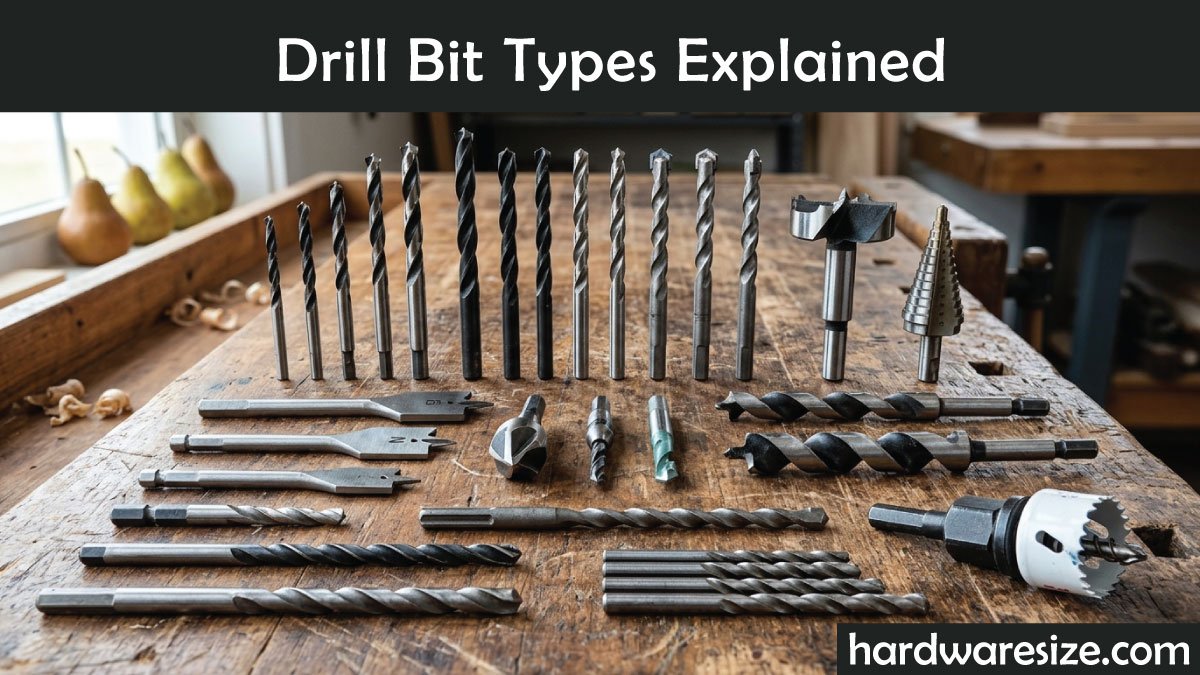
Choosing the right drill bit is just as important as choosing the right drill. Several drilling issues such as burned wood, a broken part, a rough hole, or wastage of time occur just because the inappropriate bit was applied to the material.
Woods, metals, and concrete are not the same to work with, and all of them require a certain kind of drill bit to take care of their hardness, density, and structure.
Here we guide will state clearly the types of drill bits used in wood, metal and concrete, how these drills operate and when they are used and how to achieve clean and precise results at all times.
Whether you are a DIY beginner or a professional, this guide will help you drill smarter, safer, and more efficiently.
Why Drill Bit Selection Matters
Visual inspection will show that most of the drill bits are similar and therefore individuals tend to use the same bit in all tasks.
This is an expensive and typical error. Wood, metal, and concrete react to pressure, speed as well as to heat differently.
The incorrect drill bit may lead to roughing, overheating, cracking off of bits as well as unnecessary harm to the tool and the material.
- Wood can tear, splinter, or burn
- Metal creates heat and resistance
- Concrete requires impact and abrasion
The wrong bit may be used, resulting in marred material, rough or inaccurate holes, over heating of the drill.
The bit may be worn out and cause slipping or breakage, thus the drill process will be slower, less efficient and unsafe.
- Damage your workpiece
- Wear out the bit quickly
- Overheat your drill motor
- Create unsafe drilling conditions
That’s why understanding drill bit types is essential.
Drill Bit Types for Wood
Wood is a softer one than metal and concrete yet selection of correct drill bit is still necessary to produce clean and accurate holes.
Wood drill bits are specially designed to cut through fibers smoothly, reducing splintering, tear-out, and burning while delivering better control and a cleaner finish.
1. Brad Point Drill Bits
One of the most useful types of point bits in woodworking is the Brad point bits which is used in jobs where precision is required.
The sharp center tip prevents the bit to wander off as the tip is very sharp and the tip can be easily placed before the drilling process starts.
Their exterior cutting edges cut wood fibres in a clean manner leaving smooth and splinter-free holes with a lot of control and professional appearance.
Best uses:
- Furniture making
- Cabinet work
- Precise hole placement
Advantages:
- Clean entry and exit holes
- Less splintering
- Excellent accuracy
2. Twist Drill Bits (Wood Use)
Standard twist bits may be applied on wood when doing rough or simple drilling jobs that may not require a lot of precision.
They are however not suitable in fine wood-working as they may also lead to tear-out, splintering, as well as less precise holes than wood-specific drill bits.
Best uses:
- Rough carpentry
- Quick drilling tasks
Limitations:
- Can cause tear-out
- Less precise than brad point bits
3. Spade Bits
Spade bits Spade bits are paddle shaped drill bits with a sharp pointed tip in the center.
They are created to drill large holes quickly with a significant diameter in the wood and it is the best in rough construction works where it is unimportant to have the clean finish but speed.
Best uses:
- Running wires through studs
- Rough construction
Pros and Cons:
- ✔ Fast and affordable
- ✘ Rough holes, not for finish work
4. Auger Bits
The Auger bits are drill bits of deep spiral flutes used to efficiently draw out the wood chips during drilling.
Their threaded tip has the benefit of piercing the bit into the wood easily, thus suitable in deep, straight cuts in thick lumber or timber.
Best uses:
- Thick wood
- Deep holes
- Timber framing
Key benefit: They pull themselves into the wood with minimal pressure.
5. Hole Saws (Wood)
The Hole saws are intended to cut big sized holes in wood, which are clean and effective.
These are made up of a circular saw blade fitted to a drill and are usually used in door locks, plumbing apertures, electrical enclosures, and within ventilation apertures.
Hole saws provide smooth, round cuts and work best at low speeds with steady pressure to prevent overheating and tear-out.
Common uses:
- Door hardware
- Vent openings
- Electrical boxes
👉 Complete Guide to Drill & Drill Bit Types, Sizes, and Uses: This in-depth guide covers everything you need to know about drills and drill bits, from different types and sizes to their correct applications. Whether you’re a beginner or experienced, reading the full post will help you choose the right tools, avoid common mistakes, and achieve cleaner, more accurate drilling results.
Wood Drill Bit Summary Table
To aid you in selecting the appropriate drill bit to use in the process of woodworking, we have a brief overview of the most popular.
This table points out each bit as to how best it should be utilized, the quality of holes it will offer, and to what level of skill it will demand. It is an excellent manual to a beginner or a skilled woodworker.
| Drill Bit Type | Best For | Hole Quality | Skill Level |
|---|---|---|---|
| Brad Point | Precision woodworking | Very clean | Beginner–Pro |
| Twist Bit | General wood drilling | Average | Beginner |
| Spade Bit | Fast, large holes | Rough | Beginner |
| Auger Bit | Deep holes | Clean | Intermediate |
| Hole Saw | Large diameter holes | Clean edges | Intermediate |
Drill Bit Types for Metal
Metal is harder to drill into, it needs greater accuracy and TLC when managing heat as compared to wood.
Metal drill bits are usually made from hardened steel, sometimes coated with materials like titanium to reduce friction and heat buildup.
Using the right bit ensures cleaner holes, prevents bit wear, and reduces the risk of overheating or damaging your workpiece.
1. High-Speed Steel (HSS) Drill Bits
The most popular option of metalwork is 12- HSS drill bits. They are also hardy, versatile and can be used to work with different varieties of metals easily.
These bits are cheap and can be sharpened severally and they are suitable to both amateurs and seasoned users. They do well in cutting oil to minimize heat.
Best uses:
-
Aluminum
-
Mild steel
-
Copper and brass
Advantages:
-
Affordable
-
Versatile
-
Easy to sharpen
2. Cobalt Drill Bits
The use of cobalt drill bits applies to tough metals that produce a lot of heat. These bits are hard enough to drill stainless steel, hardened steel and cast iron with high precision,
And speed by the fact that they contain high percentage of cobalt and that makes them hard even at high temperatures. They are not very cheap but are needed in challenging metal projects.
Best uses:
-
Stainless steel
-
Hardened steel
-
Cast iron
Key benefit: They maintain hardness even at high temperatures.
3. Titanium-Coated Drill Bits
Titanium-coated drill bits Titanium nitride coated high-speed steel bits. The coating lowers both friction and heat, prolonging the life of the bite, as well as simplifying repeated drilling.
These bits are suited to light to medium metal. But, when the coating is worn off the bit acts like HSS and loses its edge.
Best uses:
-
Light to medium metal drilling
-
Repetitive work
Note: Once the coating wears off, performance drops.
4. Step Drill Bits
The Step drill bits are cone shaped and can be used to drill several different hole sizes using a single bit. They suit best when working with sheet metal, thin material and electrical panels.
Step bits are time saving because they do not require the frequent change of bits and produce clean and precise holes with smooth edges which are particularly beneficial in professional or hobbyist work with metals.
Best uses:
-
Sheet metal
-
Electrical panels
-
Thin materials
Why they’re useful: No need to switch bits for different hole sizes.
5. Left-Handed Drill Bits
Left handed drill bits turn in a counterclockwise direction as opposed to regular bits. This rotation enables their application in the process of drilling, to get out broken bolts or screws.
They are a special set of tools yet very handy in any maintenance work or where fasteners get stuck or damaged.
Special use case: They can loosen stuck fasteners while drilling.
Drill Bit Types for Concrete & Masonry
Concrete and masonry are much harder than wood or metal. Drilling into these materials requires special masonry bits and usually a hammer drill. The right bit ensures effective penetration without cracking the material, reduces wear, and makes heavy-duty drilling safer and faster.
1. Masonry Drill Bits
Masonry bits have a carbide tip which crushes, as opposed to cutting, concrete, brick, block or stone. They are made to have a masonry resistance and at the same time durable.
These bits increase the rate at which a user will drill or increase the strength of the user against fatigue when using a hammer drill and also give a more precise result in terms of an anchor or a fitting.
Best uses:
-
Concrete
-
Brick
-
Block
-
Stone
Important: They work best with a hammer drill.
2. SDS Drill Bits
SDS drill bits are designed to do heavy-duty concrete work and are operated using SDS rotary hammers. They deal with reinforced concrete and structural works with ease.
SDS bits are more efficient (faster), less manual force is needed, and fatigue is minimized compared to the normal ones, which helps in construction, or long-lasting masonry tasks and make them indispensable to an expert in the field.
Best uses:
-
Reinforced concrete
-
Structural work
-
Professional construction
Advantages:
-
Faster drilling
-
Less user fatigue
3. Core Drill Bits
Core drill bits do not cut through the whole area, but a cylindrical portion of concrete.
They are perfect in order to make bigger holes without working too hard.
Core bits can be utilized to plumb, install an HVAC, or other jobs that need a clean, sharp circular hole.
Best uses:
-
Plumbing penetrations
-
HVAC openings
Concrete Drill Bit Comparison Table
The given table is a guide in the selection of the appropriate drill bit when working with concrete and masonry.
It also draws attention to the tool, the adequate material, and the required workload, and you can probably choose the most effective bit in case of any heavy-duty drilling operation..
| Drill Bit Type | Tool Required | Material | Workload |
|---|---|---|---|
| Masonry Bit | Hammer drill | Brick, concrete | Light–Medium |
| SDS Bit | SDS rotary hammer | Reinforced concrete | Heavy |
| Core Bit | Core drill | Concrete walls | Very Heavy |
How to Choose the Right Drill Bit
Choosing the right drill bit is more than picking a piece of metal or carbide from the box. In every project, the needs are always different and using the right bit guarantees a clean hole, extended life of the tool and safer drilling. Consider the material, hole size, drill type, and desired finish before starting your work.
1- Material Type – Wood, Metal, or Concrete
Drilling the various materials reacts differently. Wood is porous and accommodating, metal dense and heat sensitive whereas concrete is very hard.
A specially designed bit made of the material does not splinter, overheat or break off the bits, so working with a bit becomes quicker, cleaner and more efficient.
2- Hole Size – Diameter and Depth
The size of the hole determines which bit you need. Precision bits are necessary to make small holes, whereas spade bits or hole saws or core bits can be used to make larger holes.
There is also the issue of depth: long or deep holes will need bits which can take away debris effectively without becoming attached.
3- Drill Type – Standard Drill or Hammer Drill
The drill you use affects bit choice. Normal drills are applicable to wood and metal whereas concrete and masonry require hammered drills or rotary hammers.
Proper performance is guaranteed by matching the type of the drill with the bit and thus less wear and unwarranted strain will be exerted on your tool.
4- Finish Quality – Rough or Clean
Decide whether your project requires a rough hole or a precise, clean finish. Woodworking may require tear free holes that are smooth, whereas construction work may focus on time rather than beauty.
Choosing the right bit ensures your hole meets the desired quality without extra sanding or adjustments.
5- Avoiding Cheap or Incorrect Bits
It is easy to use the wrong or poor quality bit, but it will usually lead to issues such as rough holes, damaged bits, wastage of time.
When investing in the right, long-lasting bit to use on your material and project, it saves time, makes it more accurate, and the end result is professional level results in the end.
Tips for Better Drilling Results
It is just as significant to establish the technique of drilling as it is to select the correct drill bit.
Minor modifications in speed, lubrication and handling can be significant in the quality of holes, tool life and safety.
Keeping the bit intact and minimizing fatigue when any project is going on, follow these tips of making cleaner and more accurate holes.
-
Use low speed for metal and concrete
-
Apply cutting oil when drilling metal
-
Let the bit do the work—don’t force it
-
Clear debris frequently
-
Replace dull bits immediately
Proper technique extends tool life and improves accuracy.
Common Drill Bit Mistakes to Avoid
Even experienced DIYers and professionals can make costly drill bit mistakes. The improper technique or bit may not only destroy your tools but also your piece of work, as well as, worsen your projects.
This knowledge on errors will reduce the rate of accidents, increase the life of a bit, and end up with cleaner and more accurate holes, each and every time.
Common Mistakes to Avoid
-
Using wood bits on metal
-
Drilling concrete without a hammer function
-
Applying too much pressure
-
Ignoring heat buildup
-
Using worn or chipped bits
Avoiding these mistakes can save time, money, and frustration.
Final Thoughts
The types of drill bits used on wood, metal, and concrete are easier, safer, and more precise to use. Every bit has a purpose and in appropriate selection, it provides clean holes, increased tool life, and professional outcomes.
The right drill bit can mean the difference between success and failure whether you are working on the furniture or working on the metal or in the concrete work where anchors have to be placed.
You should invest in good bits, understand their applications and then your drilling tasks will be easy and efficient each time.

Engineer Hassan is a Mechanical Engineer with 16+ years of hands-on experience in mechanical hardware, fasteners, and workshop tools. He focuses on size selection, thread identification, and measurement, helping users choose the correct components with accuracy and safety.