
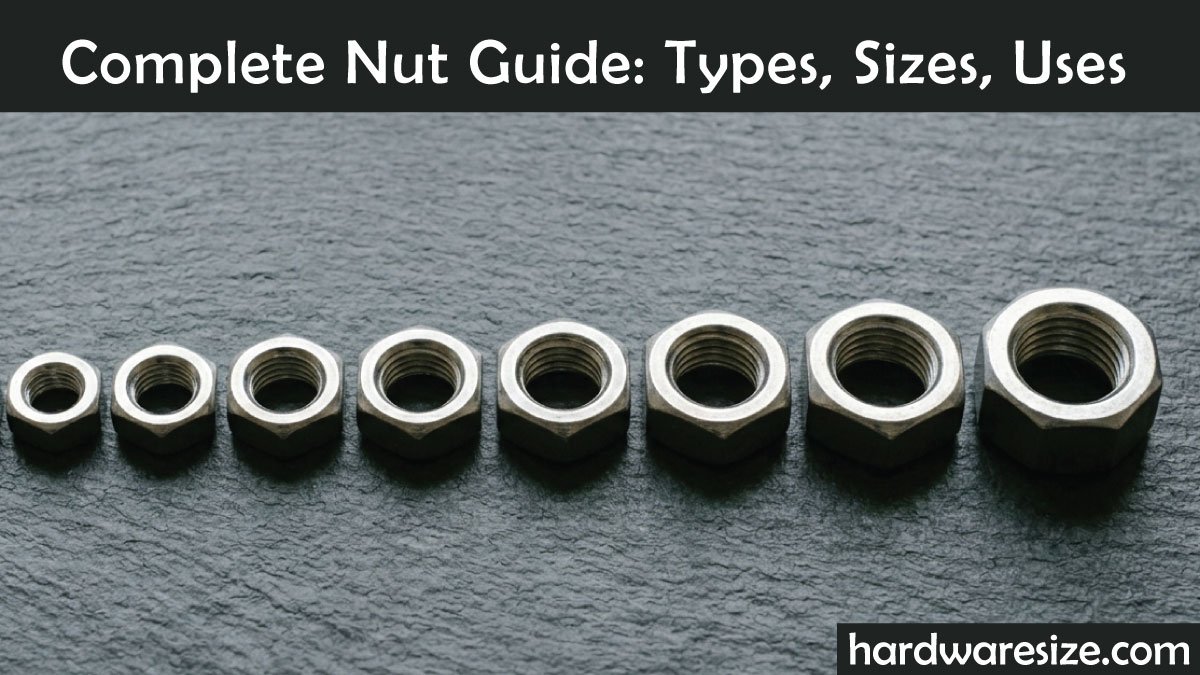
Nuts can be treated as mere hardware items, yet, their contribution in building, mechanical works, car bodybuilding, and home workshops could not be overestimated.
The design of a proper nut guarantees the strength, durability and safety of your assembly. You may be a professional mechanic, engineer, or a DIY enthusiast, but you have to know what kind of nuts, which ones, what size, and what they are used in.
The guide will be your ultimate guide as you will make the right choice every time.
What Are Nuts?
A nut is a fastener that has internal threads that attach to a bolt, screw or threaded rod.
Nuts and bolts are used to secure parts when mounted to each other to form a substantial clamping force. The bolt will cut through materials and the nut will thread onto it holding the assembly.
Correct nut guarantees strength, stability and stable safe connections in all the projects or structures.
Why Nuts Are Important
A nut is a fastener that is threaded internally, and which is matched with a bolt, screw, or threaded rod.
Once mounted on a bolt, it develops high levels of clamping force, which makes it stable and safe.
The correct nut eliminates loss, damage, and structural failure, thus the correct type of nut is crucial to any project, whether it is furniture or heavy equipment.
Safety: Properly matched nuts prevent loosening, which could cause accidents.
Strength: Nuts distribute clamping forces evenly when paired with bolts.
Durability: Correct nut selection reduces wear and tear on materials.
Versatility: Different nuts are designed for specific applications, from furniture assembly to heavy machinery.
🔹 Tip: Never underestimate the importance of nuts — the wrong size, material, or type can compromise the entire structure.
Types of Nuts
Nuts are one of the most common and essential fasteners used in mechanical, construction, and DIY projects.
They are available in various shapes, designs and materials to meet various applications.
Understanding the kind of nuts will make you pick the correct one in your project, which will have safe, long, and strong connections.
The following is a description of the most popular nuts.
1. Hex Nut
Hex nuts are six sided fasteners that are common in general uses. They are all-purpose, simple to install and most bolts fit in them, hence, a ubiquitous ingredient in furniture, machinery, and construction work.
Their hexagonal design enables quick fitting with a socket or wrench giving then a solid reliable tightening which serves as solid clamping force that holds components firmly in place.
-
Shape: Six-sided standard nut.
-
Use: General-purpose fastening; works with most bolts.
-
Applications: Furniture, machinery, construction.
-
Advantage: Easy to tighten with wrench or socket.
2. Lock Nut
Lock nuts A lock nut with a specially developed resistance to lose due to vibration or movement.
They may have a nylon insert (nyloc) or metal bending to ensure that the nut remains taut on stress.
The Lock nuts are also applied in the automotive, machinery and equipment that undergoes constant vibration to avoid the accidental loosening and to make sure that the assemblies are fastened in place over time.
-
Shape: Similar to hex, often with nylon insert (nyloc) or metal deformation.
-
Use: Resists loosening under vibration.
-
Applications: Automotive, machinery, vibrating equipment.
-
Advantage: Prevents accidental loosening without additional hardware.
3. Wing Nut
Wing nuts are to be tightened with hands, but not a tool is needed.
The two wings are easy and quick to assemble and disassemble, which is very convenient in places where changes should be made regularly.
Wing nuts are mostly used in furniture assembly, temporary boards and equipment covers as they are convenient and do not lose connection.
-
Shape: Two “wings” for hand tightening.
-
Use: Quick assembly or disassembly without tools.
-
Applications: Furniture, temporary panels, equipment covers.
-
Advantage: Tool-free, fast installation.
4. Cap Nut (Acorn Nut)
Cap nuts, also known as acorn nuts, have a top that is dome-shaped that shields the end of the bolt as well as providing decoration.
They keep the exposed threads off the hook, and give the hook a more attractive appearance.
Cap nuts are widely used in furniture, automotive applications, and decorative structures where both safety and appearance matter.
-
Shape: Dome-shaped top to cover bolt end.
-
Use: Decorative and protective; covers sharp bolt ends.
-
Applications: Furniture, automotive, decorative structures.
-
Advantage: Safety and aesthetics.
5. Flange Nut
The flange has an inbuilt washer like flange which spread the load over a more extensive area, making the material less stressed.
They are often applied in the automotive, machinery and structural assemblies where uniform distribution of forces is of great importance.
The integrated flange usually removes the requirement of an independent washer making installation easier yet keeping the flange stable and strong.
-
Shape: Hex nut with integrated washer-like flange.
-
Use: Distributes pressure over a larger surface area.
-
Applications: Automotive, machinery, structural assembly.
-
Advantage: Reduces material stress, often eliminates separate washer.
6. T-Nut
T-nuts 40 are used in wood and include a flat base and prongs which penetrate the material forming a threaded insert.
These are the best in furniture or wooden fixtures and jigs and provide high-quality and concealed threads.
T-nuts are a long-term and firm fastening system and leave the wood surface neat and smooth.
-
Shape: Flat base with prongs; internally threaded.
-
Use: Provides threaded insert in wood.
-
Applications: Furniture, wooden fixtures, jigs, and woodworking projects.
-
Advantage: Creates strong, hidden threads in wood.
7. Coupling Nut
Coupling nuts are long hex-shaped nuts that are used to join two threaded rods without the need of welding to extend their length.
They are regularly applied in structural rods, scaffold and machinery where longer structures are required.
Nuts with threads provide the sure and stable way of connecting threaded rods and can ensure its strength and stability during a long operation.
-
Shape: Long hex nut.
-
Use: Joins two threaded rods together.
-
Applications: Structural rods, scaffolding, machinery.
-
Advantage: Extends threaded rods without welding.
8. Square Nut
Square nuts are cut with four sides rather than six giving them more space to hold the tool.
They are typically employed when working with square headed bolts or where a wrench is incapable of turning a hex nut.
Square nut is also used in machinery, antique furniture and electrical part because of the convenient fastening and tight space application.
-
Shape: Four-sided nut.
-
Use: Used with square-headed bolts or where a wrench cannot rotate a hex nut.
-
Applications: Machinery, antique furniture, electrical components.
-
Advantage: Offers more surface area to grip with tools.
Nut Sizes
Choosing the correct nut size is essential for creating secure and reliable assemblies. The mismatch of size may result in loose fit, stripped threads and even structural collapse.
There are a number of important factors that determine the size of the nuts and make them compatible with bolts and the material the bolts are fastened to.
Knowing these measurements enables you to choose the correct nut to use in each of your projects; furniture to heavy machinery.
-
Diameter – must match bolt diameter.
-
Thread Pitch – distance between threads (coarse or fine).
-
Height/Thickness – standard, thin (jam), or heavy-duty.
Standard Nut Size Chart
| Nut Type | Bolt Diameter | Thread Pitch (mm) | Height (mm) | Common Use |
|---|---|---|---|---|
| Hex Nut | M6 | 1.0 | 5 | Furniture, machinery |
| Hex Nut | M8 | 1.25 | 6.5 | Automotive, brackets |
| Lock Nut | M10 | 1.5 | 8 | Machinery, automotive |
| Wing Nut | 1/4″ | 20 TPI | 10 | Furniture, panels |
| Cap Nut | M12 | 1.75 | 10 | Decorative or protective |
| Flange Nut | 3/8″ | 16 TPI | 8 | Heavy machinery |
| Coupling Nut | M16 | 2.0 | 30 | Rod extensions |
🔹 Tip: Always measure the bolt diameter and thread pitch before selecting a nut. Use a thread gauge for accuracy.
Nut Materials
To address the needs of various strength, durability, and environmental requirements of Nuts, these are available in different materials.
The selection of material influences their load bearing capacity, corrosion resistance as well as their general applicability in particular applications.
The correct material will also make the projects secure, safe and reliable in terms of fastening whether a furniture or a heavy machinery.
| Material | Features | Common Use |
|---|---|---|
| Carbon Steel | Strong, cost-effective | General use, construction |
| Stainless Steel | Corrosion-resistant | Outdoor, marine applications |
| Brass | Decorative, corrosion-resistant | Electrical, furniture |
| Aluminum | Lightweight, corrosion-resistant | Aerospace, automotive |
| Nylon Insert | Self-locking, resists vibration | Light machinery, automotive |
Choosing Nut Material
Strength, durability, and long-term performance depends on choosing an appropriate material of the nut. Certain material works better in a certain environment and applications.
Making a right choice is a guarantee that your assembly will resist rust, will be able to carry heavy loads, will be secure in case of vibrations and look even beautiful.
Knowing material properties can help you to match the nut to the task in order to fasten safely and reliably.
-
Outdoor applications: Stainless steel or brass to resist rust.
-
Heavy loads: High-grade steel nuts (Grade 5 or 8).
-
Decorative uses: Brass or cap nuts.
-
Vibration-prone machinery: Nylon insert lock nuts.
Nut Applications and Uses
The correct matching of nuts to the correct bolts and materials helps to guarantee secure, durable and safe fastening.
Each application depends on a particular type of nut and material that offers strength, stability and durability. The following is a description of the key applications of nuts in industries and projects.
1. Furniture and Woodworking
Nuts are also important in the field of furniture and wood work where they are used to produce strong and durable joints.
The most common ones are hex nuts, T-nuts and wing nuts, made of steel or brass. T-nuts used in wooden panels offer concealed long-lasting threads.
Which will give a clean appearance whilst being highly structurally sound in cabinets, tables, and other wooden constructions.
2. Automotive and Machinery
Automotive and machinery works need vibration and heavy load resistant nuts. The best ones are lock nuts, flange nuts and cap nuts that are made of high-tensile steel or stainless steel.
The nuts prevent loosening of engines, mechanical equipment and automotive components rendering safety, reliability and smooth functioning under pressure and constant movement.
3. Construction and Structural Applications
The construction and structural projects require heavy-duty nuts that secure assemblies that are large.
The load-bearing capacity is required by using hex nuts, coupling nuts, and high-strength lock nuts that are of carbon steel or stainless steel.
Correct matching with bolt grade and washers/flanges are used to provide stability to the structure of a building or a machine to avoid structural failures.
4. Decorative Applications
Decorative purposes needs nuts that are practical and attractive. Brass or stainless steel cap nuts and brass or stainless steel brass nuts conceal open threads, and are used to improve the appearance of assemblies.
They are incorporated in furniture, fixtures and decorative hardware to provide a combination of safety, good finish and aesthetics without compromising the strength.
5. Outdoor and Marine Applications
Marine and outdoor assignments require moisture and tough environment resistant corrosion resistant nuts.
Furniture, gates, marine equipment, and outdoor fixtures are usually made using stainless steel and brass nuts.
These nuts are long-lasting in performance, they do not rust easily and can withstand structural integrity even in the face of rain, salt water or humidity.
6. Electronics and Electrical Equipment
In electronics and electrical assemblies, nuts must be precise and conductive or non-corrosive. Circuit boards, panels and electrical enclosures should use brass and stainless steel nuts.
They fasten elements without undermining conductivity, they do not loosen under vibration and they shield fragile equipment against short circuits and environmental harm.
7. DIY and Home Improvement Projects
DIY and home improvement Projects need diversified nuts in performing various activities.
Depending on the furniture assembly, shelving, fixtures and hobby work, hex nuts, wing nuts and T-nuts come into play and are made out of steel or brass.
Users are in the right choice of nut, which guarantees safety, durability and correct positioning, providing ease of assembly and security.
Nut Thread Types
Nuts are internally threaded with a complement to bolts or screws and the right kind of thread type is essential in the fixation of a nut with proper fixation.
The incorrect thread may hurt hardware and decrease the clamp strength, as well as, decrease safety.
The knowledge of coarse, fine, metric, UTS threads is used to guarantee correct fit and a long performance of any project.
Coarse Threads: Larger spacing, ideal for wood and soft materials.
Fine Threads: Smaller spacing, suitable for metal and high-strength applications.
Unified Thread Standard (UTS): Common in the USA; uses threads per inch (TPI).
Metric Threads: Standard worldwide; pitch in millimeters.
🔹 Pro Tip: A mismatched thread type can strip both nut and bolt, compromising safety.
Nut Grades and Strength
The nut strength should be equal to that of the bolt so that the clamping force can be properly ensured and fastening can be secured.
Nut grades do give a clue on the tensile strength of the nuts that would assist you to have the correct mixture to be safe, durable, and to perform in any given way.
| Grade | Material | Minimum Tensile Strength | Common Use |
|---|---|---|---|
| 2 | Carbon Steel | 74,000 psi | Light-duty construction |
| 5 | Medium Carbon Steel | 120,000 psi | Automotive, general machinery |
| 8 | Medium Carbon Alloy Steel | 150,000 psi | Heavy machinery, load-bearing |
Always pair the nut grade with the bolt grade for maximum reliability.
Washers and Nut Combinations
Nuts are normally used with washers to enhance fastening and guarding of materials.
They assist in the equal distribution of load, inhibition of the loosening upon vibration, and the protection of the surfaces and finishes.
The correct washer and nut are used to make sure there is durability and stability as well as the right finish in both functional and decorative usage.
Distribute load – prevents damage to surfaces.
Prevent loosening – lock washers or spring washers.
Protect finishes – especially in decorative applications.
Quick Reference:
| Nut Type | Washer Type | Purpose |
|---|---|---|
| Hex Nut | Flat Washer | Load distribution |
| Lock Nut | Spring Washer | Vibration resistance |
| Cap Nut | Flat Washer | Protect surfaces, aesthetics |
Common Mistakes When Using Nuts
Nuts when not used properly may cause stripped threads, loosening, corrosion or even structural failure.
The most frequent ones are the improper size, unmatched threads, inappropriate materials, omitting washers in soft surfaces.
And an unthoughtful attitude to nut grades, which reduce the safety and reliability.
Wrong size nut: Can strip threads or loosen over time.
Mismatched thread pitch: Leads to damaged hardware.
Incorrect material: Can corrode or fail under load.
No washer on soft surfaces: Causes surface indentation.
Ignoring nut grade: Risk of breakage under stress.
🔹 Always double-check nut specifications before assembly.
Tips for Selecting the Right Nut
In order to make secure, durable, and safe assemblies, it is necessary to choose the correct nut. The accuracy of measurement.
The knowledge of how the nut and bolt will be used, and matching of the nut and the bolt strength are the ways of making sure that it will be reliable.
By locking them down and checking they are not damaged, they become even more resistant to loosening and failure, and therefore, your fastening projects will be safe and durable.
Measure accurately: Use calipers for diameter and thread gauge for pitch.
Consider application: Load, vibration, environmental exposure.
Match nut to bolt grade: Strength matters more than cost in critical assemblies.
Use locking devices if necessary: Nylon inserts, lock washers, or threadlike adhesives.
Inspect before use: Check for damaged threads or corrosion.
Conclusion
Nuts can be viewed as basic, however, their appropriate choice is essential to a safe, long-lasting, and efficient working project.
The knowledge of types, sizes, materials, and threads and use will enable you to select the optimal nut to use in your project, which may be furniture, automotive, machinery, or construction.
With this full nut guide you are sure to put things together, avoid accidents, and even enhance both the physical attractiveness and usefulness of your work.
Store this guide on your shelf and you will never need to guess on which nut to use next.
🔹 Pro Tip: For maximum authority, link this guide to related posts on bolts, screws, fasteners, and washers to create a strong internal linking network that Google loves.

Engineer Hassan is a Mechanical Engineer with 16+ years of hands-on experience in mechanical hardware, fasteners, and workshop tools. He focuses on size selection, thread identification, and measurement, helping users choose the correct components with accuracy and safety.