
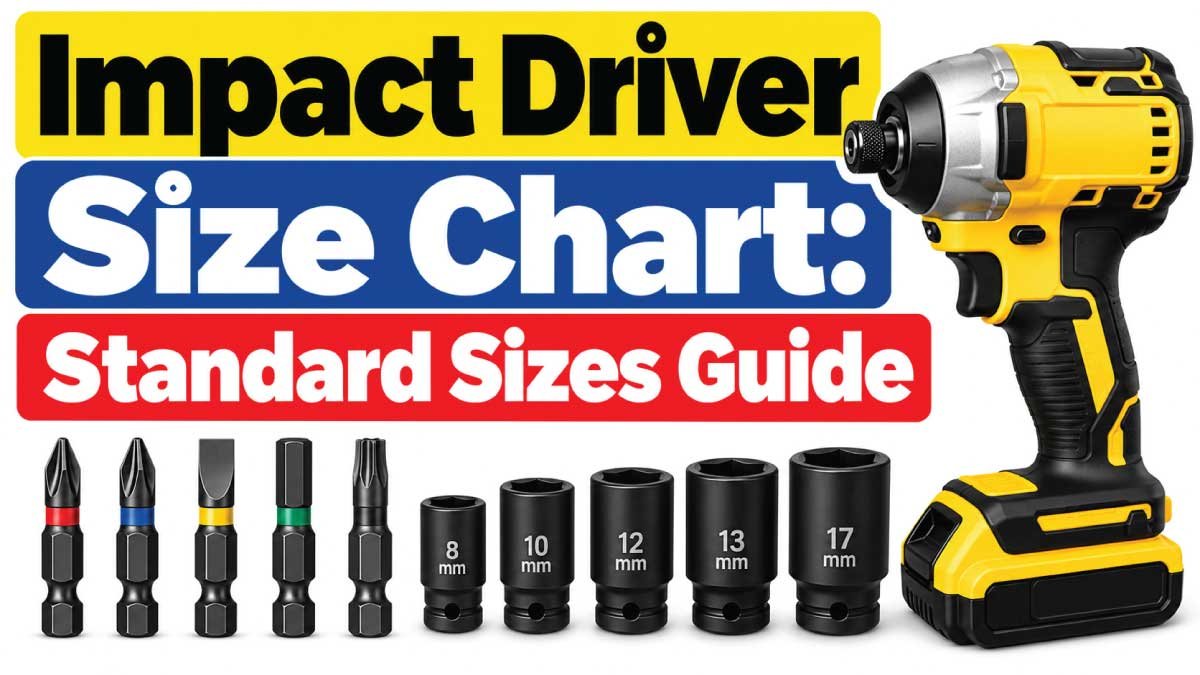
Choosing the correct impact driver size can be confusing because impact driver size may refer to the bit shank, drive interface, socket adapter, tool class, or the physical dimensions of the tool itself. Unlike impact wrenches, most cordless impact drivers use a 1/4-inch hex quick-change chuck, while larger square-drive interfaces are generally associated with impact wrenches.
This impact driver size chart explains the common sizes, hex shank dimensions, drive interfaces, bit compatibility, socket use, and practical applications. It also explains how to measure an impact driver bit, how impact drivers differ from impact wrenches, and how to choose the appropriate size for a particular job.
Impact Driver Size Chart
The most important size when selecting an impact driver bit is usually the hex shank size that fits into the tool’s quick-release chuck. The 1/4-inch hex shank is the dominant size for standard impact-driver bits.
| Impact Driver Interface | Nominal Size | Approx. Metric Equivalent | Typical Use |
|---|---|---|---|
| Hex quick-change | 1/4 in | 6.35 mm | Standard impact driver bits |
| Hex shank | 5/16 in | 7.94 mm | Specialty/heavier-duty accessories |
| Hex shank | 3/8 in | 9.53 mm | Larger specialty accessories |
| Square drive adapter | 1/4 in | 6.35 mm | Small socket applications |
| Square drive adapter | 3/8 in | 9.53 mm | Medium socket applications |
| Square drive adapter | 1/2 in | 12.70 mm | Larger socket applications |
The 1/4-inch hex interface is the size most commonly associated with a conventional impact driver. The other sizes in the chart are more commonly encountered with specialized accessories, adapters, or different impact-tool designs.
Always check the tool and accessory specifications before assuming compatibility. A nominal size alone does not guarantee that an accessory is designed for the impact loads generated by a particular tool.
What Is an Impact Driver?
An impact driver is a powered fastening tool designed to drive screws, bolts, and other fasteners while combining rotational force with rapid impact action. The impact mechanism helps the tool deliver additional torque when resistance increases.
A conventional cordless drill normally uses a chuck that grips a round or hexagonal drill bit. An impact driver generally uses a quick-change hex chuck, making it particularly convenient for screwdriver bits and impact-rated accessories.
Impact drivers are commonly used for:
- Driving wood screws
- Installing structural screws
- Fastening construction hardware
- Driving self-drilling screws
- Installing lag screws
- Drilling with compatible hex-shank bits
- Light socket work with suitable adapters
- General construction and maintenance
The compact chuck and high torque make the impact driver particularly useful when repetitive fastening is required.
Impact Driver vs. Impact Wrench Sizes
One of the most important distinctions is between an impact driver and an impact wrench. Their names are sometimes used interchangeably, but their drive systems are normally different.
| Feature | Impact Driver | Impact Wrench |
|---|---|---|
| Typical interface | 1/4 in hex | Square drive |
| Common socket use | Requires adapter | Direct socket connection |
| Primary purpose | Screws and smaller fasteners | Nuts and bolts |
| Chuck style | Quick-change hex | Square anvil |
| Common applications | Construction, woodworking | Automotive, mechanical |
| Bit compatibility | Hex impact bits | Impact sockets |
A 1/2-inch impact wrench, for example, should not be confused with a 1/2-inch impact driver. The 1/2-inch designation normally describes the square drive of the impact wrench, not the hex chuck of a conventional impact driver.
Common Impact Driver Bit Sizes
The most familiar impact-driver accessory is the screwdriver bit. These bits are normally designed with a hexagonal shank that fits into the quick-change holder.
1/4-Inch Hex Impact Bits
The 1/4-inch hex shank is the standard interface for many impact-driver accessories.
A 1/4-inch hexagonal shank has a nominal across-flats dimension of 1/4 inch, or 6.35 mm. This allows compatible bits to be inserted into a standard quick-change impact-driver chuck.
Common 1/4-inch hex accessories include:
- Phillips bits
- Slotted bits
- Torx bits
- Pozidriv bits
- Hex bits
- Nut-driver bits
- Magnetic bit holders
- Drill bits with hex shanks
- Socket adapters
The bit tip itself can have a completely different size. For example, a Phillips #2 bit and a Torx bit can both have a 1/4-inch hex shank while having different working ends.
Larger Hex Shanks
Larger hex shanks such as 5/16-inch and 3/8-inch exist for certain specialty accessories and tool systems. They should not automatically be considered standard impact-driver sizes.
The important point is that the shank size and working-tip size are different measurements.
For example, a bit may have:
- 1/4-inch hex shank
- T25 working tip
- 2-inch overall length
The 1/4-inch measurement describes the interface entering the tool, not the size of the screw head.
Impact Driver Bit Size Chart
The following chart focuses on common accessory interface sizes rather than claiming that every impact driver accepts every listed accessory.
| Bit Shank Size | Decimal Inches | Metric Equivalent | Typical Compatibility |
|---|---|---|---|
| 1/4 in | 0.250 in | 6.35 mm | Common impact-driver accessories |
| 5/16 in | 0.3125 in | 7.94 mm | Specialty accessories |
| 3/8 in | 0.375 in | 9.53 mm | Larger specialty accessories |
For ordinary cordless impact-driver use, 1/4-inch hex accessories are the key size to look for.
Impact Driver Bit Tip Sizes
The shank tells you whether the accessory fits the tool, but the tip size determines whether it fits the fastener.
For example, Phillips screwdriver bits are identified by sizes such as:
- Phillips #0
- Phillips #1
- Phillips #2
- Phillips #3
- Phillips #4
Torx bits use a different sizing system, such as:
- T10
- T15
- T20
- T25
- T27
- T30
- T40
These tip designations should not be confused with the 1/4-inch hex shank.
A T25 impact bit can have a 1/4-inch hex shank, while another T25 bit from a different accessory system may have a different mounting arrangement. Always check the accessory specifications.
Impact Driver Socket Adapter Sizes
An impact driver can be used with sockets when equipped with an appropriate impact-rated socket adapter. This is useful when you need to tighten or loosen a nut or bolt but do not have an impact wrench available.
Common adapter drive sizes include:
| Adapter Output | Metric Equivalent | Typical Application |
|---|---|---|
| 1/4 in square | 6.35 mm | Small sockets and fasteners |
| 3/8 in square | 9.53 mm | General socket work |
| 1/2 in square | 12.70 mm | Larger socket applications |
The square-drive size is the output side of the adapter, not necessarily the size of the impact driver’s chuck.
For example, an impact driver with a 1/4-inch hex chuck can accept a 1/4-inch hex-to-3/8-inch square impact-rated adapter. The adapter then allows compatible 3/8-inch-drive sockets to be used.
How to Measure an Impact Driver Bit
Measuring an impact driver bit is straightforward, but you need to measure the correct part.
Measure the Hex Shank
Use a caliper if accurate measurement is required.
- Remove the bit from the tool.
- Locate the hexagonal shank.
- Measure across the flat surfaces of the hex.
- Record the measurement in inches or millimeters.
- Compare it with the accessory specifications.
A standard 1/4-inch hex shank should measure approximately 6.35 mm across the flats.
Do not measure the screwdriver tip when trying to determine the chuck compatibility.
Measure the Working Tip
To identify the working size, inspect the tip designation or compare it with the manufacturer’s sizing system.
For a Phillips bit, the size may be #1, #2, or another designation. For Torx, it may be T20, T25, T30, and so on.
Therefore, an impact bit can have two separate size descriptions:
Shank size + tip size
For example:
1/4-inch hex shank + T25 tip
That description tells you both the tool interface and the fastener interface.
Impact Driver Size by Application
There is no single impact-driver size that is correct for every job. Tool selection depends on the fastener, material, required torque, available clearance, and frequency of use.
Light-Duty Applications
Smaller and compact impact drivers are useful for tasks such as:
- Cabinet installation
- Furniture assembly
- Small wood screws
- Electrical installation
- General household fastening
- Light maintenance
A compact tool can be easier to control in confined spaces.
General Construction
For construction work, an impact driver is commonly used for:
- Deck screws
- Construction screws
- Wood framing fasteners
- Self-tapping screws
- Structural fastening with approved accessories
The appropriate bit should be impact-rated when used with an impact mechanism.
Heavy Fastening
Large structural fasteners can require more torque than a typical impact driver is designed to provide. In these situations, an impact wrench or another appropriately rated tool may be more suitable.
Do not select a tool simply because it has a larger physical size. The tool’s rated torque, impact mechanism, accessory compatibility, and manufacturer’s application guidance are more meaningful.
How to Choose the Correct Impact Driver Size
Selecting an impact driver should involve more than looking at the chuck size.
Consider the Fastener
First determine what you are driving.
A small screw, structural screw, lag screw, and large machine bolt can have very different torque requirements.
Consider:
- Fastener diameter
- Fastener length
- Material
- Thread design
- Required installation torque
- Required removal torque
Consider the Accessory
The accessory must match both the tool and fastener.
For a standard impact driver, look for accessories with a compatible 1/4-inch hex shank and an appropriate working tip.
For socket applications, use a properly rated impact adapter and socket.
Consider Clearance
Tool dimensions matter when working in tight spaces. A compact impact driver can provide better access around:
- Cabinets
- Machinery
- Electrical enclosures
- Framing
- Automotive components
- Wall-mounted hardware
However, a compact tool may have different performance characteristics from a larger model.
Consider Torque Requirements
Torque is one of the most important performance specifications.
A higher torque rating does not automatically mean a tool is appropriate for every application. Excessive torque can damage fasteners, materials, threads, or accessories if the application is not controlled.
For critical fasteners, follow the specified installation procedure and torque requirements rather than relying solely on the impact driver’s maximum output.
Also Read:
Impact-Rated Bits vs. Standard Bits
An impact driver repeatedly applies impact forces through its mechanism. This means the accessory experiences substantially different loading from a bit used in a conventional drill.
Impact-rated bits are specifically designed for use with impact-driving tools.
They are commonly engineered to tolerate repeated torsional loading and impact forces.
Why Bit Selection Matters
Using an unsuitable accessory can result in:
- Premature bit failure
- Tip deformation
- Poor fastener engagement
- Increased cam-out
- Reduced fastening control
- Potential accessory breakage
For demanding impact-driver applications, use accessories specifically marked or specified for impact use.
Also Read:
Impact Driver Bit Lengths
Bit length is another important dimension, particularly when access is restricted.
Common accessory lengths vary by manufacturer and application. Rather than choosing one universal length, consider the distance between the tool and fastener.
Longer bits can be useful when:
- The fastener is recessed
- Access is obstructed
- Additional reach is required
Shorter bits can be advantageous when:
- Space is limited
- Maximum compactness is desired
- The fastener is easily accessible
Bit length should not be confused with shank size. Two bits can have the same 1/4-inch hex shank while having substantially different overall lengths.
Impact Driver Size and Voltage Classes
Cordless impact drivers are also commonly described by their battery platform or nominal voltage class. This is a tool-class characteristic, not a chuck-size measurement.
You may encounter tools marketed in categories such as:
- Compact 12V-class
- 18V-class
- 20V-class
- Other manufacturer-specific battery platforms
Voltage labeling varies between manufacturers and markets, so it should not be treated as a direct measurement of torque.
When comparing tools, look at the manufacturer’s published specifications for:
- Maximum torque
- No-load speed
- Impact rate
- Tool length
- Tool weight
- Battery compatibility
- Chuck/interface type
This provides a more useful comparison than voltage alone.
Also Read:
Impact Driver Size Chart for Common Accessories
The following table provides a practical way to distinguish the different size terms you may encounter.
| Size Term | What It Describes | Example |
|---|---|---|
| Shank size | Interface entering the chuck | 1/4 in hex |
| Tip size | Working end engaging fastener | T25 |
| Square drive | Socket connection size | 3/8 in |
| Bit length | Overall or specified bit length | 2 in |
| Tool voltage class | Cordless power platform | 18V-class |
| Socket size | Socket opening for fastener | 13 mm |
| Fastener size | Screw, bolt, or nut dimensions | M8 |
These measurements describe different parts of the system. Confusing them is one of the most common causes of selecting the wrong accessory.
Common Impact Driver Sizes and Their Uses
1/4-Inch Hex
This is the primary size associated with conventional impact drivers.
It is suitable for a wide range of:
- Screwdriver bits
- Nut drivers
- Hex-shank drill bits
- Bit holders
- Socket adapters
3/8-Inch Square
A 3/8-inch square drive is primarily associated with socket systems and impact wrenches, although an impact driver can use one through a suitable adapter.
It is useful for medium-sized socket applications when the adapter and tool are appropriately rated.
1/2-Inch Square
A 1/2-inch square drive is strongly associated with larger impact-wrench applications.
An impact driver may be connected to a 1/2-inch square-drive adapter, but that does not turn the tool into a conventional 1/2-inch impact wrench. The tool’s mechanical design and output capability remain important.
Common Impact Driver Sizing Mistakes
Confusing Bit Shank Size With Tip Size
A 1/4-inch hex shank does not mean that the screwdriver tip is 1/4 inch.
The shank describes the connection to the tool. The tip designation describes the fastener interface.
Using Regular Bits for High-Impact Work
Not every screwdriver bit is designed for repeated impact loading.
Use impact-rated accessories when the manufacturer specifies them for impact-driver use.
Assuming Larger Means Better
A larger interface or higher torque rating is not automatically appropriate.
The correct combination depends on the fastener, material, application, access, and required torque.
Using the Wrong Socket Adapter
A standard adapter may not be designed for impact loading. For impact-driver socket applications, use an adapter specifically suitable for impact service.
Ignoring Manufacturer Specifications
Nominal dimensions provide a useful starting point, but manufacturers may specify compatibility restrictions, maximum torque, accessory requirements, or application limitations.
How to Match an Impact Driver to a Fastener
A practical selection process can be summarized in five steps.
Step 1: Identify the Fastener
Determine whether you are working with a:
- Screw
- Lag screw
- Structural screw
- Nut
- Bolt
- Self-tapping screw
- Machine fastener
Step 2: Identify the Drive Type
Check whether the fastener uses:
- Phillips
- Pozidriv
- Slotted
- Torx
- Hex
- Square
- Another drive profile
Step 3: Select the Correct Bit
Choose a bit that matches the fastener drive profile and size.
Step 4: Verify the Shank
For a conventional impact driver, verify that the accessory has the appropriate hex shank, commonly 1/4 inch.
Step 5: Check the Application
Confirm that the bit, adapter, socket, and impact driver are suitable for the required load.
This approach is more reliable than choosing an accessory based only on appearance.
Impact Driver Size Chart: Quick Reference
| Component | Common Size | Purpose |
|---|---|---|
| Impact driver chuck | 1/4 in hex | Holds compatible bits |
| Standard impact bit shank | 1/4 in hex | Connects bit to driver |
| Small socket adapter | 1/4 in square | Connects small sockets |
| Medium socket adapter | 3/8 in square | Connects 3/8-inch sockets |
| Large socket adapter | 1/2 in square | Connects 1/2-inch sockets |
| 1/4 in hex metric equivalent | 6.35 mm | Shank dimension |
| 5/16 in metric equivalent | 7.94 mm | Larger hex accessory |
| 3/8 in metric equivalent | 9.53 mm | Larger hex accessory |
The table should be treated as a reference to common interface dimensions, not a universal compatibility chart. Always verify the specific tool and accessory.
Frequently Asked Questions
What size is a standard impact driver?
Most conventional impact drivers use a 1/4-inch hex quick-change chuck. This is the most common interface for impact-driver screwdriver bits and many compatible accessories.
Is a 1/4-inch impact driver the same as a 1/4-inch impact wrench?
No. The terms describe different tool designs. A conventional impact driver typically uses a 1/4-inch hex chuck, while an impact wrench generally uses a square-drive anvil such as 1/4, 3/8, 1/2, or another size.
What size bits fit an impact driver?
Most standard impact drivers accept 1/4-inch hex-shank bits. The working tip can have different sizes and profiles, such as Phillips #2 or Torx T25.
Can you use sockets on an impact driver?
Yes, provided you use a suitable impact-rated socket adapter and compatible socket. The adapter changes the driver’s hex interface into a square-drive connection.
Can a drill bit be used in an impact driver?
Some drill bits are manufactured with hex shanks specifically for quick-change impact drivers. However, the bit must be designed and rated for the intended application and impact loading.
What is the most common impact driver bit size?
The most common shank size is 1/4 inch hex, equivalent to approximately 6.35 mm across the flats.
Are impact driver bits universal?
Many 1/4-inch hex impact bits are broadly compatible with standard quick-change impact drivers, but compatibility can still depend on the chuck design and accessory specifications.
What does T25 mean on an impact bit?
T25 identifies the Torx tip size. It does not describe the bit shank. A T25 bit can commonly have a 1/4-inch hex shank for use in an impact driver.
Final Takeaway
The most important size to remember for a conventional impact driver is the 1/4-inch hex interface, which is approximately 6.35 mm across the flats. This is the common connection used for screwdriver bits, nut drivers, bit holders, and many impact-rated accessories.
However, impact-driver sizing involves several different measurements. Shank size, tip size, bit length, socket-drive size, tool dimensions, voltage class, and torque rating all describe different characteristics.
For most everyday fastening work, start by identifying the fastener drive profile, choose the correct impact-rated bit, and verify that its shank matches the tool. When using sockets, select an appropriate impact-rated adapter and socket. For larger nuts and bolts, an impact wrench with the appropriate square-drive size may be more appropriate.
The safest approach is to match the tool, accessory, fastener, and application rather than selecting a size based on one measurement alone. When a manufacturer’s specification or a critical fastening requirement applies, use that documentation as the final reference.

Engineer Hassan is a Mechanical Engineer with 16+ years of hands-on experience in mechanical hardware, fasteners, and workshop tools. He focuses on size selection, thread identification, and measurement, helping users choose the correct components with accuracy and safety.