
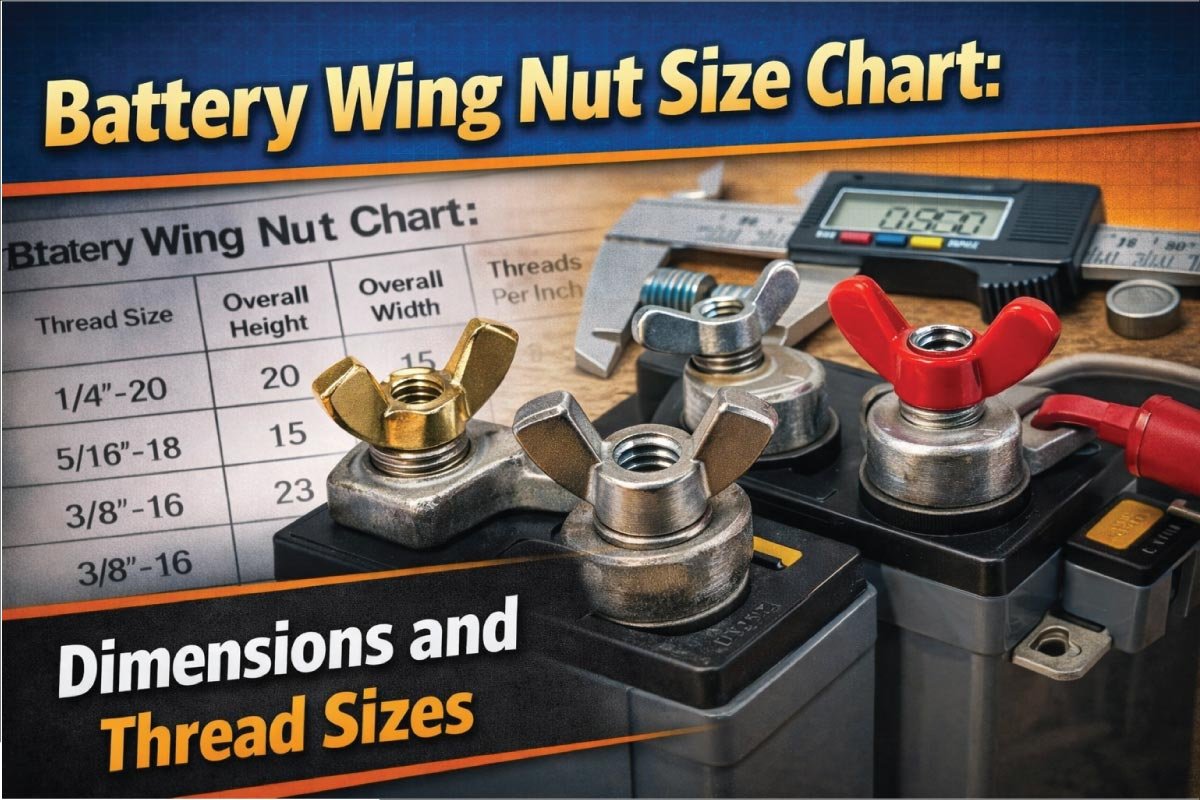
Battery wing nuts are small but critical fasteners commonly used in automotive, marine, solar, and industrial battery systems. Their hand-tightened design is easy to install and remove, which is suitable in battery terminals which need frequent maintenance.
Though, when the wrong size of battery wing nut is used, the connections may be loose, or maybe power loss, corrosion or even hazards.
This complete guide explains battery wing nut sizes, dimensions, thread types, standards, materials, and how to choose the correct size using a battery wing nut size chart.
What Is a Battery Wing Nut?
A battery wing nut is a special wing nut that is used to tighten battery terminals. It has two jutting wings as does normal wing nuts, which tighten without the aid of tools.
Battery wing nuts are however normally crafted out of corrosion resistant materials and are designed to match with standard battery terminal bolts.
Common Uses of Battery Wing Nuts
- Car and truck batteries
- Motorcycle batteries
- Marine batteries
- Solar power systems
- Backup power and UPS systems
They are especially popular where batteries need to be disconnected quickly for maintenance or storage.
Why Battery Wing Nut Size Matters
There are numerous ways of selecting the right battery wing nut, which is important to be safe, efficient, and with consistent performance.
The size used can have a negative impact on contact, voltage drop, overheating, corrosion, or failure of the battery. Appropriate sizing will guarantee appropriate clamping strength without breaking the terminal or threads.
- Poor electrical contact
- Voltage drops
- Overheating at terminals
- Corrosion buildup
- Battery failure or safety risks
Correct sizing ensures proper clamping force without damaging the terminal post or threads.
How Battery Wing Nut Sizes Are Determined
Battery wing nut sizes are determined by thread size and not wing span. Measures used are thread diameter, thread pitch or TPI, nut height and wing span.
Proper measurement guarantees correct fitment to battery terminations and eliminates strip thread, free connections and ineffective electrical operation.
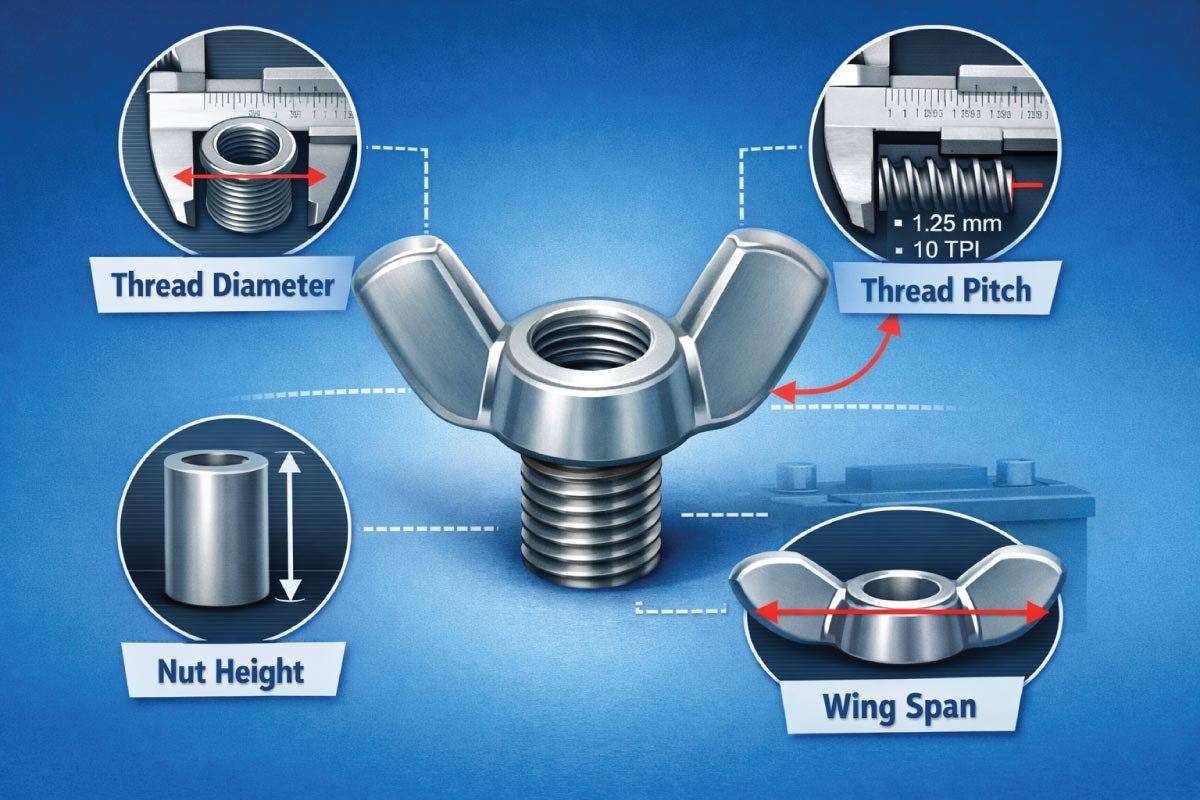
Key Measurements Include:
- Thread diameter
- Thread pitch (metric) or threads per inch (imperial)
- Nut height (thickness)
- Wing span (overall width)
Understanding these measurements helps you select the correct battery wing nut every time.
Common Battery Wing Nut Thread Sizes
Most automotive and industrial batteries use standard thread sizes such as M6, M8, 1/4″-20, and 5/16″-18. The modern use of metric size is in the vehicles younger than 20 years old, whereas the imperial size is used in the older or U.S. specific systems. Properly fitted thread size guarantees safe and stable electrical contacts and terminals are not ruined.
-
M6 (metric)
-
M8 (metric)
-
1/4″-20 (imperial)
-
5/16″-18 (imperial)
Metric sizes are more common in modern vehicles, while imperial sizes may be found in older or U.S.-specific systems.
Battery Wing Nut Size Chart (Metric)
Metric measuring nut wing nuts are compatible with ISO standards and by manufacturer. The common sizes are M5, M6, M8 and M10 and the thread pitch, nut height and wing span are different.
A comparison of these measurements with the appropriate battery usage guarantees healthy relationships and healthy electricity use.
| Thread Size | Thread Pitch (mm) | Nut Height (mm) | Wing Span (mm) |
|---|---|---|---|
| M5 | 0.8 | 9 | 20 |
| M6 | 1.0 | 11 | 24 |
| M8 | 1.25 | 14 | 32 |
| M10 | 1.5 | 18 | 40 |
Notes:
- M6 battery wing nuts are the most common for car batteries
- M8 sizes are often used in marine and industrial systems
Battery Wing Nut Size Chart (Imperial)
Imperial battery wing nuts follow ANSI and ASME standards and are less common today. Typical sizes include 1/4″-20, 5/16″-18, and 3/8″-16, with specified nut height and wing span. Verify thread compatibility before installation ensures a safe and efficient electrical connection.
| Thread Size | Threads Per Inch (TPI) | Nut Height (in) | Wing Span (in) |
|---|---|---|---|
| 1/4″-20 | 20 | 0.38 | 0.94 |
| 5/16″-18 | 18 | 0.44 | 1.12 |
| 3/8″-16 | 16 | 0.50 | 1.31 |
Imperial sizes are less common today but still used in some battery setups.
Metric vs Imperial Battery Wing Nuts
Battery systems can have either metric or imperial wing nuts. Millimeters and thread pitch are used in metric, and inches and threads per inch (TPI) are used in imperial. The mixing of them may ruin threads and unlink them in an unsafe manner. It is always advisable to verify the type of the system to be installed to ensure the correct fit and good performance.
| Feature | Metric | Imperial |
|---|---|---|
| Measurement Unit | Millimeters | Inches |
| Thread Definition | Pitch (mm) | Threads per inch |
| Common Use | Modern vehicles | Older/U.S. systems |
| Typical Sizes | M6, M8 | 1/4″, 5/16″ |
Never mix metric and imperial wing nuts—they may appear similar but will damage threads if forced.
Battery Wing Nut Standards
Battery wing nuts will comply with accepted standards to ensure compatibility and safety. Widely used standards are the DIN 315, ISO metric threads, ASME B18.17 and ANSI. The choice of the right standard is critical in automotive, industrial, or exporting applications and a proper thread engagement and electrical connection are provided.
Common Standards
- DIN 315 – Metric wing nut standard
- ISO metric threads – International compatibility
- ASME B18.17 – U.S. wing nut standard
- ANSI – American thread specifications
For automotive or export use, matching the correct standard is strongly recommended.
Materials Used in Battery Wing Nuts
The choice of material influences the durability, corrosive resistance and conductivity. Battery terminals are normally made of brass, zinc-plated steel is cheap and fairly resistant, stainless steel cannot corrode in the sea, and lead/alloy-coated nuts are used on special batteries. Material influences performance and not thread size.
Common Materials
1. Brass
- Excellent corrosion resistance
- Good electrical conductivity
- Most common for battery wing nuts
2. Zinc-Plated Steel
- Strong and affordable
- Moderate corrosion resistance
- Common in automotive use
3. Stainless Steel
- High corrosion resistance
- Slightly lower conductivity
- Ideal for marine environments
4. Lead or Alloy-Coated
- Used in some specialized battery systems
- Designed for terminal compatibility
Material does not change thread size but affects durability and performance.
How to Measure a Battery Wing Nut Correctly
Reproductive measurement eliminates incorrect fasteners. Measures internal thread diameter using a caliper, thread pitch, nut height and wing span tip to tip.
A comparison of these values to a size chart ensures the correct fit, clamped and reliable electrical performance of automotive, marine and industrial batteries.
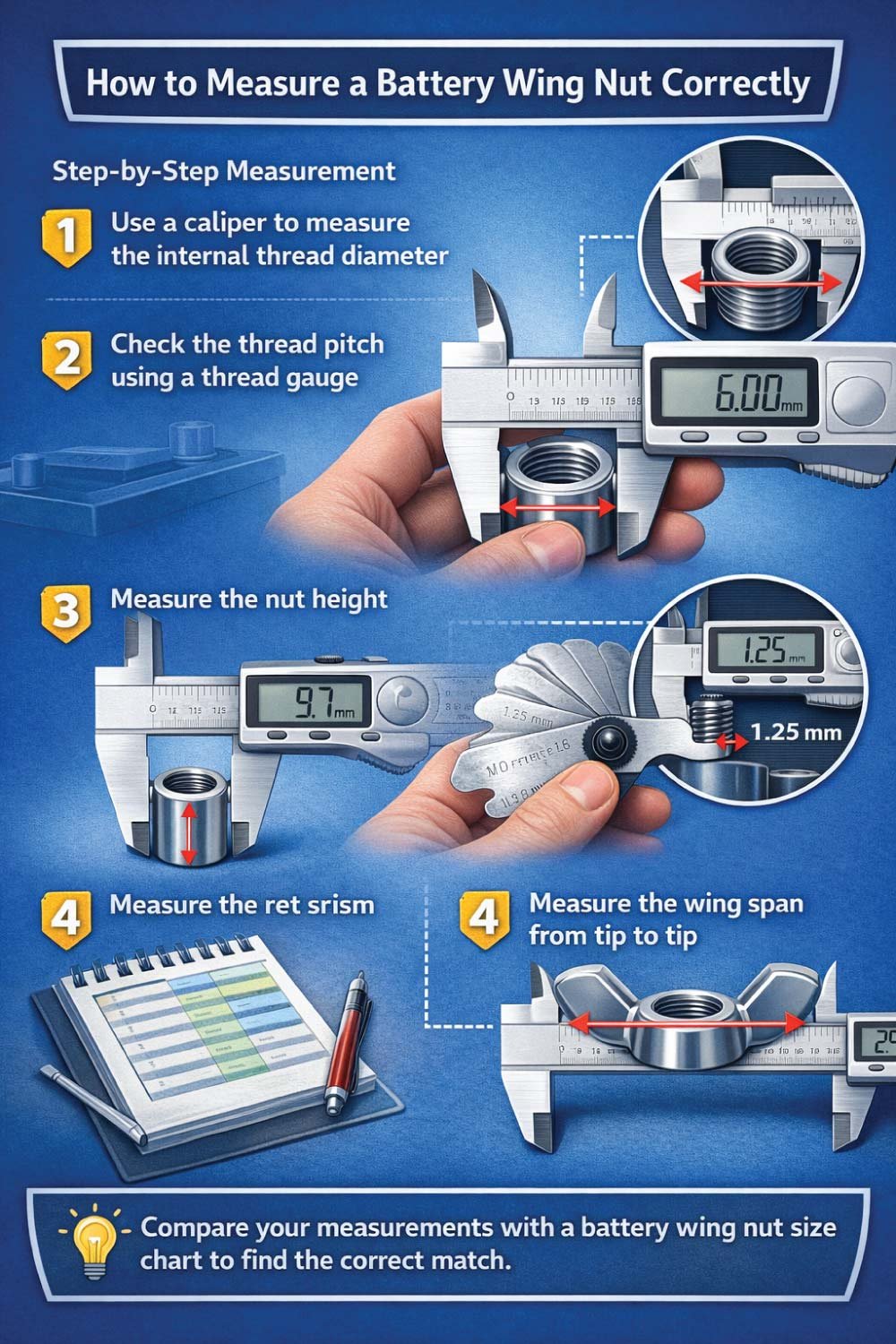
Step-by-Step Measurement
- Use a caliper to measure the internal thread diameter
- Check the thread pitch using a thread gauge
- Measure the nut height
- Measure the wing span from tip to tip
Compare your measurements with a battery wing nut size chart to find the correct match.
Common Battery Wing Nut Sizes by Application
Battery wing nut sizes are dependent on applications: M5 is small electronics, M6 is typical car and motorcycle battery, M8 is marine/solar systems, and M10 is industrial battery bank. Proper sizing makes electrical connections safe, secure and efficient in all applications.
- M5 – Small electronics and backup batteries
- M6 – Standard car and motorcycle batteries
- M8 – Marine, solar, and heavy-duty systems
- M10 – Industrial and commercial battery banks
Selecting the right size ensures a secure and efficient electrical connection.
Discover More:
👉 Wing Nut Size Chart is your complete guide to thread dimensions and standards. Learn how to select the right wing nut for easy fastening, proper fit, and secure connections in any project. Ideal for DIY enthusiasts and professionals, this post simplifies sizes, threads, and applications. Read the full guide for detailed tips and insights!
Advantages of Using Battery Wing Nuts
Battery wing nuts enable easy installation without the use of tools, faster service, reuse able and easy manipulations. They can be used in applications where disconnection of the battery is frequent. They are more convenient and functional and their design is easier and safer to maintain than a regular hex nut.
Battery wing nuts offer several practical benefits:
- Tool-free installation and removal
- Faster battery maintenance
- Reusable and adjustable
- Ideal for frequent disconnection
These features make them superior to standard hex nuts for battery terminals.
Limitations of Battery Wing Nuts
Battery wing nuts are suitable, though not suitable in high-vibration environments. They are easily loosened when they are over-handled and also have minimal torque in comparison with hex nuts.
Locking fasteners or special purpose nuts might prove more acceptable in the heavy-vibration application and ensure reliable and safe battery connections.
Potential Drawbacks
- Not ideal for high-vibration environments
- Can loosen if over-handled
- Limited torque compared to hex nuts
For heavy vibration applications, locking fasteners may be a better choice.
Common Mistakes to Avoid
The most common mistakes are; inappropriate thread size, mixed metric and imperial threads, hand tightening, or neglecting corrosion resistance.
The prevention of these errors secures safety, durability and adequate electrical functionality.
Confirm compatibility and material suitability by ensuring that it is correct before installation.
- Using the wrong thread size
- Mixing metric and imperial threads
- Over-tightening by hand
- Ignoring corrosion resistance
Always verify thread compatibility and material suitability.
Tips for Choosing the Right Battery Wing Nut
Select the correct thread size, choose corrosion-resistant materials, follow manufacturer recommendations, and keep spare sizes on hand.
Correct selection prevents battery terminal damage, improves connection reliability, and ensures safe and efficient electrical performance across automotive, marine, industrial, and backup power applications.
- Match the thread size exactly
- Choose corrosion-resistant materials
- Follow manufacturer recommendations
- Keep spare sizes for emergencies
A small investment in the correct wing nut can prevent costly battery issues.
Final Thoughts
Before connecting batteries, it is important to learn about battery wing nut size chart, dimensions and thread sizes in order to maintain safe and efficient battery connections.
Be it a car battery, marine system or solar power system, all that matters is to choose the right size that will assure you of good performance and time-saving durability.
When you know the size of thread, how to read charts, and what are the standards, you can be sure that you pick the correct battery wing nut to use in any job.
👉 Jam Nut Size Chart helps you understand how to choose the right size for secure and stable connections. Learn about different jam nut types, thicknesses, and applications to prevent loosening in your projects. Perfect for DIYers and professionals, this post makes selecting jam nuts easy and accurate. Read the full guide for detailed insights!

Engineer Hassan is a seasoned Mechanical Engineer specializing in hardware, fasteners, tools, and precision mechanical components. With over 16 years of hands-on experience in mechanical design, assembly, and maintenance, he creates detailed size charts, installation guides, and tool selection resources. His content focuses on accuracy, safety, and practical engineering solutions, helping professionals, technicians, students, and DIY enthusiasts make reliable decisions in mechanical projects.