
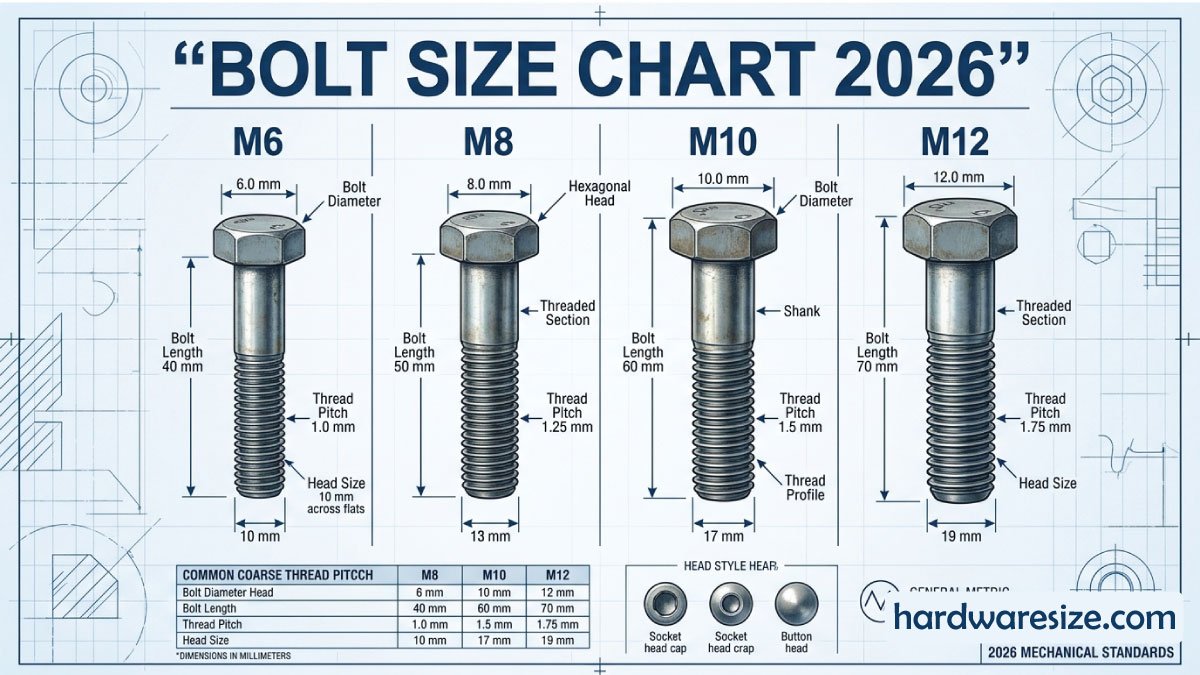
Bolt can appear easy to use, yet the most significant aspect in any mechanical, construction, automotive or DIY project is the selection of the appropriate bolt size. The incorrect size of a bolt may cause loose joints, broken threads, safety issues or even complete breakdown of the system.
This is why the knowledge of bolt size charts is not only to engineers but also to those who deal with tools. We are going to deconstruct bolt size charts in this guide in a very practical manner.
You will understand what diameter, length and type of thread mean, measurement of them, and understand how to pick the appropriate bolt to use without being in doubt.
Why Bolt Size Matters More Than You Think
Bolts are made to secure parts when they are under load, vibration, heat, and pressure. A bolt might break when it is excessively thin. And in case it is too thick, it will not fit the hole.
Otherwise, when the threads are dissimilar, the bolt will fret the nut or tapped hole. Machines and structures do not fail in many cases due to poor materials, but due to the improper selection of a fastener.
Knowing bolt size charts is the way to not make such mistakes and to use your time, money, and frustration.
Understand Bolt Size Charts:
Bolt size charts are important sources needed by any person handling fasteners. They present important data on bolts in an effective, standardized manner, which assists you in choosing the appropriate bolt to use in a certain project.
Knowledge of these charts results in proper assembly, eliminates errors, and wastage of time.
| Bolt Feature | Description |
|---|---|
| Bolt Diameter | The thickness of the bolt’s shank, measured in mm (metric) or inches (imperial). |
| Bolt Length | Measured from under the head to the tip of the bolt (not including the head). |
| Thread Pitch / TPI | Distance between threads (metric) or threads per inch (imperial). |
| Head Size | Wrench or socket size required to tighten the bolt. |
| Standard Type | Specifies whether the bolt is metric or imperial. |
At first, these charts may look confusing, but once you understand the basic terms, they become very easy to read.
Bolt Diameter Explained (The First and Most Important Measurement)
The most important measurement in the choice of bolts is the Bolt diameter because it influences the strength, fit and suitability with the holes or nuts.
It is the thickness of bolt shank and this is used to determine the size of the bolt in general. Knowledge of diameter can be useful in the process of ensuring that the correct bolt is selected to use in any given project.
What Is Bolt Diameter?
One of the most significant measurements on handling bolts is the Bolt diameter. It is the thickness of the shank of the bolt and it is the primary determinant of strength, fit and compatibility with holes or nuts.
The diameter will guarantee that you use the right bolt in any case.
- Metric bolts use millimeters (mm)
- Imperial bolts use inches or fractional sizes
Common Examples
These are some common examples of bolts diameter to enable you to quickly learn the way sizes are identified in both the imperial system and the metric system.
These illustrations demonstrate the real thickness of the shank of the bolt, and it will be easier to imagine and pick the right bolt to use in your project or to achieve the right match with the hole or nut.
- M6 bolt → 6 mm diameter
- M8 bolt → 8 mm diameter
- 1/4″ bolt → 0.25 inch diameter
- 1/2″ bolt → 0.5 inch diameter
In bolt size charts, diameter is always listed first because it determines strength and hole compatibility.
How to Measure Bolt Diameter
Determination of bolt diameter: When determining the correct bolt to use in your project, be sure to measure bolt diameter correctly. The appropriate tools and techniques to be used avoid mistakes, time wastage, and improper fitting.
The following are instructions on how to measure the bolt diameter easily either with a precision tool or simply with a reference chart.
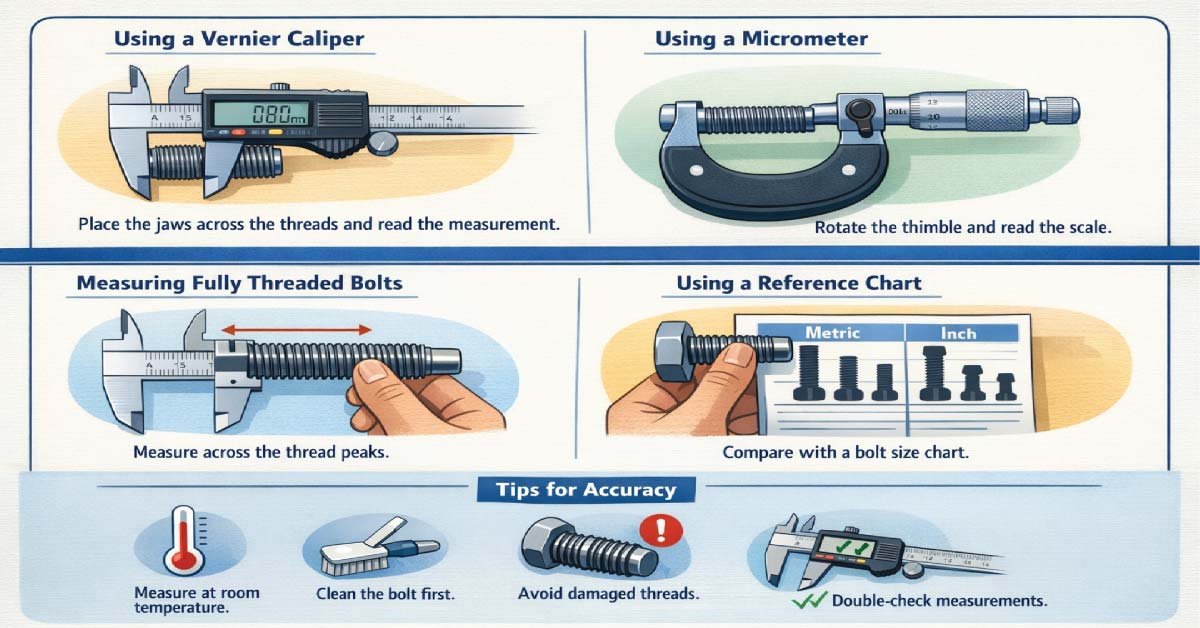
1. Using a Vernier Caliper:
The best instrument in the measurement of bolt diameter is an 8 Vernier caliper. Hold the jaws over the thread of the bolt and take the reading. Make sure that the caliper is at right angles to the threads. This technique applies both the metric and imperial bolts providing you with a precise diameter.
2. Using a Micrometer:
Another very precise measuring instrument used in determining the thickness of bolts is a micrometer. Put the bolt in between the spindle and anvil, and rotate the thimble until it is firmly in place. Scale measurement: Read the scale. Small bolts or a high degree of accuracy should use micrometers.
3. Measuring Fully Threaded Bolts
In the case of fully threaded bolts, cross measurements across the external threads are made in several locations to consider variations. Measure not the valleys of the threads: measure the peaks. Average where there is a slight difference so as to have a reliable measure that conforms to chart specifications.
4. Using a Reference Chart:
In case you have no measuring devices, look up the bolt size on a chart against one of known bolt sizes. Position your bolt with the dimensions that are charted to find the closest match. The method can be less specific and is applicable in general projects or fast identification.
5. Tips for Accuracy:
Have to be taken at room temperature and the bolt should be cleaned before taking. Bad or battered threads are to be avoided because they can produce incorrect readings.
Critical projects should be checked twice. Correct diameter measurement will guarantee correct assembly and safety and compatibility with nuts or drilled holes.
Bolt Length Explained (How Long Is Long Enough?)
Bolt length is one of the most important measurements that specify the quality of the hold of materials by a bolt. It is taken under the head to the tip to assure of adequate thread penetration.
The correct length to be selected eliminates weak joints or interference and provides secure and reliable assemblies in both the imperial and the metric systems.
1- What Is Bolt Length?
Bolt length is the distance between the point of the bolt (not the head) and the head which is below the pin. This is an error that a beginner will make, as he or she counts the total length which includes the head.
The majority of bolt size charts presuppose correct length measurement.
2- Why Bolt Length Is Important
To have a solid and strong connection, it is necessary to pick the right bolt length. Too short, and the threads won’t engage properly; too long, and the bolt may bottom out or interfere.
The right length ensures a strong, stable joint.
-
Too short → not enough thread engagement
-
Too long → bottoming out or interference
-
Correct length → strong, secure joint
3- Typical Bolt Lengths
The length of the bolts is adjusted according to the purpose and the thickness of the material. Sharing common lengths will assist you in finding the correct bolt much faster.
Measures bolted are standardized sizes that are typically employed in machines, building work, as well as DIY projects.
Metric bolts:
-
10 mm
-
20 mm
-
30 mm
-
50 mm
Imperial bolts:
-
1 inch
-
1½ inch
-
2 inches
Bolt size charts usually list diameter first, then length. Example: M8 × 40 means 8 mm diameter and 40 mm length.
Bolt Thread Types Explained (The Key to Proper Fit)
Threads are the spiral ridges on a bolt that allow it to engage securely with a nut or threaded hole. A poor fit, stripped threads, or a weak joint may occur even given the correct diameter and length the incorrect thread type may be us
1- Metric Thread Types (M Series)
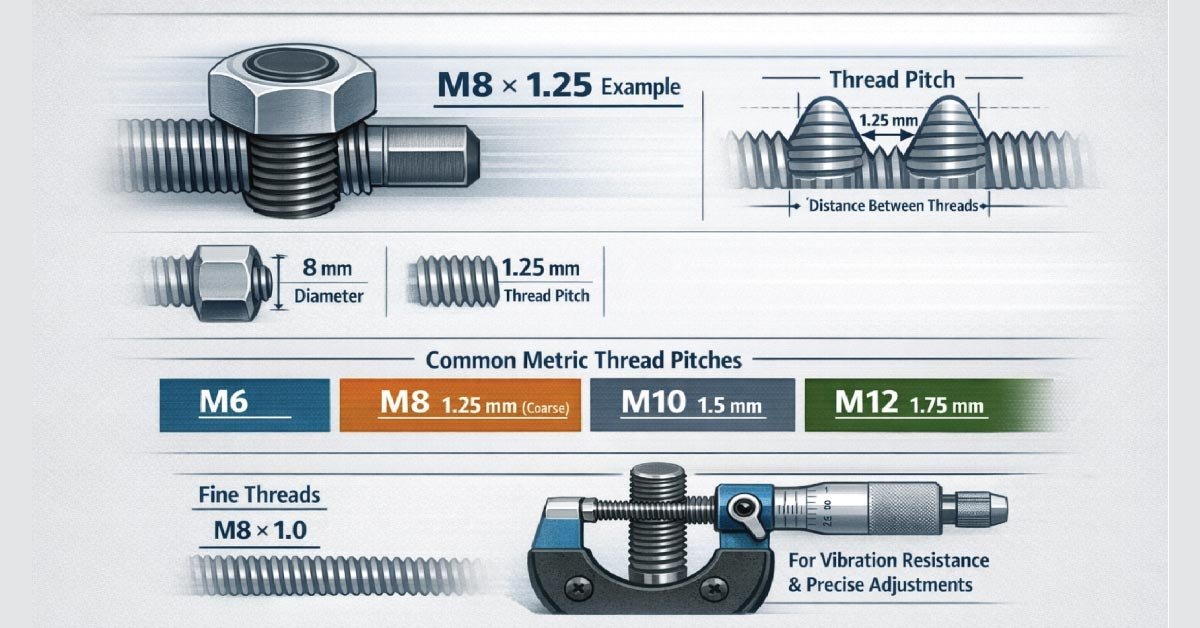
Metric bolts have a mechanism that is referred to as thread pitch which is the spacing between two adjacent threads in terms of millimeters.
The pitch of the thread is actually important in the matching of bolts to nuts or tapped holes.
When selecting the most appropriate metric thread type, proper fit is ensured, stripped threads are avoided and a secure and reliable fastening in any application is guaranteed.
Example
M8 × 1.25
8 mm diameter
1.25 mm distance between threads
Common Metric Thread Pitches
- M6 → 1.0 mm
- M8 → 1.25 mm (coarse)
- M10 → 1.5 mm
- M12 → 1.75 mm
Fine threads also exist, such as M8 × 1.0, and are used where vibration resistance or precise adjustment is needed.
Imperial Thread Types (UNC, UNF, and More)
Imperial bolts are measured using threads per inch (TPI) rather than millimeter pitch. Understanding TPI is essential for matching bolts with compatible nuts or tapped holes. Selecting the right imperial thread type among others, including UNC or UNF, will guarantee appropriate fit, avoid the damage of threads, and offer high-quality and solid connection in any assembly.
Common Imperial Thread Types
Imperial bolts are available under various thread types with each being specific to its application.
Strong threads with coarse threads (UNC) are simple to assemble and fine threads (UNF) are precise and do not come loose due to vibration.
The knowledge of the variations assists in choosing the right bolt to be used in strength, fitting, and reliability of any project.
-
UNC (Unified National Coarse)
-
Fewer threads
-
Strong and easier to assemble
-
-
UNF (Unified National Fine)
-
More threads per inch
-
Better for vibration and precision
-
Bolt size charts always specify whether the bolt is UNC or UNF.
Coarse vs Fine Threads (Which One Should You Use?)
Coarse and fine thread is used in various purposes, based on material and use.
The coarse threads tend to be simpler to install, less likely to strip, and suitable in general application whereas the fine threads have more clamping strength, reduce vibration.
And allow finer tunings, thus are appropriate in an automotive and aerospace application. Both types can be compared fast with the help of bolt size charts.
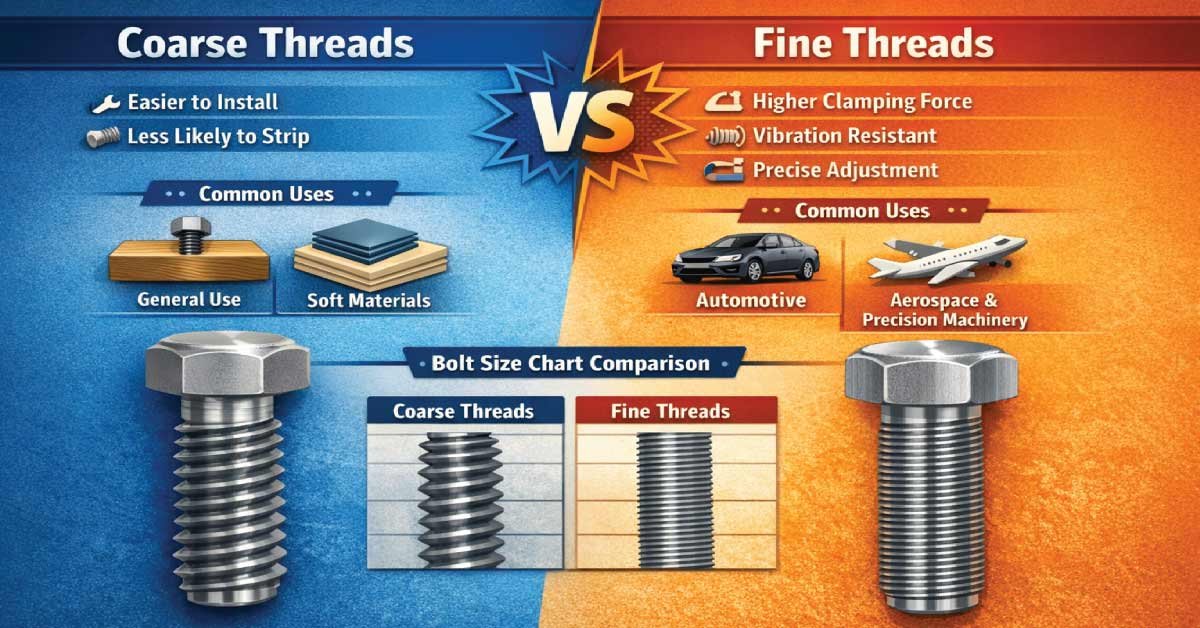
| Thread Type | Advantages | Common Applications |
|---|---|---|
| Coarse Threads | Easier to install, less likely to strip | General use, soft materials |
| Fine Threads | Higher clamping force, better resistance to vibration, precise adjustment | Automotive, aerospace, precision machinery |
Standard Bolt Size Chart Overview (Metric Example)
A standard metric bolt size chart provides a clear layout of all essential dimensions. It shows bolt diameters, standard thread pitches, available lengths, and corresponding nut sizes. Understanding this format allows you to quickly select the correct bolt for any project, saving time and preventing assembly errors.
| Diameter | Standard Pitch (mm) | Available Lengths (mm) | Matching Nut Size |
|---|---|---|---|
| M6 | 1.0 | 10, 20, 30, 40 | M6 |
| M8 | 1.25 | 20, 30, 40, 50 | M8 |
| M10 | 1.5 | 30, 40, 50, 60 | M10 |
| M12 | 1.75 | 40, 50, 60, 70 | M12 |
Once you understand the format, reading a chart takes seconds.
Bolt Head Sizes and Their Role
Bolt head size indicates the wrench or socket needed to tighten or loosen a bolt. Size charts include this information to help you select the correct tools and plan for workspace constraints. Knowing head sizes ensures efficient assembly, prevents damage, and makes working in tight spaces easier.
Example
-
M8 bolt → 13 mm head
-
M10 bolt → 17 mm head
This is useful when selecting tools or working in tight spaces.
How to Identify an Unknown Bolt Using a Size Chart
It is not hard to find a bolt that you are not used to using with the help of size chart. Diameter, length, thread pitch or threads per inch One very quick comparison is by noting the values and comparing them to a chart.
You will be able to determine the exact type of the bolt within a few minutes, so it is guaranteed that you will replace or assemble it.
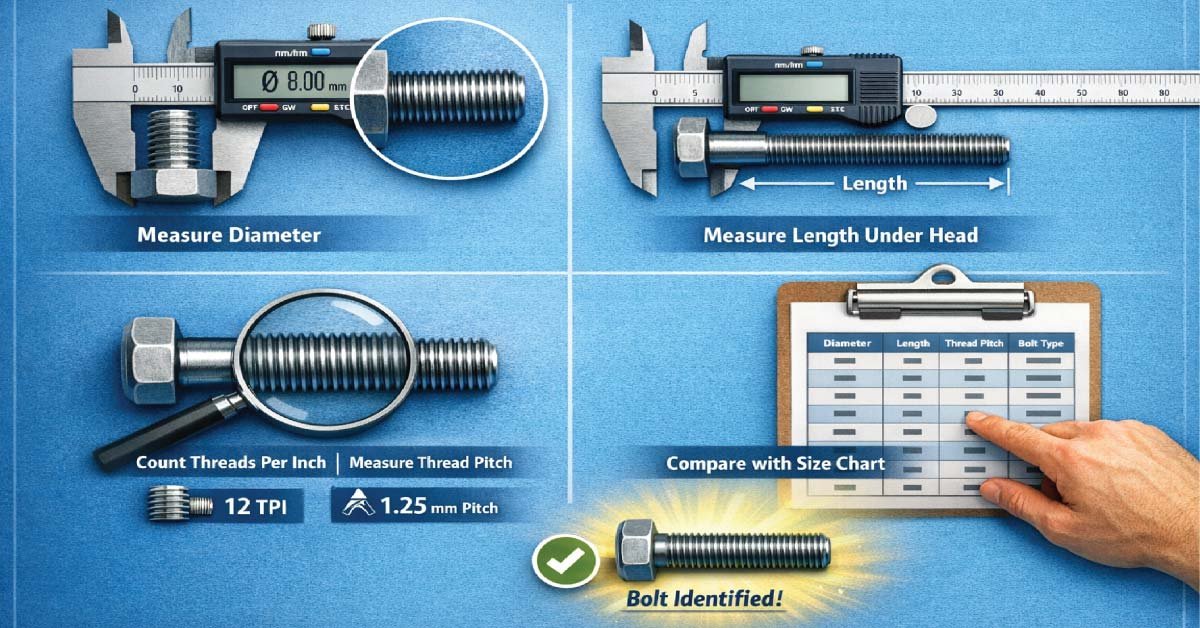
Steps:
-
Measure the diameter with a caliper
-
Measure the length under the head
-
Count threads per inch or measure pitch
-
Compare values with a bolt size chart
Within minutes, you will know exactly what bolt you have.
Common Bolt Size Mistakes to Avoid
Bolts are not rocket science and even minor mistakes can bring huge problems.
Using the incorrect size, combination of standards or not following the thread specifications may result to thread stripping, loose joints or assembly.
Knowing the mistakes also aids in good, secure and dependable fastenings in whichever endeavor.
1- Mixing Metric and Imperial
Metric and imperial bolts may appear similar, but they are not interchangeable. For example, an M8 bolt looks close to a 5/16″ bolt.
It is quite important to match the standard always since using either of them instead of the other may damage the threads and reduce the joint.
2- Ignoring Thread Pitch
Even if the diameter matches, thread pitch or TPI must be correct. Using a bolt with the wrong thread type can prevent proper engagement, strip threads, or weaken the connection.
Always check the pitch before assembly to ensure a secure and reliable joint.
3- Using the Wrong Length
The length of the bolt selected does not assure superior performance. A bolt must have the correct length for proper thread engagement without bottoming out.
Selecting the proper length ensures a strong joint, prevents interference, and maintains overall assembly integrity.
Bolt Strength Grades (Quick Mention)
The strength of bolts does not depend on size, but only on size. The use of various applications demands various levels of strength to be safe and durable.
The tensile strength is indicated by metric grades (8.8, 10.9, 12.9) and imperial grades (Grade 5, Grade 8).
Always ensure that it is of the right size and the right strength rating.
-
Metric grades: 8.8, 10.9, 12.9
-
Imperial grades: Grade 5, Grade 8
Always pair the correct size with the correct strength rating.
When to Use a Bolt Size Chart:
Bolt size charts are needed both by beginners or professionals.
They can be applied in a very broad variety of activities, including assembling machines, automotive repair and furniture installation, as well as metal fabrication, building, and do-it-yourself home work.
A size chart would make sure that the right diameter, length and type of thread are selected, avoiding error, time wastage, and ensuring that the fastenings were strong, reliable and safe in all projects.
Practical Tips for Beginners
Handling of bolts can be hectic when one is a beginner without the right guidance. Taking practical tips will lead to right selection, assembly without accidents and damage.
Such basic techniques as carrying charts, thread gauges, labeling parts and matching standards make bolt work simple, faster.
And more dependable, and both the DIYer and professional can save money lost on expensive errors.
-
Keep a printed bolt size chart in your workshop
-
Use thread gauges if available
-
Never force a bolt that doesn’t turn easily
-
Label bolts when disassembling machines
-
Match bolt, nut, and washer standards
These simple habits prevent costly errors.
Final Thoughts
The charts of Bolt sizes might sound complicated, though, when you learn about the diameter, length and type of threads, everything will be easy. Imagine bolts the same as keys, there is only one size which fits.
Be it that you are a mechanic, an engineer, a fabricator or a DIY lover, you are certain and accurate about what you are doing once you know how to use and read a bolt size chart.
Rather than working by chance, you will never select the incorrect bolt–and that is the way robust, dependable assemblies are created.
👉 Removing a broken bolt can be tricky, but with the right tools, tips, and techniques, it’s completely manageable. Our step-by-step guide covers everything from choosing the proper extractor to avoiding damage. Read the full post to learn how to tackle stuck or broken bolts safely and efficiently.

Engineer Hassan is a Mechanical Engineer with over 16 years of hands-on experience in mechanical hardware, fasteners, bolts, screws, nuts, washers, and related mechanical components. He has extensive expertise in selecting, measuring, and installing hardware, ensuring accuracy, safety, and reliability in every project.
Through Hardware Size, he provides detailed size charts, installation guides, and technical tutorials, helping engineers, technicians, students, and DIY enthusiasts solve practical hardware problems with confidence.