
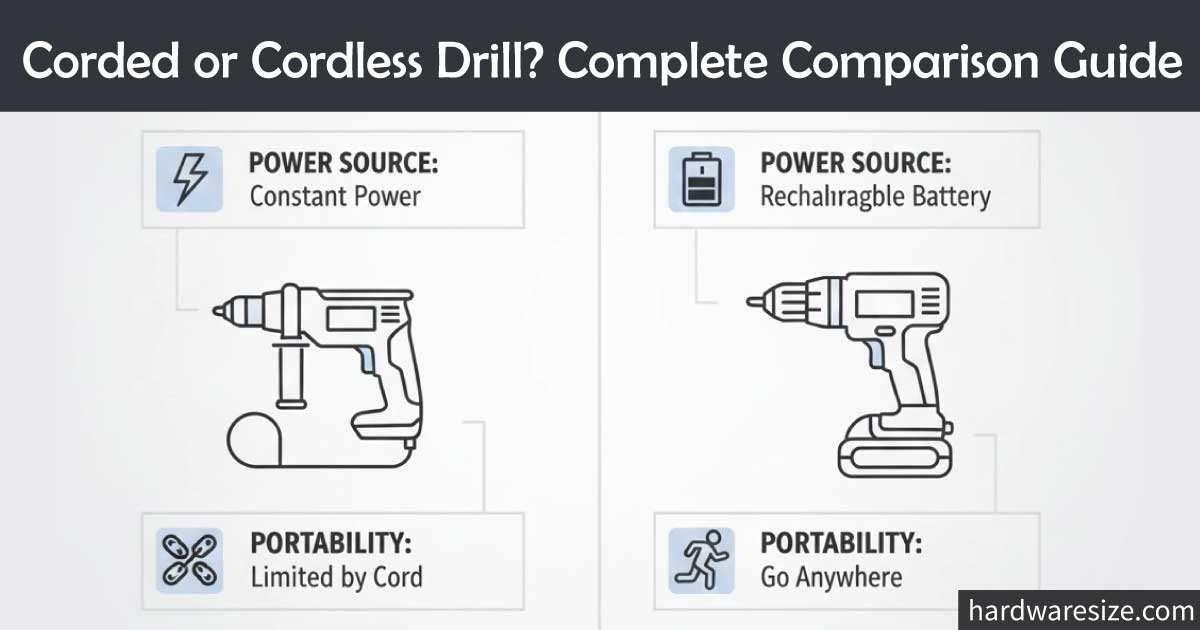
Select the appropriate drill and it will help you work faster, easier, and much less frustrating. When you are putting up a shelf in your house, or assembling a bed, or on a more serious construction job, you always asked yourself a question: Is it better to purchase a corded or a cordless drill?
Both tools might seem to be similar at first. They turn, they bore holes and they stab screws. However, in the field corded and cordless drills do not act as such.
There are power, portability, cost and maintenance and all these contribute to making a decision on which one to choose.
In this complete guide, we will break down corded vs cordless drills in simple terms, explain how they work, compare their strengths and weaknesses, and help you choose the best drill for your needs.
What Is a Corded Drill?
It is a corded drill that uses a direct power supply when a power cord is inserted in a wall plug.
This direct connection of power makes corded drills a consistent stream of power. Corded drills are not a new development.
They have been in existence over many decades and they are still common in workshops, construction sites and garages where power outlets are readily available.
How Corded Drills Work
Corded exercises would work on direct electric power supply where the motor can be operated at full strength continuously. Power is not wasted with time as there is no use of batteries.
This gives it a steady speed and a steady torque and this makes corded drills dependable when it comes to long and strenuous tasks.
This makes corded drills especially useful for:
- Drilling through hard materials
- Long working sessions
- Heavy-duty tasks that require steady power
What Is a Cordless Drill?
A cordless drill is powered by a rechargeable battery, normally lithium-ion.
These exercises are portable and easy to use, and you are able to work without being connected to an electrical source.
The technology of the cordless drills has enhanced over the years. The present day cordless drills are lighter, stronger, and more efficient compared to the older ones.
How Cordless Drills Work
Cordless, the power in the drills is saved in a replaceable battery pack that is connected to the motor when operating.
The performance of the battery is dependent on a number of factors some of which include the voltage level of the battery.
The amp-hours capacity, the performance of the motor and the ability of the battery to sustain charge when there is heavy or prolonged work on the battery.
- Battery voltage (e.g., 12V, 18V, 20V)
- Battery capacity (Ah rating)
- Motor efficiency
Cordless drills are ideal for:
- Quick home repairs
- Working outdoors
- Tight or hard-to-reach spaces
👉 Explore our Complete Drill & Drill Bit Guide: Types, Sizes & Uses to master choosing the right drill for any project. Learn the differences between corded and cordless drills, discover various drill bit types and sizes, and understand their best uses. Whether for DIY or professional work, this guide helps you drill smarter—read the full post now!
Corded vs Cordless Drills: Key Differences at a Glance
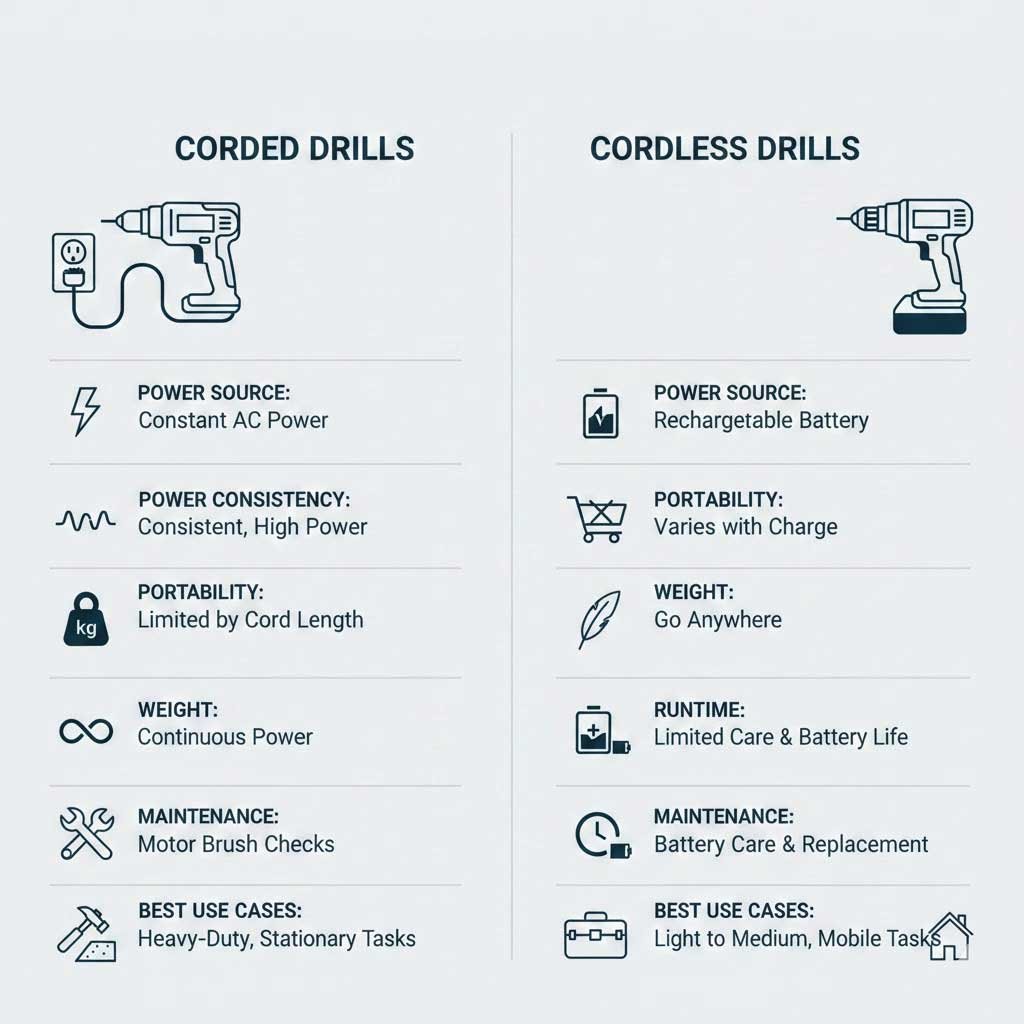
Corded vs Cordless Drill Comparison Table
| Feature | Corded Drill | Cordless Drill |
|---|---|---|
| Power Source | Wall outlet (AC power) | Rechargeable battery |
| Power Consistency | Continuous, steady power | Depends on battery charge |
| Portability | Limited by cord length | Highly portable |
| Weight | Usually lighter | Heavier due to battery |
| Runtime | Unlimited | Limited by battery |
| Maintenance | Minimal | Battery replacement needed |
| Best For | Heavy-duty, long tasks | DIY, quick jobs, mobility |
Power and Performance Comparison
Knowledge of power and performance is critical when deciding on which type of drills to take between corded and cordless ones.
Although they both serve the same purpose of drilling holes and pushing fasteners, the nature of power delivery and the amount of workload varies.
The nature of projects you deal with- light DIY, heavy-duty work will to a large extent dictate the best option that works in your favor.
A- Corded Drill Power
In terms of brute force, corded exercises remain the best. They directly pass the electricity through the outlet therefore they do not have problems of power drop.
This consistency in performance makes them dependable in tasking jobs that need long-term power and accuracy.
-
Maintain high torque under load
-
Drill through metal, masonry, and hardwood more easily
-
Run for hours without overheating (with proper use)
This makes corded drills a top choice for professional workshops and demanding tasks.
B- Cordless Drill Power
Cordless drills do not necessarily be as powerful as a corded one, but current models are quite able to do so.
The innovations in battery and motor systems enable them to perform most of their daily tasks effectively without being perceived to be weak.
-
Handle wood, plastic, and light metal drilling
-
Drive screws efficiently
-
Perform most household and DIY tasks with ease
For everyday users, the difference in power is often not noticeable unless you’re working with very tough materials.
Portability and Ease of Use
Portability is important in comfortability and helpfulness of a drill in use.
Freedom of movement, working in confined spaces or accessing high areas can have significant impacts to productivity particularly during home repairs or outdoor works.
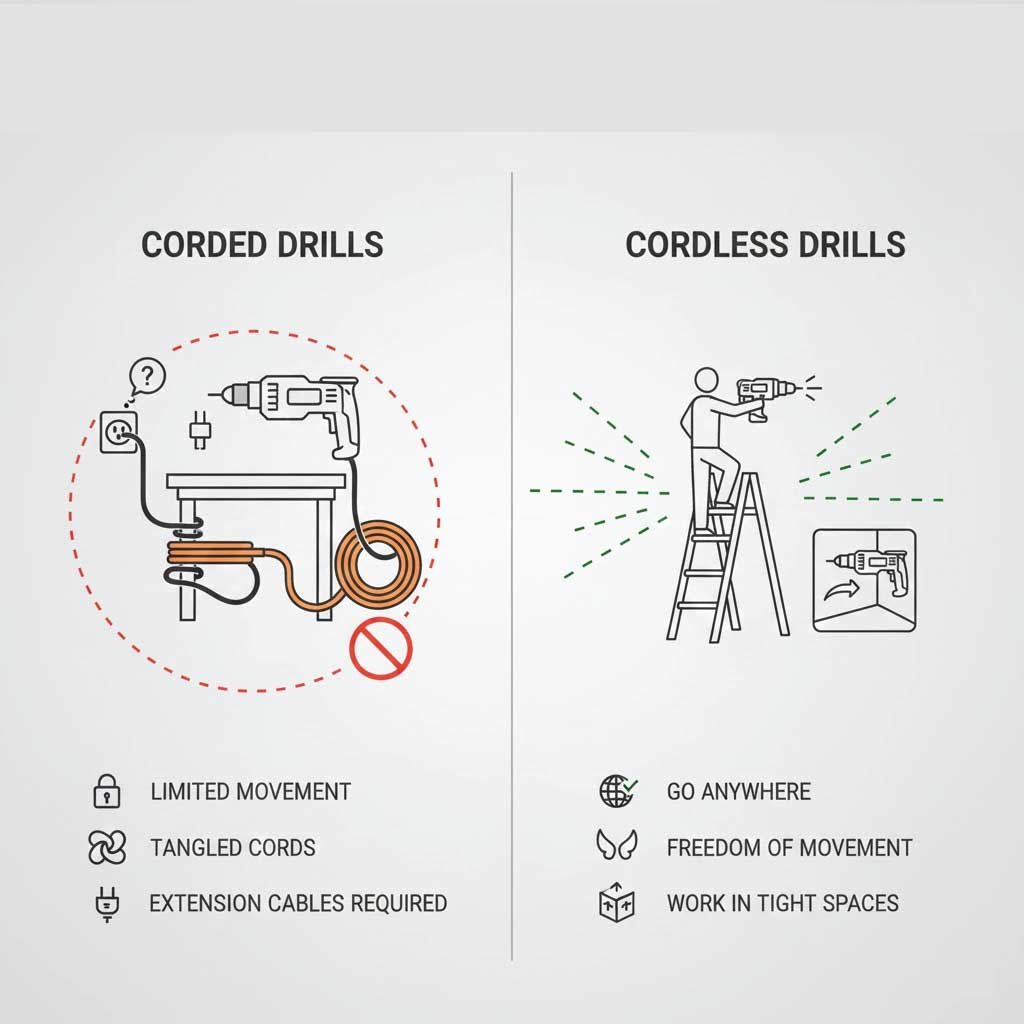
A- Corded Drill Limitations
Corded exercises are limited considering that they are physically attached to a power source.
Though this is powerful, it can in some cases restrict flexibility and slow down work especially where outlets are not readily available.
-
Power outlet availability
-
Cord length
-
Tangling or tripping hazards
You may need extension cords, which can slow you down and make work less convenient, especially outdoors or on ladders.
B- Cordless Drill Freedom
Cordless exercises are the best in terms of flexibility and convenience.
In most cases, work becomes quicker and safer since the user does not have to work with cables, and a power cord is absent.
-
Work anywhere without planning power access
-
Move freely around job sites
-
Use them in tight or elevated spaces
This freedom is one of the biggest reasons cordless drills are so popular among homeowners and DIYers.
Battery Life and Charging Considerations
The battery life can be considered as one of the most significant aspects in the comparison between corded and cordless drills.
On the one hand, corded drills provide constant activity, on the other hand, cordless drills need to plan the batteries correctly to prevent the delay of work, particularly in a long-term project.
A- Corded Drills: No Battery Worries
Power availability of a corded drill is never an issue. The drills have been found to be very useful in long and long-lasting drilling exercises so long as one has the drill in as it will be reliable in performance.
-
You never stop due to low power
-
There’s no charging time
-
Performance stays the same from start to finish
This makes them ideal for long drilling sessions.
B- Cordless Drills: Battery Management
Cordless exercises need a power control to some extent. Convenient though, batteries lose their charge as time lapses and this may impact their performance in the case of prolonged or heavy duty work.
-
Batteries need recharging
-
Performance drops as battery drains
-
Batteries wear out over time
However, many users solve this by keeping a spare battery, allowing near-continuous work.
Cost Comparison and Long-Term Value
Cost is not only concerned with the purchase price, but with long-term costs and the life of the tools.
The balance between initial expense and the long-term maintenance can be used to evaluate the merits of the drill as they are the most economical in the long run.
A- Initial Cost
Corded exercises tend to be cheaper and more available and will be a good choice in the eyes of cost-sensitive consumers. Though more costly at the beginning, cordless drills may have beneficial accessories.
-
Cheaper upfront
-
Available at lower price points
Cordless drills:
-
Cost more due to battery and charger
-
Often sold in kits with extra accessories
B- Long-Term Costs
Cordless drills can have extra costs of battery replacement, particularly when used regularly.
The parts of corded drills are less than those of other drills, thus maintaining low maintenance.
-
Battery replacement after a few years
-
Additional batteries for heavy use
Corded drills usually last longer with fewer replacement parts.
Cost and Value Comparison Table
| Cost Factor | Corded Drill | Cordless Drill |
|---|---|---|
| Initial Purchase | Lower | Higher |
| Accessories Needed | Minimal | Batteries & charger |
| Long-Term Expense | Very low | Moderate |
| Overall Value | Best for heavy use | Best for convenience |
Weight, Balance, and Comfort
Weight and balance has a direct influence on the level of comfort experienced when using a drill particularly when performing long and overhead jobs.
An ergonomic tool minimizes fatigue in the hands and increases control.
Doing the appropriate drill based on comfort can result in significant changes in productivity and general user experience.
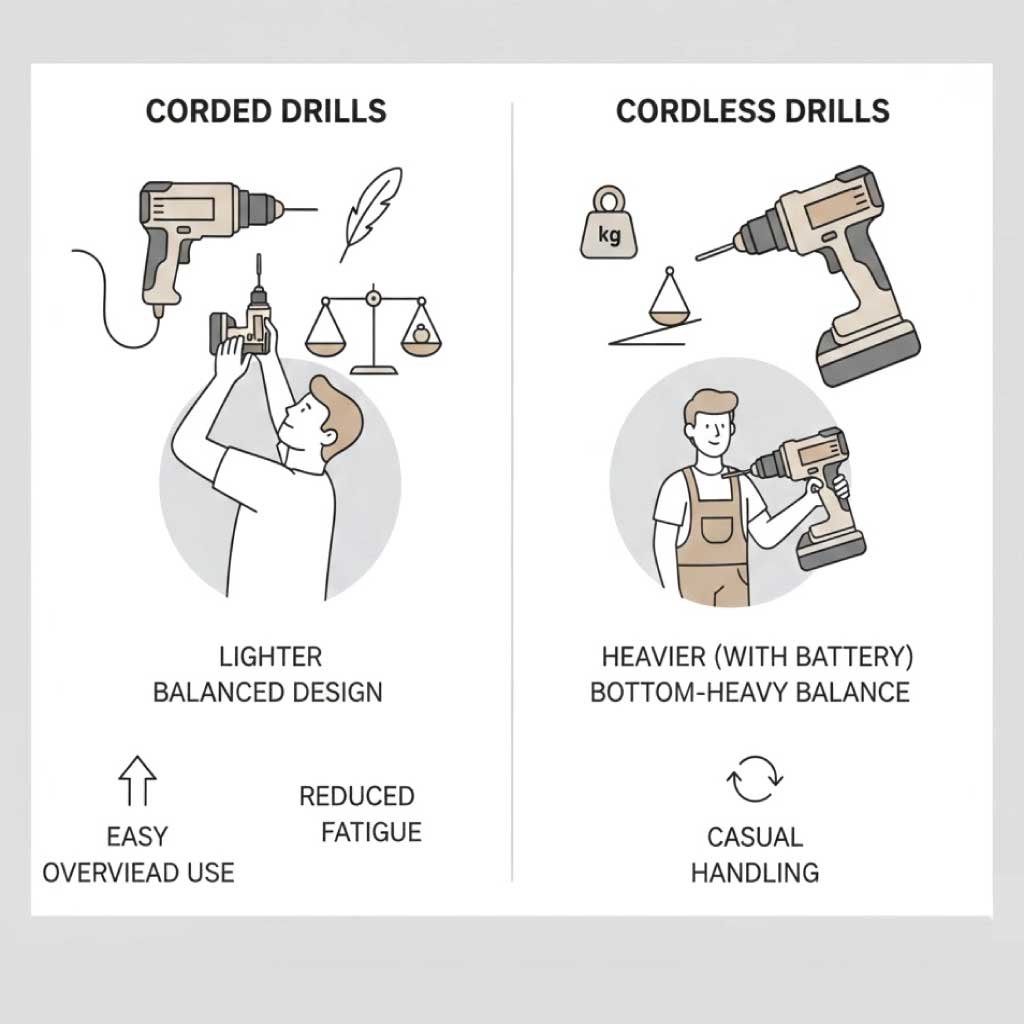
A- Corded Drills Are Often:
Corded exercises are created with no heavy battery packs that aid in making them less heavyweight and keep the weight at the center.
This facilitates their control in the case of long drilling hours and mostly in the workshops or working long hours.
-
Lighter
-
Better balanced
-
Less tiring during long sessions
B- Cordless Drills:
Cordless exercises have a battery pack that gives them an additional weight and bulky appearance.
Although this may compromise balance, modern designs are not any worse off with regards to providing good ergonomics and as a result are comfortable to perform most of the daily tasks.
-
Heavier due to battery
-
Slightly bulkier
-
Still comfortable for short to medium tasks
If you work overhead or for extended periods, weight can make a noticeable difference.
Best Uses for Corded Drills
Corded exercises would be most appropriate in the circumstances where mobility is not as significant as power and reliability.
They work well in controlled settings where access to electricity is not a problem and are designed to work under the strenuous workload without performance degradation.
-
Work in a workshop or garage
-
Drill through metal, concrete, or thick wood
-
Need constant power
-
Prefer a budget-friendly option
They are commonly used by professionals who value power and reliability over portability.
Best Uses for Cordless Drills
Cordless exercises are planned to be flexible and easy to move. They are perfect to those who would want to access a drill fast in any place without the concern of power points or extension cords.
-
Do home repairs and DIY projects
-
Work in different locations
-
Need speed and convenience
-
Value flexibility over maximum power
For most homeowners, a cordless drill is often the first and most-used power tool.
Which Drill Should You Choose?
The selection of the correct drill is more about your intended use of the drill and where you intend to use them rather than the technical specifications.
In the case of a lengthy working time, heavy material, or stationary working place such as a garage or a workshop, then a corded drill would be the wiser choice based on its uniform power and lower price.
Conversely, when the kinds of things you are doing on a regular basis are quick fixes, DIY-type jobs, or work in various places, then a cordless drill has no equal in terms of convenience and flexibility.
Most of the long-time users often end up buying both and thus they are able to alternate between them depending on the activity they want to perform and still achieve maximum results without losing quality.
Final Thoughts
It is essential to know the differences between corded and cordless drills in order to make a more efficient and definite purchase.
Cored exercises are characterized by consistent power, consistent performance and longevity value particularly in demanding or prolonged activities.
However, cordless drills are superior in the aspects of mobility, ease of handling and speed and hence daily work is made easier and more efficient.
Rather than which drill is most generally good, it is better to target the needs and the place of work.
As soon as you have determined the drill with the most frequent use, the correct option would become obvious and frictionless.

Engineer Hassan is a Mechanical Engineer with over 16 years of hands-on experience in mechanical hardware, fasteners, bolts, screws, nuts, washers, and related mechanical components. He has extensive expertise in selecting, measuring, and installing hardware, ensuring accuracy, safety, and reliability in every project.
Through Hardware Size, he provides detailed size charts, installation guides, and technical tutorials, helping engineers, technicians, students, and DIY enthusiasts solve practical hardware problems with confidence.