
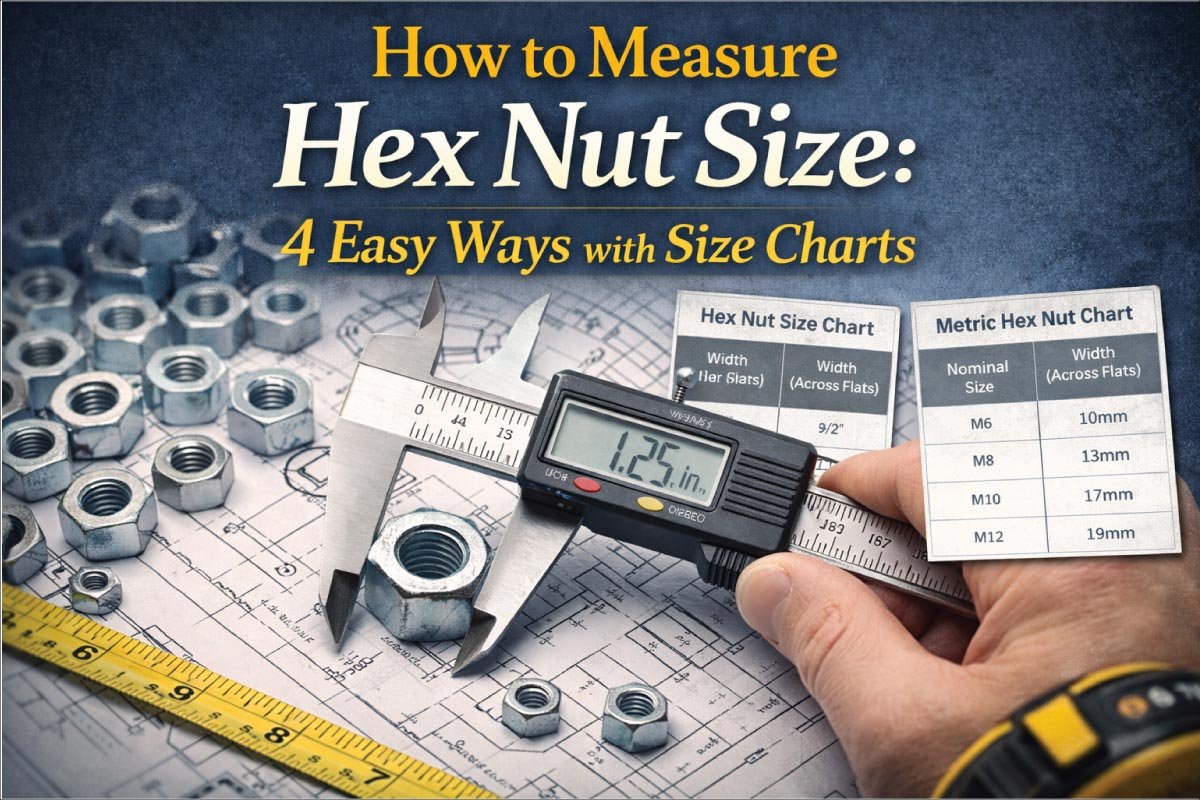
One of the most popular types of fasteners that are used in construction, automotive, machinery, and DIY are hex nuts. Although they appear straightforward, it is important to measure a hex nut correctly in order to be able to fit it properly, be strong and safe at the same time. The use of incorrect size may result in loose joints, ripped threads, or broken bolts.
In this complete guide, you will learn how to measure hex nut size using 4 easy methods, understand metric and imperial sizing, and read hex nut size charts with confidence.
Why Measuring Hex Nut Size Correctly Matters
Measuring hex nuts appropriately is a guarantee of their compatibility with bolts or threaded rods to avoid poor engagement, loose connections, ripped threads, or safety.
Accurate measurement guarantees durability, reliable load-bearing capacity, and professional results in both industrial and DIY applications, avoiding costly mistakes and improving assembly quality.
- Poor thread engagement
- Weak or unstable connections
- Damage to bolts or threads
- Safety risks in load-bearing applications
Correct measurement ensures compatibility, durability, and professional results in any project.
What Defines a Hex Nut Size?
Size of the hex nut is not only determined by its outside width. Some of the important measurements are internal thread size, thread pitch/TPI, across flats width, and nut thickness.
These four dimensions can be understood to make sure that the choice of nut, the correct fit of the bolts and the fastening are made firm and reliable in any work or machine.
Key Measurements of a Hex Nut
- Thread size (internal diameter)
- Thread pitch (metric) or threads per inch (imperial)
- Width across flats (wrench size)
- Nut thickness (height)
Understanding all four helps you select the correct nut every time.
Method 1: Measure the Thread Diameter (Most Important)
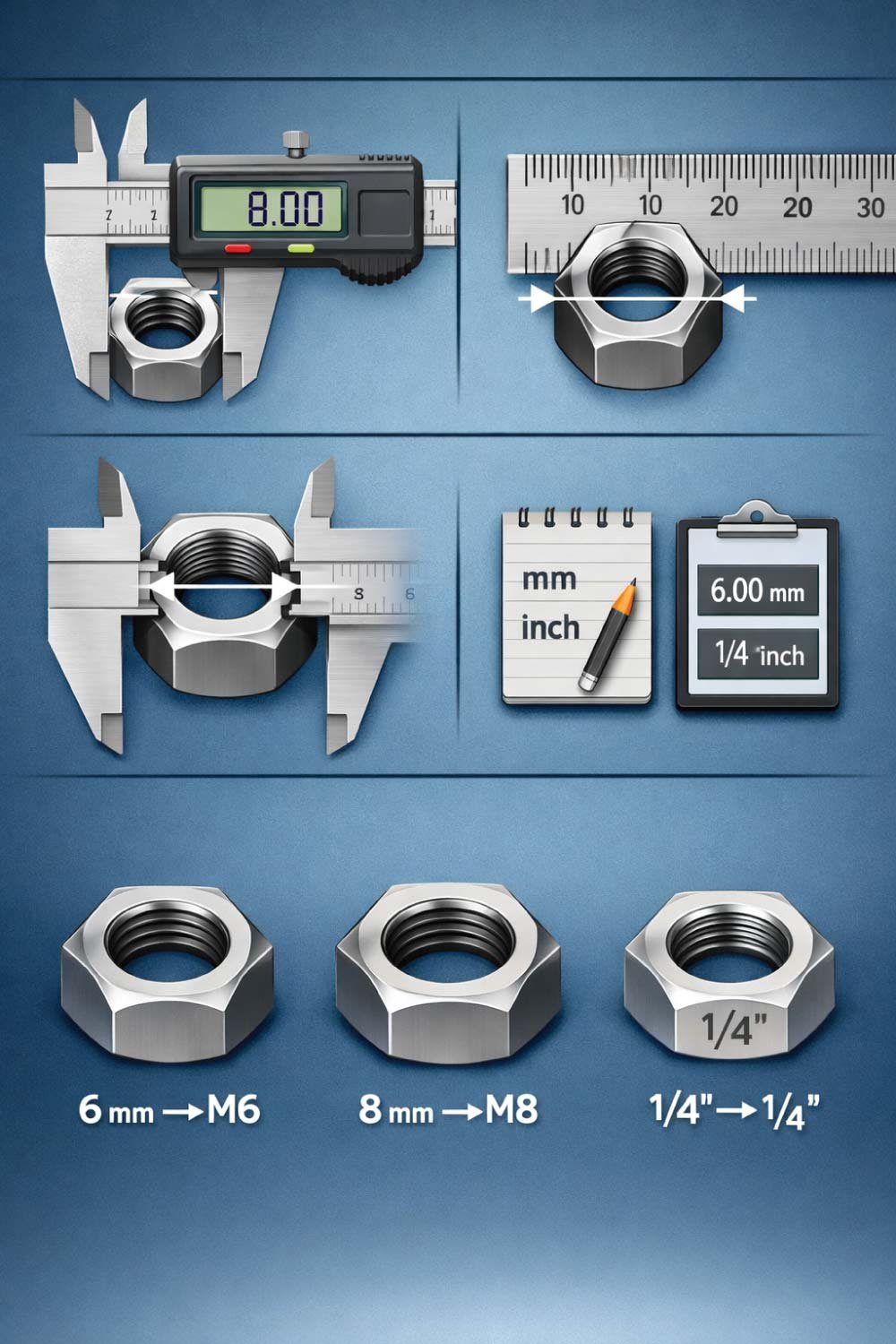
The most important measurement to make with the hex nut is thread diameter, which shows which bolts the nut can fit into. Internal threads can be measured using a caliper or a ruler in millimeters or inches.
Proper identification of diameter will avoid cross-threading as well as provide smooth and dependable engagement of both metric and imperial fasteners.
How to Measure Thread Diameter
- Use a vernier caliper or ruler
- Measure the inside diameter of the nut threads
- Record the measurement in millimeters or inches
Examples
- 6 mm internal diameter → M6 hex nut
- 8 mm internal diameter → M8 hex nut
- 1/4 inch internal diameter → 1/4″ hex nut
This measurement determines whether the nut is metric or imperial.
Method 2: Measure the Thread Pitch or TPI
The nut to bolt engagement is determined by the thread pitch or threads per inch (TPI). The pitch of metric nuts is in millimeters whereas the imperial nuts have TPI. Use a thread gauge or known bolt for comparison. Accurate measurement prevents cross-threading, ensures smooth tightening, and maintains mechanical integrity in any assembly.
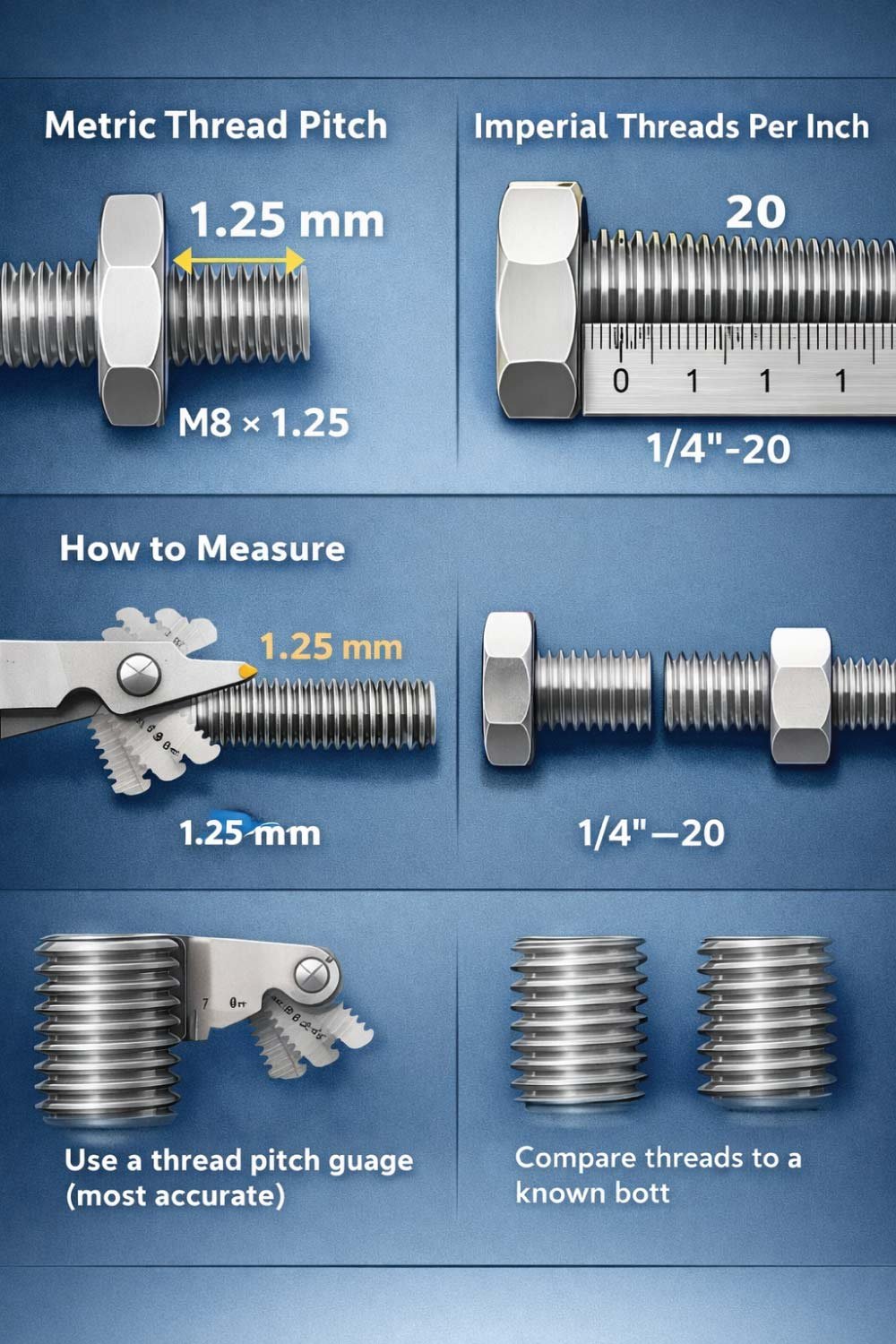
Metric Thread Pitch
- Measured as the distance between threads in millimeters
- Example: M8 × 1.25 → 1.25 mm between threads
Imperial Threads Per Inch
- Count how many threads appear in one inch
- Example: 1/4″-20 → 20 threads per inch
How to Measure
- Use a thread pitch gauge (most accurate)
- Or compare threads to a known bolt
Correct thread pitch ensures smooth engagement without cross-threading.
Method 3: Measure Width Across Flats (Wrench Size)
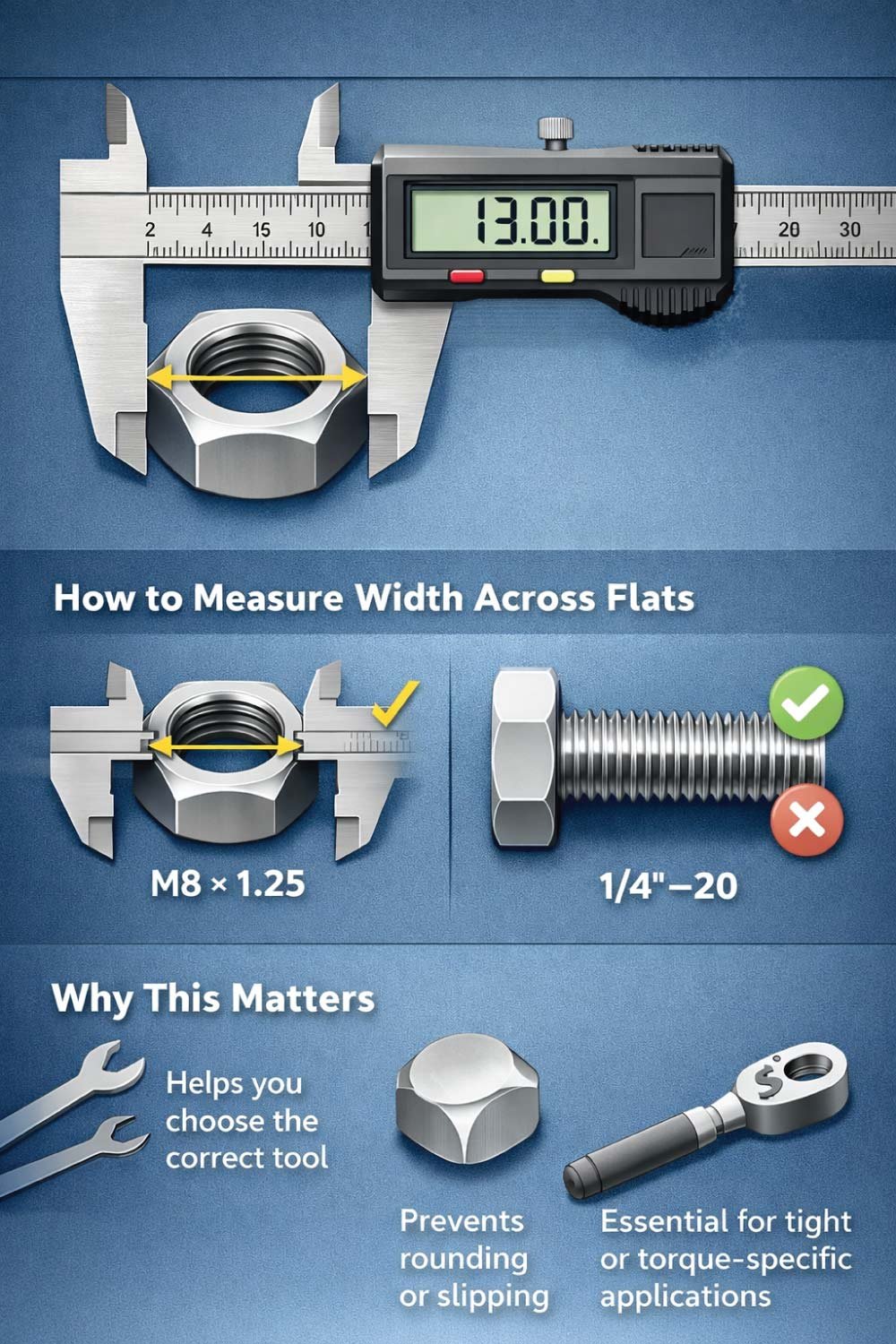
Across flats is used to find the wrench or spanner required to install. Measuring two planes that are not corner to corner but straight across. Minimizing rounding, slipping, or degradation during tightening is achieved by correct identification. This measure is known as tool fit and not thread size, although commonly referred to as nut size.
How to Measure Width Across Flats
- Place a caliper across two flat sides
- Measure straight across (not corner to corner)
Why This Matters
- Helps you choose the correct tool
- Prevents rounding or slipping
- Essential for tight or torque-specific applications
This measurement is often mistakenly called the “nut size,” but it’s actually the tool size, not the thread size.
Method 4: Measure Nut Thickness (Height)
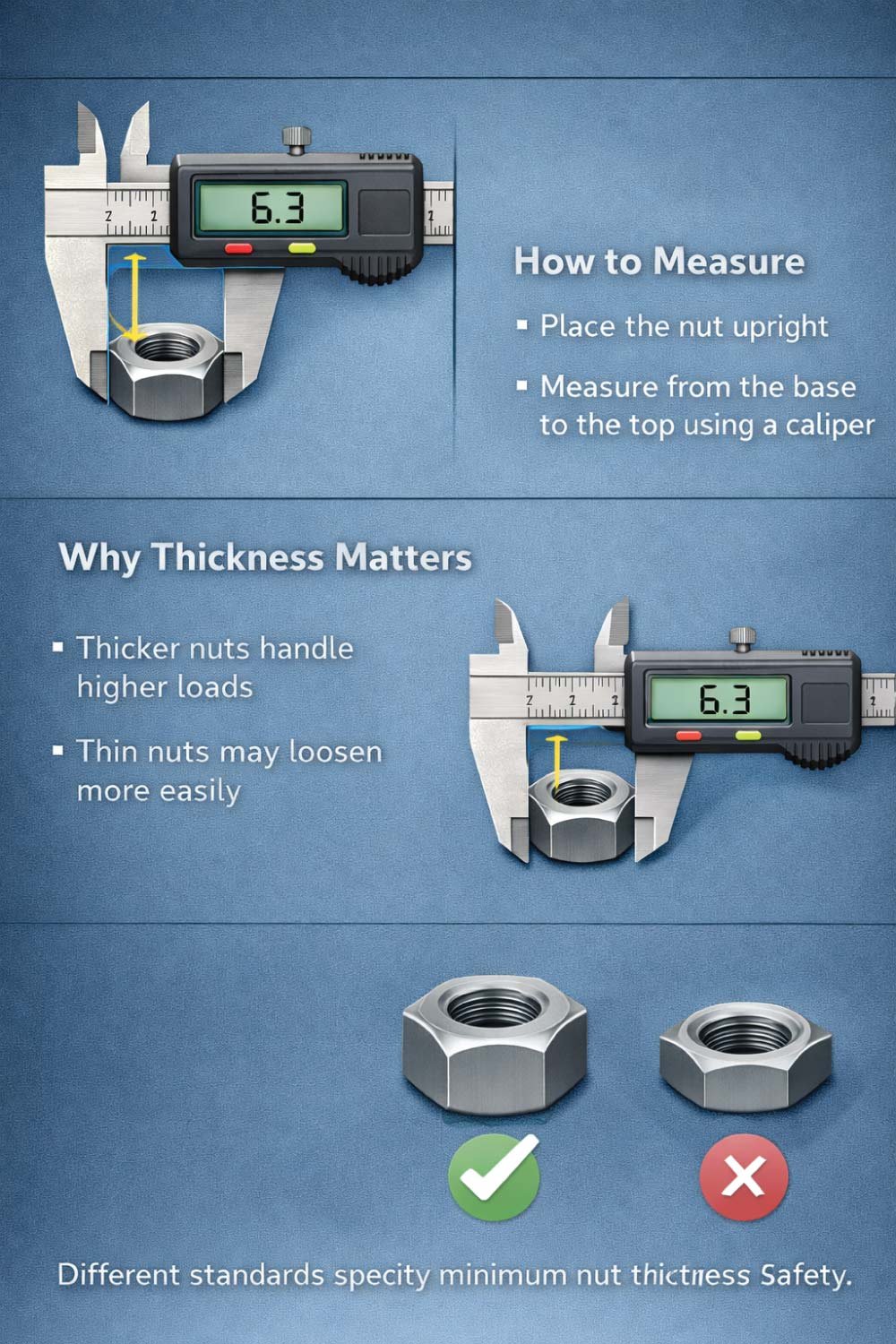
The height of the nuts determines the distance between the top and the bottom and affects the strength and distribution of loads. Nuts with greater thickness can support heavier loads whereas the ones with less thickness can easily loosen. Measuring height is essential in structural, industrial, or high-stress applications to ensure proper performance and safety under load.
How to Measure
- Place the nut upright
- Measure from the base to the top using a caliper
Why Thickness Matters
- Thicker nuts handle higher loads
- Thin nuts may loosen more easily
- Important in structural and industrial use
Different standards specify minimum nut thickness for safety.
Metric Hex Nut Size Chart
Metric hex nuts are based on ISO requirements, but have nominal thread diameters, pitch, flats width across, and thickness. The most popular common sizes are M3, M4, M6 and M12. These charts are compatible with bolts, can be quickly found, and are used to enable engineers and DIYers to choose the right hex nut that will provide good fastening.
| Thread Size | Pitch (mm) | Width Across Flats (mm) | Thickness (mm) |
|---|---|---|---|
| M3 | 0.5 | 5.5 | 2.4 |
| M4 | 0.7 | 7 | 3.2 |
| M5 | 0.8 | 8 | 4 |
| M6 | 1.0 | 10 | 5 |
| M8 | 1.25 | 13 | 6.5 |
| M10 | 1.5 | 17 | 8 |
| M12 | 1.75 | 19 | 10 |
| M16 | 2.0 | 24 | 13 |
This chart is useful for identifying hex nut size quickly.
Imperial Hex Nut Size Chart
Imperial hex nuts are measured in inches and use threads per inch (TPI). Standard sizes include 1/4″-20, 5/16″-18, and 1/2″-13. Correctly matching both diameter and TPI ensures secure assembly. Size charts assist with proper tool selection and prevent installation errors in U.S. or older industrial equipment.
| Thread Size | Threads Per Inch | Wrench Size (in) | Thickness (in) |
|---|---|---|---|
| #10-24 | 24 | 3/8 | 0.19 |
| 1/4″-20 | 20 | 7/16 | 0.22 |
| 5/16″-18 | 18 | 1/2 | 0.28 |
| 3/8″-16 | 16 | 9/16 | 0.34 |
| 1/2″-13 | 13 | 3/4 | 0.44 |
Always match both diameter and TPI for a proper fit.
👉 Hex Nut Sizes guide covers everything about dimensions, grades, and how to measure hex nuts accurately. Discover tips for choosing the right size, ensuring thread compatibility, and achieving secure, reliable connections. Perfect for DIYers, engineers, and professionals, this post makes understanding hex nuts simple. Read the full guide for complete insights!
Metric vs Imperial Hex Nuts: How to Tell the Difference
Metric and imperial hex nuts are different and cannot be used interchangeably. The millimeters and thread pitch are used in metric units whereas the inches and TPI are the imperial units. Their abuse may cut threads or loosen connections. The type of system must always be checked before being installed to ensure proper, secure fastening.
| Feature | Metric | Imperial |
|---|---|---|
| Units | Millimeters | Inches |
| Thread Definition | Pitch (mm) | TPI |
| Common Regions | Europe, Asia | USA |
| Marking | M6, M8, M10 | 1/4″, 3/8″ |
If a nut fits loosely or won’t thread smoothly, it’s likely the wrong system.
Tools Needed to Measure Hex Nut Size
Measuring hex nuts accurately requires basic tools: a vernier or digital caliper, thread pitch gauge, steel ruler, or a known bolt for comparison. Caliper alone can be used to do a majority of measurements, such as diameter, pitch, width across flats, and height, saving time and minimizing errors.
Recommended Tools
- Vernier or digital caliper
- Thread pitch gauge
- Steel ruler
- Known bolt for comparison
A caliper alone can handle most measurements accurately.
Common Hex Nut Types and Size Considerations
Although the hex nuts have the same thread size, their thickness, strength and application can vary. General use Standard hex nuts, heavy hex nuts are thicker and stronger, jam nuts are thinner to lock, and lock nuts have inserts to fit securely. The dimensions are to be measured to be able to select the task appropriately.
Examples
- Standard hex nut – General use
- Heavy hex nut – Thicker, stronger
- Jam nut – Thinner, locking applications
- Lock nut – Includes nylon insert or metal lock
Always measure thickness when strength matters.
Common Mistakes When Measuring Hex Nuts
Typical errors include measuring corner-to-corner, guessing thread size, mixing metric and imperial systems, or ignoring thread pitch. These errors may harm threads, decrease the efficiency of fasteners, and time wastage. Precise measurement is necessary in the maintenance of reliability, safety and efficiency in any mechanical or structural assembly.
- Measuring corner to corner instead of flat to flat
- Guessing thread size by appearance
- Mixing metric and imperial sizes
- Ignoring thread pitch
These mistakes can lead to damaged fasteners and wasted time.
Quick Identification Tips
Quickly identify hex nut size by wrench size: 10 mm likely equals M6, 13 mm equals M8, 7/16″ matches 1/4″. In case of tightness or roughness in the threads, recheck measurements. To prevent improper installation, upon suspicion, measure again to provide easy threading and good connections.
- If the wrench size is 10 mm, it’s likely M6
- If the wrench size is 13 mm, it’s likely M8
- If the wrench size is 7/16″, it’s likely 1/4″
- If threads feel tight or rough, stop and recheck
When in doubt, measure again.
When Size Charts Are Most Helpful
Hex nut size charts are invaluable when replacing missing nuts, working with mixed fasteners, ordering online, or identifying old or unmarked nuts. A reference chart will save time, make sure it fits, and will not give errors in any DIY or industrial work, which can be more efficient and safer.
- Replacing missing nuts
- Working with mixed fasteners
- Ordering hardware online
- Identifying old or unmarked nuts
Keeping a size chart handy saves time and prevents errors.
Final Thoughts
Learn the easy methods to measure the size of a hex nut by using 4 simple methods makes the choice of fasteners to use an easy and un stressful process. With measurements on thread diameter, thread pitch, width across flats and in thickness, you will be able to recognize any hex nut.
Be it a DIYer, a mechanic or an expert installer, using hex nut size charts would guarantee a perfect fit, security and durability. One or two minutes of accurate time will save you a lot of money in error and will see your project finished the first time round.
👉 Heavy Hex Nut Guide explains all about definition, dimensions, sizes, and materials of heavy hex nuts. Learn how to select the right nut for high-strength applications, ensure proper fit, and understand material differences for durability. Ideal for engineers, builders, and DIY enthusiasts. Read the full guide for detailed insights!

Engineer Hassan is a seasoned Mechanical Engineer specializing in hardware, fasteners, tools, and precision mechanical components. With over 16 years of hands-on experience in mechanical design, assembly, and maintenance, he creates detailed size charts, installation guides, and tool selection resources. His content focuses on accuracy, safety, and practical engineering solutions, helping professionals, technicians, students, and DIY enthusiasts make reliable decisions in mechanical projects.