
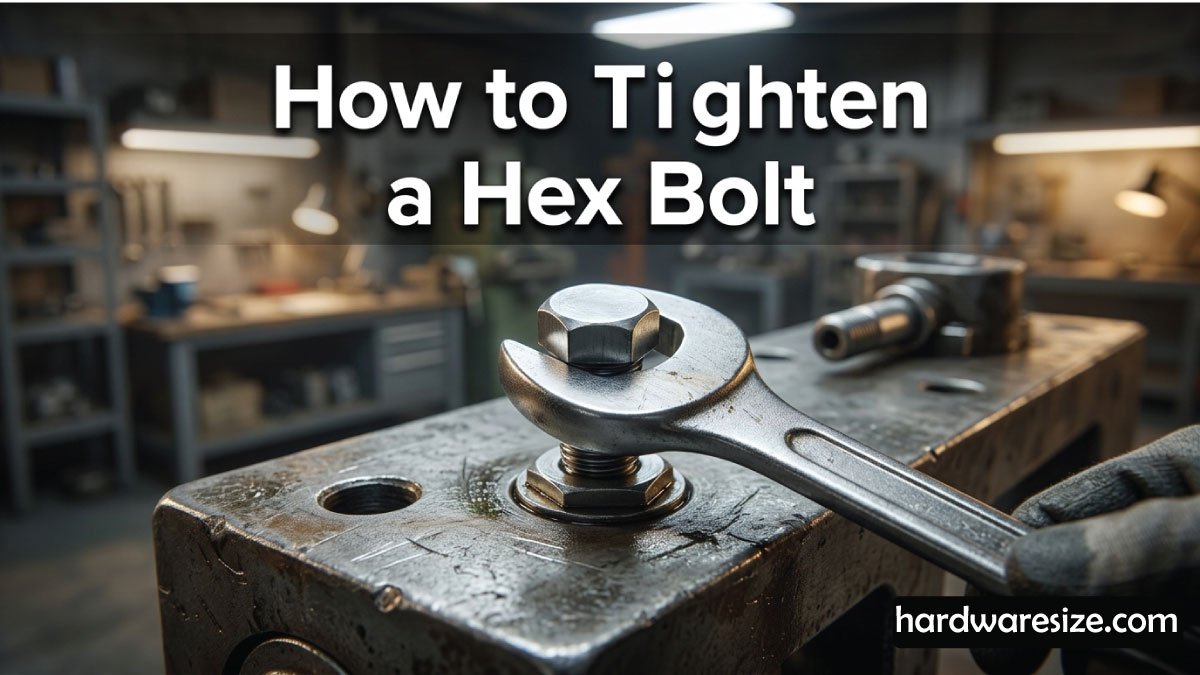
The hex bolts are widely used in building, mechanical assembly, automotive repairs and home projects. Heap machineries and steel just to mention but a few, to domestic furniture and cuisines, hex bolts offer robust and trustworthy contacts. Nevertheless, it is very important to properly tighten a hex bolt. In case a bolt is too loose the joint can break or vibrate open. When it is tightened too much, it may destroy threads, break the bolt, or break.
Knowledge of how to tighten a hex bolt the right way will guarantee safety, durability and good functionality of the components fastened. In this guide, you will learn what a hex bolt is, the tools required, and the correct step-by-step process to tighten hex bolts effectively.
What Is a Hex Bolt?
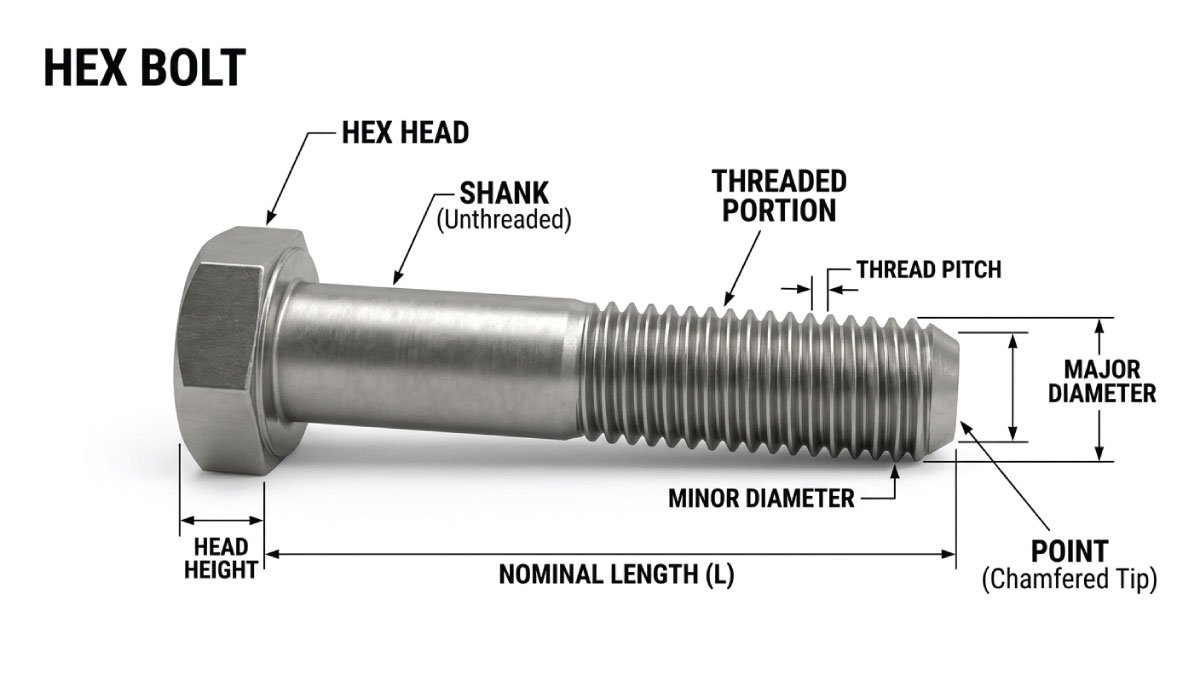
A hex bolt is a threaded fastener with a six-sided (hexagonal) head designed to be tightened use the wrench or socket. The hex form provides tools with an opportunity to securely hold the bolt in several positions, and therefore, install it faster.
Hex bolts are typically used together with nuts or threaded holes and are commonly found in:
- Mechanical equipment
- Steel structures and construction
- Automotive components
- Furniture assembly
- Industrial machines
They are available in various sizes, materials, and thread types to suit different applications.
Tools Required to Tighten a Hex Bolt
It is also necessary to ensure that the right tools are used to tighten a hex bolt beforehand. Secure grip in terms of the head of the bolt can be achieved through the use of appropriate tools that would not cause any damage to the fastener. It is also easier, safer and more efficient in tightening.
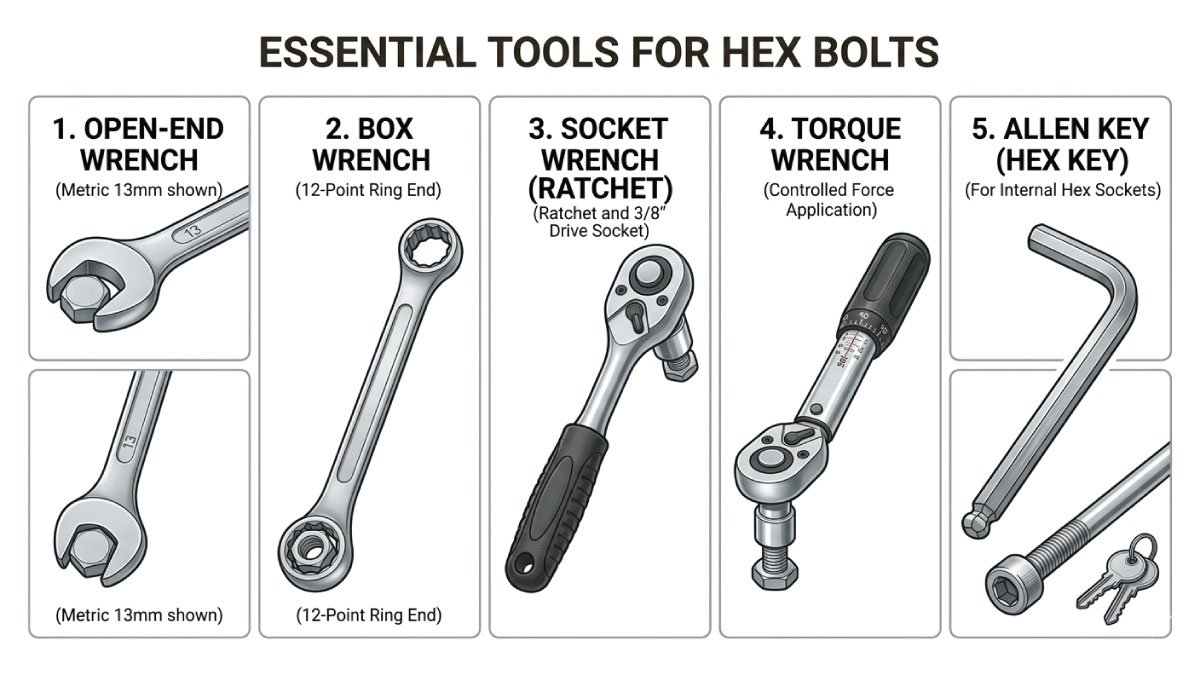
Common Tools Used
1. Open-End Wrench
An open-end wrench is a common tool that is easy in use and is a tool meant to clamp two opposite sides of the head of a hex bolt. It also suits well in small or narrow areas that a socket wrench or box wrench cannot easily fit.
2. Box Wrench
A box wrench has a closed ring which totally encircles the hex bolt head. In the construction or mechanical works where bolts are tightened or loosened, the design offers a firmer and more stable grip to eliminate the possibility of slipping.
3. Socket Wrench (Ratchet)
A socket wrench is usually installed with a ratchet handle, and it enables bolts to be tightened in a fast and efficient manner. The ratcheting mechanism lets you turn the bolt continuously without removing the tool, making it ideal for deep or confined spaces.
4. Torque Wrench
A torque wrench is a fine instrument utilized where bolts have to be clamped to a certain torque amount. It assists with the application of the right amount of force, both to avoid either over tightening or under tightening, particularly in automotive machinery and industrial machinery.
5. Allen Key or Hex Key (for Internal Hex Bolts)
There are bolts with an internal hex socket, rather than an external one. A hex key or Allen key is specifically made to fit into this socket and which can be tightened or loosened into the slot of the bolts in furniture, bicycles, and mechanical assemblies in a safe manner.
The appropriate tool to use when tightening a hex bolt is more efficient, provides the appropriate fastening and helps to avoid unnecessary damage both to the bolt and the components around it.
Step-by-Step Guide to Tighten a Hex Bolt
After the correct tightening, it assists in ensuring that there is a good and secure bond between parts. The steps are significant to make sure that the bolt secures parts without damaging threads, surfaces, and other materials.
Step 1: Check the Bolt and Threads
Check Before instalment of hex bolt, the bolt and threads must be in good condition. Broken or stained threads may not allow the connection to be fastened and may weaken it. A quick check-up prevents mechanical difficulties in future.
Make sure that:
-
The threads are clean and undamaged
-
The bolt is the correct size for the hole
-
The nut or threaded hole matches the bolt thread
Dirt, rust, or damaged threads can prevent proper tightening and weaken the connection. If necessary, clean the threads using a wire brush.
Step 2: Align the Parts to Be Fastened
Before fixing the bolt, align the parts by putting in place their holes. Correct alignment of the parts simplifies the process of installation and avoids an unwarranted strain of the bolt in the tightening process. Uneven pressure could result due to misalignment and weaken the joint or even destroy the fastener.
Proper alignment ensures:
-
Smooth bolt insertion
-
Even load distribution
-
Easier tightening
Misaligned parts can place stress on the bolt and reduce joint strength.
Step 3: Insert the Hex Bolt
When the parts have been placed in their respective positions, use the hex bolt to fit into the holes to hold the components together. Ensure that the bolt does not go in with any pushing. The correct insertion of the bolt is important so that it may lie flat, and the threads should fit properly.
In event of a nut being necessary, screw the nut on the opposite side of the bolt. Washers are also placed in between the bolt head and surface in most assemblies to spread the load.
Washers help:
-
Protect the surface
-
Prevent loosening
-
Improve load distribution
Step 4: Hand-Tighten the Bolt First
When tightening the hex bolt, it is always best to first do it by hand before tightening it with any tool. This action is meant to make sure that the threads fit properly and avoid cross threading which may spoil the bolt as well as the nut. It is also necessary to tighten the hand and ensure that the bolt fits.
Turn the bolt clockwise until it becomes snug.
Step 5: Use the Appropriate Wrench or Socket
Once the hand tightening of the bolt is completed, it can be tightened further using the relevant wrench or socket. Ensure that the tool fits the hex head well in order not to slip and round the bolt head. Turn the tool under constant pressure.
Municipal firmly on the hex head and clockwise turn the tool. Turn under constant pressure.
Use no more force than is necessary as it may strip the threads or break the bolt.
Step 6: Tighten to the Recommended Torque
In most mechanical and structural work sections, hex bolts are required to be tightened to a required torque. This guarantees the right kind of clamping force. A torque wrench is used to exert an accurate amount of force when performing a secure and reliable fastening.
Using a torque wrench ensures the bolt is tightened correctly.
Proper torque helps achieve:
-
Correct clamping force
-
Strong joint stability
-
Reduced risk of bolt failure
Always check manufacturer specifications or engineering standards for the recommended torque values.
Step 7: Double-Check the Tightness
Check the collage by any means to ascertain that everything is plumped. This process is used to make sure that the bolt is firmly in place and that the joint is stable when in use or when it is in operation.
Look for:
-
Proper seating of the bolt head
-
No visible gaps between parts
-
Firm attachment without movement
Locking washers or thread-locking compounds can also be used in vibration prone environment to ensure the loosen of bolts with time.
Read More:
👉 Learn how to measure bolt size accurately with our complete step-by-step guide. From tools to tips, this post ensures precise measurements for any project. Read the full post to master bolt sizing like a professional!
Common Mistakes to Avoid When Tightening Hex Bolts
Even skilled employees may error with the tightening of hex bolts, particularly when it comes to the speedy repair or installation. These are the most common mistakes that can be avoided to ensure healthy joints, prevent the damage of the fasteners, and guarantee the long-term reliability and safety of mechanical or structural bonds.
1- Overtightening
Overtightening this happens when there is too much force used in the tightening of a bolt. This may overstretch the bolt or destroy the threads. The bolt can be broken or weaken the parts it is connecting in case of severe cases, which will weaken the entire assembly.
2- Under tightening
Under tightening occurs when the bolt is not tightly screwed thus forming the appropriate clamping force. The loose bolts might loosen further over the time due to vibrations or movement which may cause unstable joints, structural compression, or failure of functioning equipment when the work is being performed.
3- Using the Wrong Tool
The hex bolt head can be damaged using the incorrect tool, these include pliers or an adjustable wrench that is not fitting. This could just end up rounding the edges of the bolt such that it would be hard to tighten it or later loosen it during maintenance or repairs.
4- Cross-Threading
Cross-threading takes place when the thread of the bolts does not fit in the nut or the threaded hole. This cuts off the threads and blunts the fastening bond. The solution to this issue is to always begin threading the bolt manually then with tools.
5- Ignoring Torque Specifications
Numerous mechanical systems have bolts that are tightened to a particular torque. Disregarding these specifications may result in either over tightening or under tightening. The right clamping force is guaranteed with the help of a torque wrench, and mechanical failures or instability in the joint are prevented.
Where Hex Bolts Are Commonly Used
Hex bolts are widely used fasteners in industries and everyday life that are versatile and very tough. They are also highly designed and can be installed easily hence can be used in attaching heavy components, structural parts and mechanical assemblies in construction, automotive and household work.
1- Construction
Hex bolts are also common in the construction industry that would be used to hold steel beams, structural frames, and heavy building components. They are also required in engineering projects of bridges, buildings, towers and other structural works because of their great ability to take heavy loads due to their high strength.
2- Automotive
Hex bolts are typical in the automotive production and repair. They lock the engine components, the suspension systems, chassis and other important assemblies. They are reliable and hence its components will not be affected in terms of being firmly attached to the vehicle even during vibration, heat, and heavy mechanical load.
3- Machinery
Industrial machines and manufacturing tools are made with the help of hex Bolts to assemble and mount mechanical parts. Such bolts are used to fix the motors, brackets, gears, and machine frames making their functioning stable and not allowing the parts to loosen under the constant industrial work.
4- Furniture
The hex bolts are used to assemble many pieces of furniture, most of them are metal frames and heavy wooden structures. They are very strong and durable enough in providing connection to beds, tables, shelves and cabinets and also they can be assembled, disassembled or readjusted when the need arises.
5- Household Repairs
The hex bolts are also adopted in homes and DIY. They are usually applied in putting up shelves, repairing gates, assembling equipment or repairing outdoor structures. They are easy to tighten with the usual tools, since they are designed simply.
How to Loosen a Tight Hex Bolt
Sometimes the bolts can be so tight because of corrosion, rust or accumulation of dirt or as a result of over tightening. The conditions heighten the friction between the threads and as a result, the bolt may prove difficult to loosen and may need special tools, lubrication, or method to loosen safely.
Helpful methods include:
- Applying penetrating oil to loosen rust
- Using a longer wrench for additional leverage
- Gently tapping the bolt to break corrosion
- Heating the bolt slightly to expand the metal
Always use caution when applying force to avoid damaging the bolt or surrounding components.
Read More:
👉 Want to measure a hex nut size accurately? Discover 4 easy methods with clear size charts to ensure perfect fit for your projects. Read the full post to master hex nut measurements quickly and confidently!
Safety Tips When Tightening Hex Bolts
There is a need to work on fasteners and hand tools which necessitate simple safety measures. Safety practices work to avoid injuries, secure tools and components, as well as allow the tightening process of the bolts to be carried out safely and efficiently in mechanical or DIY work.
1- Wear Protective Gloves
Wearing a glove can help prevent your hands being cut or scratched on sharp edges or rough surfaces, and being accidently hit by a tool. Gloves are also better gripping tools in the manipulation of bolts and tools, and limit the possibilities of slight cuts, abrasions, and injuries during the process of the installation.
2- Use Proper Tools
It should always be the right wrench, socket or torque tool that fits the bolt. The right tools give a safe hold to the hex head and minimize the possibilities of falling, breaking the fastener, or hurting oneself during the tightening process.
3- Maintain Stable Positioning
When tightening a hex bolt, make sure that the components that are being attached are not unstable and that they have something to hold. When components are positioned in a stable manner, any sudden movement might be avoided and hence tightening may be challenging and may cause accidents or failure to fasten the components correctly.
4- Avoid Excessive Force
When tightening the bolts too much, one may break the threads or strip the bolt. It may also result in slipping of the tool. Always use a constant and moderate pressure, and a torque wrench when a tightening is needed.
Final Thoughts
Screwing a hex bolt can be easy but it is important to do it properly in order to have good strong relationships. As you assemble the furniture, assemble machines or engage in construction projects, it is always advisable to ensure that the process of tightening is well followed to allow durability and safety.
By selecting the correct tools, aligning parts properly, starting threads by hand, and tightening to the recommended torque, you can prevent common fastener problems and extend the life of your equipment and structures.
The use of hex bolts has continued to be one of the most reliable forms of fastening in most industries. Knowing how to tighten them appropriately will assist you to attain secure and expert outcomes of any undertaking.

Engineer Hassan is a Mechanical Engineer with over 16 years of hands-on experience in mechanical hardware, fasteners, bolts, screws, nuts, washers, and related mechanical components. He has extensive expertise in selecting, measuring, and installing hardware, ensuring accuracy, safety, and reliability in every project.
Through Hardware Size, he provides detailed size charts, installation guides, and technical tutorials, helping engineers, technicians, students, and DIY enthusiasts solve practical hardware problems with confidence.