
Jam nuts might appear to be the easiest of it all yet the selection of the incorrect size will result in loose assemblies to vibration or broken threads.
Be it working on a machine, automotive parts, construction hardware, or DIY projects, jam nuts sizes are the most important as far as safety and performance are concerned.
In this guide, you will learn what a jam nut is, how it differs from standard nuts, how to read a jam nut size chart, and how to confidently select the right size for your application. We will also cover materials, thickness, thread standards, and common mistakes to avoid.
What Is a Jam Nut?
Jam nut: This is a skinny nut which is shaped to hold another nut. Normally, it is clamped to a standard hex nut, or to an immobile surface to avoid vibration or motion induced loosening. Jam nuts unlike standard hex nuts are approximately half of the height and therefore would be best used where space is minimal or a secondary locking measure is desired.
Common uses of jam nuts:
- Locking adjustment nuts on threaded rods
- Automotive suspension and steering systems
- Industrial machinery
- Electrical and mechanical assemblies
- Space-restricted fastening applications
Jam Nut vs Standard Hex Nut
The distinction between assembly of jam nut and standard hex nut is critical to assembling safely and reliably. Jam nuts are thinner and are only used to hold another nut in place whereas standard hex nuts can cope with full load bearing capability. Selecting the right type means proper fixing and elimination of mechanical defects.
| Feature | Jam Nut | Standard Hex Nut |
|---|---|---|
| Thickness | Thin (about 50% of standard nut) | Full height |
| Primary Purpose | Locking and securing | Load-bearing |
| Strength | Lower load capacity | Higher load capacity |
| Typical Use | Used with another nut | Used alone |
| Space Requirement | Minimal | More clearance needed |
Jam nuts should not be used alone in high-load applications unless specifically designed for that purpose.
How Jam Nut Locking Works
Jam nuts lock- This is done through friction between two nuts pressed together. The main nut is then fastened then the jam nut is fastened round it in such a way that opposing forces are created making it difficult to loosen.
The technique works well especially where thread size and pitch are two closely matched properties and it is therefore useful in applications that are prone to vibration.
- The main nut is tightened first
- The jam nut is tightened against it
- Opposing forces increase friction
- Rotation becomes difficult, preventing loosening
This method is highly reliable when the correct size and thread match are used.
How to Measure Jam Nut Size
Accurate determination of a jam nut can be used to make sure the nut fits with a bolt or threaded rod. Pay attention to three dimensions: thread diameter, thread pitch and nut thickness.
Vernier caliper, thread pitch gauge or micrometer, will give you accurate measurements, which will save you the error of installing fasteners that do not fit and result in maximum operation and safety of your work.
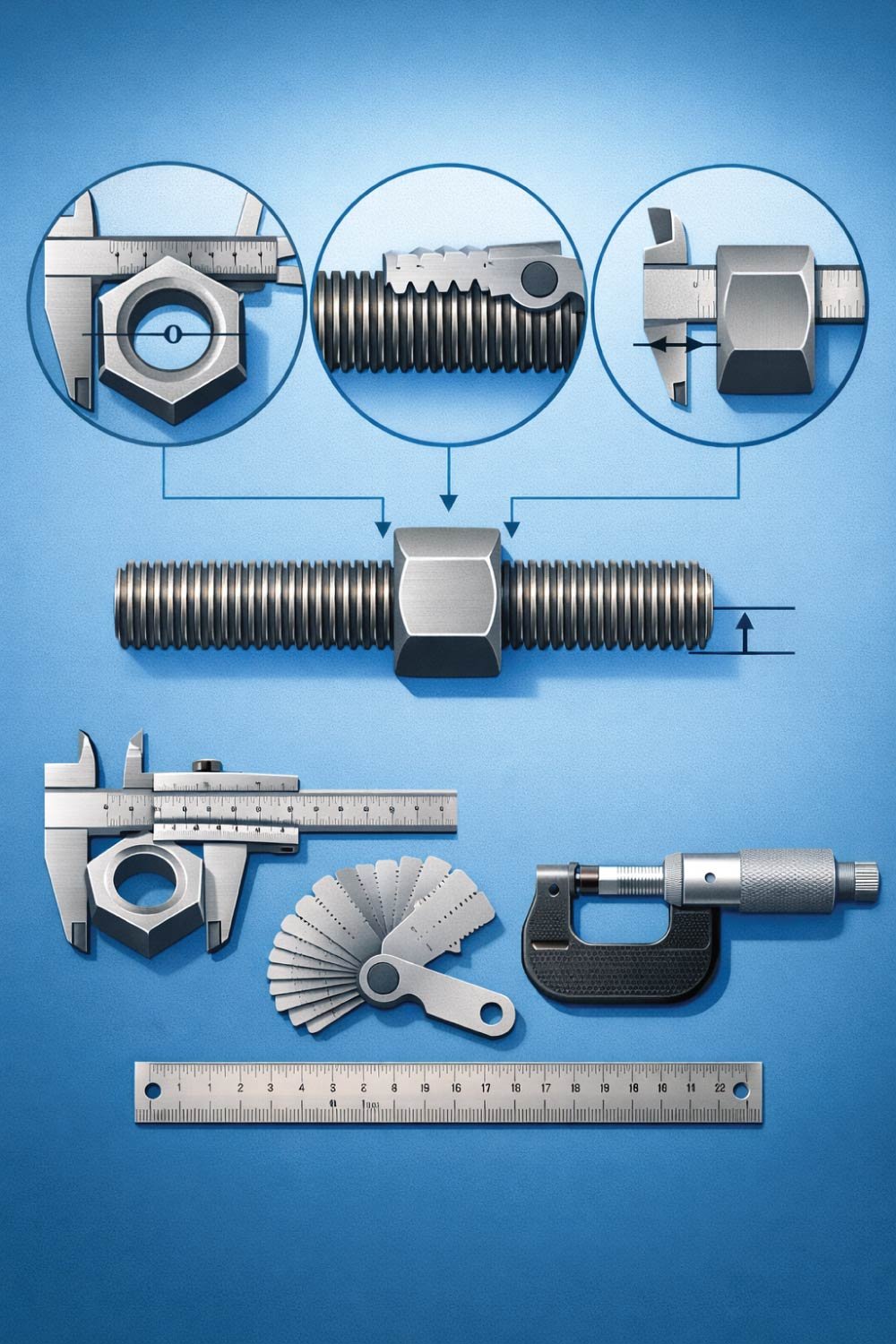
- Thread diameter
- Thread pitch
- Nut thickness
Measurement tools you will need:
- Vernier caliper
- Thread pitch gauge
- Ruler or micrometer
Jam Nut Size Chart (Metric)
Metric jam nuts follow ISO standards and are measured in millimeters, covering a variety of thread sizes and thicknesses. It is important to match the pitch of the thread to the one of the bolt in order to prevent thread stripping.
Proper selection ensures secure fastening in both industrial machinery and construction applications, offering reliable tension and locking performance.
| Thread Size (mm) | Pitch (mm) | Across Flats (mm) | Thickness (mm) |
|---|---|---|---|
| M6 | 1.0 | 10 | 3 |
| M8 | 1.25 | 13 | 4 |
| M10 | 1.5 | 17 | 5 |
| M12 | 1.75 | 19 | 6 |
| M16 | 2.0 | 24 | 8 |
| M20 | 2.5 | 30 | 10 |
Tip: Always match the jam nut thread pitch exactly with the bolt or threaded rod.
Jam Nut Size Chart (Imperial / Inch)
Imperial jam nuts are sized in inches and Threads Per Inch (TPI). These are the nuts that are commonly used in automotive, mechanical, and legacy systems.
The right size guarantees proper engagement of the thread, elimination of loosening due to vibration and integrity of the system.
Check across-flats dimensions and thickness always to ensure that they are installed correctly.
| Thread Size (in) | TPI | Across Flats (in) | Thickness (in) |
|---|---|---|---|
| 1/4″ | 20 | 7/16 | 1/8 |
| 5/16″ | 18 | 1/2 | 5/32 |
| 3/8″ | 16 | 9/16 | 3/16 |
| 1/2″ | 13 | 3/4 | 1/4 |
| 5/8″ | 11 | 15/16 | 5/16 |
| 3/4″ | 10 | 1-1/8 | 3/8 |
Imperial jam nuts are common in automotive and legacy mechanical systems.
👉 Nut Size Chart is your complete guide to understanding different nut types, materials, and applications. Learn how to choose the right nut for your project, ensure proper fit, and avoid common mistakes. This post dives deep into sizes, grades, and uses, making it easy for DIYers and professionals alike. Read the full guide for expert insights!
Jam Nut Thickness Comparison
Jam nut thickness, this is important as it dictates strength and holding power. Jam nuts are made with a thinner profile than a traditional hex nut and therefore the locking is done by friction rather than load bearing.
Knowledge of relative differences in thickness of jam, regular and heavy hex nuts assists an engineer to choose the suitable fastener based on strength, load, and space limitations.
| Nut Type | Relative Thickness | Holding Strength |
|---|---|---|
| Jam Nut | Thin | Medium |
| Regular Hex Nut | Standard | High |
| Heavy Hex Nut | Extra thick | Very High |
Jam nuts rely on friction locking, not load bearing.
Common Jam Nut Materials
Jam nuts are available in different materials to choose the strength, corrosion resistance, and suitability to application.
Carbon steel is very strong indoors, stainless steel is very resistant to corrosion when outside, brass is good when used in electrical fittings and alloy steel is very strong when it deals with high-stress systems.
The right choice of material guarantees the performance in terms of durability, safety, and performance.
| Material | Strength | Corrosion Resistance | Common Uses |
|---|---|---|---|
| Carbon Steel | High | Low | Indoor machinery |
| Stainless Steel | Medium | Excellent | Outdoor & marine |
| Brass | Low | Excellent | Electrical fittings |
| Alloy Steel | Very High | Medium | High-stress systems |
| Zinc-Plated Steel | Medium | Moderate | General purpose |
Choose material based on environment and load, not just cost.
How to Choose the Right Jam Nut Size:
To fasten properly, and safely, the jam nut size must be selected. The correct choice eliminates stripped threads, loosening and mechanical failures.
Take into account thread size, pitch, load, available space and material. When the measurement and choice are taken carefully, then your jam nut will work in any application.
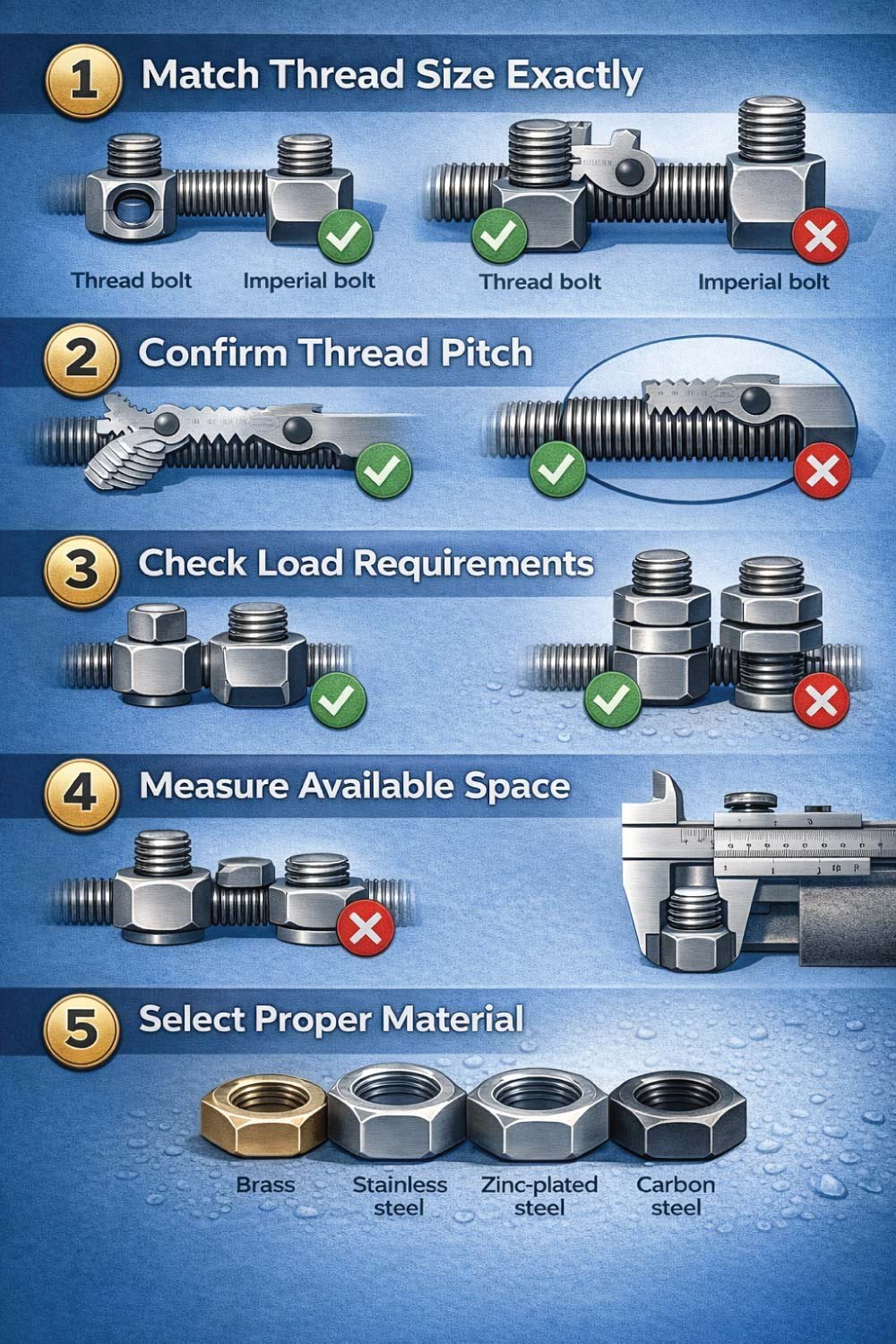
1. Match Thread Size Exactly
It is important to always ensure that the thread size of the jam nut is at the same level as the bolt or threaded rod.
The combination of metric and imperial threads, although they may seem the same, can destroy fasteners.
Proper sizing means the easy installation, good engagement, and quality friction locking to avoid the possible mechanical problems in assemblies.
2. Confirm Thread Pitch
Thread pitch defines the way the threads are interacting and latching. Nuts of the same diameter may possess different pitches leading to the loosening or the cross-threading. Check pitch with a thread pitch gauge or caliper, making sure there is a close fit, and maximum locking efficiency can be obtained in any assembly.
3. Check Load Requirements
Jam nuts are not to carry heavy loads, they are to be locked. Main load stresses should always be dealt with by a standard hex nut. Know the load needs of your application will help you to avoid structural failure as well as making the jam nut act as a safe secondary fastener without affecting safety.
4. Measure Available Space
Jam nuts find application where big nuts can not fit in because of the limited space. Clearance before being chosen should be taken to make sure it is installed properly.
The appropriate thickness also enables the jam nut to clamp in place without causing disturbance to other parts of small machines.
5. Select Proper Material
Strength, resistance against corrosion and longevity depend on material choice. Outdoor or marine Stainless steel or brass will work best in the outdoor or marine conditions, whereas indoor machinery should be made of carbon or alloy steel.
The choice of the correct material guarantees the durability, best functioning and avoidance of the wear, stress, environmental damages in the long run.
Discover More:
👉 Hex Nut Sizes guide explains everything about dimensions, grades, and how to measure hex nuts accurately. Discover tips for selecting the right size, understanding thread compatibility, and ensuring secure connections. Perfect for DIY projects and professional applications, this post makes measuring and choosing hex nuts simple. Read the full guide for complete insights!
Correct Installation Method
Jam nut should be fitted in proper position to have maximum locking efficiency and to avoid loosening. First loosen the main nut to its preferred location and keep it still and then loosen the jam nut against the main nut.
Even application of torque generates counter-acting forces which fix both nuts solidly during vibration or movement.
Best practice:
- Tighten the main nut to the desired position
- Hold the main nut stationary
- Tighten the jam nut against it
- Apply torque evenly
This creates opposing forces that lock both nuts securely.
Common Mistakes to Avoid
Preventing errors during the installation is a life-prolonging factor of the fastener and safety. Several of the most common pitfalls are jam nuts, jam nuts alone with heavy loads, mixture of metric and imperial threads.
Excessively tightening skinny nuts, overlooking material requirements on the environment or disregarding manufacturer torque requirements.
These are known as awareness and prevent failures and enhance performance among mechanical assemblies.
- Using a jam nut alone for heavy loads
- Mixing thread standards
- Over-tightening thin jam nuts
- Using incorrect material for the environment
- Ignoring manufacturer torque specs
Avoiding these mistakes improves safety and hardware lifespan.
When to Use a Jam Nut Instead of Lock Nuts
Jam nuts are good where the room is limited, where a change is required later or where the use is in a heat or vibrated environment. They operate in areas inaccessible by washers. Lock washers or nylon lock nuts could be better used on permanent installations. Effective choice guarantees flexible, safe and dependable fastening.
Jam nuts are best when:
- Space is limited
- Adjustments are needed later
- Heat or vibration is present
- Washers cannot be used
Lock washers or nylon lock nuts may be better for permanent installations.
Jam Nuts in Industrial Applications
Jam nuts find extensive application in the CNC equipment, in automotive suspension tuning, hydraulic systems, threaded shaft adjustments and electrical enclosures.
Their basic structure enables their secure fixing during vibrating or small space conditions. Jam nuts can be a viable option in a number of industrial uses due to proper sizing, selection of material and installation.
- CNC machinery
- Automotive suspension tuning
- Threaded shaft adjustments
- Hydraulic systems
- Electrical enclosures
Their simplicity makes them reliable when chosen correctly.
Final Thoughts
Choosing the right jam nut size is not just about diameter — it’s about thread pitch, thickness, material, and application. A well-matched jam nut improves safety, prevents loosening, and ensures long-term reliability.
By using the jam nut size charts above and following proper installation practices, you can confidently select the right jam nut for any mechanical or DIY project.
When you are attach something on a wall, or other objects, in order to have proper fastening, reduced failures, and a professional finish, you should always measure carefully and select good hardware.
Discover More:
👉 Nylon Insert Lock Nut guide covers all sizes, dimensions, and uses you need to know. Learn how these nuts prevent loosening, ensure secure connections, and choose the right type for your project. Perfect for DIYers and professionals alike, this post simplifies everything about lock nuts. Read the full guide for detailed insights!

Engineer Hassan is a seasoned Mechanical Engineer specializing in hardware, fasteners, tools, and precision mechanical components. With over 16 years of hands-on experience in mechanical design, assembly, and maintenance, he creates detailed size charts, installation guides, and tool selection resources. His content focuses on accuracy, safety, and practical engineering solutions, helping professionals, technicians, students, and DIY enthusiasts make reliable decisions in mechanical projects.