
When doing mechanical, construction, automotive, or DIY, it is equally important to have the right nut size as it is to have the right bolt. A nut that is not fitting may lead to loose joints, and some stripped threads, or even a complete mechanical breakdown.
This is why it is necessary to study the nut sizes, standards, material and applications both by the professionals and amateurs.
This step-by-step tutorial will take you through nut size charts, the various types of nuts, measurement standards, materials and actual real-life examples. You also get to know how to measure nut size properly and how to measure a nut to socket size, so you are sure of the correct tool each time.
What Is a Nut and Why Size Matters
A nut is a threaded nut screw that is meant to be used along with a bolt, screw, or a threaded rod to hold two or more parts together. It engages with the internal threads of a bolt to provide clenching with the external threads, which has even pressure. When this connection is tightened correctly, it forms a very strong, stable and a load bearing joint which can be used in most mechanical and structural applications.
Nut size matters because:
- Incorrect sizing can strip threads
- Loose nuts cause vibration and failure
- Oversized tools damage edges
- Wrong standards (metric vs SAE) cause poor fit
Understanding nut sizes saves time, money, and frustration.
Nut Size Chart Explained
A nut size chart is used to determine the correct nut by indicating important measurements like thread diameter, thread pitch and width across flats (WAF). Such charts play a crucial role in making sure that there is a good fit, choice of tools, and that they are safely fastened.
The majority of nut size charts are split into Metric (ISO) and SAE (Imperial) ensuring that one is able to match nuts with nuts that fit into other bolts and tools.
Metric Nut Size Chart (ISO)
Metric nuts are measured in millimeters and identified by thread diameter and pitch, which represents the distance between threads, making them easier to standardize and widely used worldwide.
| Thread Size | Pitch (mm) | Wrench Size (mm) |
|---|---|---|
| M4 | 0.7 | 7 mm |
| M5 | 0.8 | 8 mm |
| M6 | 1.0 | 10 mm |
| M8 | 1.25 | 13 mm |
| M10 | 1.5 | 17 mm |
| M12 | 1.75 | 19 mm |
| M16 | 2.0 | 24 mm |
SAE (Imperial) Nut Size Chart
SAE nuts are measured in inches and identified by threads per inch (TPI), a system commonly used in the United States for automotive, industrial, and mechanical applications.
| Thread Size | Threads per Inch | Wrench Size (inches) |
|---|---|---|
| 1/4″ | 20 | 7/16″ |
| 5/16″ | 18 | 1/2″ |
| 3/8″ | 16 | 9/16″ |
| 1/2″ | 13 | 3/4″ |
| 5/8″ | 11 | 15/16″ |
| 3/4″ | 10 | 1-1/8″ |
Types of Nuts and Their Applications
The various kind of nuts are to fulfill a particular fastening requirement with regard to its strength, vibration, appearance and convenience. The proper choice of nut enhances the safety, durability and performance of mechanical, construction, and DIY projects of any size.
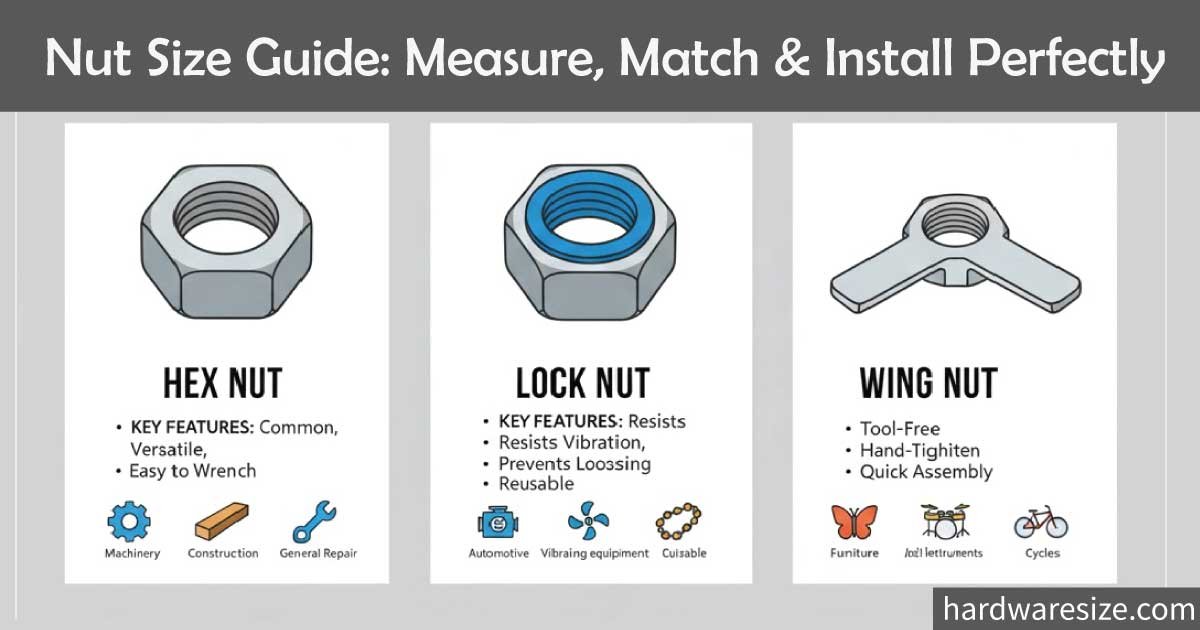
1. Hex Nuts
The most used fasteners are the hex nuts, which are six sided and therefore offer a good grip to the wrenches and sockets. They are simple to install and uninstall, provide good clamping capability and can be used with numerous types of bolts, so they can be used in light and heavy duty applications.
Applications: Used in structural joints, machinery frames, automotive engines, construction hardware, and general-purpose mechanical assemblies requiring reliable strength.
2- Lock Nuts
Lock nuts are constructed so that the loosening that may occur due to vibration, movement, and stress repetition are prevented. They do this by use of nylon inserts, distorted threads or inclusion of friction. Lock nuts do not loose their tension with time, they eliminate the possibility of failure on critical connections where safety and long time stability are needed.
Applications: Commonly used in automotive suspension systems, heavy machinery, industrial equipment, and assemblies exposed to vibration or constant motion.
3. Wing Nuts
Wing nuts are constructed with two long wings which can be tightened and loosened using the hands without any tool. They are effective in a situation where adjustment or removal has to be frequent. Although wing nuts are never intended to be heavy loading, they are convenient, fast and simple to use in less heavy loading applications.
Applications : Used in temporary assemblies, furniture setups, display fixtures, DIY projects, and light-duty installations needing quick adjustments.
4. Cap Nuts (Acorn Nuts)
Cap nuts, also called acorn nuts, have a rounded, closed-end design that covers exposed bolt threads. This improves safety by eliminating sharp edges and enhances appearance in visible installations. Cap nuts are also used to guard threads against dirt, moisture and corrosion which increases the life of the fastener.
Applications: Used in decorative hardware, safety-focused installations, furniture fittings, outdoor fixtures, and applications where exposed threads must be covered.
5. Flange Nuts
Flange nuts contain an inbuilt washer at their bottom which spreads the pressure more evenly across a larger surface area. This design minimizes the damage to the material and enhances load distribution. These nuts are also useful in assemblies that are subjected to vibration or rough surfaces because the flange also offers an additional strength against loosening.
Applications: Widely used in automotive assemblies, sheet metal work, mechanical joints, and applications requiring even load distribution.
6. Square Nuts
Square nuts are flat-sided four-sided items that offer a higher amount of surface contact or resistance to rotation than the hex nuts. The shape makes them better in holding wood and rough materials. Square nuts are often preferred in traditional, restoration, and woodworking projects where stability during tightening is important.
Applications: Commonly used in woodworking, furniture restoration, vintage machinery, and projects requiring improved grip on uneven surfaces.
Nut Standards and Specifications
Nut standards and specifications guarantee that fasteners are installed in the right place, operate safely and are strong enough. These are standards that establish thread sizes, tolerances, materials and load rating. Adherence to standards would aid in avoiding thread damage, incorrect fitting, and mechanical failure, particularly when it comes to professional, industrial and safety-critical applications.
Common Nut Standards
ISO (Metric): ISO standards define metric nut sizes, thread pitch, and tolerances, ensuring global compatibility, consistent quality, and reliable fastening across international mechanical and industrial applications.
DIN: DIN standards are German industrial specifications known for precision and consistency, widely used in Europe and globally for high-quality engineering and mechanical fasteners.
ASTM: ASTM standards focus on material composition, mechanical strength, and testing requirements, ensuring nuts meet strict performance, safety, and durability standards in demanding environments.
SAE: SAE standards govern imperial fasteners, specifying dimensions, thread forms, and strength grades commonly used in automotive, industrial, and mechanical applications in the United States.
Always match the nut standard with the bolt standard to avoid thread mismatch.
Nut Materials and Their Uses
The content of a nut strives a significant part in defining its strength, durability, resistance to corrosion, and performance in general. The selection of an appropriate nut material guarantees safe fastening, increased service life, and performance in a particular environment like cold, wet, vibration or high loads.
1. Steel Nuts
Steel nuts are tough and can be used in fastening applications that are general. They are commonly zinc-coated or plated in order to enhance resistance to corrosion and prolong life. Steel nuts are a very dependable and long-lasting clamping option and are applicable in the daily mechanical, construction and automotive fastening applications.
2. Stainless Steel Nuts
Stainless steel nuts are very resistant in relation to rust, corrosion and chemical exposures. They are strong and look good even in adverse surroundings. Such nuts are perfect where hygiene and moisture resistance is critical as well as longevity durability in outdoor, marine and food-related applications.
3. Brass Nuts
The brass nuts are non-corrosive, non-magnetic and non-sparking hence they have specialized applications. They are softer than steel and this lessens the thread damage in sensitive assemblies. Their finish is also considered attractive and therefore brass nuts have been used in a visible or decorative installation.
4. Nylon and Plastic Nuts
Nylon and plastic nuts are light, electrically insulating, and have resistance to moisture and chemical. They are best suited in those applications whose metal fasteners may lead to conductivity and unneeded weight. Such nuts fit well in the low load, non-structural and delicate electronic or home assemblies.
5. Alloy Steel Nuts
Alloy steel nuts are heat-treated so as to give them an outstanding strength, hardness, and wear resistance. They are constructed to be able to carry high loads, pressure and stress without deformation. These nuts are typically applied in harsh and mechanical working conditions where the safety, life cycles and performance are of paramount importance.
How to Measure a Nut for Socket Size
To avoid rounding, slipping, or damaging of the nut, the appropriate socket size should be selected. Proper torque, safe fastening and effective work is warranted by accurate measurement. This applies to mechanical, automotive, construction and DIY projects.
Follow These Steps
To select the right socket, start by measuring the nut’s width across flats (WAF). Confirm whether the nut is metric or SAE and match it to the corresponding socket. Always test the fit before applying force, and use a caliper or socket gauge for precise measurement.
1. Measure the Width Across Flats
The most important measure to make a socket choice is the width across flats (WAF). The distance between two opposite flat sides of the nut is known as its distance. This is important in the correct measurement of the socket to make sure that it is tight and will not be rounded off or slipping during tightening or loosening.
2. Match Metric or SAE
It is always important to make sure that the socket type is in accordance with the nut standard. Metric nuts demand metric sockets, and SAE nuts demand SAE sockets. Although the dimensions may look like, cross matching of standards may result in inappropriate fit, smooth threads, and the tools can be damaged, hence proper matching is vital in safe and efficient fastening.
3. Test Fit Before Applying Force
Slide the socket over the nut to test the fit before applying the torque. It must not be loose and wobbly or rocking. Testing will be done to guarantee that the force is applied evenly to avoid rounding off, stripped threads or injury. Indeed, never leave sockets loose, always adjust or replace them.
4. Use a Caliper or Socket Gauge
If a high accuracy of measurement is required, particularly when doing a professional or high-stress task, a caliper or socket gauge should be used. These are instruments used to measure the flats width, and this is done to make sure that the right socket is chosen. Measuring something precisely eliminates injury, enhances efficiency and ensures a safe and dependable bond in construction or engineering work.
Common Mistakes When Selecting Nut Sizes
The improper choice of the nut size may cause the stripped threads or loose connections, or even mechanical failure. Best practices to fit, be safe, and last in mechanical, automotive, construction, and DIY projects are avoiding common mistakes.
Knowledge of such pitfalls will lead to the establishment of credible fastening and avoid expensive repair or destruction of parts.
Mixing Metric Nuts with SAE Bolts: Combining metric nuts with SAE bolts causes thread mismatch, loose connections, and potential damage to both the nut and bolt.
Using Adjustable Wrenches Instead of Proper Sockets: Relying on adjustable wrenches can round off nut edges; using the correct socket ensures proper grip and torque application.
Ignoring Thread Pitch Differences: Not checking thread pitch may result in mismatched threads, stripped fasteners, and insecure connections, compromising strength and safety.
Over-Tightening Smaller Nuts: Excessive force on small nuts can strip threads, deform components, or damage the bolt, reducing the joint’s reliability.
Using Soft Material Nuts in High-Load Applications: Soft material nuts cannot withstand heavy loads, leading to deformation, loosening, or mechanical failure under stress or vibration.
Avoiding These Mistakes Improves Safety and Longevity: Following proper sizing practices ensures secure connections, extends fastener life, and maintains safety, reliability, and performance in all assemblies.
Practical Applications of Nut Size Charts
Nut size charts are useful items to mechanics, builders and people who enjoy DIY activities. They also aid in fast detection of right size of nut to get the right fit and prevent errors. With these charts, time is saved, no thread is ruined, and it is more efficient in the repair of automobiles, construction, furniture assembly, industrial maintenance, and other mechanical/ fabrication endeavors.
Automotive Repair: Nut size charts help identify the correct fasteners for engines, suspension systems, and body components, ensuring safe, precise repairs.
Construction Projects: Charts assist builders in selecting proper nuts for structural connections, preventing loose joints and ensuring stability in construction assemblies.
Furniture Assembly: Using size charts ensures correct nuts are used for furniture, avoiding stripped threads and improving durability and safety of assemblies.
Industrial Maintenance: Nut size charts help maintenance personnel quickly match replacement nuts to machinery, minimizing downtime and preventing equipment failure.
DIY Home Improvement: Home projects benefit from nut charts by providing accurate sizing for fasteners, ensuring secure and professional-quality assembly.
Manufacturing and Fabrication: Manufacturers use nut charts to standardize assembly, ensure component compatibility, and maintain consistent quality across production lines.
👉 Choosing the right bolt is crucial for safe and efficient mechanical projects. Our Perfect Bolt Selection Guide walks you through bolt types, materials, sizes, and standards, helping you avoid common mistakes and ensure strong, reliable connections. Read the full guide to master bolt selection, improve your projects, and work with confidence every time.

Engineer Hassan is a Mechanical Engineer with over 16 years of hands-on experience in mechanical hardware, fasteners, bolts, screws, nuts, washers, and related mechanical components. He has extensive expertise in selecting, measuring, and installing hardware, ensuring accuracy, safety, and reliability in every project.
Through Hardware Size, he provides detailed size charts, installation guides, and technical tutorials, helping engineers, technicians, students, and DIY enthusiasts solve practical hardware problems with confidence.