
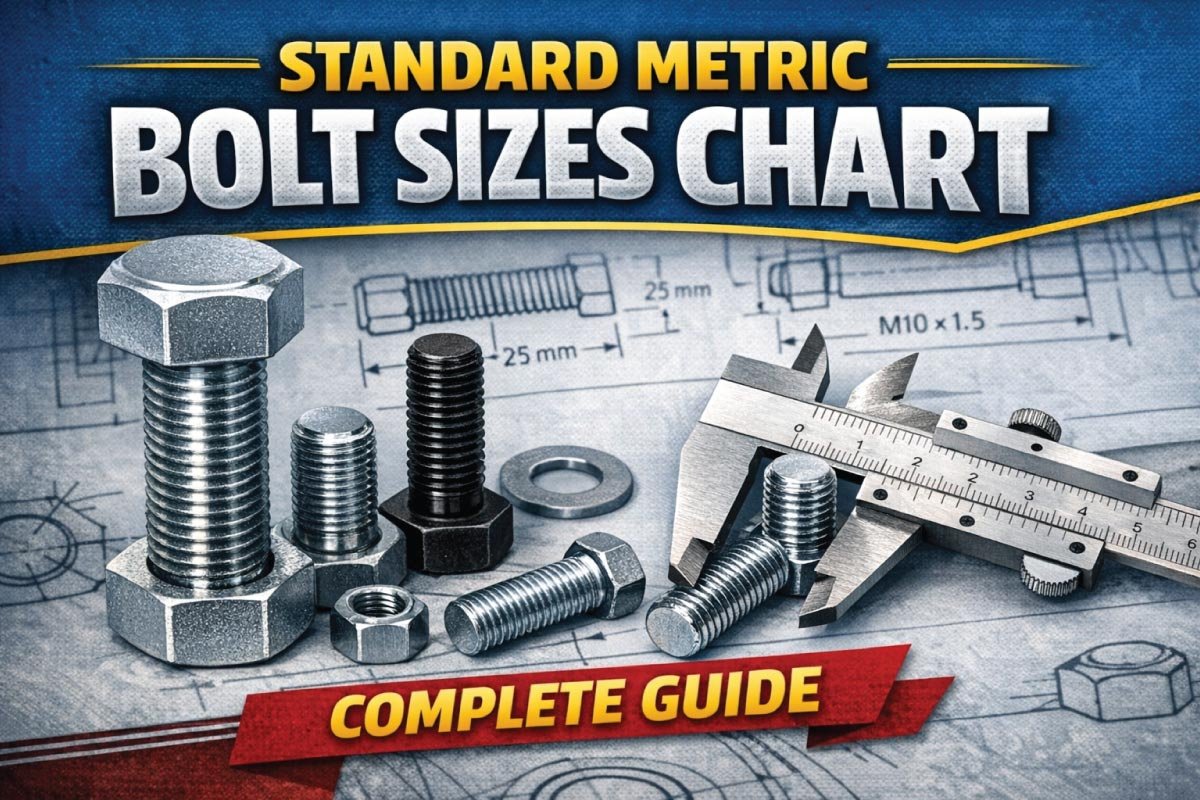
Metric bolts find application everywhere- on the automotive aspect of fixing vehicles and machinery as well as in construction and DIY works. Nevertheless, metric bolt sizes and thread pitch remain a significant source of confusion to many individuals, and they may not know how to select the appropriate bolt to use in their projects. The improper bolt size may result in loose joints or broken threads and even severe security failures.
This complete guide to standard metric bolt sizes explains everything step by step. You’ll learn how metric bolt sizing works, how to read a metric bolt size chart, and how to choose the right bolt for your project with confidence.
What Are Metric Bolts?
Metric bolts are metal bolts that are produced in the ISO metric system that is applicable globally. The metric bolts are in millimeters (mm) unlike imperial (inch based) bolts. They are more logical and normalized in their sizing and easy to comprehend on having known the fundamentals.
Metric bolts are commonly identified by:
- Thread diameter (mm)
- Thread pitch (mm)
- Bolt length (mm)
- Strength grade (property class)
These measurements work together to define a bolt’s size and performance.
Understand Metric Bolt Size Designation
Metric designation of bolt size informs you about the diameter of the bolt, the pitch of its thread and its length in millimeters. This standardized format facilitates rapid determination of compatibility, strength potential and correct fit by the user, and minimizes error in installation and provides confidence in effective fastening of mechanical and structural users. An average metric bolt is as shown:
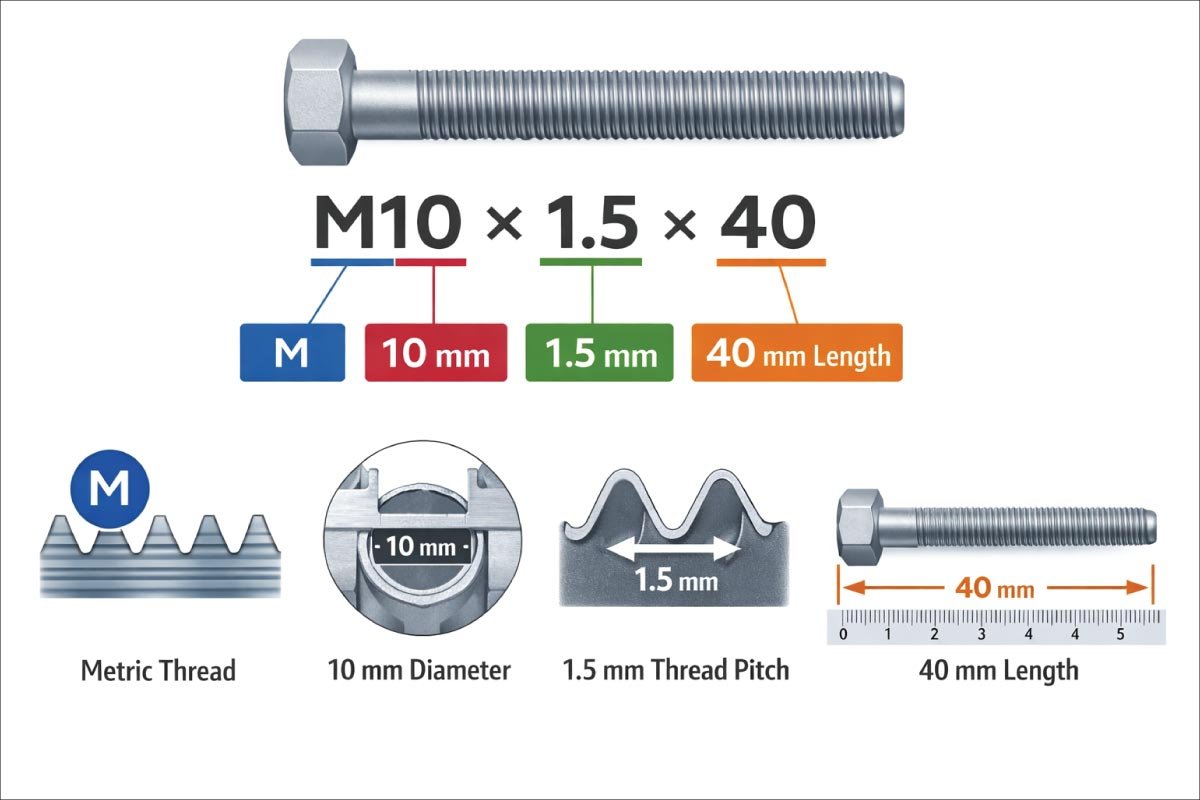
M10 × 1.5 × 40
Let’s break it down:
- M → Metric thread
- 10 → Nominal thread diameter in millimeters
- 1.5 → Thread pitch (distance between threads, in mm)
- 40 → Bolt length in millimeters
So, an M10 × 1.5 × 40 bolt has:
- A 10 mm diameter
- Threads spaced 1.5 mm apart
- A length of 40 mm
Metric Bolt Thread Pitch Explained
Thread pitch refers to the distance between adjacent threads on a metric bolt, measured in millimeters. It is important in load handling, vibration resistance and thread engagement and therefore there is a necessity of the correct pitch matching with the nut or threaded hole. One of the most puzzling aspects of bolt sizing is its thread pitch, yet it is not complicated at all.
- Coarse thread → Fewer threads, more spacing
- Fine thread → More threads, less spacing
For example:
- M10 coarse thread = 1.5 mm
- M10 fine thread = 1.25 mm or 1.0 mm
When to Use Coarse vs Fine Threads
Coarse threads are used in general applications, are quicker to install and work with lighter materials whereas the fine threads are more precise and load distributing. The selection of either of them is dependent on the needs of the application, vibration requirements, strength of the material and the holding power required.
Coarse threads
- Easier to install
- Better for soft materials
- More resistant to damage
Fine threads
- Better load holding
- More precise adjustment
- Common in automotive and machinery
Standard Metric Bolt Sizes Chart
A standard metric bolt sizes chart provides a quick reference for common bolt diameters and thread pitches. It assists the users to choose the appropriate fastener to be used in machinery, construction or repair work to have an appropriate thread alignment and safe load performance. The following is a standard chart of metric bolt size that includes the sizes that are most frequently used.
Metric Bolt Diameter and Thread Pitch Chart
| Bolt Size | Coarse Pitch (mm) | Fine Pitch (mm) |
|---|---|---|
| M3 | 0.5 | 0.35 |
| M4 | 0.7 | 0.5 |
| M5 | 0.8 | 0.5 |
| M6 | 1.0 | 0.75 |
| M8 | 1.25 | 1.0 |
| M10 | 1.5 | 1.25 / 1.0 |
| M12 | 1.75 | 1.5 / 1.25 |
| M14 | 2.0 | 1.5 |
| M16 | 2.0 | 1.5 |
| M20 | 2.5 | 2.0 |
| M24 | 3.0 | 2.0 |
This chart is essential when selecting bolts for mechanical or structural applications.
Metric Bolt Sizes Chart PDF
The Metric Bolt Sizes Chart PDF provides a clear, easy-to-read reference for bolt diameters, thread pitches, head sizes, and strength grades. It will helps engineers, mechanics, and DIY users quickly select the correct metric bolt for safe and accurate fastening.
Metric Bolt Length Measurement
Metric bolt length is a distance between the bottom of the head and the tip of the bolt, but the countersunk bolts are measured between the top of the head and the tip. Accurate length selection ensures sufficient thread engagement without bottoming out or leaving excess exposed threads.
Common Metric Bolt Lengths
Metric bolts are available in a wide range of standard lengths to the suit different material thicknesses and applications. Select the correct length prevents weak joints, thread strip, and improper clamp, especially in load-bearing or vibration-prone assemblies.
- 10 mm
- 16 mm
- 20 mm
- 25 mm
- 30 mm
- 40 mm
- 50 mm
- 60 mm
- 80 mm
- 100 mm
Always ensure the bolt length provides enough thread engagement without bottoming out.
Metric Bolt Head Sizes Chart
Metric bolt head sizes indicate the wrench or socket required for tightening. The proper head size helps to enhance better accuracy of torque, tool slippage, and also it does not round off the bolt head and this may be very hard to remove and the surrounding components may be damaged. Bolt size is defined as the size of the wrench or socket required to screw the bolt.
| Bolt Size | Hex Head Size (mm) |
|---|---|
| M5 | 8 mm |
| M6 | 10 mm |
| M8 | 13 mm |
| M10 | 17 mm |
| M12 | 19 mm |
| M14 | 22 mm |
| M16 | 24 mm |
| M20 | 30 mm |
| M24 | 36 mm |
Knowing head sizes helps avoid rounding bolts or using incorrect tools.
Metric Bolt Strength Grades Explained
Property classes are grades used to describe tensile and yield strength of the bolt that define the property classes. Knowledge of these grades is useful in assuring that bolts can comfortably accommodate loads applied on them without being stretched by mechanical forces, breaking, or collapsing. The metric bolts refer to using classification of property, rather than grade numbers.
Common Metric Bolt Grades
| Property Class | Tensile Strength (MPa) | Typical Use |
|---|---|---|
| 4.6 | Low | Light-duty applications |
| 8.8 | Medium | Automotive, machinery |
| 10.9 | High | Structural, heavy-duty |
| 12.9 | Very High | High-stress applications |
How to Read Strength Markings
Strength markings on the bolt head are used to show mechanical properties. The former indicates tensile strength and the latter implies the percentage of the yield strength and thus enables the user to select bolts that are applicable to light, medium or high stress conditions.
A bolt marked 8.8 means:
- Tensile strength = 800 MPa
- Yield strength = 80% of tensile strength
Higher numbers mean stronger bolts—but not always better for every job.
Common Types of Metric Bolts
Metric bolts are available in different designs to fit the installation requirements. All types of bolts have certain strengths, accessibility, and load distribution and it is significant to choose the right style depending on the performance and life expectancy. There are numerous styles of metric bolts. The most popular ones are the following:
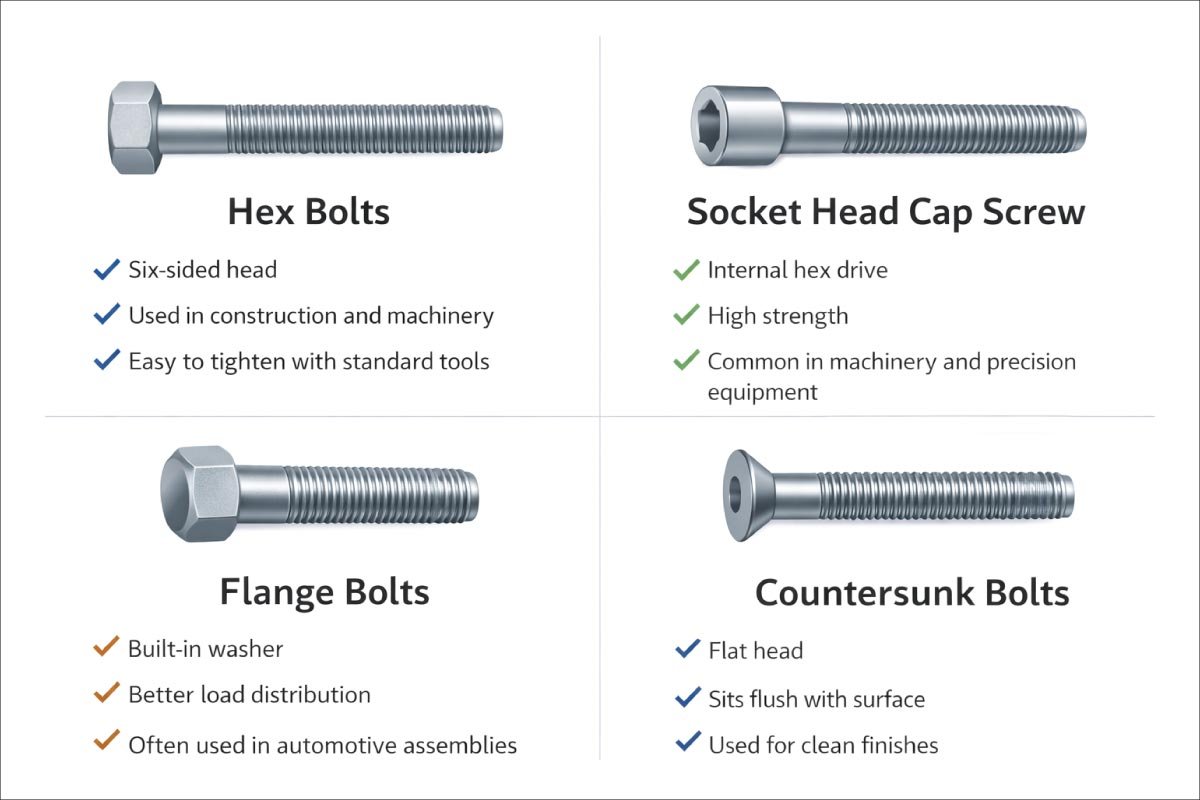
1- Hex Bolts
Hex bolts have a six sided head which can easily be tightened using common tools. They find extensive application in construction, machinery, structural assemblies because of their strength, availability and their power to withstand high torque loads.
- Six-sided head
- Used in construction and machinery
- Easy to tighten with standard tools
2- Socket Head Cap Screws
Socket head cap screws are driven an internal hex and are very strong in small areas. They are widely applied in machine work and other high precision machine work where high clamping force is needed and a clean and low profile look is desired.
- Internal hex drive
- High strength
- Common in machinery and precision equipment
3- Flange Bolts
The flange bolts have an inbuilt washer that maintains a uniform distribution of load across the surface. This design eliminates the need of having a separate washer and very instrumental in car and mechanical assemblies that are prone to vibrations.
- Built-in washer
- Better load distribution
- Often used in automotive assemblies
4- Countersunk Bolts
Countersunk bolts have a flat head designed to sit flush with the surface. They are widely applied where a smooth finish is needed as in panels, furniture or where protruding bolt heads are not wanted.
- Flat head
- Sits flush with surface
- Used for clean finishes
How to Measure a Metric Bolt Correctly
Correctly measuring a metric bolt ensures proper fit and safe performance. Proper measurements of diameter, thread pitch, length, and grade of strength eliminate thread damage, installation issues and structural weak points of the assembled parts. Measurement To make sure that you have the right sized bolt, it is important to measure it.
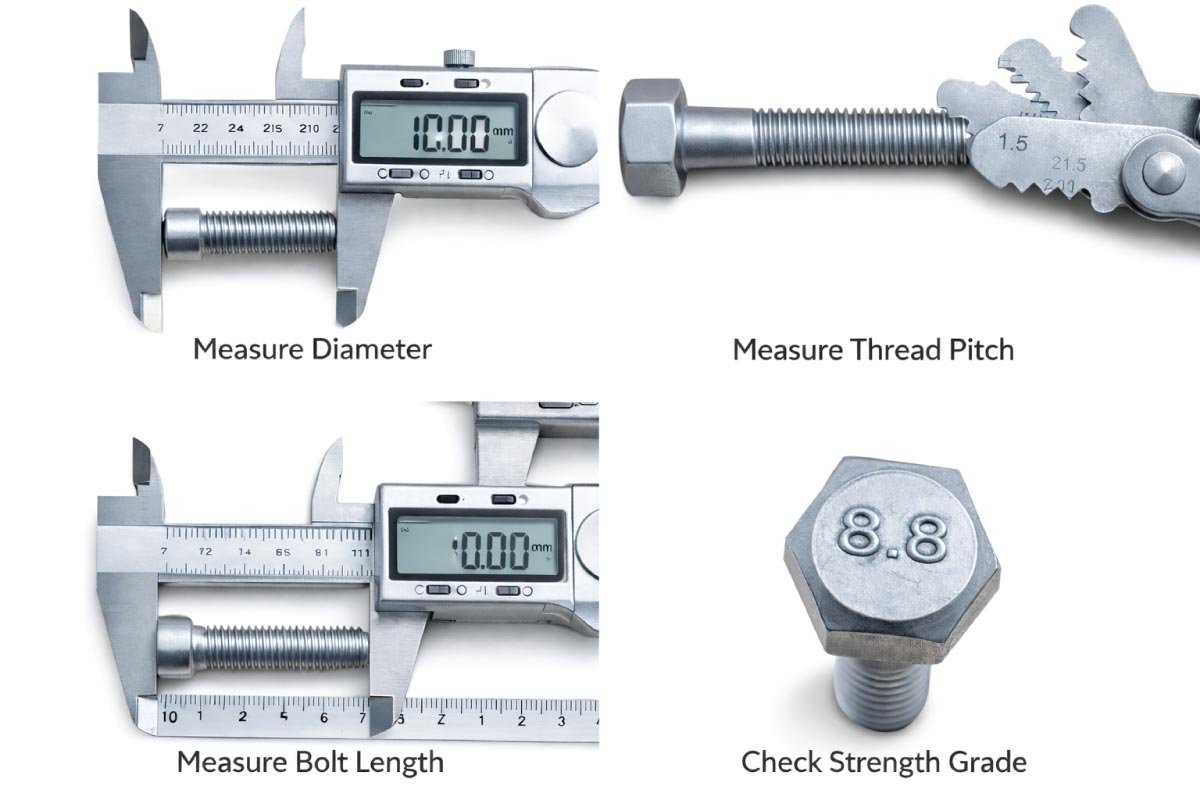
Step-by-Step Measurement
Bolt measurement is done by comparing thread diameter, thread pitch and thread length with simple equipment, such as calipers and thread gauges. Determination of head markings can also be used to establish strength grade to ensure the bolt is suitable in terms of meeting application needs.
- Measure diameter: Use a caliper to measure across threads (mm).
- Measure thread pitch: Use a thread pitch gauge or count threads over a known length.
- Measure bolt length: Measure from under the head to the tip.
- Check strength grade: Look for markings on the bolt head.
Accurate measurement ensures proper fit and performance.
Metric vs Imperial Bolt Sizes
Bolt systems in metric and imperial cannot be interchangeable as they have different standards of measurements. Not even closely similar bolts may not harm threads when mixed resulting in weak joints, improper alignment and can also be unsafe. The metric and imperial bolts do not interchange with each other despite closely resembling.
| Metric | Imperial Equivalent (Approx.) |
|---|---|
| M6 | 1/4″ |
| M8 | 5/16″ |
| M10 | 3/8″ |
| M12 | 1/2″ |
Never force an imperial bolt into a metric thread (or vice versa). This damages threads and weakens joints.
Also Read:
Choosing the Right Metric Bolt for Your Project
The choice of an appropriate metric bolt is determined by the load requirements, the material used, environment and grade of strength. These factors reduce the risk of unreliable fastening, low durability and unsafe operation during light-duty or heavy-duty applications.
To choose the correct bolt, always consider:
- Load requirements
- Material being fastened
- Environment (corrosion, heat)
- Required strength grade
- Thread type (coarse or fine)
For general use, M8 or M10 bolts in grade 8.8 are common and reliable.
Common Mistakes to Avoid
The most common errors in the selection of bolts are the wrong thread pitch, different systems of measurement, and neglecting the strength grades. By eliminating these failures, enhancement of joint integrity and preclusion of pre-mature failure as well as overall safety of mechanical and structural assemblies will be achieved.
- Using wrong thread pitch
- Over-tightening bolts
- Mixing metric and imperial fasteners
- Ignoring strength grade
- Insufficient thread engagement
Avoiding these mistakes improves safety and durability.
Final Thoughts
Understand the standard metric bolt sizes chart removes guesswork from fastening jobs. Once you know how diameter, pitch, length, and grade work together, selecting the right bolt becomes easy and reliable.
Whether you’re a mechanic, engineer, fabricator, or DIY enthusiast, mastering metric bolt sizes saves time, prevents damage, and ensures strong, secure connections every time.
When you are frequently dealing with fasteners, a metric bolt size chart is a tool that you will need, and that isn’t a bad sort of tool either.
Discover More:

Engineer Hassan is a seasoned Mechanical Engineer specializing in hardware, fasteners, tools, and precision mechanical components. With over 16 years of hands-on experience in mechanical design, assembly, and maintenance, he creates detailed size charts, installation guides, and tool selection resources. His content focuses on accuracy, safety, and practical engineering solutions, helping professionals, technicians, students, and DIY enthusiasts make reliable decisions in mechanical projects.