
Washers can be in the form of smaller and less complex hardware, but selecting the right washer size and type is a very important factor in the strength, safety, and durability of any mechanical or construction work.
Be it home repair, automotive assembly, industrial machinery or the DIY project either way, being familiar with washer size charts will save time, eliminate destruction, and enhance load distribution.
This complete guide covers flat washers, spring washers, and lock washers, along with easy-to-read size charts, practical tips, and common mistakes to avoid.
What Is a Washer and Why Size Matters
A washer is a disk of thin, flat or specially shaped, with an opening in the center, put between a bolt or nut and the surface being attached. Its key uses involve evenly distributing load, preventing damages, lowering friction, enhancing joint stability and assisting to ensure that fasteners are not loosened by vibration or wear over time.
- Distributing load evenly
- Preventing surface damage
- Reducing vibration
- Improving joint stability
- Preventing loosening over time
Choosing the wrong washer size can lead to uneven pressure, loose joints, stripped threads, or material damage. That’s why washer size charts are essential.
Understand Washer Measurements
It is worth knowing the three basic measurements that identify the size and performance of any washer before using any washer size chart.
These dimensions are guaranteed to allow alignment with the fastener, even distribution of loads, and sound joint strength.
The choice of the right measurements allows eliminating loosening, the surface damage, and unbalanced pressure during installation and exploitation.
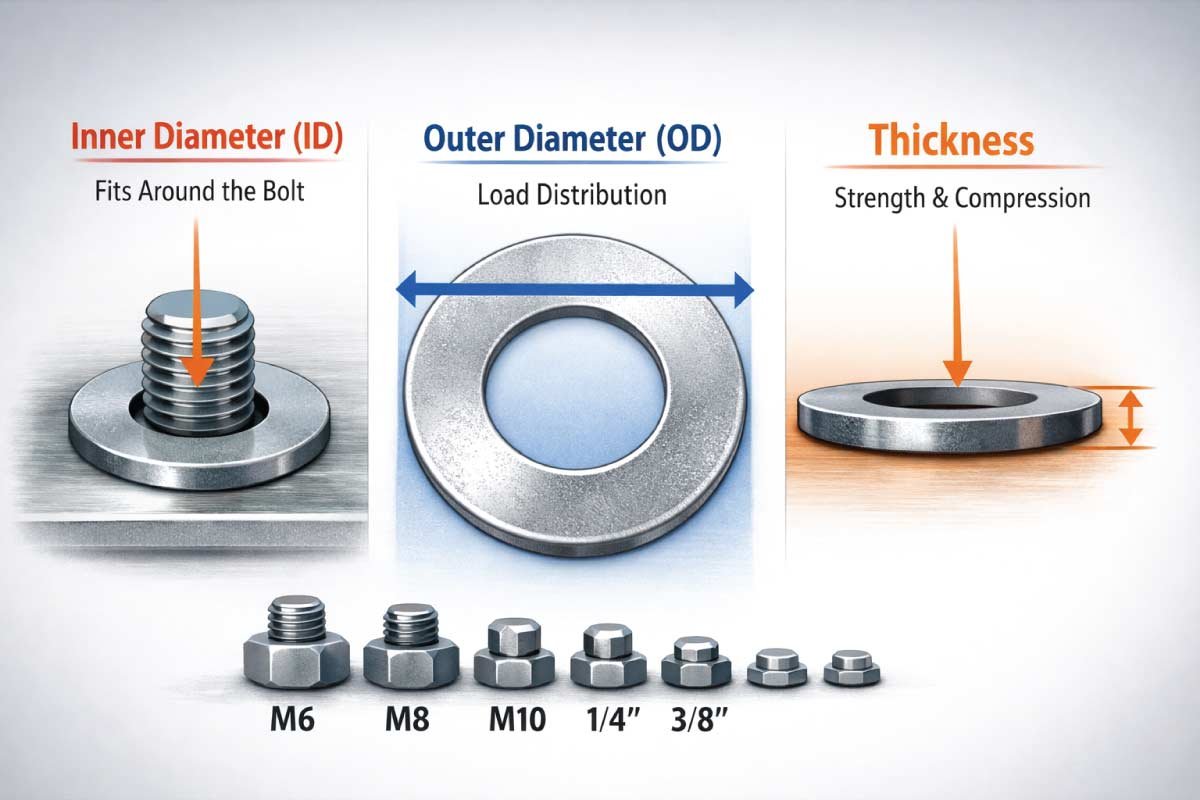
Inner Diameter (ID) – Fits around the bolt or screw
Outer Diameter (OD) – Determines load distribution
Thickness – Affects strength and compression
Washers are usually sized to match standard bolt sizes such as M6, M8, M10, 1/4″, 3/8″, and so on.
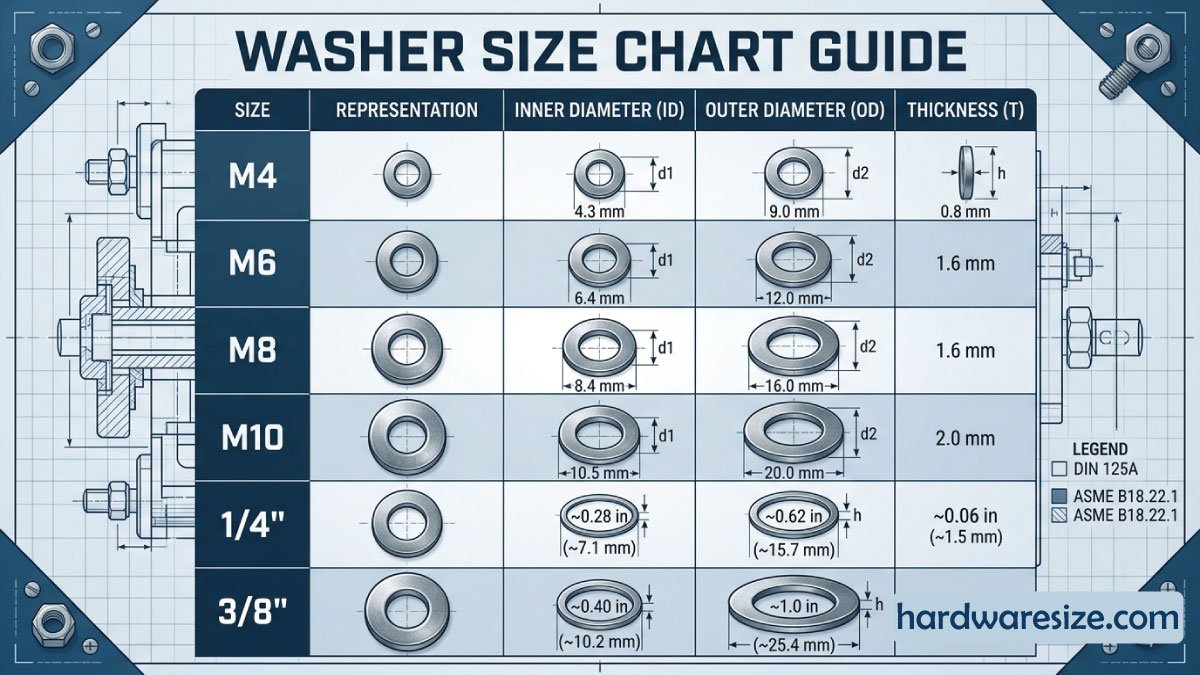
Flat Washer Size Chart (Metric & Imperial)
| Bolt Size | Inner Diameter (mm/in) | Outer Diameter (mm/in) | Thickness (mm/in) |
|---|---|---|---|
| M4 | 4.3 mm | 9 mm | 0.8 mm |
| M6 | 6.4 mm | 12 mm | 1.6 mm |
| M8 | 8.4 mm | 16 mm | 1.6 mm |
| M10 | 10.5 mm | 20 mm | 2.0 mm |
| 1/4″ | 0.281″ | 0.734″ | 0.065″ |
| 3/8″ | 0.406″ | 1.000″ | 0.065″ |
Best uses for flat washers:
- Wood and metal surfaces
- Structural assemblies
- Automotive and machinery applications
- General fastening
Spring Washer Size Chart
Split washers or spring washers are washers that are used to ensure that fasteners do not loosen as a result of vibration or thermal expansion.
Their coiled form provides a stable strain on being compressed to ensure that the bolt or the nut is under pressure and enhances stability of the joint during a movement or in high stress conditions.
| Bolt Size | Inner Diameter | Outer Diameter | Thickness |
|---|---|---|---|
| M5 | 5.1 mm | 9.2 mm | 1.3 mm |
| M6 | 6.1 mm | 11.8 mm | 1.6 mm |
| M8 | 8.1 mm | 14.8 mm | 2.0 mm |
| M10 | 10.2 mm | 18.1 mm | 2.5 mm |
| 1/4″ | 0.260″ | 0.500″ | 0.070″ |
| 3/8″ | 0.385″ | 0.688″ | 0.098″ |
Best uses for spring washers:
- Vibrating machinery
- Motors and engines
- Electrical panels
- Automotive components
Lock Washer Size Chart
Lock washers are actually made to ensure that the fasteners do not loosen due to vibration or movement. This is done by adding resistance between the surface and the nut or bolt.
Several designs of lock washers exist such as toothed, internal tooth, external tooth and split lock washers which are designed to be applied in a variety of applications.
| Bolt Size | Inner Diameter | Outer Diameter | Type |
|---|---|---|---|
| M6 | 6.4 mm | 11 mm | External Tooth |
| M8 | 8.4 mm | 15 mm | Internal Tooth |
| M10 | 10.5 mm | 18 mm | Split Lock |
| 1/4″ | 0.281″ | 0.500″ | Internal Tooth |
| 3/8″ | 0.406″ | 0.750″ | External Tooth |
Best uses for lock washers:
- High-vibration environments
- Electrical grounding
- Automotive and industrial assemblies
- Safety-critical joints
Flat vs Spring vs Lock Washers (Quick Comparison)
The selection of the appropriate type of washer varies with the extent of load support, vibration and fastening security your project needs.
Flat, spring, and lock washers are not used alike, and their main distinctions can be used to make sure that their joints are stronger,
the surfaces are more resistant, and they are more reliable both in simple and challenging tasks.
| Feature | Flat Washer | Spring Washer | Lock Washer |
|---|---|---|---|
| Load distribution | Excellent | Limited | Moderate |
| Vibration resistance | Low | Medium | High |
| Surface protection | High | Low | Medium |
| Prevents loosening | No | Yes | Yes |
| Common applications | General use | Machinery | Safety joints |
🛠️ Looking for the perfect nut for your project? Our Nut Size Chart: Types, Materials and Applications guide makes it easy to choose the right nut for any fastener, material, or load. Discover detailed charts, material tips, and practical advice to ensure strong, reliable assemblies. Read the full post to master nut selection and avoid costly mistakes.
How to Choose the Right Washer Size
Selecting the right washer is not only concerned with its size, but also application, load conditions and where the fastener will be employed.
Right washer enhances strength of the joint, avoids damage and lessens the chances of weakening in the long run particularly in strenuous or high stress circumstances.
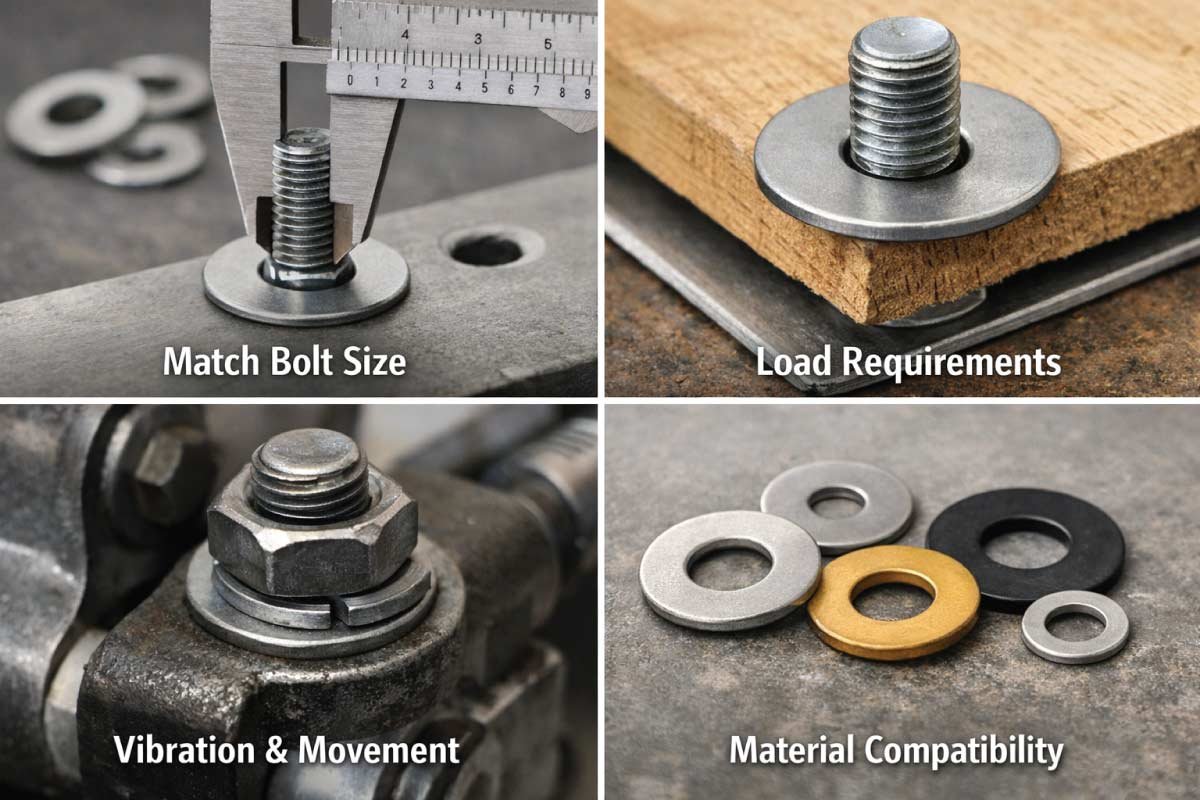
1. Match Washer to Bolt Size
It is important always to select a washer with an inner diameter which is a little larger than the bolt diameter. This will enable the washer to sit correctly without tying and distribute the pressure evenly as well as make it easier to install without a loose and tight connection.
2. Consider Load Requirements
Load requirements play a major role in washer selection. For soft materials like wood, plastic, or thin metal sheets, large-OD flat washers help spread the load over a wider area, reduce surface damage and prevent the fastener from pulling through.
3. Check Vibration Levels
In the applications subjected to a continuous movement or vibration, washer selection becomes sensitive. Lock washers or spring washers will ensure that there is tension on the fastener, which will minimize the possibility of loosening and enhance joint reliability in the long run in machinery or mechanical assemblies.
4. Material Compatibility
Washer expected material should be in line with application environment and type of fastener. The appropriate material enhances durability, corrosion and all-round performance, particularly, electrical, outdoor, or lightweight performance.
Common washer materials include:
- Stainless steel (corrosion resistance)
- Carbon steel (high strength)
- Brass (electrical applications)
- Nylon (insulation and lightweight needs)
Common Washer Size Mistakes to Avoid
The most frequent error that may be made is to choose the incorrect size or type of washer, which can lead to the destruction of the strength and safety of your assembly.
Even minor mistakes may cause loosening, unequal distribution of loads or damage to the surface.
When these pitfalls are learned, a safe, long-lasting, and dependable fastening solution can be guaranteed.
- Using oversized washers that reduce grip
- Using undersized washers that don’t fit the bolt properly
- Mixing metric and imperial sizes
- Using flat washers where lock washers are required
- Ignoring washer thickness in high-load applications
Avoiding these mistakes improves safety and extends the life of your assembly.
Washer Standards You Should Know
Washers Washers are made to the accepted international standards to be consistent, reliable and fit well in most applications.
The adherence to such standards assists in avoiding the mismatch of parts, enhances the safety of the assembly, and ensures load-based performance.
These specifications are needed in both professional and DIY projects.
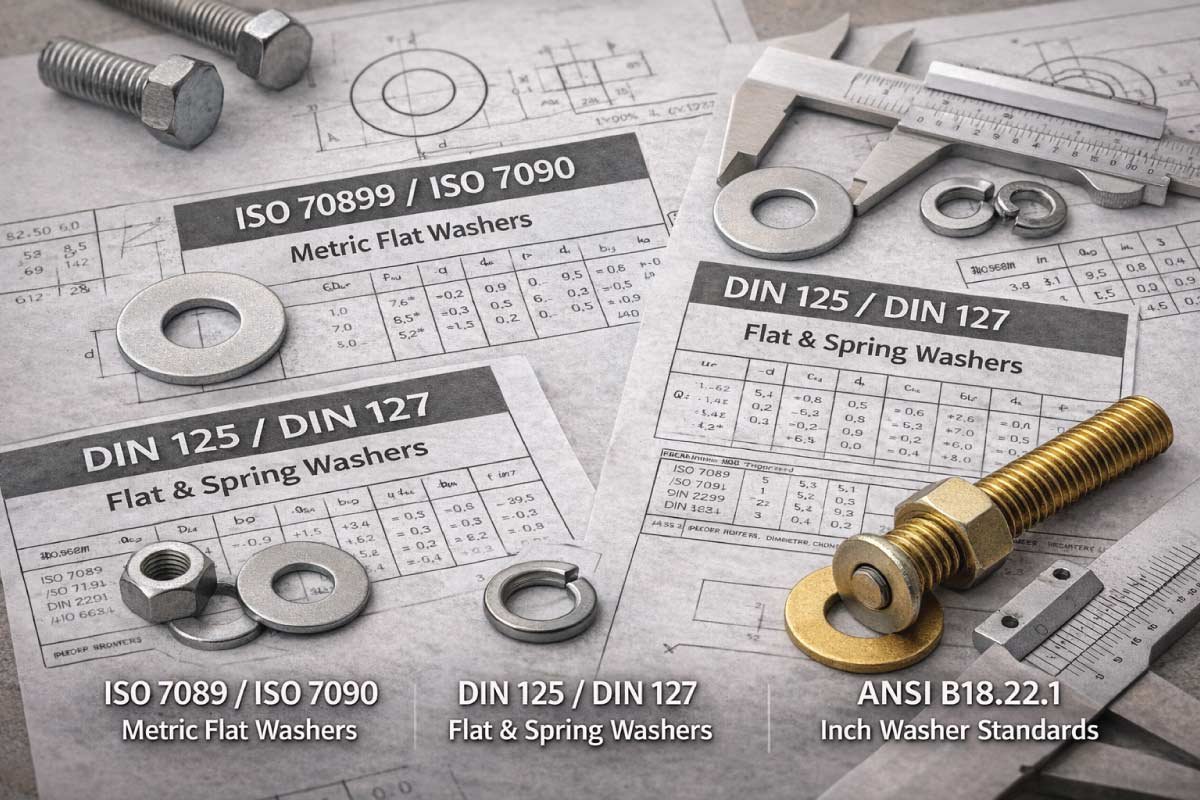
- ISO 7089 / ISO 7090 – Metric flat washers
- DIN 125 / DIN 127 – Flat and spring washers
- ANSI B18.22.1 – Inch washer standards
Knowing these standards ensures compatibility and quality.
When to Use Large OD or Fender Washers
The outer diameter (OD) or fender washers are large when additional load distribution is required, particularly in soft or thin materials such as wood, plastic, or sheet metal.
They do not allow the protruding of fasteners and destroy the surface, are more stable, and enhance the strength of joints.
The washers can also be applied to oversized holes, which reduces stress concentration and provides a safe and reliable connection in highly essential jobs.
Final Thoughts
It is important to learn and apply a washer size chart in order to fasten by one hand flat, spring, and lock washers safely, professionally, and in a long-term way.
The right washer defends the surface, enhances the distribution of loads, and avoids expensive failures due to vibration or loosening.
That is why you should have these washer charts at your fingertips, with or without DIY passion, passion in mechanics, passion in engineering, or passion in contractor, you will make decisions in a better way on any project.
🛠️ Need the right drill for your screws? Our Tap Drill Size Chart for Metric and Imperial Screws helps you select the perfect drill bit every time. Learn accurate sizes, avoid thread damage, and ensure strong, precise assemblies. Check out the full post for detailed charts and practical tips to make your projects fail-proof.

Engineer Hassan is a Mechanical Engineer with over 16 years of hands-on experience in mechanical hardware, fasteners, bolts, screws, nuts, washers, and related mechanical components. He has extensive expertise in selecting, measuring, and installing hardware, ensuring accuracy, safety, and reliability in every project.
Through Hardware Size, he provides detailed size charts, installation guides, and technical tutorials, helping engineers, technicians, students, and DIY enthusiasts solve practical hardware problems with confidence.