
Have you ever assembled a piece of furniture, or repaired a bicycle, or turned to the work on the mechanism? you are very likely to have used an Allen key perhaps without so much as the slightest idea of what it is called.
It is one of those basic but very handy things that nearly every tool box has. Although it is small, it has a large role in engineering nowadays, diy and in daily repair.
In this guide, I will walk you through what an Allen key really is, how it works, the different types available, and most importantly, how to measure its size correctly.
I will also share some practical tips based on my usage so you can avoid common mistakes.
What Is an Allen Key?
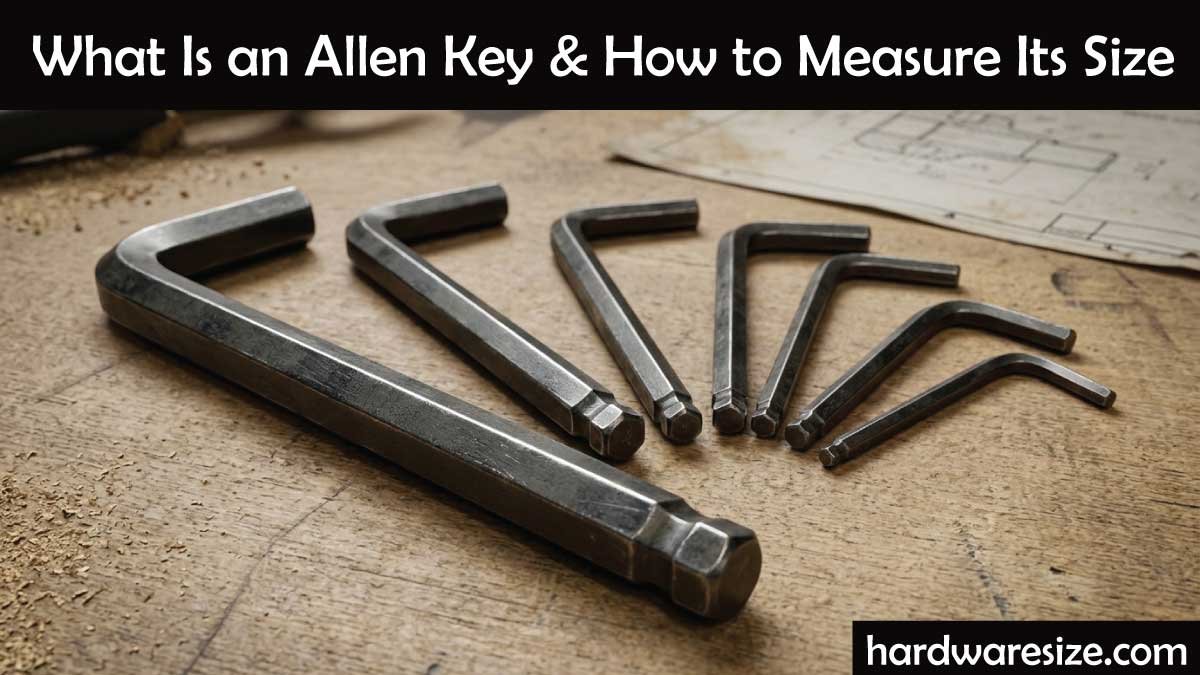
An Allen key or hex key or hex wrench is a small, L-shaped device that is used to screw in bolts and screws that have a hexagonal (six-sided) head socket.
These fasteners are recessed hex instead of a conventional screwdriver slot, or a Phillips cross. The Allen key is perfectly fitting in such shape and you can easily tighten or loosen the screw.
Why Is It Called an Allen Key?
The name of the manufacturing company, of which the tool became popularized, is Allan. The name became permanent with time although numerous companies currently manufacture the same tools.
Common Uses of an Allen Key in Everyday Applications Explained
Allen keys are common in most of the daily activities and thus it is one of the most useful tools in any toolbox. Their straightforward construction, which enables easy loosening and tightening of hex screws, can be seen in their assembly of furniture as well as in the repair of mechanism.
You will find Allen keys used in many everyday applications:
- Furniture assembly (especially flat-pack furniture)
- Bicycles and motorcycles
- Automotive repairs
- Machinery and equipment
- Electronics and appliances
Allen keys are first used in assembling furniture as in my case. They were those little tools that come with the furniture boxes? Yes, those are Allen keys.
Types of Allen Keys Used for Different Tasks
Allen keys are not all alike and each one has its purpose. When working with hex screws, depending on the job, it is possible to choose the best type and enhance efficiency, comfort, and overall performance.
1. Standard L-Shaped Allen Key
It is the most widespread model of Allen key, which has a basic L-shaped design. The short end would be used in tight spaces and the longer arm will be used in providing more torque.
2. Ball-End Allen Key
This kind features a rounded tip enabling you to screw something at some angle. It is particularly handy in those cases when you are not able to reach the screw in a straight position.
3. T-Handle Allen Key
The T-handle Allen keys have a comfortable grip that enables more control and higher in the torque. They can be used in heavy-duty work in which more force is needed to tighten or loosen bolts.
4. Folding Allen Key Set
This is a type of type that has different Allen key sizes fitted into a small folding tool resembling a Swiss Army knife. It is portable and eliminates the lost keys.
5. Allen Key Bits
Allen key bits can be operated by any power tool or screw driver, so that the work will be more efficient and quick. They are also employed in the work environment where speed and productivity are valued.
Metric vs Imperial Sizes in Allen Keys and Their Key Differences
There are two primary measurement systems that are offered by allen keys and it is important to understand the difference between them to make the right selection of the tool. It is required that the right size system is used to guarantee the right fit and avoid screw damage.
1- Metric (Millimeters)
Allen keys that are used and utilized in the majority of the countries are measured in millimeters and covered with metric. The most common sizes are 2mm, 4mm and 6mm thus are common in general purpose and international applications.
2- Imperial (Inches)
Imperial Allen keys- mostly used in the United States and are gauged in inches. Sizes are 1/8, 3/16 and 1/4 which are most frequently used in American products and equipment.
3- Important Tip
Never confuse metric and imperial sizes even when they are close. The improperly sized size may result in improper fitting, ripped screw head, and possible damage to both the tool and the fastener.
Also Read: 👉 How to Remove a Stripped Bolt: Complete Guide shows simple, practical methods to fix stuck or damaged bolts without stress. Learn easy tricks, tools, and expert tips that save time and effort. Don’t miss the full guide for step-by-step solutions!
How to Choose the Right Allen Key
To select a good Allen key size that is effective in work and does no harm. A good fit means that there are more opportunities to control, prevents stripped bolts, and covers the fastener and the tool in the case of household, mechanical, or industrial use.
1. Perfect Fit Matters
The Allen key must be slipped to the hex screw. Any slackness may strip the bolt, ruin the screw head, or decrease the efficiency of the torque. never apply force without first checking the fit, or you are sure to be safety operating within error limits.
2. Avoid Forcing It
Do not push an Allen key into a screw when it is not easily fitting. Overloading the hex, or strip of the bolt, or damaging the tool, may happen as a result of forcing the wrong size. It is better to check the size twice to avoid the unwarranted issues.
3. Use Quality Tools
Spend on good Allen keys. Poorly-made or cheap tools are worn-out quite fast and lose their shape and damage screws. Good keys have the advantage of better grip, long life, and ease of handling any kind of work.
Also Read: 👉 How to Measure Bolt Size: A Complete Step-by-Step Guide helps you easily find the right bolt dimensions for any project. Learn simple measuring methods, avoid common mistakes, and ensure a perfect fit. Read the full guide to save time and get accurate results every time!
Common Mistakes to Avoid When Using Allen Keys
The thing is that simple mistakes are common and most people make them repeatedly, and as a result, they could be stripped screws, broken tools, or waste their time. The knowledge of these mistakes enables you to operate Allen keys in the right manner and to keep the integrity of the tool and the fasteners intact.
1. Using the Wrong Size
A screw head can be ruined by a key that is somewhat smaller or bigger. Never use force without checking the size as this may strip bolts and may create unnecessary damage to both the key and the fastener.
2. Mixing Metric and Imperial Sizes
Mixing metric and imperial Allen keys is the common mistake that can strip bolts or create improper fits. Making sure that your screws are in the correct measurement system is important in order to secure a proper and perfect fit.
3. Applying Too Much Force
When a bolt is stuck, do not use a lot of force. Excessive torque may round off the screw, or break the tool. Carefully use lubricant or any other means of loosening the bolt without causing any harm.
4. Using Worn-Out Keys
Worn, old, big Allen keys will not hold on to screws, causing them to slip and result in a stripped screw. Always keep your tools in good shape and replace them as soon as they become worn to assure safety, efficiency and accuracy in all projects or even repairs.
Tips for Better Usage of Allen Keys
Use the Allen keys correctly can make your work faster, safer, and more efficient. Simple steps such as using the right arm, maintaining a complete set, and storage are the steps that will guarantee durability of the tools, as well as screws.
1- Use the Long Arm for Leverage
The longer side of the Allen key should be used in case more torque is required. This gives more turning power and one can easily tighten or loosen stubborn bolts without destroying the screw head or the tool itself.
2- Use the Short Arm for Speed
Short side of the Allen key was used in quick turning and fast adjustments. This enables quicker turning of those tasks that need very little torque to turn and save time and still have control of the screw.
3- Keep a Full Set
Always maintain both metric and imperial Allen key sets in your toolbox. The fact that all standard sizes are available just means that you are ready to take any type of screw, it is less likely that you will be in the wrong size and you are more efficient about it.
4- Store Them Properly
Store Allen keys in the holder, case, or organized toolbox to prevent lose the small sizes. The correct storage will allow the tools not to be damaged and be located easily and your workspace would be organized.
Allen Key vs Other Tools and Their Specific Purposes
Allen keys are made to fit hex screws, though there are other tools made to fit other fasteners. Being aware of the differences enables you to select the appropriate tool to the right job enhancing efficiency and eliminating damage not only to screws but tools as well.
1- Allen Key vs Screwdriver
Allen keys fit hex socket screws only and screwdrivers are made to fit slotted or cross-head screws. With the appropriate tool, one is saved the trouble of stripped screws and better torque and control.
2- Allen Key vs Torx Key
Torx keys have a star-shaped tip designed for Torx screws, whereas Allen keys have a hexagonal shape for hex screws. All tools are specifically designed to fit a screw type and accordingly, to work safely and effectively, it is important to have a tool of the right type and kind.
They all serve a purpose and knowledge of these differences will see you never apply the wrong tool to a job and you will be saving both the fasteners and your tools.
My Example
Let me share a quick example.
I once attempted to fit the wrong size of the Allen key in a metal frame. It at first appeared to be fitting but after several turns the head of the bolt was stripped. The replacement of the bolt was necessary, and it was a waste of time and money.
After that, I always double-check the size before start any work. A small step, but it saves a lot of trouble.
When Should You Replace an Allen Key?
Even though Allen keys are durable, they do not last forever.
Replace your Allen key if:
- The edges are rounded
- It slips inside the bolt
- It shows visible wear or bending
Use a damaged tool can ruin your workpiece.
Final Thoughts
An Allen key may appear to be a boring thing to have; however, it is one of the most fundamental tools to be included in any toolbox.
Whether it is assembling furniture, fixing a bike or working on mechanical parts, know the mechanics of it, and more to the point, how to measure it will save you time, effort and frustrations.
The key takeaway is simple: Always take the right size, measure and never take shortcuts. Such little practices can be the difference between good and bad work.
When you are new, you need to buy a full set of both metric and imperial Allen keys. Believe me, you will be using them more than you are going to think.

Engineer Hassan is a Mechanical Engineer with over 16 years of experience in mechanical hardware, fasteners, tools, and technical components. He specializes in selecting, measuring, and using hardware and tools accurately, ensuring safety and reliability in every project.
Through Hardware Size, he shares detailed size charts, step-by-step guides, and technical tutorials to help engineers, technicians, students, and DIY enthusiasts understand and apply mechanical knowledge effectively. His goal is to provide clear, practical guidance that makes hardware tasks simple and manageable for everyone.