
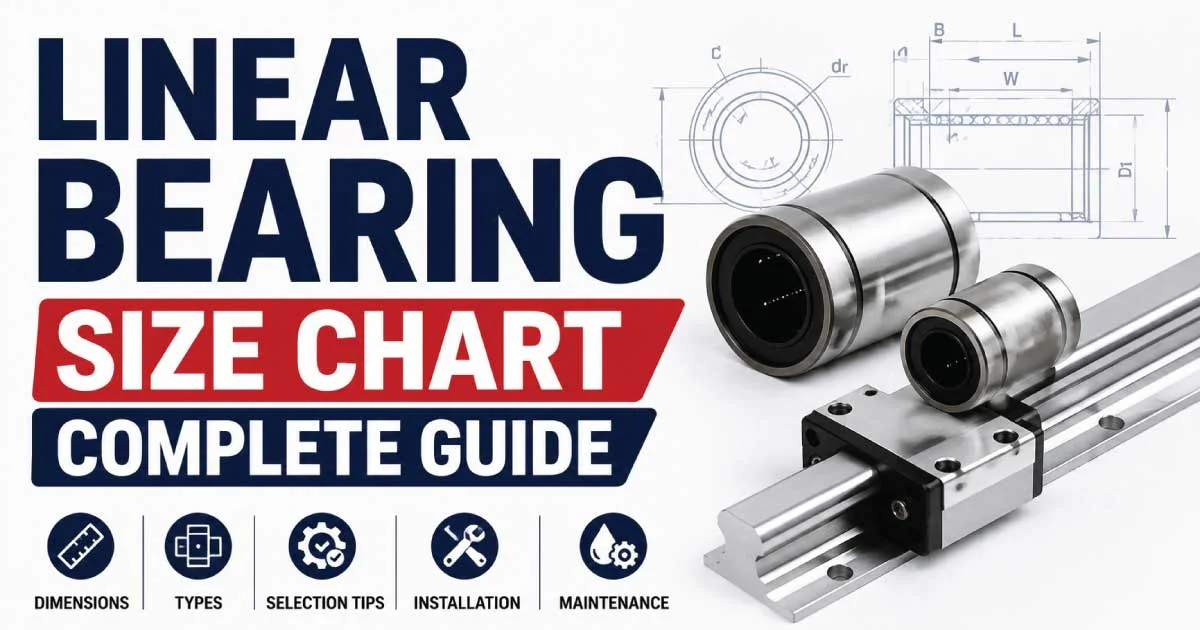
Linear bearings are essential mechanical components that allow smooth, precise, and low-friction linear motion in countless industrial and DIY applications.
Whether you are building CNC machines, 3D printers, automation systems, or industrial equipment, understanding linear bearing sizes is crucial for achieving maximum performance, durability, and efficiency.
This comprehensive guide explains everything about linear bearing size charts, dimensions, and selection methods.
Table of Contents
ToggleWhat Is a Linear Bearing?
A linear bearing is a mechanical component designed to move along a shaft while minimizing friction. Unlike rotary bearings that support rotational motion, linear bearings provide straight-line movement with excellent accuracy and consistency.
These bearings are widely used in manufacturing equipment, robotics, medical devices, packaging machines, and precision engineering where smooth linear travel is essential for operational success.
Why Linear Bearing Size Matters
Selecting the correct linear bearing size directly affects machine performance, lifespan, and operational reliability. An undersized bearing may fail prematurely under excessive loads, while an oversized bearing increases costs and requires unnecessary installation space. Proper sizing ensures better alignment, reduced wear, smoother motion, improved load capacity, lower maintenance requirements, and enhanced precision throughout the bearing’s operating life.
Benefits of Choosing the Correct Size
- Improves machine accuracy
- Extends bearing lifespan
- Reduces maintenance costs
- Minimizes vibration
- Supports higher loads safely
- Ensures smoother movement
- Prevents premature component failure
Understanding Linear Bearing Size Charts
A linear bearing size chart provides standardized dimensions that help engineers, technicians, and buyers identify compatible bearings for different shaft diameters. These charts include measurements such as inside diameter, outside diameter, overall length, dynamic load rating, static load rating, and weight. Manufacturers follow international standards, making size charts valuable references when replacing or selecting new bearings.
Main Dimensions Found in a Linear Bearing Size Chart
Every linear bearing size chart includes several important measurements that determine compatibility and performance. Understanding these dimensions allows users to confidently compare products from different manufacturers while ensuring proper fit and functionality within the intended mechanical system without unnecessary modifications or costly installation errors.
Common Dimensions Include
- Shaft Diameter (d)
- Outside Diameter (D)
- Overall Length (L)
- Dynamic Load Capacity
- Static Load Capacity
- Maximum Speed
- Bearing Weight
- Lubrication Requirements
Standard Linear Bearing Size Chart
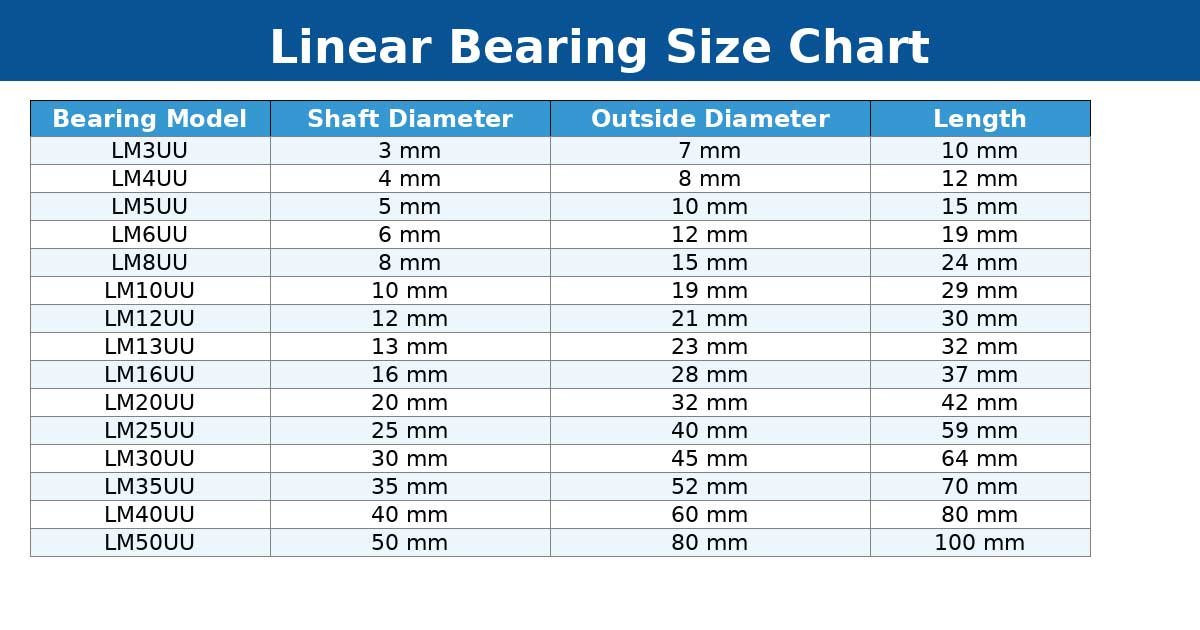
The following table represents common metric linear bearing sizes widely used in industrial machinery and automation systems.
| Bearing Model | Shaft Diameter | Outside Diameter | Length |
|---|---|---|---|
| LM3UU | 3 mm | 7 mm | 10 mm |
| LM4UU | 4 mm | 8 mm | 12 mm |
| LM5UU | 5 mm | 10 mm | 15 mm |
| LM6UU | 6 mm | 12 mm | 19 mm |
| LM8UU | 8 mm | 15 mm | 24 mm |
| LM10UU | 10 mm | 19 mm | 29 mm |
| LM12UU | 12 mm | 21 mm | 30 mm |
| LM13UU | 13 mm | 23 mm | 32 mm |
| LM16UU | 16 mm | 28 mm | 37 mm |
| LM20UU | 20 mm | 32 mm | 42 mm |
| LM25UU | 25 mm | 40 mm | 59 mm |
| LM30UU | 30 mm | 45 mm | 64 mm |
| LM35UU | 35 mm | 52 mm | 70 mm |
| LM40UU | 40 mm | 60 mm | 80 mm |
| LM50UU | 50 mm | 80 mm | 100 mm |
Linear Bearing Size Chart PDF
The Linear Bearing Size Chart helps you quickly compare common LM-series linear bearings by shaft diameter, outside diameter, and overall length. Use this chart to select the correct bearing size for CNC machines, 3D printers, automation systems, and other precision motion applications, ensuring smooth operation and proper fit.
Metric vs Imperial Linear Bearing Sizes
Linear bearings are manufactured in both metric and imperial dimensions to accommodate global engineering standards.
Metric bearings dominate modern machinery, especially in Europe and Asia, while imperial sizes remain common in older American equipment.
Selecting the correct measurement system ensures compatibility with shafts, housings, and replacement components without requiring custom machining or adapters.
How to Read Bearing Model Numbers
Linear bearing model numbers follow a standardized naming system that makes identification simple. For example, LM8UU indicates a standard linear motion bearing designed for an 8 mm shaft.
Larger numbers represent larger shaft diameters, while additional letters may identify specialized seals, extended lengths, stainless steel construction, or other manufacturer-specific design features.
Example Breakdown
LM8UU
- LM = Linear Motion Bearing
- 8 = Shaft Diameter (8 mm)
- UU = Double Rubber Seals
Different Types of Linear Bearings
Not every linear bearing shares the same construction or intended application. Manufacturers offer various designs to accommodate different load capacities, operating environments, speeds, and installation requirements.
Choosing the correct bearing type improves efficiency, reduces maintenance, and ensures reliable performance in demanding industrial or commercial applications.
Common Linear Bearing Types
- Standard Ball Linear Bearings
- Flanged Linear Bearings
- Open-Type Linear Bearings
- Closed-Type Linear Bearings
- Adjustable Linear Bearings
- Stainless Steel Linear Bearings
- Polymer Linear Bearings
- Heavy-Duty Linear Bearings
Factors That Influence Bearing Size Selection
Selecting the appropriate linear bearing involves more than matching shaft diameter alone. Engineers must evaluate multiple operating conditions to ensure the bearing performs efficiently under expected workloads.
Proper consideration of these factors helps maximize service life while minimizing downtime, maintenance expenses, and unexpected mechanical failures.
Key Selection Factors
- Load capacity
- Operating speed
- Shaft diameter
- Installation space
- Working environment
- Temperature
- Lubrication method
- Required precision
- Maintenance schedule
Applications of Linear Bearings
Linear bearings play a vital role across numerous industries because they provide accurate, repeatable linear movement with minimal friction. Their versatility makes them indispensable in precision equipment where reliable positioning, smooth travel, and long operating life are critical for maintaining productivity and product quality.
Industries That Use Linear Bearings
- CNC Machines
- 3D Printers
- Robotics
- Packaging Equipment
- Medical Devices
- Semiconductor Manufacturing
- Textile Machinery
- Food Processing Equipment
- Printing Machines
- Automation Systems
Common Materials Used in Linear Bearings
The material used to manufacture a linear bearing significantly influences its strength, corrosion resistance, wear characteristics, and operating lifespan. Different environments require different materials, making material selection an important consideration when reviewing any linear bearing size chart before purchasing replacement or new components.
Popular Bearing Materials
- Hardened Steel
- Stainless Steel
- Chrome Steel
- Polymer Composites
- Aluminum Bearing Housings
- Brass Bearing Cages
How to Select the Right Linear Bearing Size
Selecting the correct linear bearing size requires evaluating the machine design, shaft dimensions, load requirements, and movement conditions. A proper selection process prevents performance issues and ensures reliable operation. Engineers should always consider both static and dynamic forces because bearings experience different stresses during movement, acceleration, and continuous operation in real-world applications.
Important Selection Steps
- Measure the shaft diameter accurately
- Calculate the expected load
- Determine required travel speed
- Check available installation space
- Consider environmental conditions
- Select suitable bearing material
- Verify manufacturer specifications
Understanding Load Ratings in Linear Bearings
Load ratings are among the most important specifications in a linear bearing size chart. They determine how much force a bearing can handle during operation without excessive wear or failure. Dynamic load ratings represent moving conditions, while static load ratings indicate the maximum force a stationary bearing can support safely without permanent deformation.
Types of Load Ratings
- Dynamic Load Rating: Capacity during continuous movement
- Static Load Rating: Maximum load while stationary
- Moment Load: Resistance against tilting forces
- Radial Load: Side force capacity on the bearing
Also Read:
Linear Bearing Length Selection Guide
The length of a linear bearing affects stability, load distribution, and overall performance. Longer bearings generally provide better support and reduced shaft deflection, while shorter bearings are suitable for compact designs with lighter loads.
Choosing the correct length helps maintain accuracy and prevents uneven wear during repeated linear movement applications.
General Length Considerations
- Short bearings suit limited-space applications
- Long bearings improve stability
- Longer lengths support higher loads
- Compact designs require careful load calculation
- Multiple bearings may improve performance
Linear Bearing Size Chart for Heavy-Duty Applications
Heavy-duty linear bearings are designed for machines requiring increased load capacity, improved durability, and continuous operation.
These bearings typically feature stronger materials, larger dimensions, and enhanced internal structures. They are commonly used in industrial automation, manufacturing equipment, and systems where downtime can result in significant production losses or maintenance expenses.
| Bearing Model | Shaft Diameter | Outer Diameter | Length |
|---|---|---|---|
| LM60UU | 60 mm | 90 mm | 125 mm |
| LM80UU | 80 mm | 120 mm | 165 mm |
| LM100UU | 100 mm | 150 mm | 210 mm |
| LM120UU | 120 mm | 180 mm | 260 mm |
Linear Bearing Installation Requirements
Proper installation is essential for achieving the expected performance and lifespan of linear bearings. Incorrect alignment, improper fitting, or contamination during installation can lead to noise, increased friction, and premature failure.
Following correct installation procedures ensures smooth movement and prevents unnecessary stress on the bearing components.
Installation Guidelines
- Clean the shaft before installation
- Check shaft straightness
- Ensure proper alignment
- Avoid excessive installation force
- Use recommended lubrication
- Confirm smooth movement after installation
Also Read:
Difference Between Linear Bearing and Linear Guide Rail
Linear bearings and linear guide rails both provide straight-line motion, but their designs and applications differ significantly.
Linear bearings usually move along cylindrical shafts, while linear guide rails use precision tracks and blocks.
Understanding these differences helps engineers choose the best solution based on accuracy requirements, load capacity, speed, and available installation space.
Linear Bearing Advantages
- Lower cost
- Easy replacement
- Simple installation
- Suitable for many applications
- Available in many sizes
Linear Guide Rail Advantages
- Higher rigidity
- Better accuracy
- Greater load capacity
- Improved stability
- Suitable for precision machinery
How Lubrication Affects Linear Bearing Performance
Lubrication plays a critical role in reducing friction, preventing wear, and extending bearing life. Without proper lubrication, internal balls and raceways may experience excessive friction, heat generation, and surface damage. The correct lubricant type depends on operating speed, temperature, environment, and manufacturer recommendations.
Lubrication Tips
- Use manufacturer-approved grease
- Avoid over-lubrication
- Maintain regular lubrication intervals
- Remove contaminated lubricant
- Monitor operating temperature
Also Read:
Common Linear Bearing Problems and Solutions
Even high-quality linear bearings can experience problems when improperly selected, installed, or maintained. Recognizing early warning signs helps prevent expensive equipment failures.
Common issues include unusual noise, rough movement, increased resistance, and reduced positioning accuracy caused by wear, contamination, misalignment, or insufficient lubrication.
Common Problems
1. Excessive Noise
Possible causes:
- Lack of lubrication
- Damaged balls
- Contaminated shaft
Solution:
- Clean components
- Apply proper lubricant
- Replace damaged bearings
2. Rough Movement
Possible causes:
- Shaft damage
- Misalignment
- Incorrect bearing size
Solution:
- Inspect shaft condition
- Correct alignment
- Install the correct bearing model
Factors Affecting Linear Bearing Lifespan
The service life of a linear bearing depends on several operating conditions. Proper sizing, regular maintenance, environmental protection, and correct installation all contribute to longer performance. Ignoring these factors may significantly reduce bearing life and increase operational costs through frequent replacements and machine downtime.
Ways to Extend Bearing Life
- Select the correct bearing size
- Keep shafts clean
- Maintain proper lubrication
- Avoid overloading
- Protect against dust and moisture
- Perform regular inspections
Choosing Between Standard and High-Precision Linear Bearings
Different applications require different levels of accuracy. Standard linear bearings are suitable for general movement systems, while high-precision bearings are designed for applications requiring minimal clearance and extremely accurate positioning. Selecting the correct precision level prevents unnecessary costs while ensuring the machine performs according to design requirements.
Standard Bearings Are Suitable For
- Basic automation
- DIY projects
- General machinery
- Low-cost applications
High-Precision Bearings Are Suitable For
- CNC machines
- Medical equipment
- Semiconductor systems
- Precision robotics
Future Trends in Linear Bearing Technology
Linear bearing technology continues to improve with advanced materials, smarter designs, and improved manufacturing methods. Modern bearings are becoming more efficient, quieter, and durable while supporting higher speeds and heavier loads. Innovations in automation and robotics are increasing demand for precision linear motion solutions across multiple industries worldwide.
Modern Developments Include
- Self-lubricating bearings
- Lightweight composite materials
- Corrosion-resistant designs
- Smart monitoring systems
- Improved sealing technology
Final Checklist for Choosing a Linear Bearing
Before purchasing or replacing a linear bearing, reviewing essential specifications helps avoid compatibility problems. A complete evaluation ensures that the selected bearing matches the machine requirements, operating environment, and expected workload. Using a reliable linear bearing size chart simplifies comparison and improves decision-making.
Selection Checklist
- Confirm shaft diameter
- Check bearing dimensions
- Verify load capacity
- Match operating speed
- Consider environmental conditions
- Select suitable material
- Review maintenance requirements
- Confirm manufacturer specifications
Conclusion:
A linear bearing size chart is an essential reference for engineers, technicians, and manufacturers seeking reliable linear motion solutions. Understanding key factors such as dimensions, load ratings, bearing types, materials, and installation requirements helps ensure the right bearing is selected for each application.
Proper selection of a linear bearing improves movement accuracy, reduces maintenance needs, and enhances overall machine performance. Whether used in CNC equipment, robotics, automation systems, or industrial machinery, choosing the correct size and specification ensures smooth operation and dependable performance.
By following proper sizing guidelines and considering application requirements, users can confidently select, install, and maintain linear bearings. The right choice provides efficient motion control, extended service life, and reliable operation in a wide range of industrial applications.

Engineer Hassan is a Mechanical Engineer with 16+ years of hands-on experience in mechanical hardware, fasteners, and workshop tools. He focuses on size selection, thread identification, and measurement, helping users choose the correct components with accuracy and safety.