
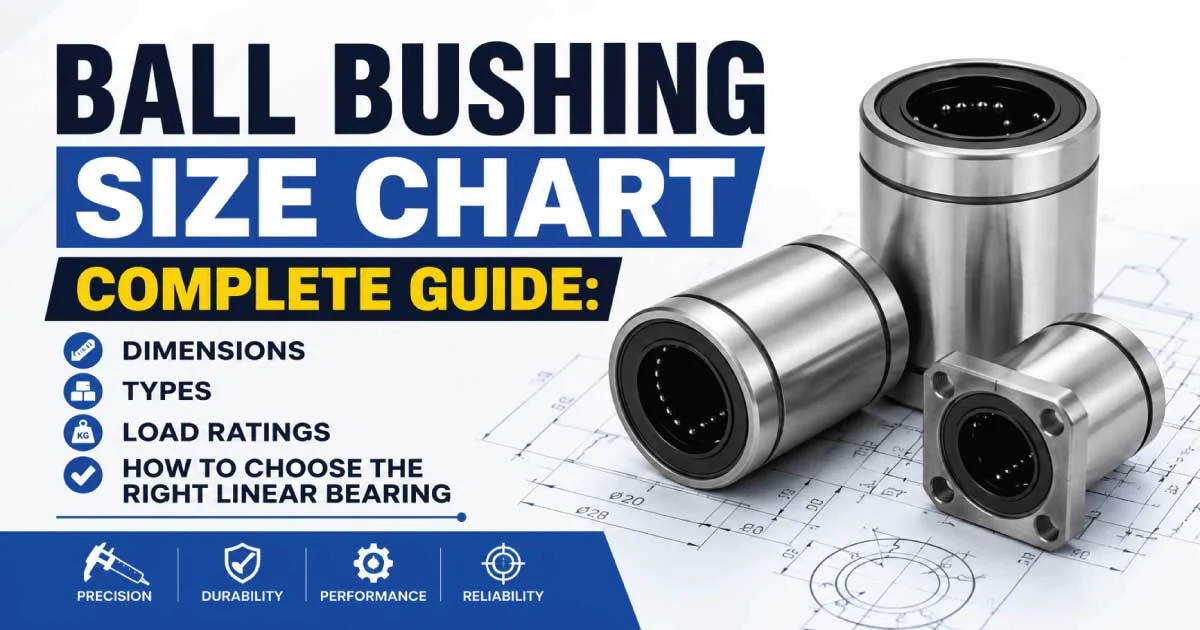
Ball bushings are precision components designed to provide smooth linear movement in machines, automation systems, and industrial equipment. Choosing the correct ball bushing size is essential because the wrong dimensions can cause vibration, excessive wear, reduced accuracy, and early component failure.
This guide explains sizing standards, measurements, and selection methods. Ball bushings work by using rows of recirculating balls inside a cylindrical housing.
These balls reduce friction between the moving shaft and the bearing surface, allowing controlled and efficient motion. The size of a ball bushing determines its load capacity, shaft compatibility, and overall performance.
A proper size chart helps engineers and technicians quickly identify:
- Inner diameter required for the shaft.
- Outer diameter needed for housing installation.
- Overall length and mounting requirements.
- Dynamic and static load ratings.
- Compatibility with supported linear shafts.
Understanding these measurements makes it easier to select a ball bushing that matches the application requirements and ensures long-lasting mechanical performance.
What Is a Ball Bushing Sizes
A ball bushing size chart is a reference table that lists the standard dimensions and specifications of different linear bearing models. It allows users to compare shaft diameter, bearing diameter, length, and load ratings before selecting the correct component for their machine design.
Most manufacturers provide ball bushing charts using common measurement categories. These categories help users identify whether a bearing can fit a specific shaft or housing. Although dimensions may vary between manufacturers, many industrial ball bushings follow standardized sizing systems.
Typical information included in a ball bushing size chart includes:
- Shaft diameter measurements.
- Bearing outside diameter.
- Total bearing length.
- Flange dimensions for mounted versions.
- Weight specifications.
- Maximum load capacity.
- Recommended operating conditions.
Using a size chart reduces mistakes during purchasing and installation. It also helps prevent problems caused by selecting a bearing that is too small, too large, or unsuitable for the operating environment.
Key Measurements Required for Selecting the Correct Ball Bushing Size
Selecting the right ball bushing requires understanding several important measurements. The most critical dimensions are the inside diameter, outside diameter, and length. These measurements determine whether the bearing will properly fit the shaft and mounting structure.
The inner diameter represents the size of the shaft that passes through the ball bushing. For example, a 20 mm ball bushing is designed to work with a 20 mm linear shaft. The fit between the shaft and bearing must be accurate to maintain smooth movement.
The outer diameter determines the required housing size. A larger outside diameter usually provides greater strength and higher load capacity. However, the available installation space must also be considered.
The length of the ball bushing affects stability and load distribution. Longer bearings generally provide better support against moment loads, while shorter designs may be suitable for compact applications.
Important measurements include:
- Shaft diameter.
- Bearing outer diameter.
- Overall length.
- Mounting hole spacing.
- Flange diameter when applicable.
Standard Ball Bushing Size Chart Explained for Common Applications
Ball bushings are available in many standard bush sizes to meet different industrial requirements. Small sizes are commonly used in compact automation devices, while larger sizes are preferred for heavy-duty machinery and manufacturing equipment.
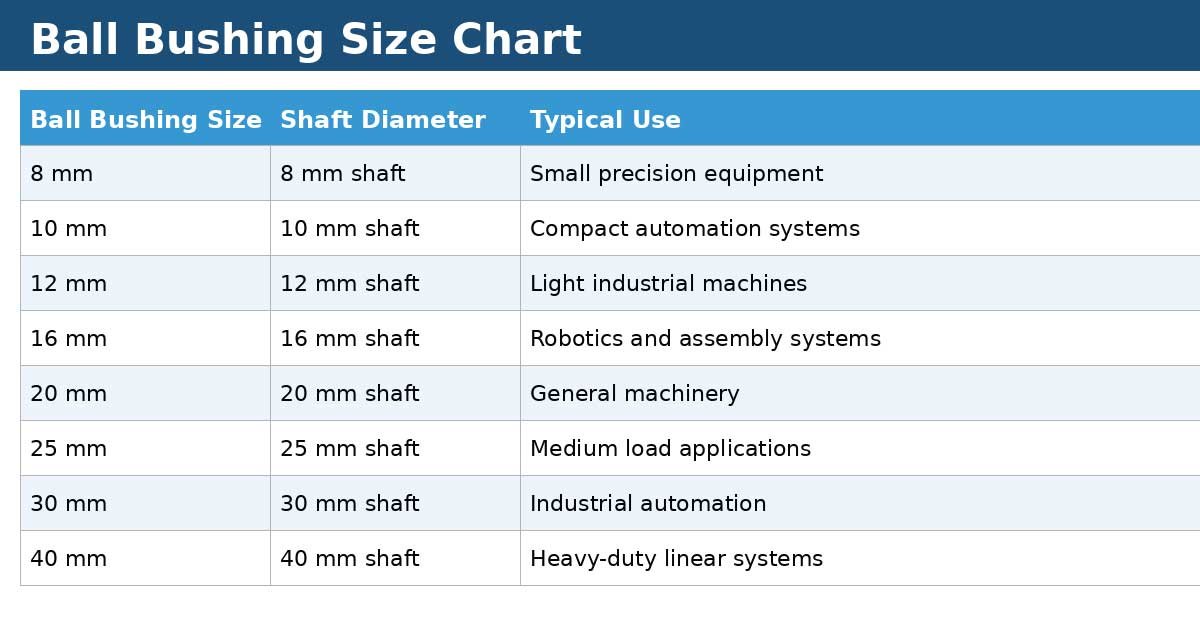
A general ball bushing size chart may include common metric sizes such as:
| Ball Bushing Size | Shaft Diameter | Typical Use |
|---|---|---|
| 8 mm | 8 mm shaft | Small precision equipment |
| 10 mm | 10 mm shaft | Compact automation systems |
| 12 mm | 12 mm shaft | Light industrial machines |
| 16 mm | 16 mm shaft | Robotics and assembly systems |
| 20 mm | 20 mm shaft | General machinery |
| 25 mm | 25 mm shaft | Medium load applications |
| 30 mm | 30 mm shaft | Industrial automation |
| 40 mm | 40 mm shaft | Heavy-duty linear systems |
Ball Bushing Size Chart PDF
A ball bushing size chart helps you choose the correct bushing and shaft diameter for smooth, accurate linear motion. Whether you’re designing automation equipment, robotics, or industrial machinery, using the right ball bushing size improves performance, reduces wear, and ensures reliable operation in a wide range of applications.
These sizes are common examples, but exact dimensions and load ratings depend on the manufacturer and bearing series.
When selecting from a chart, users should not consider diameter alone. The application’s speed, load, environment, and required accuracy also influence the final choice.
Metric and Imperial Ball Bushing Sizes: Understanding the Difference
Ball bushings are manufactured using both metric and imperial measurement systems. Metric sizes are common in modern industrial machinery, especially equipment produced in Asia and Europe. Imperial sizes are widely used in North American machinery and replacement applications.
Metric ball bushings are measured in millimeters, such as 12 mm, 20 mm, or 30 mm shaft sizes. Imperial versions are usually measured in inches, including sizes like 1/2 inch, 3/4 inch, and 1 inch.
When replacing an existing ball bushing, it is important to match the original measurement system. Converting between metric and imperial sizes may create fitting problems because similar measurements are not always identical.
For example:
- A 25 mm shaft is not exactly the same as a 1-inch shaft.
- Housing dimensions may differ between standards.
- Load ratings can change between equivalent-looking sizes.
Always check the manufacturer specifications before replacing or upgrading a ball bushing.
How Ball Bushing Diameter Affects Load Capacity and Performance
The diameter of a ball bushing directly influences how much force it can handle during operation. Larger diameter bearings generally contain more rolling elements and provide a stronger contact area, allowing them to support heavier loads.
Small ball bushings are suitable for lightweight applications where precision and compact design are more important than maximum strength. Larger ball bushings are preferred for industrial systems that experience continuous operation and higher mechanical stress.
Factors affected by diameter include:
- Maximum supported weight.
- Shaft stiffness requirements.
- Resistance to bending forces.
- Operating life expectancy.
- Machine stability.
However, choosing the largest available size is not always the best solution. Oversized components can increase cost, require more installation space, and add unnecessary weight to moving assemblies.
The ideal selection balances load requirements, available space, operating speed, and precision needs.
Also Read:
Choosing the Right Ball Bushing Length for Better Stability
Ball bushing length plays an important role in maintaining smooth and accurate linear movement. A longer bearing provides more contact area with the shaft, improving guidance and reducing unwanted movement during operation.
Short ball bushings are often used in applications where space is limited and loads are relatively low. Longer versions are recommended when the system requires better support, higher accuracy, or resistance against twisting forces.
When selecting length, consider:
- Distance between supporting bearings.
- Amount of side load.
- Movement speed.
- Required precision level.
- Available installation space.
A properly selected length improves machine performance and reduces uneven wear. In high-precision applications, using the correct bearing length can significantly extend service life and maintain consistent movement over time.
Understanding Ball Bushing Load Ratings and Size Selection Requirements
Ball bushing load ratings are essential factors when selecting the correct size for a linear motion system. A bearing may physically fit a shaft but still fail if it cannot handle the required force. Load capacity determines how much weight and pressure the ball bushing can support during operation.
Manufacturers usually provide two main load ratings:
- Dynamic load rating for moving applications.
- Static load rating for stationary or slow-moving conditions.
Dynamic load ratings indicate how much load a ball bushing can handle while continuously moving. Static ratings show the maximum force it can withstand without permanent damage when not moving.
When choosing a size, engineers should consider:
- Total weight of the moving components.
- Direction of applied force.
- Operating speed.
- Frequency of movement.
- Expected service life.
Selecting a ball bushing with a suitable load rating prevents premature failure and improves machine reliability. A correctly sized bearing maintains smooth movement while reducing maintenance costs and downtime.
Also Read:
Ball Bushing Size Chart Based on Shaft Diameter and Application Type
The shaft diameter is one of the first measurements considered when choosing a ball bushing. Different shaft sizes are designed for specific load levels and machine requirements. Smaller shafts are commonly used in lightweight systems, while larger shafts provide greater rigidity and support.
A general application-based size guide includes:
| Shaft Diameter | Recommended Application |
|---|---|
| 8 mm – 12 mm | Small automation devices and compact equipment |
| 16 mm – 20 mm | Robotics, laboratory machines, and assembly systems |
| 25 mm – 30 mm | Industrial machinery and production equipment |
| 40 mm – 50 mm | Heavy-duty linear motion systems |
| 60 mm and above | Large manufacturing and specialized equipment |
Choosing the correct shaft diameter helps maintain alignment between the shaft and bearing. A shaft that is too small may bend under load, while an oversized shaft can increase cost without improving performance.
The best selection depends on balancing mechanical strength, operating conditions, and available installation space.
How to Calculate the Correct Ball Bushing Size for Your Machine
Calculating the correct ball bushing size requires evaluating the mechanical requirements of the application. Although manufacturers provide size charts, engineers often need to calculate expected forces before selecting a final bearing model.
Important calculation factors include:
- Applied load weight.
- Acceleration and movement speed.
- Shaft length.
- Mounting position.
- Operating environment.
For example, a machine carrying a heavy moving platform requires a larger ball bushing than a small electronic positioning device. Side loads and uneven weight distribution should also be considered because they increase stress on the bearing.
A common selection process involves:
- Determine the shaft diameter.
- Calculate the total moving load.
- Check dynamic and static ratings.
- Compare available bearing sizes.
- Select a suitable safety margin.
Using proper calculations ensures that the ball bushing operates efficiently and avoids unexpected breakdowns.
Also Read:
Flanged Ball Bushing Sizes and Their Advantages in Mounting Systems
Flanged ball bushings are designed with an extended mounting flange that allows easier installation and improved positioning. They are commonly used when a bearing needs to be attached directly to a machine plate or housing structure.
The flange provides several advantages:
- Simplifies installation.
- Improves bearing alignment.
- Reduces additional mounting components.
- Provides stronger positioning support.
- Helps maintain accurate movement.
Flanged models are available in various sizes that match standard shaft diameters. They can be selected using the same basic measurements as standard ball bushings, including inner diameter, outer diameter, and length.
Common applications include:
- CNC machines.
- Automated production lines.
- 3D printers.
- Packaging equipment.
- Precision positioning systems.
When space allows, flanged ball bushings can provide a more secure mounting solution compared with traditional cylindrical designs.
Open and Closed Ball Bushing Sizes: Which One Should You Choose?
Ball bushings are generally available in open and closed designs. The correct choice depends on the shaft support structure and the mechanical arrangement of the system.
Closed ball bushings completely surround the shaft and are commonly used with supported shafts or simple linear guides. They provide excellent guidance when the shaft remains fixed and properly aligned.
Open ball bushings have a cut section that allows them to be installed on supported rails. They are useful when the shaft requires additional support along its length.
Key differences include:
- Closed types provide full shaft coverage.
- Open types allow supported shaft installation.
- Open designs handle longer shaft systems better.
- Closed designs are easier to install in compact machines.
Understanding these differences helps users select a ball bushing size that matches the machine structure and performance requirements.
Common Mistakes When Selecting Ball Bushing Sizes
Incorrect ball bushing selection can reduce machine accuracy and shorten component life. Many failures occur because users focus only on shaft diameter without considering other important specifications.
Common mistakes include:
- Choosing a bearing based only on price.
- Ignoring load capacity requirements.
- Selecting the wrong shaft tolerance.
- Using unsuitable lubrication.
- Overlooking environmental conditions.
- Installing mismatched components.
Another common issue is selecting a bearing that fits physically but cannot handle the operating forces. A machine may work initially, but excessive wear can appear after continuous use.
To avoid these problems:
- Review manufacturer specifications.
- Calculate expected loads.
- Consider future operating conditions.
- Use proper installation methods.
- Maintain correct lubrication levels.
A careful selection process ensures better performance and longer service life.
Ball Bushing Installation Tips for Maximum Performance and Durability
Proper installation is necessary to achieve the expected performance from a ball bushing. Even a high-quality bearing can fail early if it is installed incorrectly or exposed to poor operating conditions.
Important installation guidelines include:
- Clean the shaft before installation.
- Avoid forcing the bearing onto the shaft.
- Ensure proper alignment.
- Use recommended lubrication.
- Prevent contamination from dust and debris.
Misalignment is one of the biggest causes of premature ball bushing failure. When the bearing and shaft are not perfectly aligned, the internal balls experience uneven pressure, increasing wear.
Regular inspection also helps identify problems before they become serious. Checking for unusual noise, resistance, or movement irregularities can prevent unexpected machine downtime.
Maintenance Practices to Extend Ball Bushing Service Life
Routine maintenance improves the reliability and lifespan of ball bushings. Although these components are designed for continuous operation, they require proper care to maintain smooth movement.
Recommended maintenance practices include:
- Regular lubrication according to manufacturer guidelines.
- Cleaning shafts to remove contaminants.
- Checking for abnormal vibration.
- Inspecting bearing movement quality.
- Replacing damaged components promptly.
The operating environment strongly affects maintenance requirements. Machines exposed to dust, moisture, or chemicals may require more frequent cleaning and lubrication.
Proper maintenance reduces friction, prevents corrosion, and protects internal rolling elements. This results in improved accuracy, lower operating noise, and longer component life.
Final Thought:
Selecting the correct ball bushing size requires careful evaluation of several technical factors to ensure compatibility, reliability, and efficient operation. Reviewing dimensions, load ratings, movement conditions, and environmental requirements helps prevent installation issues and improves overall system performance.
Before purchasing a ball bushing, it is important to confirm that the shaft diameter matches the bearing’s inner diameter, the outer diameter fits the mounting housing, and the length provides adequate support. Additionally, checking load capacity, operating speed, lubrication needs, and environmental conditions ensures the component is suitable for the application.
A complete understanding of ball bushing size charts makes the selection process more accurate and efficient. Whether used in robotics, automation systems, CNC machinery, or industrial equipment, the correct ball bushing size enhances precision, reduces maintenance requirements, and delivers reliable long-term performance.

Engineer Hassan is a Mechanical Engineer with 16+ years of hands-on experience in mechanical hardware, fasteners, and workshop tools. He focuses on size selection, thread identification, and measurement, helping users choose the correct components with accuracy and safety.