
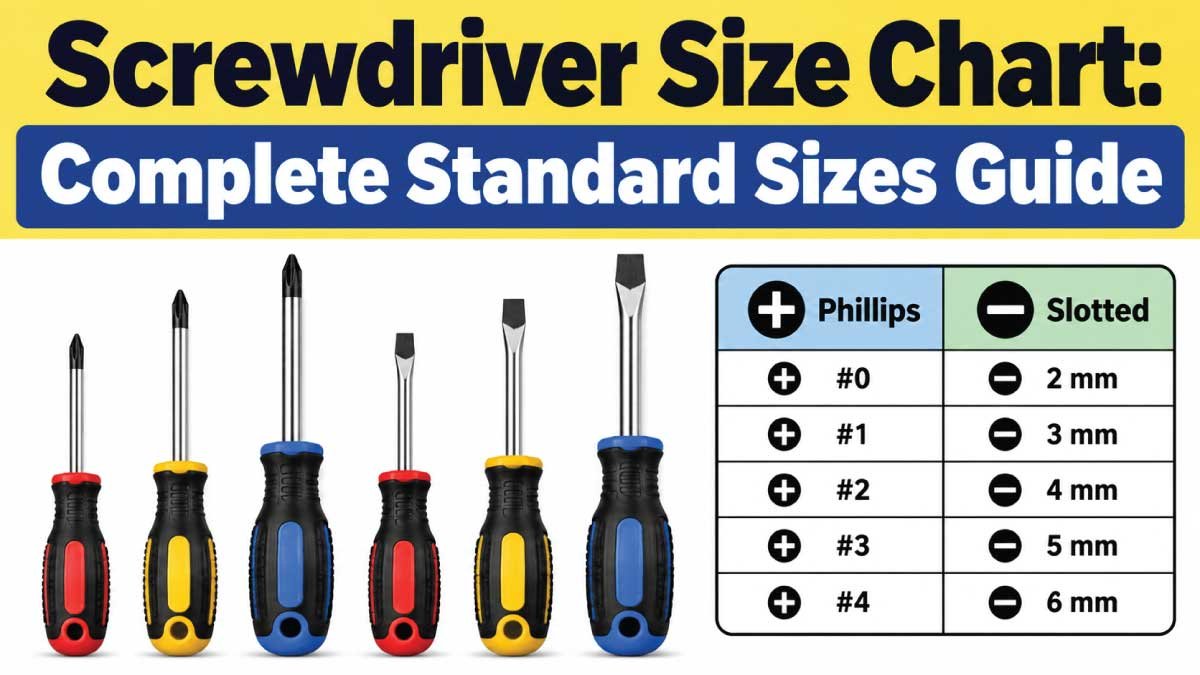
Choosing the correct screwdriver is about more than picking a handle that feels comfortable. The tip size, tip shape, drive type, shaft dimensions, and screw head pattern all affect whether a screwdriver will fit properly and transfer torque efficiently. A driver that is too small can slip and damage the screw, while one that is too large may not seat fully.
This screwdriver size chart explains common Phillips, slotted, Pozidriv, Torx, hex, and other screwdriver sizes in a practical format. It also covers how screwdriver sizes are identified, how to measure a screwdriver tip, which size to use for common screws, and how to avoid selecting the wrong driver.
What Does Screwdriver Size Mean?
Screwdriver size normally refers to the working end of the tool, particularly the dimensions of its tip and the screw-drive profile it is designed to fit. It does not necessarily refer to the overall length of the screwdriver.
Different screwdriver systems use different methods to identify size. For example, Phillips screwdrivers commonly use numbered sizes such as PH0, PH1, PH2, and PH3, while Torx drivers use sizes such as T10, T15, T20, and T25.
For slotted screwdrivers, size is commonly described using the blade width and blade thickness.
The important characteristics include:
Drive type: Phillips, slotted, Pozidriv, Torx, hex, square, or another profile.
Tip size: The dimensions of the portion that engages the screw.
Shaft length: The distance from the handle to the working tip.
Shaft diameter: Important for access and clearance.
Overall length: The complete length of the tool.
Tip geometry: Determines whether the driver properly matches the fastener.
A screwdriver should be selected according to the screw head drive, not simply by the physical size of the screw.
Screwdriver Size Chart by Drive Type
The following charts provide commonly encountered screwdriver sizes. Exact tip geometry can vary between manufacturers, so the markings on the fastener and tool should always take priority when available.
Phillips Screwdriver Size Chart
Phillips drivers are identified by the PH designation and number. The larger the number, the larger the intended drive profile.
| Phillips Size | Common Marking | Typical Use |
|---|---|---|
| PH000 | PH000 | Very small precision screws |
| PH00 | PH00 | Small electronics and precision work |
| PH0 | PH0 | Small screws and light-duty applications |
| PH1 | PH1 | Small to medium screws |
| PH2 | PH2 | General-purpose screws |
| PH3 | PH3 | Larger screws and heavier applications |
| PH4 | PH4 | Large fasteners and specialized applications |
PH2 is one of the most commonly encountered Phillips driver sizes for general-purpose work, but it should not automatically be used for every Phillips screw.
Slotted Screwdriver Size Chart
Slotted, or flat-head, screwdrivers are generally described by blade width and thickness rather than a numbered drive system.
| Blade Width | Typical Blade Thickness | Typical Application |
|---|---|---|
| 2.0 mm | Small | Precision screws |
| 2.5 mm | Small | Electronics and small hardware |
| 3.0 mm | Small | Small general-purpose screws |
| 4.0 mm | Medium | General maintenance |
| 5.5 mm | Medium | General-purpose fasteners |
| 6.5 mm | Medium | Larger screws |
| 8.0 mm | Large | Heavy-duty applications |
| 10.0 mm+ | Large | Large slotted fasteners |
For a slotted screw, the blade should fill the slot without extending excessively beyond its sides.
Pozidriv Screwdriver Size Chart
Pozidriv is commonly identified as PZ followed by a number. Although Pozidriv and Phillips both have cross-shaped appearances, their tip geometry is different.
Using a Phillips driver in a Pozidriv screw, or vice versa, can result in poor engagement and increased risk of cam-out.
| Pozidriv Size | Marking | Typical Application |
|---|---|---|
| PZ0 | PZ0 | Small screws |
| PZ1 | PZ1 | Small and medium screws |
| PZ2 | PZ2 | General-purpose applications |
| PZ3 | PZ3 | Larger construction and industrial screws |
| PZ4 | PZ4 | Large specialized fasteners |
The most appropriate PZ size depends on the screw head. The driver should sit firmly in the recess without excessive movement.
Torx Screwdriver Size Chart
Torx drivers use a six-point star-shaped profile and are identified with a T number. Torx sizes are not interchangeable with Phillips or slotted sizes.
Common Torx sizes include:
| Torx Size | Typical Application |
|---|---|
| T5 | Small electronics |
| T6 | Small electronic and precision assemblies |
| T8 | Electronics and small mechanisms |
| T10 | Small equipment and appliances |
| T15 | Electronics and machinery |
| T20 | General equipment and hardware |
| T25 | Automotive, machinery, and construction |
| T27 | Larger mechanical applications |
| T30 | Automotive and industrial hardware |
| T40 | Larger fasteners |
| T45 | Automotive and mechanical assemblies |
| T50 | Heavy-duty fasteners |
| T55 | Large mechanical applications |
| T60 | Large specialized fasteners |
Torx sizing should always be matched directly to the screw. A T25 driver, for example, should not be substituted simply because a T20 appears visually close.
Hex Screwdriver and Hex Bit Sizes
Hex drivers use a six-sided profile. They are often supplied as hex keys, hex screwdrivers, nut drivers, or screwdriver bits.
Metric hex sizes are usually expressed in millimeters, while imperial versions are expressed in fractions of an inch.
Metric Hex Driver Size Chart
| Hex Size | Common Use |
|---|---|
| 1.5 mm | Precision hardware |
| 2 mm | Small machinery and assemblies |
| 2.5 mm | Small mechanical hardware |
| 3 mm | General mechanical applications |
| 4 mm | Machinery and equipment |
| 5 mm | General-purpose hardware |
| 6 mm | Larger mechanical fasteners |
| 8 mm | Heavy-duty assemblies |
| 10 mm | Large fasteners |
Metric and imperial hex sizes can appear similar but are not necessarily interchangeable. Using the wrong system can damage the fastener recess.
Square or Robertson Screwdriver Sizes
Square-drive screws, often associated with the Robertson drive, use a square-shaped recess.
Common sizes include:
| Square Drive Size | Common Identification | Typical Use |
|---|---|---|
| #0 | SQ0 | Small screws |
| #1 | SQ1 | Small hardware |
| #2 | SQ2 | General-purpose applications |
| #3 | SQ3 | Larger screws |
| #4 | SQ4 | Large fasteners |
The correct square driver should engage the recess fully. A loose fit can make torque transfer less reliable.
Common Screwdriver Sizes at a Glance
For quick reference, the following chart groups common screwdriver profiles and their frequently encountered sizes.
| Drive Type | Common Sizes | Identification |
|---|---|---|
| Phillips | PH0, PH1, PH2, PH3 | PH + number |
| Pozidriv | PZ0, PZ1, PZ2, PZ3 | PZ + number |
| Torx | T10, T15, T20, T25, T30, T40 | T + number |
| Slotted | 2, 3, 4, 5.5, 6.5, 8 mm | Blade width |
| Hex Metric | 1.5, 2, 2.5, 3, 4, 5, 6 mm | Across flats |
| Square | SQ0, SQ1, SQ2, SQ3 | Number |
This is a general reference chart, not a universal interchangeability chart. Screw dimensions, manufacturers, drive standards, and applications can vary.
How to Measure Screwdriver Size
If the screwdriver has no visible size marking, you can identify its approximate dimensions by measuring the working end.
Measure a Slotted Screwdriver
A slotted screwdriver is relatively straightforward to measure.
Measure:
Blade width across the flat working end.
Blade thickness through the thickest part of the tip.
Shaft length from the handle to the tip.
Overall length from the end of the handle to the working end.
The blade width and thickness are the most important measurements when matching it to a slotted screw.
Measure a Phillips or Pozidriv Driver
Cross-shaped drivers are more difficult to identify using only a ruler because their geometry is three-dimensional.
Instead:
- Look for the PH or PZ marking on the shaft or handle.
- Compare the tip against a known driver.
- Test the fit in the screw recess without applying significant force.
- Check whether the driver sits fully in the recess.
- Avoid assuming PH and PZ drivers are interchangeable.
A proper fit is usually a better indicator than simply measuring the outside diameter of the tip.
Measure a Torx Driver
Torx drivers should preferably be identified by their T marking. If the marking is missing, compare the tip with a known Torx fastener or use an appropriate measuring tool to establish the approximate geometry.
Because Torx sizes are defined by the drive profile rather than a simple blade width, measuring one dimension alone may not reliably identify the size.
Screwdriver Shaft Length and Dimensions
Tip size is only one part of screwdriver dimensions. Shaft length can significantly affect accessibility.
A screwdriver with the correct tip may still be unsuitable if its shaft is too long or too short for the working area.
Common Shaft Length Categories
| Shaft Length Category | Typical Characteristic | Useful For |
|---|---|---|
| Short | Compact shaft | Tight spaces and confined access |
| Medium | General-purpose length | Everyday maintenance |
| Long | Extended reach | Deep or recessed screws |
| Extra-long | Specialized reach | Difficult-access applications |
Stubby screwdrivers are particularly useful where a normal handle cannot rotate freely. Long-shaft drivers can reach recessed fasteners but may have less convenient handling in confined spaces.
The best length is determined by access, clearance, required torque, and working position.
How to Choose the Correct Screwdriver Size
Selecting the right driver starts with identifying the screw’s drive profile.
Match the Drive Type First
Determine whether the screw is:
- Phillips
- Pozidriv
- Slotted
- Torx
- Hex
- Square
- Another specialized profile
Do not select a driver solely based on how similar the screw head looks.
Match the Tip Size Second
Once the drive type is known, choose the size that provides a firm, complete fit.
The correct screwdriver should:
- Sit deeply in the recess.
- Have minimal side-to-side movement.
- Contact the intended drive surfaces evenly.
- Remain stable when moderate hand pressure is applied.
- Transfer turning force without immediately slipping.
Consider Access
After selecting the tip, consider shaft length and handle dimensions.
For recessed screws, a longer shaft may be useful. For restricted spaces, a short or stubby screwdriver can be more practical.
Why Using the Wrong Screwdriver Size Causes Problems
A screwdriver that does not fit properly can create several practical problems.
Cam-Out
Cam-out occurs when the driver moves out of the screw recess while torque is being applied. This is especially common when the driver is too small, the wrong profile, worn, or held at an angle.
Stripped Screw Heads
Repeated slipping can wear away the drive recess. Once the recess becomes damaged, removing the fastener becomes more difficult.
Damaged Screwdriver Tips
Using an undersized or incompatible driver can concentrate force on small contact areas, increasing wear on the tool.
Poor Torque Transfer
A properly matched driver transfers force through the intended surfaces. An incorrect size can reduce the usable contact area and make controlled tightening or loosening more difficult.
Phillips vs Pozidriv: Are They the Same Size?
Phillips and Pozidriv are different drive systems even though both have cross-shaped recesses.
A Phillips recess has a primary cross shape, while Pozidriv incorporates additional geometry intended to improve engagement with its matching driver.
The practical rule is simple:
Use a PH driver for a Phillips screw and a PZ driver for a Pozidriv screw whenever the fastener is identified as such.
If a screw has markings on the head, use those markings to determine the correct driver type.
Also Read:
Screwdriver Size vs Screw Size
One common misunderstanding is that the screwdriver size should directly correspond to the screw’s diameter.
It does not.
A screw may have a particular thread diameter, length, head diameter, and drive recess, but the screwdriver is selected primarily according to the drive recess.
For example, two screws can have different body diameters but use the same drive size. Conversely, screws of similar body diameter can use different drive profiles.
When choosing a screwdriver, identify the head drive first, then select the corresponding size.
Screwdriver Types and Their Applications
Different screwdriver profiles are suited to different fastener designs and environments.
Phillips Screwdrivers
Common in general assembly, household hardware, equipment, appliances, and many manufactured products.
Slotted Screwdrivers
Used with traditional flat-recess screws and can also be useful for certain adjustment and maintenance tasks.
Pozidriv Screwdrivers
Frequently encountered in applications using Pozidriv fasteners, particularly where the matching drive profile is specified.
Torx Screwdrivers
Common in automotive, electronics, machinery, appliances, and equipment where a six-point star drive is used.
Hex Drivers
Useful for hex socket screws and mechanical assemblies. They are available in both metric and imperial sizes.
Precision Screwdrivers
Designed for small fasteners found in electronics, instruments, optical equipment, and other delicate assemblies. Their small tips require controlled force rather than high torque.
Also Read:
Common Screwdriver Size Mistakes to Avoid
Even experienced users can select an unsuitable screwdriver when the screw head is worn or difficult to identify.
Avoid these mistakes:
Using PH when the screw requires PZ.
Choosing a driver that is visibly too small.
Forcing a larger driver into a recess.
Using metric and imperial hex sizes interchangeably.
Ignoring worn screwdriver tips.
Applying high torque before confirming proper engagement.
Using a long screwdriver where access requires a compact tool.
Assuming screwdriver size is based on screw diameter.
Using a damaged screw head as the only reference for size selection.
When a fastener is damaged, first determine whether the original drive profile can still be identified. If not, forcing different drivers into the recess can make the problem worse.
Also Read:
Tips for Maintaining Screwdriver Accuracy and Performance
A screwdriver works best when its tip remains in good condition.
Keep these practices in mind:
- Inspect the tip before demanding high torque.
- Replace drivers with severely worn or deformed tips.
- Keep precision screwdriver tips clean.
- Store tools so working ends do not become damaged.
- Use the correct driver profile for the fastener.
- Apply firm axial pressure while turning when the application requires it.
- Keep the driver aligned with the screw axis.
- Do not use a screwdriver as a pry bar unless it is specifically designed for that purpose.
- Use a torque-controlled tool when the fastening specification requires controlled torque.
Tool markings can also become difficult to read over time. Maintaining an organized screwdriver set makes it easier to identify the correct size quickly.
Frequently Asked Questions
What is the most common Phillips screwdriver size?
PH2 is one of the most commonly encountered Phillips sizes in general-purpose applications. However, the correct size depends on the screw head, so PH2 should not be treated as a universal choice.
What screwdriver sizes should a basic set include?
A practical general-purpose set often includes several Phillips, slotted, and Torx sizes. A broader set can add Pozidriv, hex, square, and precision drivers.
The exact combination should reflect the fasteners commonly encountered in your work.
Is a PH2 screwdriver the same as a PZ2?
No. PH2 and PZ2 are different drive profiles. Their similar numbering does not make them interchangeable.
How do I know what size screwdriver I need?
Identify the drive pattern on the screw first, then match the corresponding screwdriver size. The tip should fit deeply and securely with minimal movement.
Can I use a smaller screwdriver if it almost fits?
It is generally better to use the correct size. A screwdriver that is too small may engage only part of the recess and can slip or damage the fastener.
Does screwdriver shaft length determine screwdriver size?
No. Shaft length is a separate dimension. A screwdriver can have the same tip size as another driver while having a substantially different shaft length.
What is the difference between a screwdriver and a screwdriver bit?
A screwdriver is normally a complete hand tool with a handle and shaft. A screwdriver bit is a removable working component designed to fit a compatible bit holder, driver, or power tool.
Are Torx and star screwdrivers the same?
In common usage, “star” is often used to describe the six-point profile associated with Torx-style fasteners. The exact designation should be confirmed from the tool and fastener specifications.
Final Screwdriver Selection Checklist
Before using a screwdriver, check these points:
Identify the drive profile.
Select the correct tip size.
Confirm full engagement with the screw recess.
Choose an appropriate shaft length.
Check the tip for wear or damage.
Keep the driver aligned with the fastener.
Use the appropriate tool when controlled torque is required.
Do not substitute similar-looking drive profiles without confirming compatibility.
The most important lesson from a screwdriver size chart is that there is no single measurement system covering every screwdriver. Phillips and Pozidriv use numbered sizes, Torx uses T numbers, slotted drivers are commonly specified by blade dimensions, and hex drivers use across-flat measurements.
Selecting the correct drive type and tip size gives the screw the engagement it was designed for and helps reduce slipping, recess damage, and unnecessary tool wear. For critical assemblies, always use the fastener manufacturer’s specified drive and tool requirements.

Engineer Hassan is a Mechanical Engineer with 16+ years of hands-on experience in mechanical hardware, fasteners, and workshop tools. He focuses on size selection, thread identification, and measurement, helping users choose the correct components with accuracy and safety.