
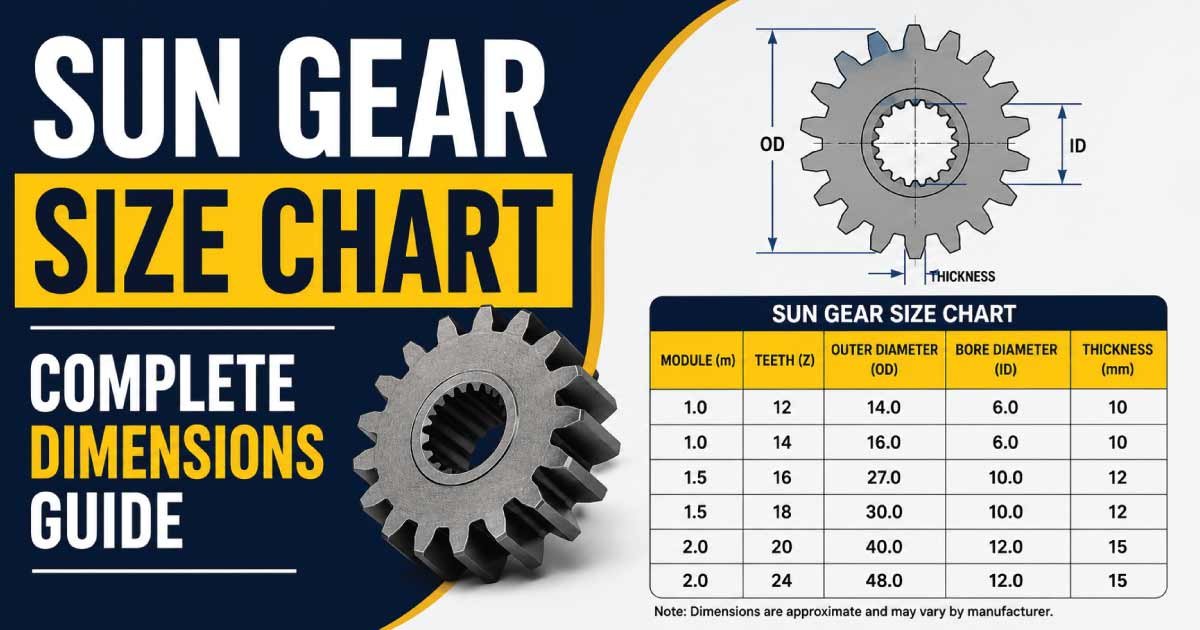
A sun gear is one of the central components of a planetary gear system. It sits near the center of the planetary assembly and meshes with one or more planet gears. The size of the sun gear directly affects the speed ratio, torque distribution, gear geometry, and overall performance of the planetary transmission.
Choosing the correct sun gear size requires more than measuring its outside diameter. Important factors include the number of teeth, module or diametral pitch, pressure angle, pitch diameter, face width, bore diameter, and gear material. The sun gear must also match the planet gears and ring gear used in the same planetary gear set.
This sun gear size chart provides a practical reference for common gear dimensions and explains how to measure, identify, select, and match a sun gear. Because planetary gear dimensions are application-specific rather than universally standardized, always verify the exact specifications against the original gear or manufacturer’s drawing before replacement.
What Is a Sun Gear?
A sun gear is the central gear in a planetary gear system. It meshes with multiple planet gears that rotate around it.
A basic planetary gear set normally contains three major gear elements:
- Sun gear
- Planet gears
- Ring gear
The planet gears are mounted on a carrier and rotate around the sun gear. Depending on which component is held stationary and which component receives the input or output, the planetary system can produce different speed ratios and torque characteristics.
Sun gears are commonly found in:
- Automatic transmissions
- Industrial gearboxes
- Robotics
- Construction equipment
- Wind turbine gear systems
- Aerospace mechanisms
- Agricultural machinery
- Hybrid and electric drivetrains
- Power transmission equipment
Because the sun gear is part of a matched planetary system, its dimensions must be compatible with the other gears.
How Sun Gear Sizes Are Determined
Sun gear size is determined by several dimensions rather than one measurement.
The most important specifications include:
- Number of teeth
- Module
- Diametral pitch
- Pitch diameter
- Outside diameter
- Root diameter
- Face width
- Bore diameter
- Pressure angle
- Helix angle for helical gears
- Material
- Heat treatment
For spur planetary gears, the relationship between module, tooth count, and pitch diameter is:
Pitch Diameter = Module × Number of Teeth
For inch-based gears:
Pitch Diameter = Number of Teeth ÷ Diametral Pitch
For example, a sun gear with 20 teeth and a module of 2 mm has a pitch diameter of approximately 40 mm.
These calculations help identify gear geometry, but they do not by themselves establish whether two gears are interchangeable.
Common Sun Gear Size Chart
The following chart provides representative sun gear sizes based on common tooth counts and metric modules. These are reference dimensions, not a universal standard for replacement parts.
| Sun Gear Teeth | Module | Approx. Pitch Diameter | General Size Category |
|---|---|---|---|
| 12 | 1.0 | 12 mm | Small |
| 15 | 1.0 | 15 mm | Small |
| 18 | 1.0 | 18 mm | Small |
| 20 | 1.0 | 20 mm | Small |
| 20 | 1.5 | 30 mm | Small/Medium |
| 24 | 1.5 | 36 mm | Medium |
| 30 | 1.5 | 45 mm | Medium |
| 20 | 2.0 | 40 mm | Medium |
| 24 | 2.0 | 48 mm | Medium |
| 30 | 2.0 | 60 mm | Medium/Large |
| 36 | 2.0 | 72 mm | Large |
| 40 | 2.5 | 100 mm | Large |
| 50 | 2.5 | 125 mm | Large |
| 60 | 3.0 | 180 mm | Heavy-duty |
The actual outside diameter will differ from the pitch diameter because the tooth geometry extends above the pitch circle. Exact outside diameter depends on the gear standard, tooth profile, pressure angle, module, and manufacturing design.
Sun Gear Tooth Count
The number of teeth is one of the most important sun gear specifications.
A sun gear can have relatively few teeth compared with the ring gear, while the planet gears fill the space between the two.
Common tooth counts may range from small numbers for compact planetary systems to much larger counts for industrial gearboxes.
Tooth count affects:
- Gear ratio
- Pitch diameter
- Planet gear compatibility
- Ring gear relationship
- Contact ratio
- Rotational speed
- Torque characteristics
A replacement sun gear must have the correct tooth count for the planetary set.
Changing the tooth count without redesigning the rest of the gear set can cause incorrect meshing or an entirely different transmission ratio.
Sun Gear Module Size
Module is a metric measurement used to describe gear tooth size.
It is calculated as:
Module = Pitch Diameter ÷ Number of Teeth
A larger module means larger gear teeth.
For example:
| Module | Tooth Count | Pitch Diameter |
|---|---|---|
| 1.0 | 20 | 20 mm |
| 1.5 | 20 | 30 mm |
| 2.0 | 20 | 40 mm |
| 2.5 | 20 | 50 mm |
| 3.0 | 20 | 60 mm |
| 4.0 | 20 | 80 mm |
For a planetary system, the sun, planet, and ring gears must have compatible tooth dimensions.
Module is especially important when replacing a damaged sun gear because a gear with the same number of teeth but a different module will not mesh correctly.
Sun Gear Diametral Pitch
Diametral pitch, often abbreviated as DP, is commonly used for inch-based gear systems.
It describes the number of teeth per inch of pitch diameter.
The basic relationship is:
DP = Number of Teeth ÷ Pitch Diameter
For example, a 20-tooth gear with a 2-inch pitch diameter has a diametral pitch of 10.
Common diametral pitch values include:
- 4 DP
- 6 DP
- 8 DP
- 10 DP
- 12 DP
- 16 DP
- 20 DP
A higher diametral pitch generally indicates smaller teeth, while a lower diametral pitch indicates larger teeth.
The sun gear and mating planetary gears must use compatible pitch specifications.
Sun Gear Pitch Diameter
Pitch diameter is the theoretical diameter at which two mating gears effectively transfer motion.
For metric gears:
Pitch Diameter = Module × Teeth
For diametral-pitch gears:
Pitch Diameter = Teeth ÷ DP
Pitch diameter is extremely useful when identifying an unknown sun gear because it connects the physical gear diameter with tooth count and gear pitch.
However, measuring the outside diameter alone is not enough to determine pitch diameter.
Sun Gear Outside Diameter
Outside diameter is the largest diameter measured across the gear teeth.
For a common standard spur gear profile, the outside diameter can often be approximated using:
Outside Diameter ≈ Module × (Number of Teeth + 2)
For example, a standard module 2 gear with 20 teeth may have an approximate outside diameter of:
2 × (20 + 2) = 44 mm
Actual dimensions can vary according to the gear standard and tooth profile.
Outside diameter should therefore be treated as an identification measurement rather than a complete description of a sun gear.
Sun Gear Face Width
Face width is the axial width of the toothed portion of the gear.
A wider face can provide greater tooth contact area and may be suitable for higher torque applications, provided the rest of the gear design supports it.
Typical sun gear face widths vary significantly depending on the application.
Face width affects:
- Load distribution
- Torque capacity
- Gear weight
- Heat generation
- Packaging
- Tooth contact
A replacement gear should normally use the same face width as the original unless the planetary assembly has been specifically redesigned.
Sun Gear Bore Size
The bore is the central opening through which the sun gear is mounted on a shaft or connected to another component.
Bore dimensions may include:
- Straight bore
- Keyway bore
- Splined bore
- Spline profile
- Special internal drive configuration
The bore must match the shaft or mounting system.
For example, two sun gears can have identical tooth counts, module, and outside diameter but still be incompatible because their internal spline or bore dimensions are different.
When identifying a replacement sun gear, measure:
- Bore diameter
- Bore length
- Keyway dimensions, if present
- Spline tooth count, if applicable
- Internal profile
Sun Gear Pressure Angle
Pressure angle describes the angle between the line of action and the tangent to the pitch circle.
Common pressure angles include:
- 14.5°
- 20°
- 25°
A 20° pressure angle is widely used in modern involute gear systems.
Pressure angle must match between mating gears. A sun gear with the wrong pressure angle may not mesh correctly with the planet gears even if its tooth count and diameter appear correct.
Therefore, pressure angle should be checked when identifying or replacing a sun gear.
Sun Gear Types
Sun gears can have different designs depending on the planetary transmission.
Spur Sun Gear
A spur sun gear has straight teeth parallel to the gear axis.
Advantages include:
- Simple design
- Easy manufacturing
- Lower production cost
- Straightforward inspection
Spur planetary gears are commonly used in applications where axial forces need to be minimized.
Helical Sun Gear
A helical sun gear has teeth angled relative to the gear axis.
Helical gears can provide smoother and quieter engagement and may offer higher contact ratios. However, they also generate axial forces that must be accommodated by the transmission design.
For a helical planetary system, the helix direction and angle must match the mating gears.
Spline-Mounted Sun Gear
Some sun gears use internal or external splines to transmit torque.
Spline dimensions are particularly important because the gear must fit the corresponding shaft or carrier component precisely.
How to Measure a Sun Gear
If you need to identify an existing sun gear, record as many dimensions as possible.
Measure the Number of Teeth
Count every tooth around the gear.
For small gears, marking the starting tooth can make counting easier.
Measure the Outside Diameter
Use a precision caliper to measure across the outermost tooth tips.
Avoid measuring at an angle because this can produce inaccurate results.
Determine the Module
If the gear is metric, calculate:
Module = Pitch Diameter ÷ Tooth Count
If the gear’s pitch diameter is not known, use additional measurements and compare them with the manufacturer’s gear specifications.
Measure the Face Width
Measure the axial width of the toothed section.
Measure the Bore
Measure the internal diameter or spline dimensions.
Check the Pressure Angle
If technical documentation is available, verify the pressure angle. This is much more reliable than trying to determine it from visual inspection.
Discover More:
Sun Gear and Planet Gear Relationship
The sun gear does not operate independently.
For a simple planetary gear set, the tooth counts of the sun, planet, and ring gears must satisfy a geometric relationship.
A common relationship is:
Ring Gear Teeth = Sun Gear Teeth + 2 × Planet Gear Teeth
This relationship helps ensure that the gears can physically mesh within the planetary carrier.
For example, if a planetary set uses:
- Sun gear = 20 teeth
- Planet gear = 30 teeth
Then the corresponding ring gear would have:
20 + 2(30) = 80 teeth
This relationship is useful when designing or identifying a simple planetary gear set, but actual assemblies can have additional constraints involving planet spacing, manufacturing tolerances, gear profile, and carrier geometry.
Sun Gear Size and Planetary Gear Ratio
The sun gear’s tooth count affects the ratio of a planetary gear system.
For a simple planetary system, the fundamental relationship is commonly expressed as:
Nₛωₛ + Nᵣωᵣ = (Nₛ + Nᵣ)ω𝑐
Where:
- Nₛ = sun gear tooth count
- Nᵣ = ring gear tooth count
- ωₛ = sun gear speed
- ωᵣ = ring gear speed
- ω𝑐 = carrier speed
The final speed ratio depends on which component is held stationary and which component is used as the input or output.
This is why changing the sun gear tooth count can significantly change the operating characteristics of the planetary transmission.
Discover More:
How to Choose the Correct Sun Gear Size
Selecting the correct sun gear requires matching it to the complete planetary system.
Check the Tooth Count
Start with the number of teeth.
The replacement should normally have the same tooth count as the original unless a different ratio has been intentionally designed.
Match the Module or DP
The gear pitch must match the planet and ring gears.
Check the Pressure Angle
Verify that the pressure angle matches the mating gears.
Check the Bore or Spline
Make sure the gear fits the shaft or mounting system.
Check the Face Width
The replacement should provide the required tooth width and fit within the assembly.
Check the Material
High-load planetary systems may require hardened alloy steel or other specially treated materials.
Check the Helix Angle
For helical planetary systems, verify both helix angle and direction.
Sun Gear Materials
Sun gears are exposed to repeated tooth loading and may operate at high rotational speeds.
Common materials include:
- Alloy steel
- Carbon steel
- Case-hardened steel
- Through-hardened steel
- Powder-metal materials in some applications
Heat treatment can significantly improve wear resistance and fatigue performance.
Common treatments include:
- Carburizing
- Nitriding
- Induction hardening
- Through hardening
The appropriate material and treatment depend on torque, speed, duty cycle, lubrication, temperature, and required service life.
Discover More:
Common Sun Gear Problems
Sun gears can experience several types of damage during operation.
Tooth Wear
Repeated contact can gradually wear the tooth surfaces.
Pitting
Surface fatigue can create small pits on gear teeth, especially under repeated high loads.
Tooth Breakage
Excessive torque, shock loading, poor alignment, or material defects can cause teeth to fracture.
Scoring
Insufficient lubrication or excessive surface pressure can damage the tooth surfaces.
Spline Wear
If the sun gear uses splines, repeated torque cycles can cause wear or backlash in the spline connection.
Regular inspection and correct lubrication can help reduce these problems.
Sun Gear Replacement Tips
When replacing a sun gear, compare the old and new components carefully.
Check:
- Tooth count
- Module or DP
- Outside diameter
- Pitch diameter
- Face width
- Bore diameter
- Spline dimensions
- Pressure angle
- Helix angle
- Material
- Heat treatment
- Manufacturer part number
Do not assume that a gear is compatible simply because it has the same outside diameter.
The tooth geometry and mounting dimensions must also match the planetary assembly.
Common Sun Gear Sizing Mistakes
Avoid these common mistakes when identifying or replacing a sun gear:
- Measuring only the outside diameter
- Ignoring tooth count
- Using the wrong module
- Mixing metric and inch gear pitches
- Ignoring pressure angle
- Overlooking the bore or spline
- Using the wrong face width
- Mixing spur and helical gears
- Ignoring helix direction
- Assuming larger gears automatically provide higher capacity
- Replacing only the sun gear when the mating gears are worn
Planetary gears operate as a matched system, so all mating components should be inspected when replacing a heavily worn sun gear.
Sun Gear Maintenance Tips
Proper maintenance can significantly extend planetary gear life.
Use the Correct Lubricant
Use the lubricant specified for the transmission or gearbox.
Monitor Gear Noise
Unusual whining, grinding, clicking, or knocking can indicate gear wear, misalignment, or lubrication problems.
Inspect Tooth Surfaces
Look for:
- Pitting
- Cracks
- Scoring
- Discoloration
- Excessive polishing
- Broken teeth
Check Backlash
Excessive backlash can indicate wear in the gear set or related components.
Maintain Alignment
Proper alignment is essential for distributing load evenly across the gear teeth.
Frequently Asked Questions About Sun Gear Sizes
What is the most important sun gear size measurement?
The most important measurements depend on the application, but tooth count, module or diametral pitch, pressure angle, and mounting dimensions are critical for compatibility. Outside diameter alone is not enough to identify a sun gear because different gear designs can have similar outside dimensions.
How do I calculate sun gear pitch diameter?
For a metric gear, multiply the module by the number of teeth. For example, a module 2 gear with 20 teeth has a pitch diameter of 40 mm. For an inch-based gear, divide the tooth count by the diametral pitch to determine pitch diameter.
Can I use any sun gear with a planetary gear set?
No. A sun gear must match the planet and ring gears in tooth geometry, module or diametral pitch, pressure angle, and other important dimensions. The mounting bore, spline, face width, and helix specifications must also be compatible with the planetary assembly.
Does a larger sun gear increase torque?
Not necessarily. Sun gear size affects the planetary ratio, geometry, and load distribution, but torque capacity depends on the complete gear design. Material, tooth size, face width, heat treatment, lubrication, speed, and the ring and planet gears all influence the system’s torque capability.
How many teeth should a sun gear have?
There is no single correct tooth count for every planetary gear system. The number depends on the desired ratio, planet gear size, ring gear tooth count, geometry, and application. The sun, planet, and ring gears must be designed as a compatible set.
Conclusion
A sun gear size chart is a useful starting point for identifying planetary gear dimensions, but there is no single universal sun gear size that fits every planetary transmission. Tooth count, module, diametral pitch, pitch diameter, pressure angle, face width, bore, spline dimensions, and helix specifications all affect compatibility.
When replacing a sun gear, begin by recording the number of teeth, outside diameter, module or DP, face width, bore, and mounting configuration. Then compare those measurements with the planet and ring gear specifications.
For accurate replacement, use the original manufacturer’s part number or engineering drawing whenever possible. Since planetary gears operate as a matched system, selecting the correct sun gear size is essential for proper meshing, efficient power transmission, durability, and reliable operation.

Engineer Hassan is a Mechanical Engineer with 16+ years of hands-on experience in mechanical hardware, fasteners, and workshop tools. He focuses on size selection, thread identification, and measurement, helping users choose the correct components with accuracy and safety.