
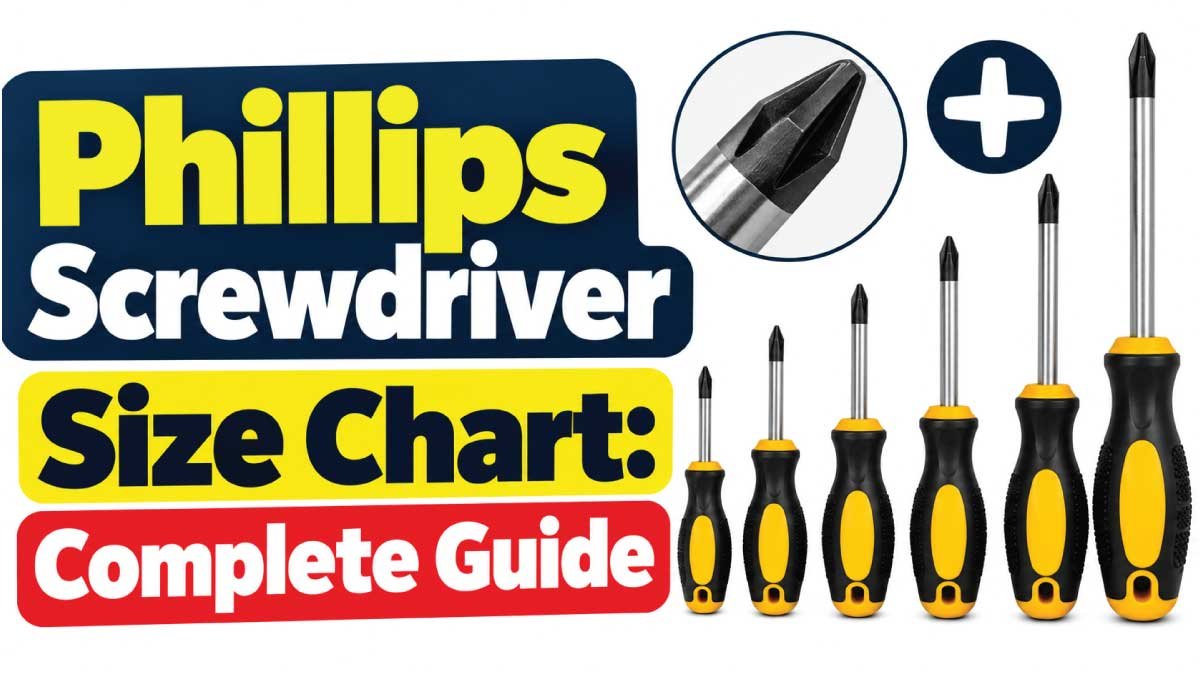
Choosing the correct Phillips screwdriver is easier when you understand how Phillips sizes are designated and how the driver tip should fit the screw recess. A screwdriver that is too small can slip and damage the recess, while one that is too large may not seat properly.
The Phillips screwdriver size chart below explains the commonly encountered #000, #00, #0, #1, #2, #3, and #4 sizes, along with typical applications, fit considerations, measurement methods, and practical selection tips. Because exact recess geometry can vary by screw manufacturer and application, the number on the driver is more useful than relying on a single tip-width measurement.
What Is a Phillips Screwdriver?
A Phillips screwdriver is a hand tool designed for screws with a cross-shaped Phillips recess in the head. Its tip has four primary driving surfaces arranged around a central point.
Phillips screws are commonly identified by a number preceded by a hash symbol, such as #0, #1, or #2. The number indicates the intended driver size rather than simply describing the physical length of the screwdriver.
The most important characteristic is the relationship between the driver tip and the screw recess. The correct Phillips driver should enter the recess fully and sit firmly without excessive movement.
Phillips screwdrivers are widely used in:
- Machinery and equipment
- Electrical devices
- Appliances
- Automotive components
- Furniture and hardware
- Consumer electronics
- General maintenance
- Construction and workshop applications
A Phillips screwdriver may have a short or long shaft, different handle designs, or interchangeable bits, but the Phillips size designation refers primarily to the driving tip.
Phillips Screwdriver Size Chart
Phillips drivers are available in several sizes, from very small precision drivers to large industrial versions. The following chart provides a practical overview of the commonly encountered sizes.
| Phillips Size | Relative Tip Size | Typical Applications | Common Screw Category |
|---|---|---|---|
| #000 | Very small | Precision electronics and miniature hardware | Tiny machine screws |
| #00 | Extra small | Electronics, small devices, precision work | Small machine screws |
| #0 | Small | Small appliances, electronics, light hardware | Small screws |
| #1 | Medium-small | Electrical equipment, hardware, small machinery | Small to medium screws |
| #2 | Medium | General-purpose fastening, appliances, machinery | Common general-purpose screws |
| #3 | Large | Heavy hardware and larger fasteners | Large screws |
| #4 | Very large | Specialized heavy-duty applications | Very large Phillips screws |
The #2 Phillips screwdriver is one of the most commonly encountered general-purpose sizes, but it should not automatically be used for every Phillips screw. The screw head determines the appropriate size.
Understanding Phillips Screwdriver Sizes
What Does the # Number Mean?
The number identifies the Phillips driver size. In general, a larger number corresponds to a larger driver tip.
For example:
- #000 is smaller than #00.
- #00 is smaller than #0.
- #0 is smaller than #1.
- #1 is smaller than #2.
- #2 is smaller than #3.
- #3 is smaller than #4.
This numbering system is important because two Phillips drivers can look similar while having significantly different tip geometry.
The designation should therefore be treated as a driver-size classification, not simply a measurement of the shaft or handle.
Does a Larger Number Always Mean a Longer Screwdriver?
No. Phillips size and screwdriver length are separate characteristics.
A #2 Phillips screwdriver can have:
- A short shaft
- A standard shaft
- A long shaft
- A stubby handle
- An interchangeable bit
The #2 designation describes the tip size, while the shaft length describes how far the tip extends from the handle.
Phillips Screwdriver Sizes and Typical Uses
#000 Phillips Screwdriver
The #000 Phillips is intended for extremely small fasteners. It is commonly encountered where the screw head and recess are too small for ordinary household drivers.
Typical applications include:
- Miniature electronics
- Precision instruments
- Small electronic assemblies
- Tiny machine screws
- Specialized repair work
Because the recess is very small, using a larger driver can quickly damage the screw head.
#00 Phillips Screwdriver
The #00 is another small Phillips size frequently associated with precision work.
It can be useful for:
- Small electronics
- Compact devices
- Precision assemblies
- Small appliance components
- Miniature hardware
A #00 is larger than a #000 but smaller than a #0.
#0 Phillips Screwdriver
The #0 Phillips is a small general-purpose precision size. It is useful when a #00 is too small but a #1 is too large.
Typical applications may include:
- Small mechanical assemblies
- Electronics
- Small appliances
- Electrical components
- Compact hardware
The exact screw application depends on the recess specification rather than the screw’s overall appearance.
#1 Phillips Screwdriver
The #1 is commonly used for smaller general-purpose screws. It provides more driving capacity than the smaller precision sizes while remaining considerably smaller than a #2.
Common applications include:
- Electrical equipment
- Small machinery
- Hardware assemblies
- Appliances
- Furniture components
- Small sheet-metal screws
#2 Phillips Screwdriver
The #2 Phillips screwdriver is a widely used general-purpose size. It is frequently found in household, workshop, maintenance, furniture, electrical, and mechanical applications.
Common uses include:
- General machine screws
- Wood screws with Phillips recesses
- Appliance fasteners
- Electrical hardware
- Furniture assembly
- Workshop maintenance
- General mechanical work
Because #2 is common, many screwdriver sets include several different #2 configurations, such as standard, long-shaft, stubby, and bit-driver versions.
#3 Phillips Screwdriver
The #3 is substantially larger than the common smaller sizes and is intended for larger Phillips recesses.
Typical applications can include:
- Larger mechanical assemblies
- Heavy hardware
- Machinery
- Automotive components
- Larger structural or equipment fasteners
The correct application still depends on the screw design and recess.
#4 Phillips Screwdriver
The #4 is a very large Phillips size used for specialized fasteners requiring a large driving interface.
It is much less common in ordinary household toolboxes than #1 or #2.
When using a #4 driver, verify that the screw is specifically designed for that size rather than attempting to force the driver into a smaller recess.
Phillips Driver Dimensions Explained
When people search for Phillips screwdriver dimensions, they may be referring to several different measurements. These should not be confused.
Tip Size
The tip is the portion that enters the Phillips recess. The # designation primarily identifies this driving size.
Tip geometry includes more than just its maximum width. The shape, taper, angles, and engagement surfaces all influence how well the driver fits.
Shaft Length
Shaft length is the distance from the handle to the working end of the screwdriver.
Common screwdriver configurations include:
- Short shaft
- Standard shaft
- Long shaft
- Extra-long shaft
Shaft length should be selected based on access requirements rather than screw size alone.
Overall Length
Overall length includes the handle and shaft. A compact screwdriver may have the same Phillips tip size as a long screwdriver while being much shorter overall.
Handle Size
Handle dimensions affect grip, comfort, and torque. A large handle may be useful when more turning force is required, while a compact handle can provide better access in restricted spaces.
Why Exact Phillips Tip Measurements Can Vary
It is tempting to create a simple table showing one exact diameter for every Phillips size. However, Phillips drive geometry is not adequately described by a single diameter.
The actual driving interface involves multiple geometric features, including:
- Tip width
- Recess depth
- Taper
- Driving-face geometry
- Point shape
- Engagement area
Manufacturers may also produce drivers with slightly different physical dimensions while maintaining the same nominal Phillips designation.
For this reason, a #2 Phillips driver should be selected primarily according to the screw’s specified drive size and actual fit, rather than assuming every #2 tool has exactly the same physical dimensions.
Phillips Screwdriver Size Comparison
The following comparison helps visualize the relative progression of commonly used Phillips sizes.
| Size | Relative Size | Best Suited For | Availability in Tool Sets |
|---|---|---|---|
| #000 | Very small | Miniature precision work | Specialized |
| #00 | Extra small | Small electronics | Common in precision sets |
| #0 | Small | Small hardware | Common |
| #1 | Medium-small | Small general-purpose screws | Very common |
| #2 | Medium | General-purpose fastening | Very common |
| #3 | Large | Large fasteners and equipment | Common in larger sets |
| #4 | Very large | Specialized heavy fasteners | Less common |
The progression is straightforward, but the correct size is determined by the screw recess, not by the expected application alone.
Also Read:
How to Choose the Correct Phillips Screwdriver Size
Inspect the Screw Recess
Start by looking directly at the cross-shaped recess.
The driver should enter the recess without needing to be forced. If the tip sits high above the bottom of the recess, it may be too large or have the wrong geometry.
Test the Fit
Place the driver into the screw before applying substantial force.
A properly matched driver should:
- Seat firmly in the recess
- Engage the driving surfaces properly
- Have minimal side-to-side movement
- Remain centered when moderate pressure is applied
If the driver rocks noticeably, stop and try another size.
Apply Downward Pressure
Phillips screws benefit from firm axial pressure while turning. This helps maintain contact between the driver and screw recess.
However, excessive force should not be used to compensate for an incorrect driver.
Choose the Size That Fully Engages
If two sizes appear close, compare how deeply each one seats.
The appropriate driver generally provides strong engagement across the intended driving surfaces without bottoming out incorrectly or binding against the recess.
Also Read:
How to Measure a Phillips Screwdriver
Measure the Driver Tip
A caliper can be used to measure accessible portions of the driver tip, but the result should not automatically be interpreted as an official Phillips size.
The reason is that the Phillips profile is three-dimensional. A single measurement cannot fully describe the drive geometry.
For practical identification:
- Clean the driver tip.
- Inspect the four driving surfaces.
- Compare the tip with known Phillips sizes.
- Check how it fits a known screw.
- Confirm the size marking if available.
Measure the Screw Head
Measuring the outside diameter of the screw head can provide useful information, but it does not reliably identify the Phillips driver size.
Different screw designs can have different head dimensions while using similar drive sizes.
The recess itself is the more relevant feature.
Also Read:
Phillips Screwdriver vs Phillips Screw Size
A common misunderstanding is that screwdriver size can be determined from screw diameter alone.
For example, two screws with similar outside diameters may use different drive configurations. Likewise, screws with different dimensions may use the same nominal driver size.
When selecting a screwdriver, consider:
- Drive designation
- Recess geometry
- Screw head design
- Fastener manufacturer
- Application
- Required torque
- Available access
The screw’s drive specification is more useful than simply measuring its threaded diameter.
Phillips vs Pozidriv Screwdrivers
Phillips and Pozidriv drivers can appear very similar because both have cross-shaped driving patterns. However, they are not identical.
A Pozidriv recess includes additional features between the primary cross arms, while a conventional Phillips recess has a different geometry.
Using the wrong driver can result in:
- Poor engagement
- Driver slipping
- Damaged recesses
- Reduced torque transfer
- Premature tool wear
If a screw is marked or specified as Pozidriv, use the corresponding Pozidriv driver rather than assuming a Phillips #2 will provide the correct fit.
Phillips vs Flat-Head Screwdrivers
A Phillips screwdriver has a cross-shaped tip, while a flat-head or slotted screwdriver has a single blade.
The two tools are designed for different screw recesses.
A Phillips screwdriver is appropriate when the screw has a compatible cross-shaped Phillips recess. A flat-head screwdriver should be used for a straight slot.
Trying to substitute one for the other can damage the fastener or tool.
Common Phillips Screwdriver Problems
Driver Keeps Slipping
Slipping usually indicates one or more problems with the tool or fastener.
Possible causes include:
- Incorrect Phillips size
- Worn driver tip
- Damaged screw recess
- Insufficient downward pressure
- Contamination inside the recess
- Incorrect drive type
Start by cleaning the recess and trying the correct driver size.
Screw Head Is Stripped
A stripped recess has lost some of its original driving geometry.
Before attempting removal, verify that the driver size and type are correct. A worn screwdriver should also be replaced.
For future work, avoid continuing to turn a driver that repeatedly slips.
Driver Fits but Does Not Turn the Screw
A driver can appear to fit while still having insufficient engagement.
Check whether the tip is fully seated and whether it is the correct Phillips type. Also inspect the screw for damage.
Tips for Preventing Phillips Screw Damage
Proper tool selection can significantly reduce unnecessary wear on Phillips fasteners.
Follow these practices:
- Use the correct size.
- Keep the driver aligned with the screw axis.
- Apply firm downward pressure.
- Avoid using worn driver tips.
- Clean dirt from the screw recess.
- Do not use excessive force to compensate for poor fit.
- Replace badly damaged screws when practical.
- Use a suitable driver length for the working area.
- Avoid mixing Phillips and other cross-drive types.
The goal is to maximize contact between the driver and the recess.
Phillips Screwdriver Bit Size and Interchangeable Drivers
Phillips bits use the same basic size designations as fixed-shaft Phillips screwdrivers. A #2 Phillips bit, for example, is intended for compatible #2 Phillips recesses.
Interchangeable bit systems provide several advantages:
- Multiple sizes in one tool
- Easy replacement of worn bits
- Compact storage
- Compatibility with bit holders
- Convenient use with powered tools
However, powered tools require additional care. Excessive speed or torque can damage the screw recess even when the bit size is correct.
For delicate fasteners, controlled pressure and speed are especially important.
Choosing Phillips Screwdriver Size for Different Applications
| Application | Common Phillips Range | Selection Consideration |
|---|---|---|
| Miniature electronics | #000–#0 | Prioritize precise engagement |
| Small appliances | #0–#1 | Check recess size carefully |
| Electrical hardware | #1–#2 | Match the fastener drive |
| Furniture assembly | #1–#3 | Screw design varies |
| General workshop work | #1–#3 | Keep multiple sizes available |
| Machinery | #2–#4 | Use the specified drive size |
| Heavy equipment | #3–#4 | Verify fastener specification |
These are typical application ranges, not universal rules. The actual screw recess should always determine the driver size.
What Phillips Screwdriver Sizes Should a Basic Tool Set Have?
For general household and workshop use, having several sizes is more useful than owning many screwdrivers of only one size.
A practical selection can include:
- #0 for smaller screws
- #1 for small general-purpose work
- #2 for common fastening
- #3 for larger screws
For precision work, adding #000 and #00 can be useful. If larger industrial fasteners are part of the work, a #4 may also be appropriate.
A set with different shaft lengths can further improve access without requiring different Phillips tip sizes.
Frequently Asked Questions
What is the most common Phillips screwdriver size?
The #2 Phillips is widely used for general-purpose fastening. However, it is not the correct choice for every Phillips screw. The screw’s recess should always be checked before selecting the driver.
What is the smallest common Phillips screwdriver size?
#000 is commonly used among standard Phillips size designations for very small precision fasteners. Smaller or specialized precision drive systems may use other designations or drive types.
Is a #1 Phillips smaller than a #2?
Yes. A #1 Phillips driver is smaller than a #2. The number generally increases as the nominal Phillips driver size increases.
Can I use a #2 Phillips on every Phillips screw?
No. A #2 is common, but Phillips screws are manufactured in multiple sizes. Using an incorrectly sized driver increases the risk of slipping and damaging the recess.
How do I know if my Phillips screwdriver is the right size?
Insert the tip into the screw recess and check the engagement. The driver should seat securely with minimal movement and should not require force simply to enter the recess.
Are Phillips and Pozidriv screwdrivers interchangeable?
They are not designed as interchangeable drive systems. Although they may look similar, their recess geometries differ. Use the driver type specified for the fastener.
Does screwdriver shaft length determine Phillips size?
No. Shaft length and Phillips tip size are independent characteristics. A #2 Phillips screwdriver can be manufactured with a short, standard, or long shaft.
Why does my Phillips screwdriver keep stripping screws?
Common causes include the wrong driver size, incorrect drive type, worn tooling, damaged fasteners, poor alignment, or insufficient downward pressure.
Key Takeaways from the Phillips Screwdriver Size Chart
Phillips screwdriver sizes are identified primarily by their # designation, with commonly encountered sizes ranging from #000 through #4.
The most important points to remember are:
- #000 and #00 are used for very small precision fasteners.
- #0 and #1 suit many smaller screws and assemblies.
- #2 is a widely used general-purpose size.
- #3 and #4 are intended for larger Phillips drive recesses.
- Shaft length does not determine Phillips tip size.
- Screw head diameter alone cannot reliably identify driver size.
- The correct driver should seat firmly with minimal movement.
- Phillips and Pozidriv drives should not be treated as identical.
- Exact physical dimensions can vary between manufacturers and tool designs.
- For critical applications, use the fastener manufacturer’s specified drive size and applicable documentation.
Conclusion
A Phillips screwdriver size chart is useful for narrowing down the right tool, but proper selection ultimately depends on the screw’s actual drive recess. The commonly used #000, #00, #0, #1, #2, #3, and #4 sizes cover a broad range of precision, household, mechanical, electrical, and industrial applications.
For the best fit, choose the correct Phillips designation, ensure the tip sits fully in the recess, keep the driver aligned, and replace worn tools. When a fastener specification is available, use it rather than relying solely on visual size comparisons.

Engineer Hassan is a Mechanical Engineer with 16+ years of hands-on experience in mechanical hardware, fasteners, and workshop tools. He focuses on size selection, thread identification, and measurement, helping users choose the correct components with accuracy and safety.