
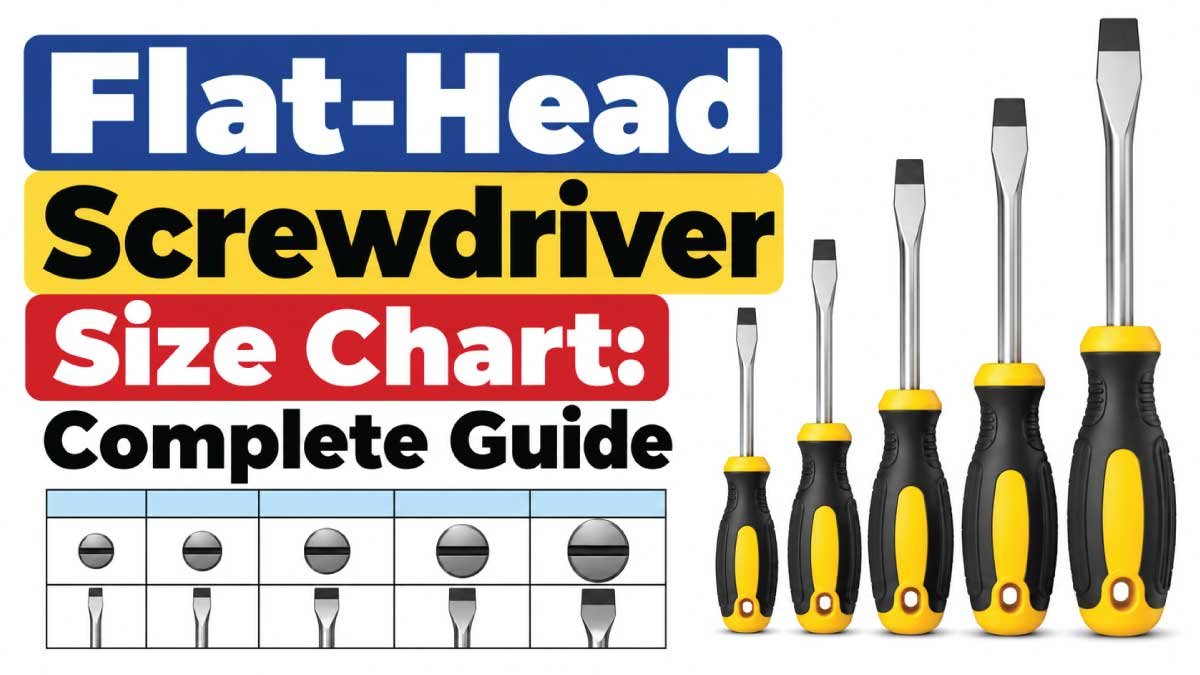
Choosing the correct flat-head screwdriver is easier when you understand how screwdriver sizes are measured. Unlike bolts, nuts, or drill bits, a flat-head screwdriver is generally identified by the width and thickness of its blade tip, along with the overall shaft and handle dimensions.
A screwdriver that is too narrow can slip inside the screw slot, while one that is too thick may not enter the slot at all. The correct size should fit the entire slot closely and sit firmly without excessive movement.
This flat-head screwdriver size chart explains common blade widths, approximate thickness ranges, typical applications, metric and inch measurements, how to measure a screwdriver, and how to select the right size for different slotted screws.
What Is a Flat-Head Screwdriver?
A flat-head screwdriver, also called a slotted screwdriver, has a straight blade with a flat tip designed to engage a single straight slot in a screw head. It is one of the oldest and most widely recognized screwdriver designs.
The tip has two primary working dimensions:
- Blade width: The distance across the flat tip.
- Blade thickness: The thickness of the tip that enters the screw slot.
Both measurements affect how well the screwdriver fits. Width determines how much of the slot the tip contacts, while thickness determines whether the blade can enter the slot properly.
The term flat-head can sometimes be confusing because it may also describe the shape of a screw head. When discussing tools, flat-head screwdriver normally means a slotted screwdriver.
How Flat-Head Screwdriver Sizes Work
There is no single universal numbering system for slotted screwdrivers. Manufacturers commonly identify them by blade width, such as 3 mm, 4 mm, 5.5 mm, or 6.5 mm, or by approximate inch dimensions.
A screwdriver labeled 5.5 mm generally refers to the tip or blade width, not the screw diameter.
For example, a 5.5 mm slotted screwdriver is intended to fit a suitable slotted screw whose slot accommodates a blade around that width.
Flat-Head Screwdriver Size Chart
The following chart provides common nominal slotted screwdriver sizes. Actual blade thickness, shaft length, tip geometry, and tolerances can vary by manufacturer and tool series.
| Nominal Tip Width | Approx. Width in Inches | Typical Blade Thickness | Common Use |
|---|---|---|---|
| 2.0 mm | 0.079 in | ~0.3–0.4 mm | Small precision work |
| 2.5 mm | 0.098 in | ~0.4 mm | Small screws |
| 3.0 mm | 0.118 in | ~0.5 mm | Electronics and light work |
| 3.5 mm | 0.138 in | ~0.6 mm | Small hardware |
| 4.0 mm | 0.157 in | ~0.6–0.8 mm | General light-duty work |
| 4.5 mm | 0.177 in | ~0.7–0.9 mm | General repairs |
| 5.0 mm | 0.197 in | ~0.8–1.0 mm | Medium-duty applications |
| 5.5 mm | 0.217 in | ~0.9–1.1 mm | General mechanical work |
| 6.0 mm | 0.236 in | ~1.0–1.2 mm | Medium-duty fastening |
| 6.5 mm | 0.256 in | ~1.0–1.3 mm | Larger slotted screws |
| 8.0 mm | 0.315 in | ~1.2–1.5 mm | Heavy-duty fastening |
| 10.0 mm | 0.394 in | ~1.5–2.0 mm | Large screws and hardware |
These thicknesses are representative ranges rather than universal standards. A screwdriver from one manufacturer may have a different blade thickness from another tool with the same nominal width.
Common Flat-Head Screwdriver Sizes
Although many sizes are available, a relatively small group covers a large portion of everyday slotted-screw applications.
Small Flat-Head Screwdrivers
Small slotted screwdrivers commonly have tips around 2 to 4 mm wide.
They are useful for:
- Small mechanical screws
- Electronics
- Small appliances
- Instruments
- Precision assemblies
- Eyeglass and similar miniature hardware where appropriate
A small screwdriver should not be used simply because its blade can enter the slot. The tip should also have enough width and thickness to contact the slot properly.
Medium Flat-Head Screwdrivers
Medium sizes typically fall around 4 to 6.5 mm in nominal tip width.
These are common general-purpose tools for:
- Household repairs
- Furniture hardware
- Electrical equipment
- Small machinery
- General mechanical assemblies
- Standard slotted screws
A 5.5 mm or 6 mm screwdriver is often a useful general-purpose size, but the actual screw slot should always determine the final selection.
Large Flat-Head Screwdrivers
Larger screwdrivers generally use tips around 8 mm and above.
They are intended for larger slotted fasteners and applications where a wider blade provides greater contact with the screw slot.
Large screwdrivers are often manufactured with stronger shafts and larger handles because the screws they service may require greater turning force.
Flat-Head Screwdriver Metric and Inch Sizes
Slotted screwdrivers may be sold using either metric or inch-based dimensions. The two systems do not always provide exact one-to-one equivalents.
| Metric Tip Width | Approx. Inch Equivalent | Closest Common Fraction |
|---|---|---|
| 2.0 mm | 0.079 in | ~5/64 in |
| 2.5 mm | 0.098 in | ~3/32 in |
| 3.0 mm | 0.118 in | ~1/8 in |
| 4.0 mm | 0.157 in | ~5/32 in |
| 5.0 mm | 0.197 in | ~3/16 in |
| 6.0 mm | 0.236 in | ~15/64 in |
| 6.5 mm | 0.256 in | ~1/4 in |
| 8.0 mm | 0.315 in | ~5/16 in |
| 10.0 mm | 0.394 in | ~3/8 in |
These are dimensional conversions, not indications that the tools are interchangeable in every application. A nominally similar metric and inch screwdriver can still have different tip thicknesses or profiles.
For precision work, choose the screwdriver based on the actual screw slot rather than selecting the closest converted size.
Flat-Head Screwdriver Blade Dimensions
Blade width is only one part of screwdriver sizing. The blade’s thickness and shape also determine whether the tool will work correctly.
Blade Width
Blade width is measured across the flat end of the screwdriver.
A wider tip generally contacts more of a compatible screw slot. However, a wider blade is not automatically better. If it extends beyond the slot or cannot enter the recessed area around the screw, it is the wrong size.
Blade Thickness
Blade thickness is measured through the tip from one broad face to the opposite face.
The screwdriver must be thin enough to enter the slot while remaining thick enough to fill it properly. A blade that is significantly thinner than the slot can move from side to side and concentrate force on small areas of the screw.
Tip Profile
The end of a slotted screwdriver may have different geometries depending on the manufacturer and intended application.
Common considerations include:
- Straight-sided tip
- Parallel tip faces
- Ground or machined tip
- Tapered blade
- Precision blade
- Standard-duty blade
A properly designed tip should provide good contact along the screw slot rather than touching only at its edges.
How to Choose the Correct Flat-Head Screwdriver Size
Selecting the correct screwdriver is primarily a matter of matching the blade to the screw slot.
1. Examine the Screw Slot
Look directly at the screw head and determine the approximate width and depth of the slot.
The slot should be clean enough for the screwdriver to sit fully inside it.
2. Match the Blade Width
Choose a blade that fills the slot as closely as practical without extending beyond the usable slot area.
A blade that is too narrow may rock during rotation.
3. Check the Blade Thickness
Make sure the blade can enter the slot completely. If the blade is too thick, it may sit above the bottom of the slot and have limited contact.
4. Check the Fit Before Turning
Place the screwdriver into the screw without applying significant force.
A good fit should feel stable with relatively little side-to-side movement.
5. Apply the Correct Pressure
Once the correct size is selected, maintain firm axial pressure toward the screw while turning. This helps keep the tip seated and reduces the chance of slipping.
How to Measure a Flat-Head Screwdriver
If the screwdriver has no visible size marking, you can measure the working end with a ruler, caliper, or suitable measuring tool.
Measure Blade Width
Place the measuring tool across the flat tip and measure from one side to the other.
For example, if the tip measures approximately 5.5 mm across, it can be described as a 5.5 mm slotted screwdriver.
Measure Blade Thickness
Measure the thickness of the blade at the working tip. A digital caliper generally provides a more precise measurement than a ruler.
Record both measurements because two screwdrivers can have the same width but different thicknesses.
Measure Shaft Length
Shaft length is normally measured from the end of the handle to the end of the blade or shaft, depending on the manufacturer’s stated measurement method.
Common shaft lengths include:
- Short shafts for confined spaces
- Medium shafts for general work
- Long shafts for recessed or difficult-to-reach screws
Shaft length does not determine the screwdriver’s tip size.
Screwdriver Size vs. Screw Size
One of the most common misunderstandings is assuming that a screwdriver’s size corresponds directly to the diameter of the screw.
It generally does not.
A 6 mm screwdriver does not mean it is designed for a 6 mm screw. The 6 mm designation normally refers to the nominal width of its slotted tip.
The correct relationship is:
Screw slot dimensions → screwdriver tip dimensions
rather than:
Screw diameter → screwdriver tip width
The screw’s head design, slot dimensions, material, and application all influence which screwdriver is appropriate.
Flat-Head Screwdriver Size by Application
Different jobs call for different screwdriver dimensions.
| Application | Typical Tip Range | Important Consideration |
|---|---|---|
| Precision work | 2–3 mm | Small slot and controlled force |
| Small mechanical work | 2.5–4 mm | Match slot depth and width |
| Household repairs | 4–6.5 mm | General-purpose fit |
| Electrical equipment | 3–6.5 mm | Use an appropriately rated tool where required |
| Mechanical assemblies | 4–8 mm | Strong slot engagement |
| Large hardware | 8–10+ mm | Correct tip fit and adequate shaft strength |
The ranges are general examples rather than fixed application standards. The screw manufacturer’s requirements should take priority whenever specified.
Also Read:
Types of Flat-Head Screwdrivers
Not every slotted screwdriver is designed in exactly the same way.
Standard Slotted Screwdriver
This is the conventional design with a straight blade and standard handle. It is suitable for general-purpose fastening where the screw is accessible.
Precision Slotted Screwdriver
Precision models have smaller tips and are designed for small fasteners requiring greater control.
They are commonly found in tool kits intended for delicate mechanical or electronic work.
Heavy-Duty Slotted Screwdriver
Heavy-duty models generally have larger shafts and handles designed for demanding fastening applications. Some are designed to tolerate higher manual torque than lightweight precision tools.
Stubby Slotted Screwdriver
A stubby screwdriver has a short overall length. Its compact design is useful when there is insufficient clearance for a conventional handle and shaft.
Insulated Slotted Screwdriver
Insulated screwdrivers are designed for electrical work where the tool is specifically rated for the applicable electrical environment. Insulation markings should never be treated as permission to work on energized equipment.
When a Flat-Head Screwdriver Is the Wrong Choice
A slotted screwdriver should only be used with a compatible slotted screw.
Do not substitute a flat-head screwdriver for:
- Phillips screws
- Pozidriv screws
- Torx screws
- Hex socket screws
- Square-drive screws
- Security screw designs requiring specialized tips
Trying to force a flat blade into another drive profile can damage both the fastener and the tool.
Likewise, avoid using a screwdriver as a chisel, pry bar, punch, or lever unless the specific tool is expressly designed for that purpose.
Also Read:
Common Flat-Head Screwdriver Sizing Mistakes
Choosing the wrong size can make a simple fastening job unnecessarily difficult.
Using a Blade That Is Too Narrow
A narrow blade may fit into the slot but leave substantial unused space. This allows the tool to rotate within the slot and can damage the screw head.
Using a Blade That Is Too Thick
A thick blade may not reach the bottom of the slot. It can appear to fit while actually making contact only near the upper edges.
Ignoring Blade Thickness
Two tools with the same nominal width can behave differently if their tip thicknesses differ.
Choosing by Handle Size
A large handle does not mean the screwdriver has a large tip. Always inspect the working end or its marked size.
Using a Damaged Tip
Rounded, chipped, bent, or excessively worn tips can reduce contact with the screw slot. Replace the tool when the working geometry is no longer suitable.
Also Read:
How to Prevent Screw and Driver Damage
Correct sizing is only one part of good screwdriver practice.
Use these habits:
- Select the largest suitable tip that properly fits the slot.
- Keep the screwdriver aligned with the screw axis.
- Apply steady downward pressure while turning.
- Avoid excessive force when the screw does not move.
- Keep the screw slot free from dirt and debris.
- Replace severely worn screwdriver tips.
- Do not use damaged screwdrivers for demanding applications.
- Use the correct drive type rather than forcing an incompatible tool.
If a screw is seized, investigate the cause instead of simply increasing force. Corrosion, cross-threading, contamination, or damaged threads may require a different removal method.
Flat-Head Screwdriver Size Chart: Quick Selection Guide
For quick reference, the following simplified chart can help narrow down the tool you need.
| Tip Width | General Size Category | Typical Purpose |
|---|---|---|
| 2–2.5 mm | Precision | Very small fasteners |
| 3–4 mm | Small | Small mechanical work |
| 4.5–5.5 mm | Medium | General-purpose fastening |
| 6–6.5 mm | Medium-Large | Larger slotted screws |
| 8 mm | Large | Heavy-duty applications |
| 10 mm+ | Extra Large | Large slotted hardware |
This chart is intended as a selection reference, not a substitute for measuring the screw slot.
Flat-Head Screwdriver Size FAQs
What is the most common flat-head screwdriver size?
There is no single universal size because slotted screws are manufactured in many dimensions. For general-purpose tool sets, several medium sizes around 4 to 6.5 mm are commonly useful, while smaller and larger tools cover specialized applications.
What size flat-head screwdriver do I need?
Choose the screwdriver whose tip width and thickness closely match the screw slot. The blade should sit firmly in the slot with minimal side-to-side movement and should enter deeply enough to achieve good contact.
Is a flat-head screwdriver the same as a slotted screwdriver?
Yes. In common tool terminology, flat-head screwdriver and slotted screwdriver generally refer to the same screwdriver type: a tool designed for screws with one straight slot.
How is a flat-head screwdriver measured?
The working tip is primarily identified by its blade width, although blade thickness is also important. If the size marking is missing, measure the tip width and thickness with an appropriate measuring tool.
Does screwdriver size refer to the shaft or tip?
For slotted screwdrivers, a stated size commonly refers to the nominal tip or blade width. Shaft length and handle dimensions are separate specifications.
Can I use a smaller screwdriver if it fits the slot?
It may physically fit, but that does not mean it is suitable. If the blade is substantially narrower than the slot, it can move within the slot and increase the risk of damaging the fastener.
Should the screwdriver fill the entire screw slot?
Ideally, the tip should provide broad and stable contact across the usable slot without being forced into an incompatible opening. Proper width and thickness are both important.
Are metric and SAE flat-head screwdriver sizes interchangeable?
Not automatically. Metric and inch dimensions can be close, but the actual tip width and thickness may differ. For critical or tight-fitting applications, select the tool based on the screw’s actual slot dimensions.
What is the difference between a flat-head screwdriver and a Phillips screwdriver?
A flat-head screwdriver has a single straight blade, while a Phillips screwdriver has a cross-shaped tip. They are designed for different screw-head profiles and should not normally be substituted for one another.
Why does my flat-head screwdriver keep slipping?
Common causes include an incorrect tip size, worn screwdriver edges, a damaged screw slot, inadequate downward pressure, or an angled screwdriver position. Check the tip fit before applying additional force.
Final Takeaway
A flat-head screwdriver is sized primarily around the dimensions of its working blade, especially tip width and thickness. The correct screwdriver should fit the slotted screw closely, enter the slot properly, remain stable during rotation, and provide broad contact without excessive movement.
For quick selection, common sizes range from approximately 2 mm precision tips to 10 mm or larger heavy-duty tips, but these should be treated as general size categories rather than universal specifications.
When an exact fit matters, measure the screw slot and compare it with the screwdriver’s actual blade dimensions. Also remember that manufacturer specifications can vary, so the marked tool size should be verified when precision is important.
The key principle is simple: match the screwdriver to the screw slot, not merely to the apparent size of the screw or handle. A properly fitted tip improves control, reduces slipping, and helps protect both the fastener and the tool.

Engineer Hassan is a Mechanical Engineer with 16+ years of hands-on experience in mechanical hardware, fasteners, and workshop tools. He focuses on size selection, thread identification, and measurement, helping users choose the correct components with accuracy and safety.