
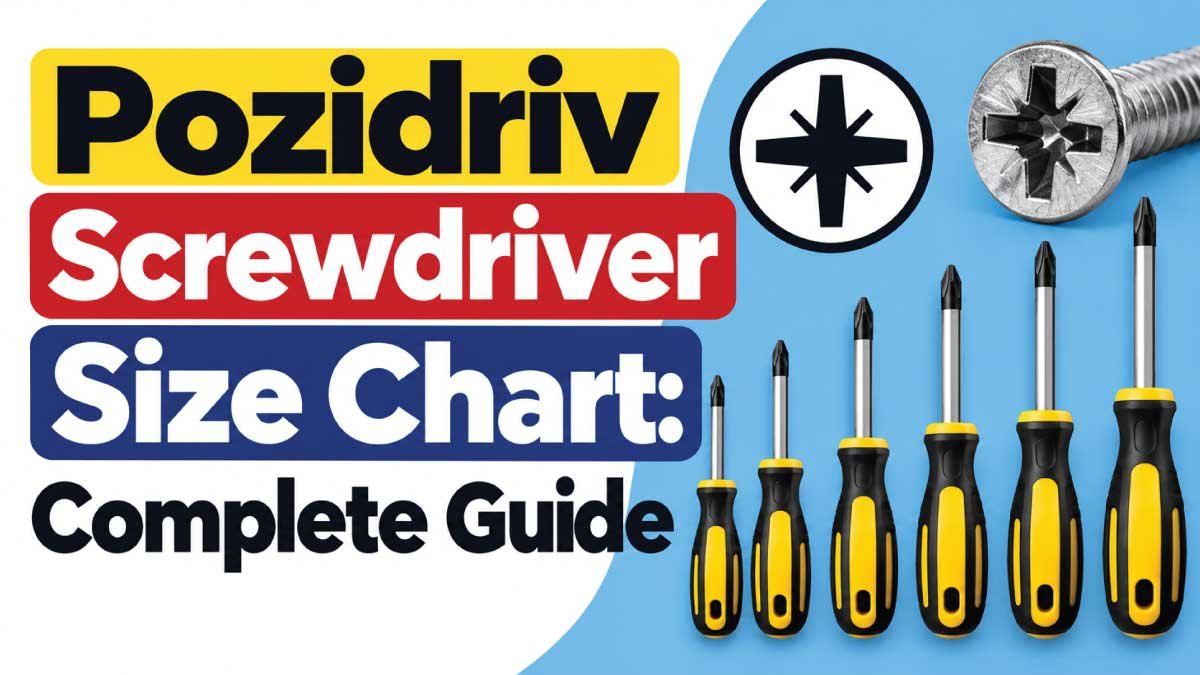
Choosing the correct Pozidriv screwdriver is easier when you understand the PZ size system, tip dimensions, screw compatibility, and intended application. Pozidriv screwdrivers are designed for screws with a distinctive cross-shaped recess that includes additional secondary grooves, giving the driver more contact with the screw head than a standard Phillips design.
The most common Pozidriv sizes range from PZ0 through PZ4, with PZ1 and PZ2 frequently used for general assembly, woodworking, electrical equipment, furniture, appliances, and machinery. However, the correct size depends on the screw head rather than simply the overall screw diameter.
This Pozidriv screwdriver size chart explains the common PZ sizes, approximate screwdriver dimensions, applications, identification methods, differences between Pozidriv and Phillips, and practical tips for choosing the right driver.
Pozidriv Screwdriver Size Chart
Pozidriv screwdrivers are identified by PZ numbers. As the number increases, the driver tip generally becomes larger and is intended for larger screw recesses.
The following chart provides a practical reference for commonly available Pozidriv screwdrivers. Blade diameter and length are representative dimensions because the overall screwdriver construction can vary by manufacturer.
| Pozidriv Size | Typical Blade Diameter (mm) | Common Blade Lengths (mm) | General Application |
|---|---|---|---|
| PZ0 | 3.0 | 60–75 | Small screws, light assemblies |
| PZ1 | 4.5–5.0 | 75–100 | Small to medium screws |
| PZ2 | 6.0 | 100–125 | General-purpose fastening |
| PZ3 | 8.0 | 150 | Large screws and machinery |
| PZ4 | 9.0–10.0 | 150–200 | Large, heavy-duty fasteners |
These dimensions describe the screwdriver shaft or blade, not the diameter of the screw itself. A PZ2 screwdriver, for example, can be available with several different blade lengths depending on whether it is intended for ordinary assembly, deep access, or specialized work.
For a typical hand-tool set, PZ1, PZ2, and PZ3 provide useful coverage for many everyday applications.
What Is a Pozidriv Screwdriver?
A Pozidriv screwdriver is a driver designed for screws with a Pozidriv cross recess. The profile resembles a Phillips recess at first glance, but Pozidriv screws have additional smaller grooves between the main cross slots.
The four primary recesses form the main cross. Four additional secondary recesses are positioned between them. This creates a recognizable pattern that helps distinguish Pozidriv from Phillips.
The design provides several practical benefits:
- Improved engagement between driver and screw.
- Better resistance to cam-out during appropriate applications.
- More contact surfaces for transmitting turning force.
- Easier identification through the distinctive recess pattern.
- Good suitability for machine assembly, woodworking, electrical equipment, and general construction.
Pozidriv screwdrivers are marked PZ0, PZ1, PZ2, PZ3, or PZ4. The marking is normally printed or stamped on the handle, shaft, packaging, or bit.
Pozidriv Screwdriver Sizes Explained
PZ0 Screwdriver
PZ0 is one of the smallest commonly encountered Pozidriv sizes. It is intended for relatively small screws and compact assemblies where a larger driver would not properly engage the recess.
A typical PZ0 screwdriver may have a blade diameter around 3 mm, although exact shaft construction varies.
Common uses include:
- Small hardware.
- Light mechanical assemblies.
- Compact electrical equipment.
- Small brackets.
- Furniture hardware.
- Small screws requiring a Pozidriv recess.
Because the recess is small, using excessive force with an incorrectly sized driver can quickly damage the screw head.
PZ1 Screwdriver
PZ1 is larger than PZ0 and is useful for small and medium-sized Pozidriv screws. Depending on the manufacturer, standard PZ1 screwdrivers commonly have blade diameters around 4.5 to 5 mm.
Typical applications include:
- Electrical components.
- Cabinet hardware.
- Furniture assembly.
- Small machinery.
- General maintenance.
- Appliance components.
PZ1 is often useful when PZ0 is too small but PZ2 is too large.
PZ2 Screwdriver
PZ2 is one of the most widely used Pozidriv sizes. It is a particularly useful general-purpose size for maintenance, assembly, woodworking, electrical equipment, and many common fasteners.
A standard hand screwdriver may have a blade diameter of approximately 6 mm, although the handle, blade length, and exact dimensions vary.
Typical applications include:
- Wood screws.
- Furniture fasteners.
- Electrical equipment.
- Metal enclosures.
- General construction.
- Appliance assembly.
- Workshop maintenance.
If you regularly work with Pozidriv screws, PZ2 is one of the sizes worth having readily available.
PZ3 Screwdriver
PZ3 is designed for larger Pozidriv recesses and is generally paired with larger screws than PZ1 or PZ2.
Common PZ3 screwdrivers have blade diameters around 8 mm and are frequently available with longer shafts.
Typical applications include:
- Heavy woodworking.
- Machinery.
- Large brackets.
- Construction hardware.
- Industrial equipment.
- Large structural or assembly screws.
A PZ3 driver should not be forced into a PZ2 recess simply because both have a similar cross-shaped appearance.
PZ4 Screwdriver
PZ4 is among the largest commonly encountered Pozidriv screwdriver sizes. It is intended for large screw heads and applications requiring a larger driver profile.
Depending on the manufacturer, PZ4 hand screwdrivers may use a shaft around 9 to 10 mm in diameter.
Typical applications include:
- Large machinery.
- Heavy-duty equipment.
- Large timber fasteners.
- Industrial assemblies.
- Large structural components.
PZ4 is less common in ordinary household toolboxes than PZ1 or PZ2, but it can be important for specialized mechanical and industrial work.
Pozidriv Screwdriver Dimensions
The term “size” can refer to more than one measurement. Understanding the difference between PZ tip size, blade diameter, blade length, and overall screwdriver length prevents confusion when selecting a tool.
Tip Size
The PZ designation identifies the size of the Pozidriv tip profile. It is the most important dimension when determining whether a driver matches the screw recess.
For example:
- PZ1 fits a PZ1 recess.
- PZ2 fits a PZ2 recess.
- PZ3 fits a PZ3 recess.
The PZ number should not be interpreted as a measurement such as millimeters or inches.
Blade Diameter
Blade diameter refers to the diameter of the screwdriver shaft behind the working tip on a round-shaft design.
Typical examples include:
| PZ Size | Representative Blade Diameter | Purpose |
|---|---|---|
| PZ0 | 3 mm | Small-driver construction |
| PZ1 | 4.5–5 mm | Small and medium applications |
| PZ2 | 6 mm | General-purpose applications |
| PZ3 | 8 mm | Large fasteners |
| PZ4 | 9–10 mm | Heavy-duty applications |
These values should be treated as representative screwdriver dimensions rather than universal tip standards. Different manufacturers can use different shaft constructions.
Blade Length
Blade length determines how far the screwdriver can reach into a work area.
Common lengths include:
- 60–75 mm for compact drivers.
- 80–100 mm for general-purpose work.
- 125–150 mm for deeper access.
- 200 mm or longer for extended-reach applications.
A longer blade does not mean a larger PZ size. A PZ2 screwdriver can have a short blade or a substantially longer blade while retaining the same PZ2 tip profile.
How to Identify a Pozidriv Screw
Correct identification is important because Pozidriv and Phillips screws can look very similar.
Look closely at the screw head. A Pozidriv screw has a primary cross-shaped recess plus four smaller secondary grooves positioned between the main slots.
Pozidriv Identification Features
A Pozidriv screw normally has:
- A four-arm primary cross.
- Four smaller secondary recesses.
- A more detailed cross pattern than a basic Phillips recess.
- A matching PZ driver designation.
The small secondary grooves are one of the easiest visual clues.
Another useful method is to inspect the screw marking or packaging. Fastener manufacturers may identify the drive as PZ, Pozidriv, or with the corresponding size designation.
When identification is uncertain, avoid applying high torque until the driver fits correctly.
Pozidriv vs Phillips Screwdriver
Pozidriv and Phillips are often confused because both use a cross-shaped recess. However, they are different drive profiles.
| Feature | Pozidriv | Phillips |
|---|---|---|
| Typical Marking | PZ | PH |
| Basic Shape | Cross with secondary grooves | Simple cross |
| Secondary Recesses | Yes | No |
| Designed Driver | Pozidriv | Phillips |
| Common Sizes | PZ0–PZ4 | PH0–PH4 |
| Interchangeability | Not recommended | Not recommended |
| Common Applications | Woodworking, equipment, assembly | General fastening, appliances, machinery |
The two systems may appear interchangeable because a Phillips driver can sometimes enter a Pozidriv recess. That does not mean the fit is correct.
Using the wrong profile can result in:
- Poor engagement.
- Driver wobble.
- Damaged screw recesses.
- Reduced torque transmission.
- Premature wear of the screwdriver tip.
For the best fit, match PZ with PZ and PH with PH.
How to Choose the Correct Pozidriv Screwdriver Size
Selecting the right PZ screwdriver is primarily a matter of matching the tip profile and size to the screw recess.
1. Identify the Drive Type
First determine whether the screw is Pozidriv, Phillips, Torx, slotted, hex, or another drive type.
Do not select a PZ screwdriver simply because the screw appears to have a cross-shaped recess.
2. Check the PZ Number
If the screw or fastener packaging identifies the drive, use that information.
For example:
- PZ0 → PZ0 screwdriver.
- PZ1 → PZ1 screwdriver.
- PZ2 → PZ2 screwdriver.
- PZ3 → PZ3 screwdriver.
- PZ4 → PZ4 screwdriver.
3. Test the Fit
Insert the screwdriver straight into the recess.
The correct driver should:
- Sit firmly in the recess.
- Engage the main contact surfaces.
- Have minimal sideways movement.
- Seat fully without excessive force.
4. Choose the Appropriate Blade Length
After choosing the PZ size, select a shaft length based on access.
A short blade works well in confined spaces, while a longer blade is useful when the screw is recessed or difficult to reach.
5. Consider the Handle
For frequent work, choose a handle that provides adequate grip and control. For high-torque applications, a larger ergonomic handle may provide better control than a compact precision handle.
Also Read:
Common Applications of Pozidriv Screwdrivers
Pozidriv screws are used across many industries and everyday products.
Woodworking and Furniture
Pozidriv screws are commonly encountered in furniture assembly and woodworking. The drive profile can provide secure engagement when the correct driver is used.
Typical examples include:
- Cabinet construction.
- Furniture assembly.
- Hinges.
- Wooden frames.
- Shelving.
- General wood fastening.
Electrical and Electronic Equipment
Pozidriv fasteners are also found in electrical equipment, panels, cabinets, and various assemblies.
PZ1 and PZ2 are particularly useful sizes for general maintenance work, although the actual screw specification should always determine the required driver.
Machinery and Mechanical Assembly
Larger PZ sizes may be found in machinery, equipment housings, brackets, and other assemblies.
PZ3 and PZ4 are useful where the fastener has a larger Pozidriv recess.
Construction and Maintenance
Maintenance technicians may encounter Pozidriv screws in:
- Fixtures.
- Hardware.
- Panels.
- Equipment.
- Brackets.
- Building components.
The exact size depends on the fastener selected by the manufacturer.
Also Read:
Pozidriv Screwdriver Bit Sizes
Pozidriv screwdrivers are available as traditional hand tools, interchangeable bits, bit-driver attachments, and power-tool accessories.
Common bit sizes include:
| Bit Size | Typical Bit Lengths | Typical Use |
|---|---|---|
| PZ0 | 25–50 mm | Small fastening |
| PZ1 | 25–70 mm | Small assemblies |
| PZ2 | 25–70 mm | General fastening |
| PZ3 | 25–90 mm | Larger screws |
| PZ4 | 25–50+ mm | Large fasteners |
Bit length is independent of PZ size. A PZ2 bit may be available in multiple lengths for different tools and access conditions.
Many power-tool Pozidriv bits also use a 1/4-inch hex shank, but the shank specification should be checked separately from the PZ tip size.
Common Mistakes When Using Pozidriv Screwdrivers
Using the wrong driver is one of the most common causes of damaged cross-head screws.
Using Phillips Instead of Pozidriv
A Phillips screwdriver may appear to fit, but its geometry does not properly match the secondary recesses of a Pozidriv screw.
Use a PZ driver when the fastener is designed for Pozidriv.
Choosing a Driver That Is Too Small
A small driver can move inside the recess and concentrate force on limited contact areas.
This can damage both the screw and the screwdriver.
Using a Driver That Is Too Large
A large tip may fail to seat completely. Forcing it can deform the screw recess.
Holding the Driver at an Angle
Cross-head drivers should generally be kept straight and aligned with the screw axis. Tilting the driver increases the risk of slipping.
Ignoring Driver Wear
A worn tip may not engage the recess correctly even when the PZ size is correct.
Replace heavily worn bits and screwdrivers when engagement becomes unreliable.
Also Read:
Tips for Getting the Best Pozidriv Fit
A few simple practices can significantly improve fastening results.
Keep the driver aligned with the screw.
Use the exact PZ size whenever possible.
Clean dirt and debris from the screw recess.
Apply steady pressure while turning.
Avoid using a worn or rounded tip.
Do not substitute Phillips and Pozidriv drivers unnecessarily.
Use the shortest practical blade for confined areas.
Choose a longer shaft when access requires additional reach.
For powered tools, use bits designed for the intended drive system.
Follow the fastener manufacturer’s torque requirements when specified.
For repeated assembly work, having several PZ sizes available is generally more useful than relying on one supposedly universal cross-head screwdriver.
Pozidriv Size Selection Chart by Application
The following chart provides a practical starting point for selecting a PZ size. It is not a substitute for identifying the actual screw recess.
| PZ Size | Relative Size | Common Applications | Typical Tool Type |
|---|---|---|---|
| PZ0 | Very small | Small hardware and compact assemblies | Precision/standard |
| PZ1 | Small | Electrical, furniture, small equipment | Standard/bit |
| PZ2 | Medium | General assembly, woodworking, appliances | Standard/bit |
| PZ3 | Large | Machinery, construction, large fasteners | Heavy-duty/bit |
| PZ4 | Very large | Industrial and heavy-duty assemblies | Heavy-duty |
The application column is only a general guide. Screw manufacturers can specify different drive sizes for fasteners used in similar applications.
How to Measure a Pozidriv Screwdriver
You normally do not need to measure the tip with a ruler to identify its PZ number. The PZ marking is the most practical identification method.
However, if you are documenting a tool or comparing screwdrivers, several measurements can be recorded.
Measure Blade Length
Measure from the point where the blade exits the handle to the end of the working tip.
Do not include the handle in the blade-length measurement.
Measure Blade Diameter
For a round shaft, use a caliper to measure the shaft diameter.
Remember that blade diameter is a tool dimension, not the PZ designation itself.
Identify the Tip Profile
Inspect the working end for the Pozidriv cross profile. The additional secondary grooves help distinguish it from a Phillips driver.
Measure Overall Length
Overall length includes the screwdriver handle and blade. This dimension is useful when determining whether a tool will fit within a particular workspace.
PZ2 vs PZ1: Which Size Is Larger?
PZ2 is larger than PZ1.
The PZ numbering system progresses from smaller to larger drive profiles. Therefore:
PZ0 < PZ1 < PZ2 < PZ3 < PZ4
This does not mean that a PZ2 screwdriver is simply twice the size of a PZ1 screwdriver. The numbers identify different standardized drive profiles rather than a direct linear measurement.
If a PZ1 driver is too small for a screw recess, the next size to test is normally PZ2, provided the screw is actually Pozidriv.
Can You Use a PZ2 Driver on a PZ1 Screw?
A PZ2 driver should not be used on a PZ1 recess simply because it is larger.
The larger tip may not seat properly in the smaller recess. Applying force can damage the screw head or screwdriver.
Likewise, using a PZ1 driver in a PZ2 screw can produce excessive movement and insufficient contact.
The best approach is simple: match the PZ number to the screw recess.
Frequently Asked Questions
What is the most common Pozidriv screwdriver size?
PZ2 is one of the most commonly encountered Pozidriv sizes for general-purpose work. It is widely useful for woodworking, furniture, electrical equipment, appliances, and general assembly.
What sizes do Pozidriv screwdrivers come in?
Common Pozidriv sizes include PZ0, PZ1, PZ2, PZ3, and PZ4. Availability varies by manufacturer and tool range.
Is PZ2 the same as Phillips #2?
No. PZ2 and PH2 are different drive profiles. They may look similar, but the recess geometry is different. A correctly matched driver provides better engagement.
How do I know if a screw is Pozidriv?
Look for the four smaller secondary grooves between the main cross slots. These additional grooves are a key visual characteristic of a Pozidriv recess.
What does PZ mean on a screwdriver?
PZ identifies a Pozidriv screwdriver or bit. The number following PZ identifies the drive size, such as PZ1 or PZ2.
Can I use a Pozidriv screwdriver on any cross-head screw?
No. Cross-head screws can use different drive systems, including Pozidriv and Phillips. The driver should match the screw’s actual recess profile.
What PZ size should I keep in a general tool kit?
For broad everyday coverage, a set containing PZ1, PZ2, and PZ3 is useful. Adding PZ0 and PZ4 provides coverage for smaller and larger applications.
Does screwdriver shaft length change the PZ size?
No. Shaft length and PZ size are separate characteristics. A PZ2 screwdriver can have a short, standard, long, or extended shaft while remaining a PZ2 tool.
Conclusion
The Pozidriv screwdriver size chart provides a useful starting point for identifying and selecting PZ drivers. The common range runs from PZ0 through PZ4, with PZ1, PZ2, and PZ3 covering many everyday applications.
The most important rule is to match the Pozidriv profile and PZ size to the screw recess. Do not assume that a Phillips screwdriver is an equivalent substitute just because both drives have a cross shape.
For general work, PZ2 is an especially useful size, while PZ0 and PZ1 serve smaller fasteners and PZ3 and PZ4 accommodate larger recesses. Blade length and shaft diameter should then be selected according to access, handling requirements, and the specific tool design.
When exact dimensions or fastening requirements matter, use the fastener and screwdriver manufacturer’s specifications rather than relying only on a general size chart.

Engineer Hassan is a Mechanical Engineer with 16+ years of hands-on experience in mechanical hardware, fasteners, and workshop tools. He focuses on size selection, thread identification, and measurement, helping users choose the correct components with accuracy and safety.