
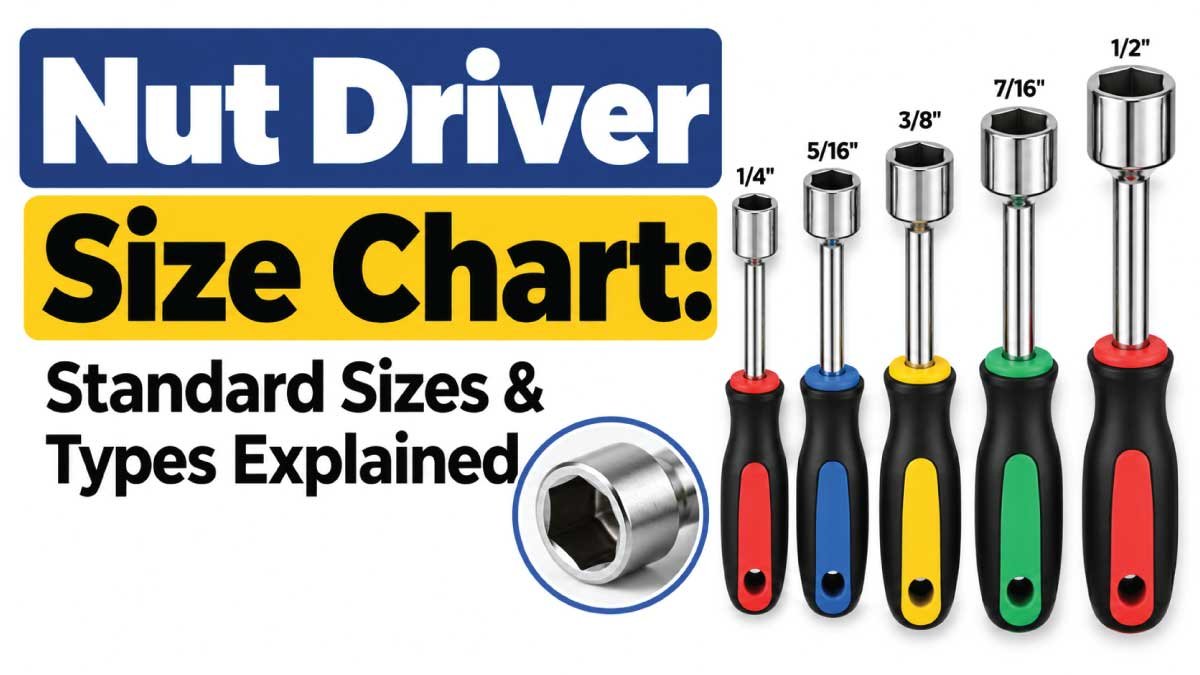
A nut driver is a hand tool designed to tighten or loosen hex nuts, hex-head screws, and similar fasteners. Unlike a standard screwdriver, it surrounds the fastener with a hex-shaped socket, allowing the tool to apply torque directly to the flats of the nut or head.
Choosing the correct size matters because even a small mismatch can cause slipping, rounded fastener corners, poor torque transfer, or difficulty working in tight spaces. A nut driver size is normally based on the across-flats (AF) dimension of the hex fastener, rather than the thread diameter.
This nut driver size chart explains common SAE and metric sizes, different nut driver types, how to measure a fastener, how sizes relate to applications, and how to select the correct tool for a particular job.
What Is a Nut Driver?
A nut driver is essentially a screwdriver-style handle connected to a hollow hex socket. The hollow construction allows the tool to fit over nuts threaded onto studs, bolts with exposed threads, and other hex fasteners.
Nut drivers are especially useful when a socket wrench is too bulky or when a fastener is positioned on a long threaded stud.
Common applications include:
- Electrical installation and maintenance
- Appliance repair
- Automotive work
- HVAC equipment
- Small machinery
- Electronics and equipment assembly
- Furniture and hardware installation
- General mechanical maintenance
The tool may have a fixed handle, interchangeable bit, T-handle, ratcheting mechanism, or another drive configuration.
The most important specification is the socket size. For example, a 10 mm nut driver is intended for a hex fastener measuring approximately 10 mm across its flats.
Nut Driver Size Chart
Nut drivers are available in both metric and SAE (inch) sizes. The correct size is determined by the hex head or nut that the tool needs to engage.
The following chart lists common sizes used for general mechanical, electrical, maintenance, and assembly work.
Common Metric Nut Driver Sizes
| Nut Driver Size | Nominal System | Typical Use |
|---|---|---|
| 5 mm | Metric | Small equipment and electronics |
| 5.5 mm | Metric | Small hardware and appliances |
| 6 mm | Metric | Small mechanical fasteners |
| 7 mm | Metric | Automotive and equipment hardware |
| 8 mm | Metric | General mechanical work |
| 9 mm | Metric | Equipment and machinery |
| 10 mm | Metric | Automotive and general maintenance |
| 11 mm | Metric | Mechanical assemblies |
| 12 mm | Metric | Machinery and larger hardware |
| 13 mm | Metric | General mechanical applications |
| 14 mm | Metric | Larger fasteners |
| 15 mm | Metric | Machinery and equipment |
| 16 mm | Metric | Larger mechanical assemblies |
These are common working sizes rather than a complete list of every size available. Specialty tool sets can include additional metric sizes.
Common SAE Nut Driver Sizes
| Nut Driver Size | Decimal Equivalent | Typical Use |
|---|---|---|
| 3/16 in | 0.1875 in | Small hardware |
| 7/32 in | 0.2188 in | Small fasteners |
| 1/4 in | 0.2500 in | Electrical and general hardware |
| 9/32 in | 0.2813 in | Small mechanical work |
| 5/16 in | 0.3125 in | General maintenance |
| 11/32 in | 0.3438 in | Mechanical assemblies |
| 3/8 in | 0.3750 in | General mechanical work |
| 7/16 in | 0.4375 in | Larger hardware |
| 1/2 in | 0.5000 in | Larger fasteners |
| 9/16 in | 0.5625 in | Heavy-duty applications |
| 5/8 in | 0.6250 in | Larger mechanical hardware |
Availability varies by tool manufacturer and product series, so a particular set may not contain every size shown.
How Nut Driver Sizes Work
The size printed on a nut driver generally identifies the width across the flats of the hexagonal socket.
For example, a 10 mm nut driver has an internal hex opening intended to fit a fastener whose relevant hex dimension is approximately 10 mm.
This is different from measuring the threaded portion of a bolt.
Across-Flats Measurement
The across-flats dimension is measured from one flat side of a hex nut or head directly across to the opposite flat side.
It is the measurement most directly related to nut driver selection.
For example:
- A nut driver labeled 8 mm is selected for an approximately 8 mm across-flats hex.
- A 10 mm nut driver is selected for an approximately 10 mm across-flats hex.
- A 1/2-inch nut driver is intended for a fastener with an approximately 1/2-inch across-flats dimension.
The fastener’s thread diameter can be completely different from its across-flats dimension.
Why Thread Size Can Be Confusing
A bolt may be identified by its thread size, while the nut driver is identified by the hex size.
For instance, a metric bolt can be described using its nominal thread diameter and pitch, but the nut driver required to turn its hex nut is chosen according to the nut’s across-flats dimension.
Therefore, do not select a nut driver simply because its number resembles the bolt’s thread diameter.
Metric vs. SAE Nut Drivers
The two major sizing systems are metric and SAE.
Metric nut drivers are specified in millimeters, while SAE nut drivers are generally specified in fractions of an inch.
Metric Nut Drivers
Metric tools are commonly used with fasteners manufactured to metric dimensions. Typical sizes include 5 mm, 6 mm, 7 mm, 8 mm, 10 mm, 12 mm, and 13 mm.
Metric sizes are especially common in:
- Modern machinery
- Automotive equipment
- Industrial assemblies
- Appliances
- Imported equipment
- General mechanical work
SAE Nut Drivers
SAE or inch-sized nut drivers use fractional-inch dimensions such as 1/4, 5/16, 3/8, 7/16, and 1/2 inch.
They are commonly encountered in equipment and hardware using inch-based fasteners.
Can Metric and SAE Sizes Be Substituted?
Sometimes two sizes may appear close enough to fit, but using an approximate substitute is generally not recommended.
A tool that is slightly too large can have excessive play. A tool that is slightly too small may not seat completely or may damage the fastener.
Use the correct measurement system and exact size whenever possible.
Types of Nut Drivers
Nut drivers are available in several configurations. The socket size determines compatibility with the fastener, while the handle or drive style affects how the tool is used.
Standard Nut Driver
A standard nut driver has a screwdriver-style handle and a fixed hollow shaft.
It is useful when:
- Fasteners are relatively small
- Frequent hand tightening is required
- The work does not require very high torque
- The user wants screwdriver-like control
The hollow shaft can also allow the tool to reach nuts positioned over threaded studs.
T-Handle Nut Driver
A T-handle design provides a crossbar that can be gripped with both hands or used to generate additional leverage.
It is useful when more turning force is needed than a conventional screwdriver-style handle can comfortably provide.
Nut Driver Bit
Nut driver bits are designed for use with compatible bit holders, screwdrivers, drills, or powered drivers.
They are convenient for repetitive fastening because the same driver can accept different sizes of interchangeable bits.
However, when using a powered driver, the tool’s torque setting should be appropriate for the fastener and application.
Ratcheting Nut Driver
A ratcheting nut driver incorporates a mechanism that allows the handle to move without removing the socket from the fastener.
This can be particularly useful in confined areas where there is limited room to rotate a conventional handle continuously.
Magnetic Nut Driver
Some nut drivers have a magnet inside the socket to help hold the fastener during positioning.
Magnetic designs can be convenient for:
- Overhead work
- Small screws with hex heads
- Electrical assembly
- Fastener installation
- Working in awkward positions
Magnetism does not replace correct socket engagement, however. The hex opening still needs to match the fastener properly.
How to Measure a Nut for the Correct Driver
If the fastener size is unknown, you can determine the required nut driver size by measuring the hex portion.
Measure Across the Flats
Place a caliper across two opposite flat faces of the nut or hex head.
Record the measurement in either millimeters or inches.
For example, if the measured dimension is approximately 10 mm, a 10 mm nut driver would normally be the appropriate starting choice.
Use a Caliper for Accuracy
A digital or vernier caliper provides a more reliable measurement than a ruler.
The process is simple:
- Clean dirt or debris from the fastener.
- Place the caliper jaws against opposite flat surfaces.
- Keep the jaws perpendicular to the flats.
- Read the measurement.
- Compare the measurement with available nut driver sizes.
- Test the selected driver for a secure fit.
Avoid measuring from one corner to the opposite corner because that does not represent the across-flats dimension used for normal socket sizing.
Also Read:
Nut Driver Size Selection Guide
Selecting a nut driver is more than matching a number. The correct tool should fit the fastener securely and also suit the working environment.
Match the Exact Hex Size
The first priority is the socket opening.
A correctly sized nut driver should slide onto the hex fastener without excessive looseness and should fully engage the flats.
Consider the Fastener Type
Determine whether you are working with:
- A hex nut
- A hex-head screw
- A machine screw with a hex head
- A self-tapping screw with a hex head
- A fastener mounted on a long stud
The fastener geometry can affect whether a standard socket, deep nut driver, or another tool configuration is appropriate.
Check Available Clearance
A nut driver may need to fit into a narrow or recessed area.
Consider:
- Handle diameter
- Shaft length
- Socket depth
- Access angle
- Clearance around the fastener
A compact nut driver can be more useful than a large tool in confined spaces.
Consider Required Torque
Nut drivers are excellent for many light and medium-duty fastening tasks, but they are not automatically suitable for every high-torque application.
For critical fasteners requiring a specified torque, use a tool designed to provide and measure that torque accurately.
Also Read:
Nut Driver Shaft Length and Reach
Nut driver size describes the hex opening, but the shaft length also affects tool selection.
A longer shaft can help reach a recessed fastener or a nut positioned deeper inside equipment.
A shorter tool may provide better control in compact spaces.
Short Nut Drivers
Short designs are useful where:
- Working space is limited
- The fastener is easy to access
- Compact tool storage is important
- The user needs close control
Long Nut Drivers
Longer designs can reach:
- Recessed nuts
- Fasteners around wiring
- Long threaded studs
- Deep equipment panels
- Difficult-to-access hardware
The correct length depends on the physical layout of the job rather than the fastener size alone.
Also Read:
Common Nut Driver Applications
Nut drivers are widely used because they combine the control of a screwdriver with the hex engagement of a socket.
Electrical Work
Nut drivers are commonly used for small hex fasteners found in electrical equipment, panels, enclosures, terminal assemblies, and hardware.
Their narrow profile can make them convenient when space around a fastener is restricted.
Automotive Work
Automotive equipment contains numerous small hex fasteners. Nut drivers can be useful for trim, brackets, covers, clamps, and other components where the required torque is appropriate.
Appliance Repair
Appliances frequently use small hex-head screws and nuts. A nut driver can provide better engagement than a conventional screwdriver when working with these fasteners.
Mechanical Assembly
Nut drivers are also useful for machinery assembly, equipment maintenance, workshop projects, and general hardware installation.
Their fast operation makes them particularly convenient for repeated fastening.
Nut Driver vs. Socket Wrench
A nut driver and socket wrench can perform similar basic functions, but their designs are different.
| Feature | Nut Driver | Socket Wrench |
|---|---|---|
| Handle style | Screwdriver-style or specialized | Ratchet handle |
| Typical control | High hand control | Higher mechanical leverage |
| Long stud access | Excellent with hollow shaft | Depends on socket design |
| Compact profile | Often narrow | Usually wider |
| High torque work | Limited by design | Better suited |
| Fast repeated turning | Very convenient | Convenient with ratchet |
| Interchangeable sockets | Some designs | Yes |
A nut driver is often preferred for quick, controlled fastening, while a socket wrench is more appropriate when greater torque or interchangeable socket functionality is required.
Common Nut Driver Mistakes
Using the wrong tool can damage both the fastener and the tool.
Using the Wrong Size
A loose-fitting nut driver may rock against the fastener’s flats. This reduces effective contact and can contribute to damaged corners.
Confusing Thread Size with Hex Size
This is one of the most common sizing mistakes.
The bolt’s thread diameter does not necessarily tell you the required nut driver size. Always identify the hex across-flats dimension.
Forcing a Close Size
A nearby metric or SAE size may seem to fit, but forcing an almost-correct tool can cause poor engagement.
Select the exact size whenever possible.
Using a Nut Driver for Excessive Torque
Nut drivers are not a universal replacement for torque tools.
If a fastener has a specified tightening torque, use an appropriate torque-controlled tool when required.
Ignoring Access Requirements
Even the correct socket size may be inconvenient if the handle, shaft, or tool length cannot reach the fastener properly.
Always consider the surrounding workspace.
Tips for Choosing a Nut Driver Set
If you regularly work with different fasteners, a set is usually more practical than purchasing individual sizes.
Look for a set that provides:
- A useful range of metric sizes
- A useful range of SAE sizes if inch fasteners are common
- Clearly marked sizes
- Comfortable handles
- Durable socket construction
- Appropriate shaft lengths
- Magnetic options when useful
- Interchangeable bits when portability matters
- A storage system that keeps sizes organized
For professional maintenance, owning both metric and SAE options can reduce the temptation to use an incorrectly sized tool.
How to Use a Nut Driver Correctly
Correct technique improves control and reduces fastener damage.
Identify the fastener size. Measure the hex across flats if necessary.
Select the matching nut driver.
Place the socket squarely over the fastener.
Push it fully onto the hex surfaces.
Turn the handle smoothly.
Avoid excessive side loading.
Stop when the required tightening condition is reached.
For installation, start threading the fastener carefully rather than immediately applying heavy force. Cross-threading or misalignment can damage the threads.
For removal, make sure the tool is fully seated before applying additional force.
Nut Driver Size Chart: Quick Selection Reference
The following simplified reference can help when choosing a tool for common work.
| System | Common Sizes | Typical Applications |
|---|---|---|
| Metric | 5–8 mm | Small equipment, electronics, appliances |
| Metric | 9–10 mm | General maintenance and automotive work |
| Metric | 11–13 mm | Machinery and larger assemblies |
| Metric | 14–16 mm | Larger mechanical hardware |
| SAE | 3/16–1/4 in | Small hardware |
| SAE | 5/16–3/8 in | General mechanical work |
| SAE | 7/16–1/2 in | Larger hardware |
| SAE | 9/16–5/8 in | Larger mechanical applications |
This chart is intended as a practical size reference. Actual fastener dimensions and tool availability can vary according to the fastener design and manufacturer.
Frequently Asked Questions
What size is a standard nut driver?
There is no single standard nut driver size. Common metric sizes include 5 mm through 13 mm, while common SAE sizes include 1/4, 5/16, 3/8, 7/16, and 1/2 inch. The appropriate size depends on the fastener.
How do I know what size nut driver I need?
Measure the fastener across two opposite flat sides. Match that measurement to the nut driver’s socket size. A caliper provides the most useful measurement when the size is uncertain.
Is a nut driver the same as a socket?
They perform a similar function, but their handles and intended use differ. A nut driver normally has a screwdriver-style handle or specialized shaft, while a socket is typically attached to a ratchet, breaker bar, torque wrench, or another drive tool.
Can I use a metric nut driver on an SAE nut?
A metric size may sometimes appear close to an SAE size, but it should not be treated as a universal substitute. Use the exact matching size to obtain proper engagement and reduce the chance of damaging the fastener.
What is the most common nut driver size?
There is no single size that is universally most common because applications vary. Sizes such as 8 mm, 10 mm, and 13 mm are widely encountered in metric work, while 1/4, 5/16, and 3/8 inch are common in inch-based applications.
Are nut drivers suitable for high torque?
Some heavy-duty nut drivers can handle substantial force, but a standard screwdriver-style nut driver is not automatically suitable for high-torque fastening. Follow the tool manufacturer’s limits and use a suitable torque tool for critical applications.
Why does my nut driver slip?
Slipping can occur when the socket size is incorrect, the fastener is damaged, the tool is not fully seated, or the fastener and driver use incompatible dimensions. Check the across-flats measurement and inspect both components.
Final Thoughts
The key to choosing the correct nut driver size is understanding that the tool is matched to the fastener’s hex across-flats dimension, not simply its thread diameter. Metric and SAE systems use different measurements, so identifying the correct system is equally important.
For routine work, choose a driver that fits the fastener securely, provides adequate access, and matches the required torque. When working with multiple fastener types, a well-organized metric and SAE nut driver set provides greater flexibility.
Use the nut driver size chart as a starting reference, measure unfamiliar fasteners when necessary, and select the exact size rather than relying on a close substitute. For critical assemblies, always follow the applicable fastener, tool, and manufacturer requirements.

Engineer Hassan is a Mechanical Engineer with 16+ years of hands-on experience in mechanical hardware, fasteners, and workshop tools. He focuses on size selection, thread identification, and measurement, helping users choose the correct components with accuracy and safety.