

When a pipe bursts, a suspension component fails, or a structural clamp gives way under load, the cause is rarely dramatic. Most of the time, it comes down to one small, overlooked detail — the wrong fastener in the wrong size.
U-bolts are among the most widely used mechanical fasteners in construction, manufacturing, and engineering. They secure pipework in industrial plants, hold leaf springs to axle housings in heavy trucks, clamp conduit runs through commercial buildings, and anchor structural members on offshore platforms. Despite how common they are, U bolts are frequently selected incorrectly, the wrong inside diameter, insufficient leg length, the wrong material for the environment, or a thread size that does not match the hardware it is paired with.
This guide exists to fix that problem.
Whether you are a mechanical engineer specifying pipe supports for a process facility, a tradesperson replacing suspension hardware on a work vehicle, or a project manager reviewing hardware procurement for a construction site, understanding U-bolt dimensions is a practical skill that directly affects the safety and longevity of your work.
In the sections that follow, you will learn what every U bolt dimension means and how to measure it correctly, how to read standard size charts without falling into the nominal pipe size trap, which materials perform in which environments, and how to match a U bolt precisely to your application from light-duty pipe hangers to heavy industrial structural clamps.
Getting these dimensions right is not complicated. But it does require knowing exactly what to look for and that is what this guide will show you.
What Is a U-Bolt and Why Do Its Dimensions Matter?
A U-bolt is a fastener shaped like the letter “U,” with two threaded legs extending from a curved or square base. It wraps around a pipe, structural beam, rod, or tube and is locked in place using nuts and a mounting plate on the open side. You will find U-bolts in plumbing systems, HVAC installations, automotive suspension assemblies, marine rigging, offshore platforms, and heavy industrial pipework.
The dimensions of a U bolt are not a secondary consideration, they are the entire selection decision. Every measurement, from the inside diameter of the curve to the length and diameter of the threaded legs, directly determines whether the fastener will fit correctly, clamp with adequate force, handle the intended load, and resist failure over time.
An undersized U bolt will not fit around the pipe or structural member. An oversized U bolt will introduce unwanted play, reduce clamping force, and create vibration-induced loosening over time. Getting the dimensions right from the start saves time, reduces material waste, and prevents costly installation failures.
Before you start selecting hardware, it is worth understanding how to read and interpret fastener specifications properly. If you are working with multiple fastener types on a project, the complete guide to how to measure bolt size covers the fundamental measuring principles that apply across all threaded fasteners, including U-bolts.
The Five Core U-Bolt Dimensions You Must Know
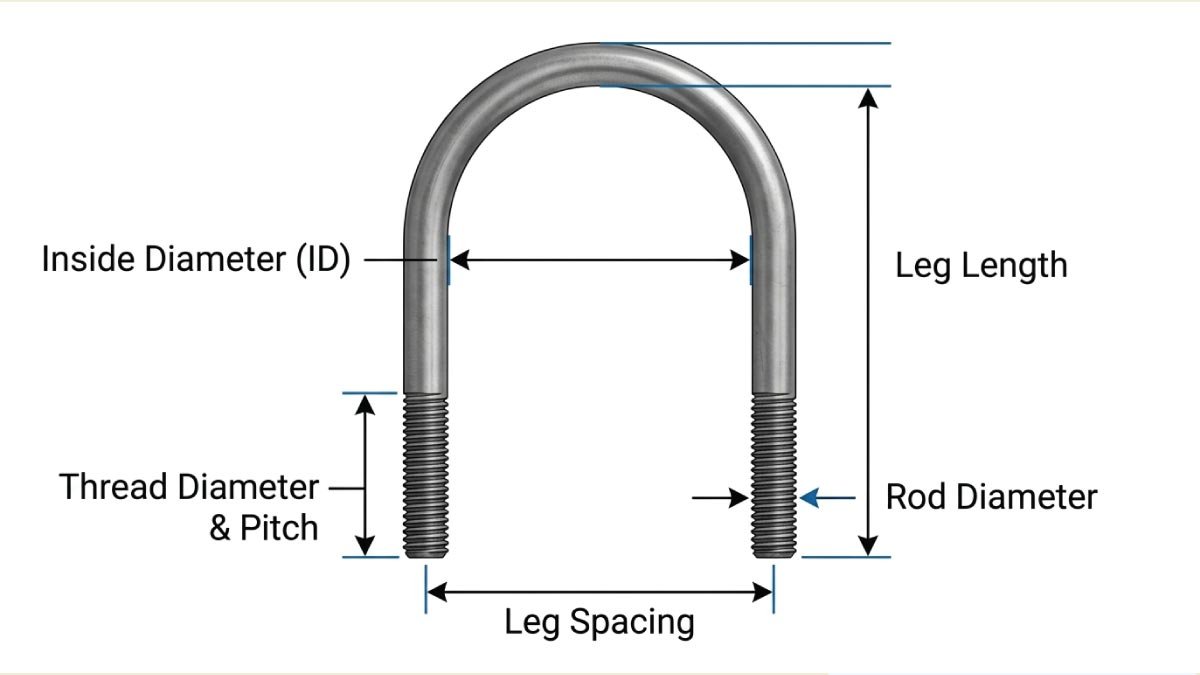
Every U bolt is defined by five primary measurements. Understanding each one gives you full control over the selection process.
1. Inside Diameter (ID) — The Most Critical Measurement
The inside diameter is the measurement across the interior of the curved section — the opening that wraps around your pipe or rod. This dimension must match the actual outside diameter (OD) of the object being clamped. A slight clearance is acceptable, but excessive gap reduces clamping efficiency.
Here is the most common mistake engineers and tradespeople make: confusing nominal pipe size (NPS) with actual outside diameter. These are not the same. A 2-inch NPS pipe has an actual OD of 2.375 inches. A 3-inch NPS pipe measures 3.500 inches OD. If you select a U-bolt based on nominal size rather than actual OD, your fastener will not fit correctly.
Always measure the pipe or tube with calipers before ordering. This single habit eliminates the most frequent U-bolt sizing error.
2. Leg Length
Leg length is the distance from the bottom of the curved section to the tip of the threaded end on each leg. This measurement must account for the thickness of the mounting plate, any washers used, and the minimum required thread engagement for the nut.
A common rule of thumb is that nut engagement should be at least 1.5 times the thread diameter. For a 1/2-inch thread, you need at least 3/4-inch of thread beyond the mounting plate surface. Insufficient thread engagement under load causes nut stripping and bolt pull-through — two of the most common U-bolt failure modes.
3. Thread Diameter and Pitch
The threaded legs of a U-bolt must match the nuts you are using. Thread diameter is expressed in fractional inches for imperial fasteners (1/4″, 3/8″, 1/2″, etc.) or in millimeters for metric hardware. Thread pitch refers to the spacing between threads — coarse thread (UNC) is used in most general construction and piping work, while fine thread (UNF) appears in precision mechanical and automotive applications.
Never mix metric and imperial hardware or combine coarse and fine thread components. Doing so produces minimal thread engagement, damages the threads, and creates an unsafe connection.
4. Rod Diameter (Bolt Body Diameter)
This is the thickness of the steel rod used to form the U-bolt body. A heavier rod diameter means greater tensile strength, higher working load, and better resistance to bending under stress. Light-duty pipe hangers may use 1/4-inch rod, while heavy industrial piping supports and structural clamps use 5/8-inch to 1-inch rod or larger.
Rod diameter and thread diameter are often equal, but not always. Some U-bolts use a reduced thread diameter to accommodate standard nut sizes while maintaining a heavier body for load capacity.
5. Leg Spacing (Inside Width)
For round U-bolts, leg spacing equals the inside diameter. For square U-bolts used on structural tubing or rectangular beams, the leg spacing is independent of the height of the curved section and must match the width of the member being clamped. Always verify both the inside width and inside height when selecting square U-bolts for non-circular sections.
Standard U-Bolt Size Reference Chart
The table below lists common U-bolt sizes for round pipe applications based on standard NPS pipe outside diameters:
| Pipe NPS | Pipe OD (in) | U-Bolt ID (in) | Rod Diameter | Thread Size | Typical Leg Length |
|---|---|---|---|---|---|
| 1/2″ | 0.840 | 7/8″ | 1/4″ | 1/4″-20 UNC | 2″ |
| 3/4″ | 1.050 | 1-1/16″ | 5/16″ | 5/16″-18 UNC | 2-1/2″ |
| 1″ | 1.315 | 1-5/16″ | 3/8″ | 3/8″-16 UNC | 2-1/2″ |
| 1-1/4″ | 1.660 | 1-11/16″ | 3/8″ | 3/8″-16 UNC | 3″ |
| 1-1/2″ | 1.900 | 1-15/16″ | 1/2″ | 1/2″-13 UNC | 3″ |
| 2″ | 2.375 | 2-3/8″ | 1/2″ | 1/2″-13 UNC | 3-1/2″ |
| 2-1/2″ | 2.875 | 2-7/8″ | 5/8″ | 5/8″-11 UNC | 4″ |
| 3″ | 3.500 | 3-1/2″ | 5/8″ | 5/8″-11 UNC | 4″ |
| 4″ | 4.500 | 4-1/2″ | 3/4″ | 3/4″-10 UNC | 4-1/2″ |
| 6″ | 6.625 | 6-5/8″ | 7/8″ | 7/8″-9 UNC | 5″ |
Always verify dimensions against the manufacturer’s product datasheet. Tolerances vary between suppliers, and specific project specifications may require tighter conformance.
When your project involves multiple measurement systems or mixed unit standards, an engineering units conversion chart for projects is an essential reference to keep on hand — especially when converting between metric and imperial fastener specifications or working with international piping standards.
U-Bolt Types by Shape and Application Profile
The shape of a U-bolt is determined by the cross-section of the object it clamps. Selecting the wrong shape is just as problematic as selecting the wrong size.
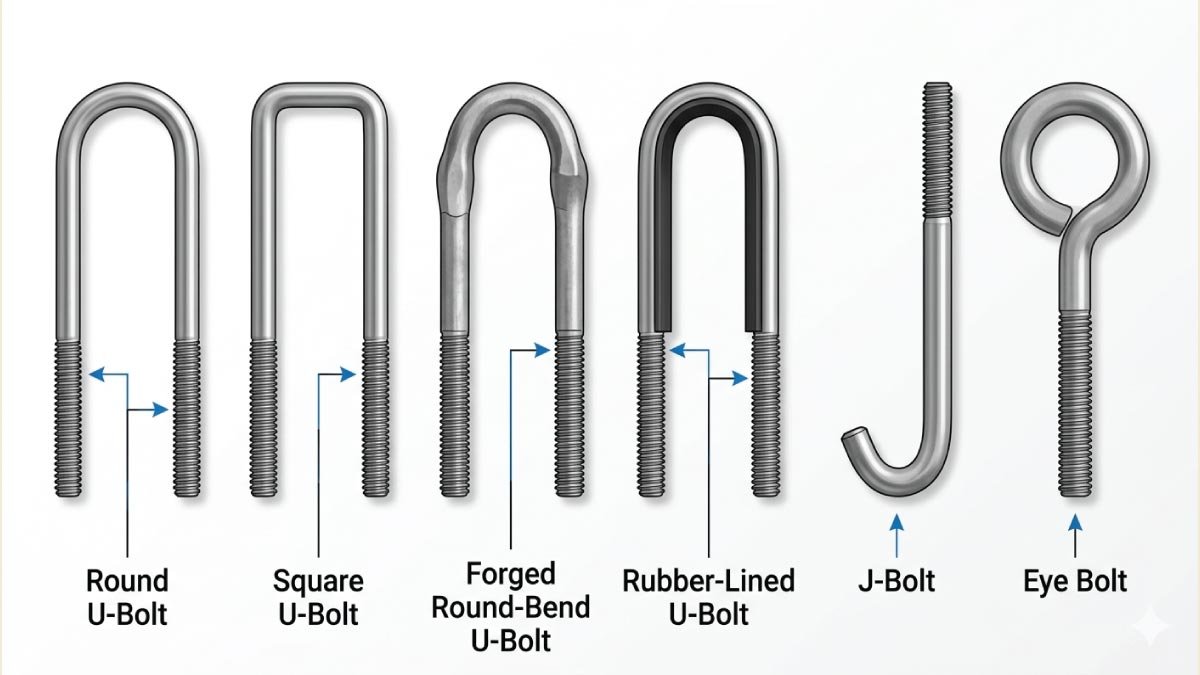
Round U-Bolts are the most widely used type. The curved base conforms to cylindrical pipe, tubing, rods, and bars. This is the default shape for plumbing, HVAC, and process piping applications.
Square U-Bolts feature a flat base and 90-degree corners. They are used for square structural tubing, rectangular hollow sections, wooden beams, and channel iron. Both the inside width and inside height must be specified when ordering.
Forged Round-Bend U-Bolts are manufactured from a single forged piece rather than being bent from rod stock. Forged U-bolts have a more uniform grain structure and higher strength-to-weight ratio, making them appropriate for high-vibration environments such as heavy truck suspension and offshore rigging.
Rubber-Lined or Cushioned U-Bolts incorporate a resilient liner inside the curved section. The liner protects the pipe surface from abrasion, provides electrical isolation between the fastener and the pipe, and adds vibration damping. These are commonly used with copper tubing, plastic-coated conduit, and thermoplastic pipe.
J-Bolts and Eye Bolts are close relatives of the U-bolt family. While technically different fasteners, they share many of the same dimensional standards and are selected using similar measurement logic.
U-Bolt Materials: Matching the Fastener to the Environment
Material selection is as important as dimensional selection. The right material ensures the U-bolt performs reliably throughout its service life without corrosion, fatigue, or chemical degradation.
1- Carbon Steel (Plain, Zinc-Plated, or Hot-Dip Galvanized)
Carbon steel is the most common and economical choice. Plain carbon steel is limited to dry indoor applications where corrosion is not a concern. Electroplated zinc offers light corrosion protection for outdoor use in moderate climates.
Hot-dip galvanizing applies a much thicker zinc coating and is suitable for exposed outdoor installations, underground pipe supports, and water treatment infrastructure. The galvanized coating provides substantially longer service life than electroplating in wet or humid conditions.
2- Stainless Steel (Grades 304 and 316)
Stainless steel U-bolts are specified when corrosion resistance is a primary requirement. Grade 304 stainless performs well in most outdoor, food-processing, and mild industrial environments. Grade 316 stainless contains molybdenum, which dramatically improves resistance to chloride attack — making it the correct choice for marine installations, coastal infrastructure, chemical processing plants, and any application involving saltwater exposure or acidic cleaning agents.
For a detailed comparison of stud bolt materials and grades across industrial applications, the complete guide to stud bolt sizes and applications provides useful reference data that translates directly to U-bolt material selection decisions.
3- Alloy Steel and High-Strength Grades
High-strength alloy steel U-bolts are used in structural, rigging, and heavy-lift applications where load ratings exceed the capability of standard carbon steel. These are common in offshore oil and gas, bridge construction, and heavy equipment mounting.
4- Specialty and Coated Options
Epoxy-coated and mechanically galvanized U-bolts are used in water and wastewater applications where standard coatings are insufficient. Nylon-insert U-bolts are found in electrical conduit work and sensitive instrument piping where metallic contact must be avoided.
How to Accurately Measure and Select a U-Bolt
Measurement accuracy is the foundation of correct U-bolt selection. Use this step-by-step process on every project:
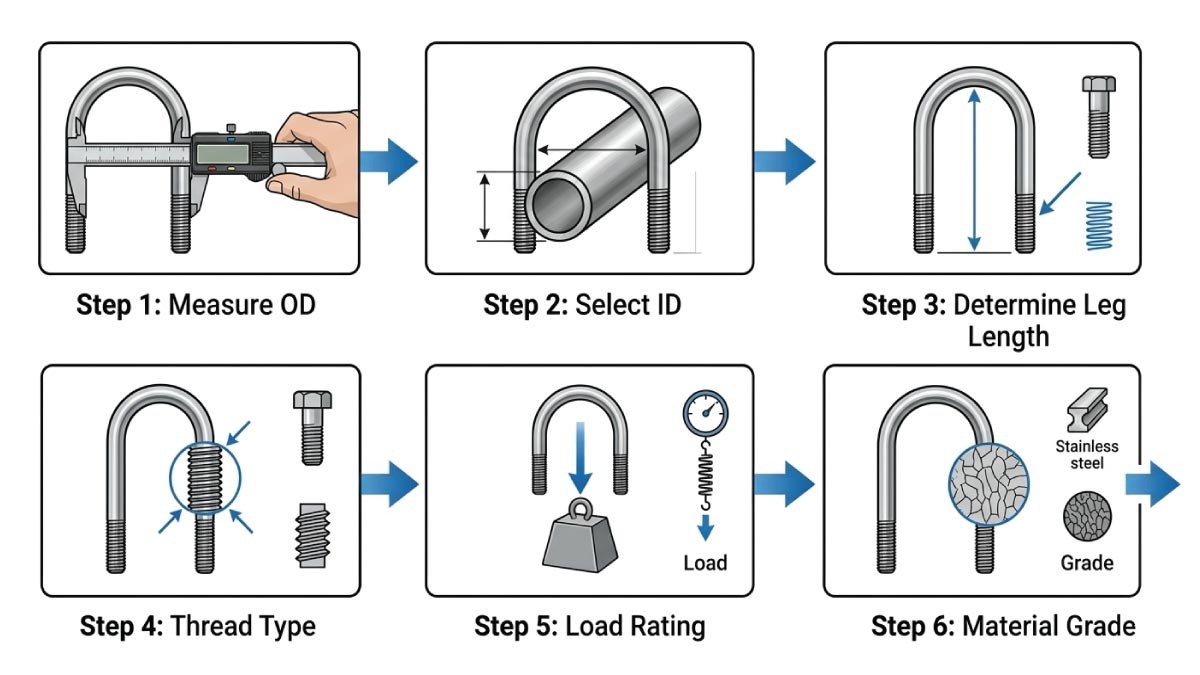
Step 1 — Measure the actual OD of your pipe or member. Use digital calipers for accuracy. Record this in both inches and millimeters if your project uses mixed units.
Step 2 — Select the U-bolt ID to match. Choose an ID equal to or fractionally larger than the measured OD. Avoid large clearances, as these reduce clamping force.
Step 3 — Determine the required leg length. Measure the thickness of your mounting plate, add washers if applicable, and calculate the minimum thread engagement needed. Leg length must exceed this total.
Step 4 — Specify thread diameter and type. Match the thread to your existing hardware or specify new hardware consistently. Confirm whether the application requires UNC coarse or UNF fine thread.
Step 5 — Confirm the load rating. Look up the manufacturer’s working load limit (WLL) for the selected U-bolt size and material. Apply the appropriate safety factor required by your engineering specification or industry code.
Step 6 — Select the material grade. Match the material to your service environment: temperature range, moisture exposure, chemical contact, and required service life.
Understanding how to take precise measurements from physical fasteners and hardware is a foundational skill for anyone working with mechanical assemblies. The mechanical measurement tools and their sizes reference covers the instruments and techniques used to measure fasteners accurately in the field and workshop.
U-Bolt Selection by Application Type
1- Process Piping and Pipe Supports
In process piping, U-bolt selection follows pipe support engineering standards such as MSS SP-58 and ASME B31.3. The U-bolt inside diameter is matched to the pipe OD, and the material is selected based on fluid temperature, pipe material, and ambient environment. Hot lines require sliding supports that allow thermal expansion — in these cases, a slightly larger ID or a pipe shoe assembly is used instead of a fixed U-bolt clamp.
2- Automotive Leaf Spring Suspension
U-bolts in leaf spring suspension carry the full corner weight of the vehicle plus dynamic road loads. They are typically Grade 5 or Grade 8 carbon steel with longer legs to accommodate the spring pack and axle assembly. Replacement U-bolts must match the original thread diameter, leg length, and leg spacing exactly — even small dimensional differences affect suspension geometry and handling.
3- Marine and Offshore Rigging
Marine U-bolts are almost always 316 stainless steel, sized to the wire rope or rod diameter being secured. Working load limits in marine applications include safety factors of 4:1 or greater, and hardware is selected from certified stock with documented mechanical properties.
4- HVAC and Building Services
In commercial building services, U-bolts are part of pipe hanger assemblies supporting insulated or bare pipework from structural decks and beams. Selection follows manufacturer load tables, with hanger spacing determined by pipe size, fluid weight, and insulation thickness.
Common U-Bolt Selection Mistakes and How to Avoid Them
Using nominal pipe size as the inside diameter. Nominal sizes do not represent actual pipe OD. Always measure.
Ordering insufficient leg length. Short legs leave minimal thread engagement, creating a structural weak point under load. Always calculate required leg length before ordering.
Ignoring environmental conditions when choosing material. Plain steel in a wet or coastal environment will corrode rapidly. Specify the correct coating or stainless grade for your service conditions.
Failing to verify working load limits. Every U-bolt has a published WLL. Exceeding it introduces fatigue failure risk, especially under dynamic or cyclic loading.
Mixing thread standards. Always confirm whether your project uses metric or imperial hardware and whether the thread pitch is coarse or fine. Mismatched threads reduce engagement, damage fastener components, and create safety hazards.
Summary: Getting U-Bolt Dimensions Right Every Time
Selecting the correct U-bolt for a project comes down to five measurements — inside diameter, leg length, thread diameter, rod diameter, and leg spacing — combined with the right material choice for your service environment. None of these decisions should be made by guesswork or nominal approximation.
Measure the actual OD of the pipe or structural member. Calculate the leg length based on your mounting plate and thread engagement requirements. Confirm the load rating against your engineering specifications. Match the material to your environment.
When you approach U-bolt selection with the same precision you apply to any other engineered component, you eliminate the most common causes of installation failure and ensure a safe, durable, and code-compliant result — whether you are building a process piping system, an automotive suspension assembly, or a marine rigging installation.

Engineer Hassan is a Mechanical Engineer with 16+ years of hands-on experience in mechanical hardware, fasteners, and workshop tools. He focuses on size selection, thread identification, and measurement, helping users choose the correct components with accuracy and safety.