
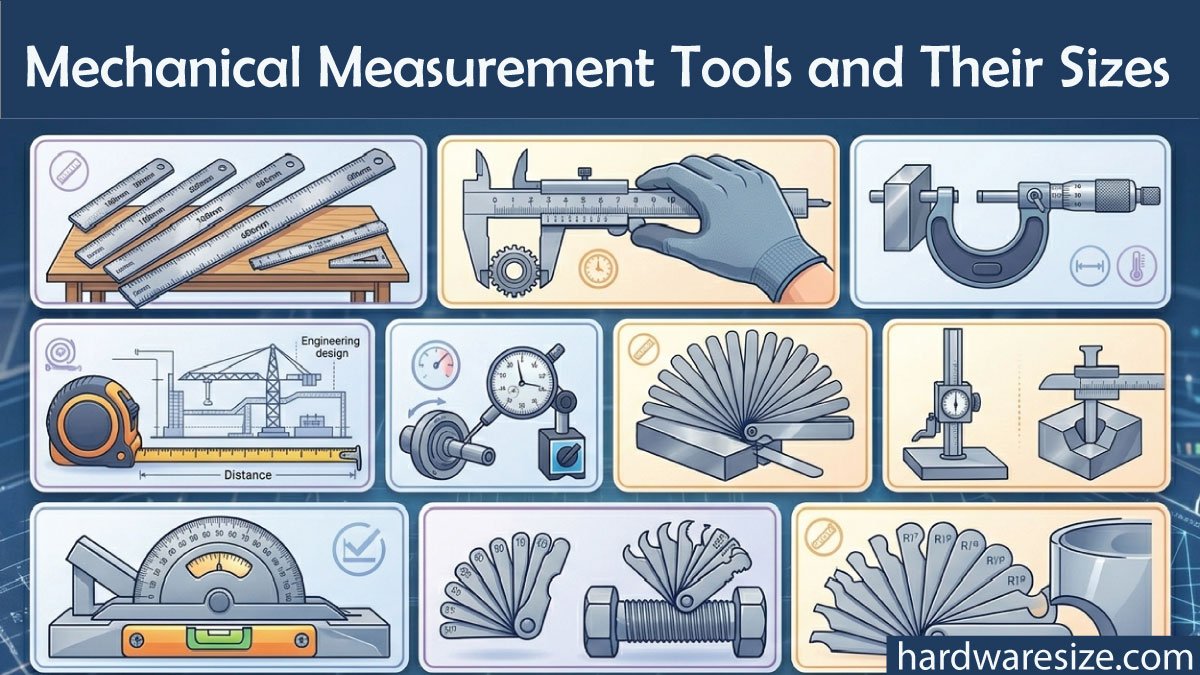
Accurate measurement is the foundation of every successful engineering project. Whether you are working in manufacturing, machining, construction, or mechanical design, using the right measurement tools—and understanding their sizes—is essential for precision and quality.
👉 In this complete guide, you will learn about mechanical measurement tools and their sizes, how they work, and how to choose the right tool for your job.
What Are Mechanical Measurement Tools?
Mechanical measurement tools are devices used to measure physical dimensions such as length, thickness, diameter, depth, and angles. These tools help engineers and technicians achieve precise results in design, production, and inspection.
They are commonly used in:
- Mechanical workshops
- CNC machining
- Construction sites
- Quality control labs
- Automotive and aerospace industries
Why Are Measurement Tool Sizes Important?
Each measurement tool comes in different sizes and ranges, specifically designed to handle certain tasks accurately. Choosing the correct size ensures that measurements are precise, consistent, and reliable, preventing errors in fabrication, design, and inspection. Using the wrong size can compromise efficiency and quality.
Importance of choosing the right size:
- Ensures accurate readings
- Prevents measurement errors
- Improves efficiency
- Reduces material waste
- Enhances product quality
👉 Using the wrong size tool can lead to incorrect measurements and costly mistakes.
Common Mechanical Measurement Tools and Their Sizes
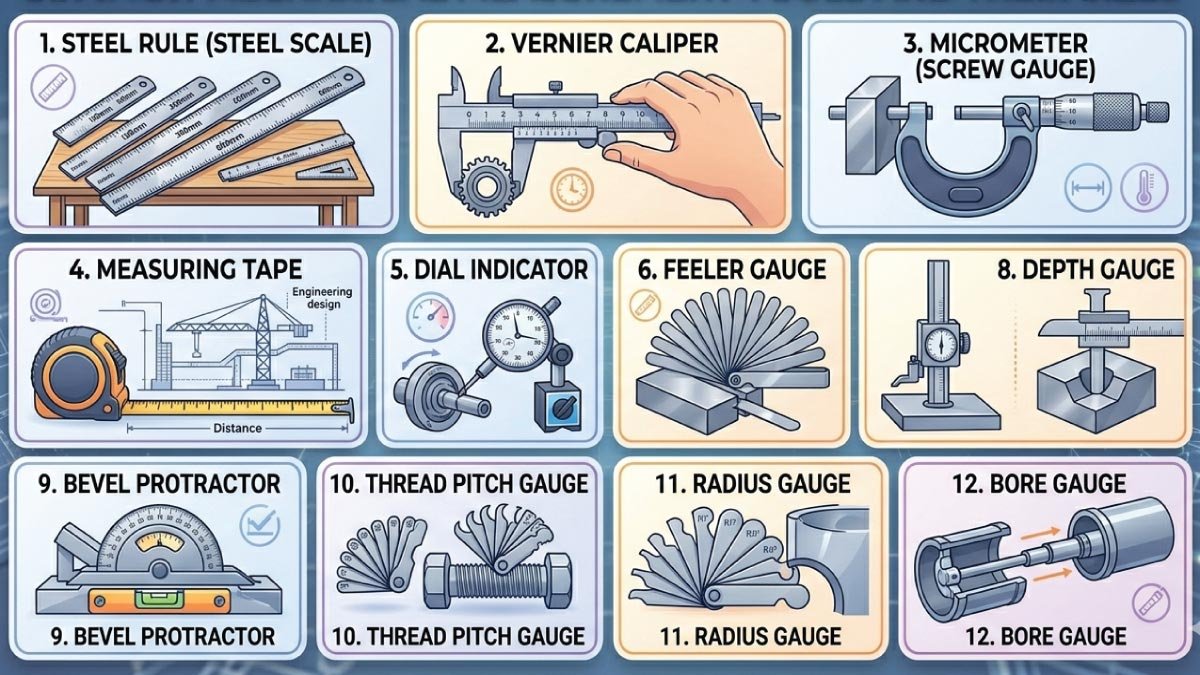
Mechanical measurement tools are essential in engineering, manufacturing, and inspection processes. Selecting the appropriate tool and size ensures accuracy and efficiency in measurements. Below are the most commonly used tools along with their standard size ranges and features for practical applications.
1. Steel Rule (Steel Scale)
The steel rule is a simple, versatile measuring tool used for general measurements in workshops and labs. Its compact design and dual marking in mm and inches make it ideal for quick checks, layout work, and rough measurements. Steel rules come in multiple standard lengths.
Common sizes:
- 150 mm (6 inches)
- 300 mm (12 inches)
- 600 mm (24 inches)
- 1000 mm (1 meter)
Features:
- Made of stainless steel
- Marked in mm and inches
- Used for rough measurements
👉 Best for quick and general measurements where high precision is not required.
2. Vernier Caliper
A vernier caliper is a highly accurate tool for measuring internal, external, and depth dimensions. It is essential in engineering, machining, and quality control, offering precision far beyond simple scales. Vernier calipers are available in analog, digital, and dial versions to suit various applications.
Common sizes:
- 150 mm (6 inches)
- 200 mm (8 inches)
- 300 mm (12 inches)
Accuracy:
- Typically 0.02 mm or 0.001 inch
Types:
- Analog vernier caliper
- Digital vernier caliper
- Dial caliper
👉 Ideal for measuring diameters, thickness, and small components.
3. Micrometer (Screw Gauge)
Micrometers are precision tools designed for extremely accurate measurements of small dimensions, often in machining and engineering workshops. They are indispensable for quality inspection, allowing tolerances to be measured down to 0.01 mm or better. Different types allow measurement of outside, inside, and depth dimensions.
Common sizes:
- 0–25 mm
- 25–50 mm
- 50–75 mm
- 75–100 mm
Accuracy:
- Up to 0.01 mm or better
Types:
- Outside micrometer
- Inside micrometer
- Depth micrometer
👉 Perfect for precision engineering and machining work.
4. Measuring Tape
Measuring tapes are flexible tools ideal for measuring long distances and large structures. They are commonly used in construction, layout work, and site inspections. Available in steel or fiberglass, measuring tapes combine portability with durability for practical field use.
Common sizes:
- 3 meters
- 5 meters
- 10 meters
- 30 meters
Features:
- Flexible steel or fiberglass tape
- Easy to carry
- Used in construction and layout work
👉 Best for measuring large distances and structures.
5. Dial Indicator
Dial indicators measure small variations in dimensions with high precision. Widely used in quality control and machining, they detect misalignment, runout, and flatness deviations. They provide visual feedback through a graduated dial, making them essential for accurate inspections.
Common range:
- 0–10 mm
Accuracy:
- 0.01 mm or finer
Uses:
- Checking alignment
- Measuring runout
- Flatness inspection
👉 Essential for quality control and precision inspection.
6. Feeler Gauge
Feeler gauges are used to measure small gaps or clearances in mechanical assemblies. They consist of multiple thin metal blades of different thicknesses and are often employed in engine maintenance, valve adjustments, and precise assembly checks where exact spacing is critical.
Common sizes:
- 0.02 mm to 1 mm (in multiple blades)
Features:
- Thin metal strips
- Different thickness values
👉 Used in engine maintenance, valve adjustment, and gap measurement.
7. Height Gauge
Height gauges are precision tools used to measure vertical distances from a reference surface, such as a surface plate. They are widely used in inspection, marking, and layout work to ensure components meet dimensional specifications.
Common sizes:
- 150 mm
- 300 mm
- 600 mm
Accuracy:
- Up to 0.02 mm
👉 Commonly used in inspection and marking work.
8. Depth Gauge
Depth gauges measure the depth of holes, slots, and recesses accurately. They can be standalone tools or integrated into vernier calipers. Depth gauges are critical for ensuring proper assembly, component fit, and compliance with design tolerances.
Common sizes:
- 150 mm
- 200 mm
- 300 mm
👉 Often included in vernier calipers or used as separate tools.
9. Bevel Protractor
Bevel protractors are used for measuring and transferring angles with high accuracy. They are essential in machining, fabrication, and toolmaking, helping ensure precise angular relationships between surfaces and components.
Common range:
- 0° to 360°
Accuracy:
- 5 minutes (1/12 degree)
👉 Important for angular measurements in machining and fabrication.
10. Thread Pitch Gauge
Thread pitch gauges measure the pitch of threads on bolts and screws quickly and accurately. They help engineers and technicians identify thread sizes to ensure compatibility between fasteners and threaded components.
Common sizes:
- Metric threads (0.5 mm to 6 mm pitch)
- Imperial threads (4 to 62 TPI)
👉 Helps identify thread size quickly and accurately.
11. Radius Gauge
Radius gauges are used to measure the radius of curved surfaces in machining and inspection. They help ensure that curved components conform to design specifications and tolerances, providing accurate quality control in toolmaking and manufacturing.
Common sizes:
- 1 mm to 25 mm (set)
👉 Useful in tool making and inspection work.
12. Bore Gauge
Bore gauges measure the internal diameter of holes with high accuracy. Commonly used in engine cylinder inspections and precision machining, they allow engineers to verify hole dimensions and maintain tolerances critical for component fit and function.
Common range:
- 50 mm to 300 mm (varies by model)
👉 Commonly used in engine cylinder measurement.
Comparison of Measurement Tools
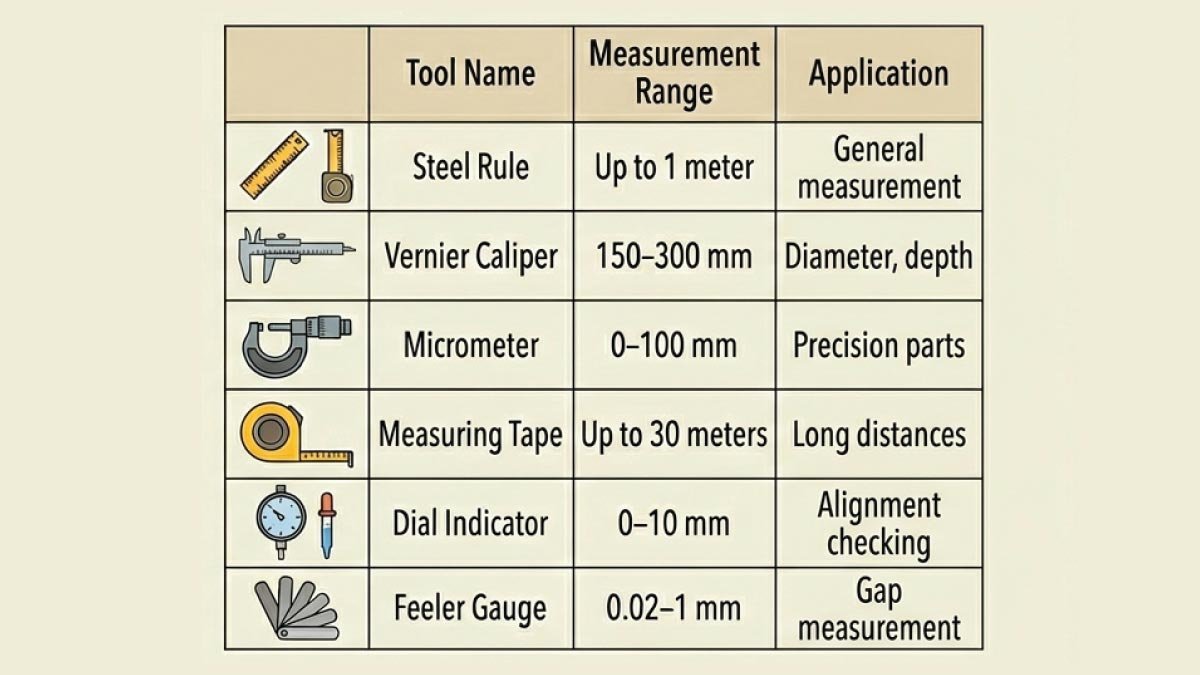
Here’s a quick comparison for better understanding:
| Tool Name | Measurement Range | Accuracy | Application |
|---|---|---|---|
| Steel Rule | Up to 1 meter | Low | General measurement |
| Vernier Caliper | 150–300 mm | Medium-High | Diameter, depth |
| Micrometer | 0–100 mm | Very High | Precision parts |
| Measuring Tape | Up to 30 meters | Medium | Long distances |
| Dial Indicator | 0–10 mm | Very High | Alignment checking |
| Feeler Gauge | 0.02–1 mm | High | Gap measurement |
How to Choose the Right Measurement Tool
Selecting the correct measurement tool is critical for achieving accurate and reliable results in any engineering or technical task. Choosing the right tool depends on the measurement type, required accuracy, size range, and the working environment to ensure efficiency and precision.
1. Measurement Range
Always choose a tool that fully covers the range of dimensions you need to measure. Using a tool with a range too small or too large can result in inaccurate readings, wasted effort, or the inability to measure critical components effectively.
2. Accuracy Required
Determine the level of precision needed for your task. Rough measurements can be done with a steel rule, while high-precision work, such as machining or quality inspection, requires tools like micrometers or vernier calipers to ensure reliable results.
3. Type of Measurement
Select a tool based on the specific type of measurement. For length, scales or tapes work best; for diameter, vernier calipers or micrometers are ideal; and for gaps or clearances, feeler gauges provide accurate results. The correct choice ensures efficiency.
4. Working Environment
Consider where the measurement will be taken. In a workshop, standard tools with fixed bases are convenient. For fieldwork, portable and durable tools are preferred. Environmental factors such as temperature, dust, or vibration can affect tool performance and accuracy.
Tips for Accurate Measurement
Accurate measurements are essential for precision and quality in engineering and technical work. Following simple best practices ensures reliable readings, reduces errors, and improves efficiency. Proper handling, calibration, and attention to detail make measurement tools work effectively in every application.
To get the best results, follow these practical tips:
- Always clean the tool and surface
- Avoid parallax error when reading scales
- Use proper lighting
- Check calibration regularly
- Handle tools carefully to avoid damage
👉 Even the best tool gives wrong results if used incorrectly.
Common Mistakes to Avoid
Beginners often make common errors that compromise measurement accuracy. Awareness of these mistakes helps engineers and technicians avoid faulty readings, improve precision, and maintain consistency in their work. Avoiding these pitfalls ensures better quality and reliable results in all measurements.
Beginners often make these mistakes:
- Using the wrong tool size
- Applying too much pressure
- Ignoring calibration
- Misreading scales
- Measuring from worn edges
Avoiding these errors will improve your accuracy significantly.
Maintenance of Measurement Tools
Proper maintenance of measurement tools is essential to ensure their longevity, accuracy, and reliability. Regular care prevents wear, corrosion, and damage, helping tools perform consistently over time. Following simple maintenance practices keeps your instruments precise and ready for every measurement task.
Maintenance tips:
- Store in dry, clean place
- Apply light oil to prevent rust
- Keep in protective cases
- Avoid dropping tools
- Calibrate periodically
Applications of Mechanical Measurement Tools
Mechanical measurement tools are indispensable in engineering and technical work. They provide accurate, reliable measurements, ensuring quality, efficiency, and precision in a wide range of industries. Using these tools properly helps maintain standards and reduces errors in critical processes.
1- CNC Machining
In CNC machining, mechanical measurement tools are used to verify dimensions, tolerances, and alignments. Accurate measurements are essential for ensuring parts fit correctly, machines operate efficiently, and the final product meets design specifications without costly errors or rework.
2- Automotive Repair
Automotive technicians rely on measurement tools to check engine components, alignments, and clearances. Accurate readings are vital for vehicle safety, performance, and durability, helping mechanics diagnose problems and perform repairs with precision and confidence.
3- Aerospace Manufacturing
In aerospace manufacturing, precision is critical. Measurement tools are used to verify the dimensions of parts, assemblies, and components to meet strict tolerances. Accurate measurement ensures safety, functionality, and reliability of aircraft systems in both production and maintenance.
4- Construction Projects
Construction engineers use measurement tools to ensure correct dimensions in building layouts, structural components, and material placement. Accurate measurements reduce errors, maintain structural integrity, and ensure compliance with architectural and engineering plans.
5- Quality Inspection Labs
In quality inspection labs, measurement tools are essential for verifying product dimensions, tolerances, and surface finishes. They support quality assurance processes, help maintain consistency across production batches, and ensure that products meet industry standards and specifications.
Final Thoughts
Understanding mechanical measurement tools and their sizes is crucial for anyone in engineering or technical work. Each tool has a specific purpose, and selecting the right size ensures accurate measurements, efficiency, and high-quality outcomes.
Start with basic tools such as steel rules, vernier calipers, and measuring tapes, then progress to advanced instruments like micrometers, dial indicators, and bore gauges.
With regular practice, proper handling, and attention to detail, you can achieve professional-level precision and reliability in every project.
Also Read: 📏 Engineering Units Conversion Chart for Projects – This post provides a clear and easy-to-use chart for converting engineering units like length, weight, temperature, and more. Perfect for students, engineers, and DIY users to ensure accuracy in every project. Read the full guide to simplify your calculations!

Engineer Hassan is a Mechanical Engineer with 16+ years of hands-on experience in mechanical hardware, fasteners, and workshop tools. He focuses on size selection, thread identification, and measurement, helping users choose the correct components with accuracy and safety.