
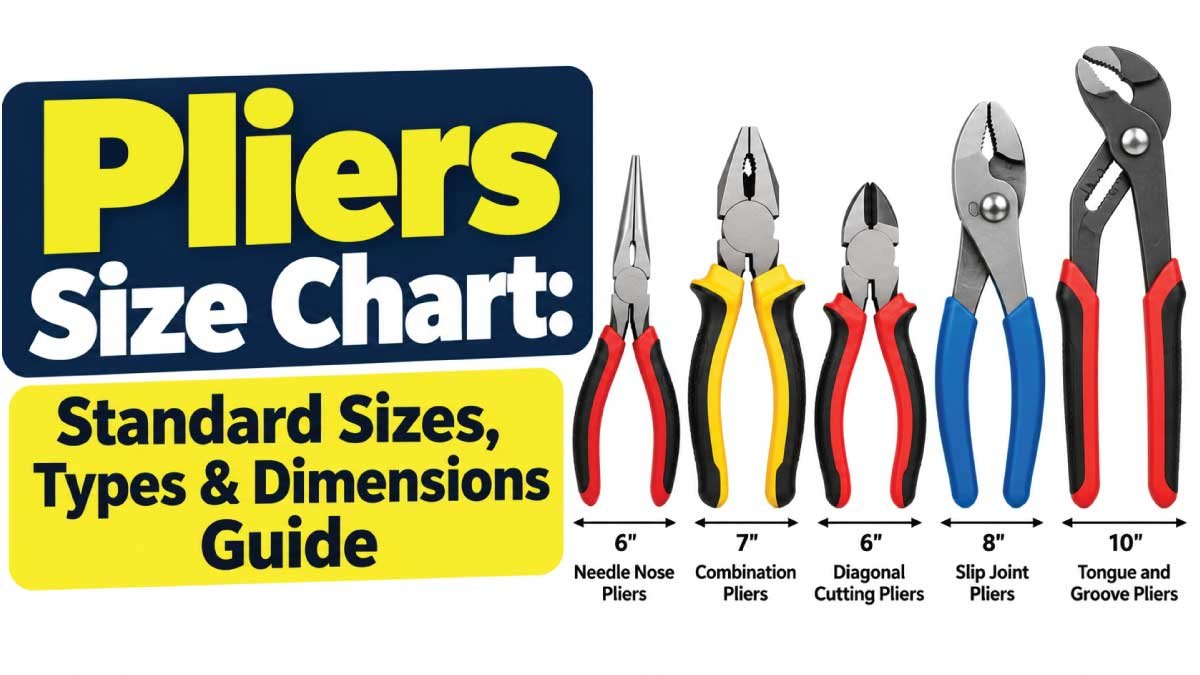
Choosing the right pliers is easier when you understand how plier size, jaw dimensions, overall length, and intended application work together. Pliers are available in many designs, including combination pliers, long-nose pliers, diagonal cutters, slip-joint pliers, locking pliers, and specialty types. Each design has different dimensions because it performs a different task.
This pliers size chart explains common plier sizes, typical dimensions, major types, jaw measurements, applications, and selection factors. It also explains how to measure pliers correctly and why the stated size on a tool should not be treated as a universal dimensional standard.
Pliers Size Chart
Pliers are commonly identified by their overall length, although manufacturers may also specify jaw length, cutting capacity, head width, handle length, or opening capacity. Overall length is usually measured from the end of the handles to the front of the jaws or head.
There is no single universal sizing system that applies to every type of pliers. A 6-inch combination plier and a 6-inch long-nose plier may have the same approximate overall length but very different jaw shapes and working dimensions.
The following chart provides general size categories for commonly used hand pliers. Actual dimensions vary by design and manufacturer.
| Pliers Size | Approx. Overall Length | Typical Use | General Classification |
|---|---|---|---|
| Mini | 3–4 in (75–100 mm) | Electronics, small components | Compact |
| Small | 4–5 in (100–125 mm) | Light repair work | Light-duty |
| Medium | 5–6 in (125–150 mm) | General maintenance | General-purpose |
| Standard | 6–8 in (150–200 mm) | Workshop and household work | General/heavy-duty |
| Large | 8–10 in (200–250 mm) | Larger components | Heavy-duty |
| Extra Large | 10–12+ in (250–300+ mm) | High-leverage work | Heavy-duty/specialty |
These ranges should be treated as size categories rather than manufacturing specifications. Always check the dimensions provided for a particular tool when exact fit or access is important.
Common Pliers Sizes and Dimensions
The overall length is only one part of a plier’s dimensions. Two tools with the same length can differ considerably in jaw width, jaw length, handle geometry, and maximum opening.
4-Inch Pliers
Pliers around 4 inches long are compact tools designed for applications where control and accessibility are more important than maximum gripping force.
Common uses include:
- Electronics and small mechanical components
- Jewelry and hobby work
- Small wire manipulation
- Model making
- Precision assembly
- Tight spaces
Because the handles and jaws are shorter, these pliers generally provide less leverage than larger tools.
5-Inch Pliers
Five-inch pliers occupy a useful middle ground between precision and general-purpose work. They are commonly found in small tool kits and are available in several designs.
They can be useful for:
- Light mechanical repairs
- Electrical component work
- Wire bending
- Small fasteners
- Assembly tasks
The actual jaw capacity depends heavily on the plier type.
6-Inch Pliers
The 6-inch size is one of the most common categories for general-purpose pliers. Combination, long-nose, diagonal-cutting, and slip-joint pliers are frequently available around this length.
A 6-inch tool generally offers a practical balance of:
- Hand control
- Accessibility
- Leverage
- Portability
- Jaw reach
For many routine maintenance tasks, this size is a convenient starting point.
7- to 8-Inch Pliers
Larger pliers around 7 to 8 inches provide additional handle length and leverage. They are often selected for heavier gripping, bending, cutting, and general workshop applications.
They can be appropriate when the workpiece is larger or additional mechanical advantage is useful.
9- to 12-Inch Pliers
Longer pliers are generally intended for applications requiring greater reach or leverage. Large groove-joint, slip-joint, locking, and specialty pliers can fall into this category.
However, larger does not automatically mean better. A long tool can be inconvenient in confined spaces and may provide more force than a delicate component can safely tolerate.
Pliers Size Chart by Type
Different plier designs use size differently. The following chart shows common types and the approximate size ranges frequently encountered in hand-tool applications.
| Pliers Type | Common Overall Length | Primary Function | Typical Applications |
|---|---|---|---|
| Combination Pliers | 6–8 in | Grip, bend, cut | General maintenance |
| Long-Nose Pliers | 5–8 in | Reach and precision gripping | Electrical, assembly |
| Diagonal Cutters | 5–8 in | Cutting wire | Electrical, general work |
| Slip-Joint Pliers | 6–10 in | Adjustable gripping | Maintenance, plumbing |
| Tongue-and-Groove Pliers | 8–16 in | Large adjustable gripping | Plumbing, mechanical |
| Locking Pliers | 5–12 in | Locking grip | Clamping, repair |
| Bent-Nose Pliers | 5–8 in | Angled access | Assembly, electronics |
| Round-Nose Pliers | 5–7 in | Forming loops | Jewelry, wire work |
| Flat-Nose Pliers | 5–8 in | Holding and bending | Wire and fabrication |
| Circlip Pliers | 5–9 in | Installing retaining rings | Mechanical service |
The ranges are representative rather than universal. Tool manufacturers may use different nominal size conventions, so the product’s published dimensions and specifications should be checked when a precise size is required.
Combination Pliers Size Chart
Combination pliers are among the most versatile general-purpose pliers. Their jaws normally combine gripping surfaces with a cutting area near the pivot.
Common overall sizes include approximately 6, 7, and 8 inches.
| Nominal Size | Approx. Overall Length | Typical Application |
|---|---|---|
| 6 in | 150 mm | Light general-purpose work |
| 7 in | 175 mm | General maintenance |
| 8 in | 200 mm | Heavier gripping and cutting |
A 6-inch combination plier is convenient where portability and control matter. An 8-inch version generally provides longer handles and greater leverage.
The cutting capacity is not determined by overall length alone. Wire material, hardness, cutter geometry, and the manufacturer’s rated capacity all affect what the tool can safely cut.
Long-Nose Pliers Size Chart
Long-nose pliers, also called needle-nose or pointed-nose pliers, have narrow jaws designed to reach areas that wider pliers cannot access.
| Size | Approx. Overall Length | Typical Use |
|---|---|---|
| 5 in | 125 mm | Precision work |
| 6 in | 150 mm | Electrical and assembly |
| 7 in | 175 mm | General reach |
| 8 in | 200 mm | Extended access |
The jaw length and tip width are particularly important with long-nose pliers. A longer tool is not necessarily more precise if its nose is too wide for the application.
When working around small components, compare the actual nose dimensions rather than selecting solely by overall length.
Diagonal Cutting Pliers Size Chart
Diagonal cutters are designed primarily for cutting wire and similar materials. Their cutting edges are positioned diagonally relative to the handles, allowing the jaws to approach material from the side.
| Nominal Size | Approx. Overall Length | Typical Application |
|---|---|---|
| 4–5 in | 100–125 mm | Small wire and precision work |
| 6 in | 150 mm | General wire cutting |
| 7 in | 175 mm | Increased leverage |
| 8 in | 200 mm | Heavier cutting applications |
Always follow the cutter’s stated material and diameter capacity. Do not assume that a larger pair of diagonal cutters can safely cut every larger wire.
Slip-Joint Pliers Size Chart
Slip-joint pliers use an adjustable pivot position to provide different jaw openings. They are useful for gripping objects of different sizes.
| Nominal Size | Approx. Overall Length | Typical Application |
|---|---|---|
| 6 in | 150 mm | Small repairs |
| 8 in | 200 mm | General maintenance |
| 10 in | 250 mm | Larger components |
| 12 in | 300 mm | Heavy-duty gripping |
The pivot adjustment changes the relationship between the jaws and handles. When selecting slip-joint pliers, consider both overall length and maximum jaw opening.
Tongue-and-Groove Pliers Size Chart
Tongue-and-groove pliers, often associated with pump-plier designs, provide a wide range of adjustable jaw positions.
They are commonly used for larger nuts, fittings, pipes, and irregularly shaped components.
| Approx. Length | General Size Category | Typical Application |
|---|---|---|
| 8 in | Small | Small fittings |
| 10 in | Medium | General maintenance |
| 12 in | Large | Plumbing and mechanical work |
| 16 in | Extra large | Large fittings and components |
Jaw opening can vary significantly between designs. Therefore, maximum jaw capacity is often more useful than nominal length when choosing these pliers for a specific fitting.
Locking Pliers Size Chart
Locking pliers use an adjustable mechanism that allows the jaws to clamp and remain locked around a workpiece.
They are available in straight-jaw, curved-jaw, long-nose, and specialty configurations.
| Approx. Length | General Use |
|---|---|
| 5–6 in | Small components |
| 7–8 in | General repair |
| 9–10 in | Larger components |
| 11–12 in | Heavy clamping applications |
For locking pliers, jaw configuration and opening capacity can be more important than overall length. Curved jaws, for example, are useful for many rounded objects, while straight jaws can provide broader contact on flat surfaces.
What Pliers Dimensions Should You Check?
A plier’s size involves several measurements. Understanding these dimensions helps you compare tools more accurately.
Overall Length
Overall length is the distance from the rear of the handles to the front of the tool. It is commonly expressed in inches or millimeters.
This is the dimension most often used to describe plier size.
Jaw Length
Jaw length measures the working section of the jaws. Long jaws can improve reach, while shorter jaws may provide a more compact gripping area.
Jaw Width
Jaw width is important when working in confined spaces. Wide jaws can offer a larger contact area but may not fit around small components.
Jaw Opening
Jaw opening describes how far the jaws can separate. This is particularly important for adjustable and gripping pliers.
Handle Length
Longer handles generally provide greater leverage, while shorter handles can offer better control in restricted areas.
Head Thickness and Width
The head dimensions determine how easily the pliers can enter a confined workspace. A tool with a large head may be unsuitable even when its overall length is correct.
How to Measure Pliers
Measuring pliers is straightforward, but the correct reference points depend on the dimension you need.
Measure Overall Length
To measure overall length:
- Close the plier handles.
- Place the tool on a flat surface.
- Measure from the rear end of the handle to the front-most point of the jaws.
- Record the measurement in inches or millimeters.
- Compare it with the manufacturer’s stated nominal size.
Do not assume your measured value will exactly match the nominal size printed on the package. A tool labeled 6 inches may not measure precisely 6.000 inches.
Measure Jaw Length
Measure from the front tip of the jaws toward the pivot along the working jaw area.
For specialty pliers, the manufacturer’s definition of jaw length may differ, so use the published dimensional drawing when available.
Measure Jaw Opening
Open the jaws to the desired position and measure the shortest distance between the gripping surfaces at the relevant point.
For adjustable pliers, measure the opening at the adjustment position being evaluated.
Measure Jaw Width
With the jaws closed, measure the external width of the jaw or nose at the location relevant to your application.
This measurement is especially useful for long-nose, needle-nose, flat-nose, and specialty pliers.
Also Read:
How to Choose the Correct Pliers Size
The correct size depends on the job rather than simply selecting the largest available tool.
Consider the Workpiece
Start by determining what you need to grip, bend, cut, hold, or form.
For small components, compact pliers usually provide better control. Larger components may require longer handles, wider jaws, or greater jaw capacity.
Consider Available Space
A large pair of pliers may not fit where a smaller pair can easily reach.
For confined areas, prioritize:
- Narrow jaws
- Slim head profile
- Appropriate jaw length
- Compact handles
- Suitable access angle
Consider Required Leverage
If the application requires substantial gripping or cutting force, handle length becomes important.
Longer handles can provide greater mechanical advantage, but leverage should not be used as a substitute for using a tool rated for the specific task.
Match the Jaw Design
Choose the jaw shape according to the work.
Flat jaws: holding and bending
Pointed jaws: reaching small areas
Curved jaws: gripping rounded objects
Cutting jaws: wire and material cutting
Smooth jaws: delicate surfaces
Knurled jaws: stronger general-purpose gripping
Also Read:
Pliers Size vs. Pliers Capacity
One of the most common sizing mistakes is confusing overall length with working capacity.
A 10-inch pair of pliers is not necessarily capable of gripping a specific 10-inch object. Similarly, two 8-inch pliers can have very different jaw openings.
Capacity can depend on:
- Jaw opening
- Jaw geometry
- Pivot design
- Handle construction
- Intended application
- Manufacturer’s specifications
For this reason, use overall length to understand the general size, but use jaw opening and rated capacity to determine whether the tool will actually work for a particular component.
Metric and Imperial Pliers Sizes
Pliers are commonly sold using nominal sizes in inches, especially in markets where imperial tool sizing is traditional. Manufacturers may also provide dimensions in millimeters.
| Approx. Nominal Size | Approx. Metric Length |
|---|---|
| 4 in | 100 mm |
| 5 in | 125 mm |
| 6 in | 150 mm |
| 7 in | 175 mm |
| 8 in | 200 mm |
| 10 in | 250 mm |
| 12 in | 300 mm |
These are nominal conversions, not indications that every tool at that size has exactly the listed metric length.
For example, a tool described as 8 inches may be marketed with a metric nominal size of approximately 200 mm. Its actual measured length may differ slightly.
Also Read:
Pliers for Different Applications
Different tasks call for different combinations of size and jaw design.
Electrical Work
Long-nose pliers, combination pliers, and diagonal cutters are common choices.
Compact sizes can provide useful control when working with smaller components, while larger tools may be appropriate for heavier general-purpose work.
Always use electrically rated tools when the application requires them, and follow the applicable electrical safety procedures.
Automotive Work
Automotive maintenance can involve a wide variety of pliers, including long-nose, locking, slip-joint, and specialty hose or clip pliers.
Access is often as important as size because components can be located in narrow spaces.
Plumbing
Larger adjustable and tongue-and-groove pliers are commonly used for fittings and larger components.
The important dimensions are often jaw opening, jaw shape, and handle length, rather than overall length alone.
Mechanical Work
Mechanical repair may require combination, locking, circlip, long-nose, and specialty pliers.
Select a tool based on the component geometry and the operation being performed rather than using one general-purpose plier for every task.
Electronics and Precision Work
Small long-nose, flat-nose, round-nose, and diagonal pliers are useful for delicate components and confined spaces.
The jaws should be appropriately sized so that the tool can manipulate the component without excessive force.
Common Pliers Size Selection Mistakes
Selecting pliers only by the number printed on the handle can lead to poor results.
Choosing Based Only on Overall Length
Overall length does not tell you everything about jaw opening, tip width, or cutting capacity.
Always check the dimensions that directly affect the task.
Using Oversized Pliers on Small Components
Large jaws can damage small components or make precise positioning difficult.
Use a smaller tool when control and access are more important than leverage.
Ignoring Jaw Opening
For adjustable pliers, insufficient jaw opening can make an otherwise suitable tool unusable.
Check the required workpiece diameter or fitting size before selecting the tool.
Ignoring Material Capacity
Cutting pliers are designed for particular materials and capacities. Using them outside their rated application can damage the cutting edges or create a safety hazard.
Assuming All 6-Inch Pliers Are the Same
Nominal size describes the general tool length, not its complete geometry.
A 6-inch diagonal cutter, long-nose plier, and combination plier can have very different working characteristics.
Pliers Size Selection Checklist
Before purchasing or using pliers, check these points:
Overall length: Does the tool provide the required reach and leverage?
Jaw length: Is there enough working surface or reach?
Jaw opening: Can the jaws accommodate the workpiece?
Jaw width: Will the tool fit into the available space?
Jaw shape: Does it match the component?
Cutting capacity: Is the cutter rated for the material?
Handle design: Can you control the tool comfortably?
Material and construction: Is it appropriate for the workload?
Application rating: Is the tool designed for the intended task?
Manufacturer dimensions: Are exact specifications available?
For professional work, the manufacturer’s dimensional and capacity information should take precedence over a generic pliers size chart.
Frequently Asked Questions About Pliers Sizes
What is the most common pliers size?
Around 6 to 8 inches is a common range for general-purpose pliers. The ideal size depends on the plier type and intended application.
What does 6-inch pliers mean?
A 6-inch plier generally refers to a tool with an overall nominal length of approximately 6 inches. It does not mean the jaws have a 6-inch opening or that every dimension measures exactly 6 inches.
Are 8-inch pliers better than 6-inch pliers?
Neither size is universally better. An 8-inch tool may provide greater reach or leverage, while a 6-inch tool can be easier to control and use in confined spaces.
How are pliers sizes measured?
Pliers are commonly measured by overall length, from the rear of the handles to the front of the jaws. Other useful measurements include jaw length, jaw width, head dimensions, and jaw opening.
What size pliers are best for electrical work?
There is no single correct size. Six- to eight-inch combination pliers, long-nose pliers, and diagonal cutters are common general-purpose sizes, but the correct choice depends on the electrical task and required tool rating.
What size pliers are best for plumbing?
Larger adjustable or tongue-and-groove pliers are often useful for plumbing because they can accommodate larger fittings. The required jaw opening should be checked against the fitting or component.
Do pliers have standard sizes?
Pliers have common nominal sizes, but there is no universal dimensional standard that makes every plier of the same nominal length identical. Manufacturer specifications should be used for exact dimensions.
Can plier size affect leverage?
Yes. Longer handles can generally provide greater mechanical advantage, although actual performance also depends on pivot location, jaw geometry, and tool design.
Final Takeaway
A pliers size chart is useful for understanding the general relationship between overall length, jaw dimensions, leverage, reach, and application. Common sizes range from compact 3- to 4-inch tools through larger 10- to 12-inch and specialty designs.
The most important point is that plier size alone does not determine suitability. Before choosing a tool, consider the type of pliers, jaw shape, jaw opening, overall dimensions, cutting capacity, workspace, and intended material.
For exact applications, use the manufacturer’s published dimensions and capacity ratings rather than relying only on nominal size. Choosing according to the actual job will give you better control, access, and tool performance.

Engineer Hassan is a Mechanical Engineer with 16+ years of hands-on experience in mechanical hardware, fasteners, and workshop tools. He focuses on size selection, thread identification, and measurement, helping users choose the correct components with accuracy and safety.