
Washers are small but essential components used in countless fastening applications. Whether you’re working on machinery, automotive repairs, construction projects, or household maintenance, selecting the correct washer size is critical for achieving a secure and reliable connection.
Many people focus on bolt and nut sizes while overlooking the washer. However, using the wrong washer can lead to uneven load distribution, loose fasteners, material damage, and premature failure.
This guide explains how to measure washer size accurately, understand washer dimensions, and choose the right washer for your application.
What Is a Washer?
A washer is a thin plate, usually circular with a hole in the center, placed under a bolt head or nut. Washers help distribute loads, reduce surface damage, minimize vibration, and improve fastening performance.
Washers are commonly used in:
- Construction projects
- Automotive assemblies
- Industrial machinery
- Furniture manufacturing
- Plumbing systems
- Electrical installations
Because washers come in many sizes and types, proper measurement is important when replacing or selecting one.
Why Measuring Washer Size Matters
Selecting the correct washer size is just as important as choosing the right bolt or nut. Washers play a critical role in distributing loads, protecting surfaces, and maintaining the integrity of a fastening system. An incorrectly sized washer can lead to uneven pressure, material damage, loosening, and reduced assembly performance. Proper measurement helps ensure the washer functions as intended.
Improved Load Distribution
One of the primary functions of a washer is to distribute the clamping force generated by a bolt or nut. By spreading the load over a larger area, washers help reduce localized stress and minimize the risk of material deformation.
The washer spreads the fastening force across a larger surface area.
Better Fastener Performance
A properly sized washer supports the fastener and helps maintain consistent clamping pressure. This improves the overall performance of the fastening system and reduces the likelihood of movement caused by vibration or repeated loading. Properly sized washers help maintain secure connections.
Reduced Surface Damage
When bolts or nuts are tightened directly against softer materials, they can create dents, scratches, or permanent deformation. Washers act as protective barriers that help preserve the integrity of the contact surface. Washers protect softer materials from bolt and nut pressure.
Increased Durability
Correctly sized washers help distribute stress more evenly throughout the assembly. This reduces excessive wear on fasteners and connected components, extending the service life of the entire fastening system. Correct sizing reduces wear and stress concentration.
Enhanced Safety
In critical applications, a properly sized washer contributes to a safer and more reliable connection. It helps maintain proper clamping force and reduces the risk of fastener loosening under load or vibration. Proper washers help prevent loosening and connection failure.
Using an incorrectly sized washer may reduce the effectiveness of the entire fastening assembly. Therefore, accurate washer measurement should always be part of the fastener selection process.
Tools Needed to Measure a Washer
Measuring a washer accurately requires only a few basic tools. The choice of tool depends on the level of precision required and the size of the washer being measured. While simple tools can provide approximate dimensions, calipers offer the most reliable and professional results.
1. Vernier Caliper
A vernier caliper is one of the most commonly used tools for measuring washer dimensions. It provides highly accurate readings for inside diameter, outside diameter, and thickness measurements. Provides precise measurements of washer dimensions.
2. Digital Caliper
Digital calipers offer the same accuracy as vernier calipers while displaying measurements on an easy-to-read digital screen. They are widely used in workshops, manufacturing facilities, and maintenance environments. Offers quick and accurate readings.
3. Steel Ruler
A steel ruler can be used when high precision is not required. It is suitable for estimating outside diameter and general washer dimensions, although it may not provide the accuracy needed for exact sizing. Useful for basic measurements.
4. Measuring Tape
For oversized washers used in construction, structural steelwork, or industrial equipment, a measuring tape can be a practical solution for obtaining approximate dimensions. Suitable for larger washers.
5. Washer Size Chart
After taking measurements, a washer size chart helps identify the nearest standard washer size. Comparing measurements with standard charts ensures compatibility with bolts, nuts, and fastening systems. Helps compare measurements with standard sizes.
For best accuracy, a digital or vernier caliper is recommended. These tools provide precise measurements and help ensure the correct washer size is selected for safe, reliable, and long-lasting fastening applications.
Understanding Washer Dimensions
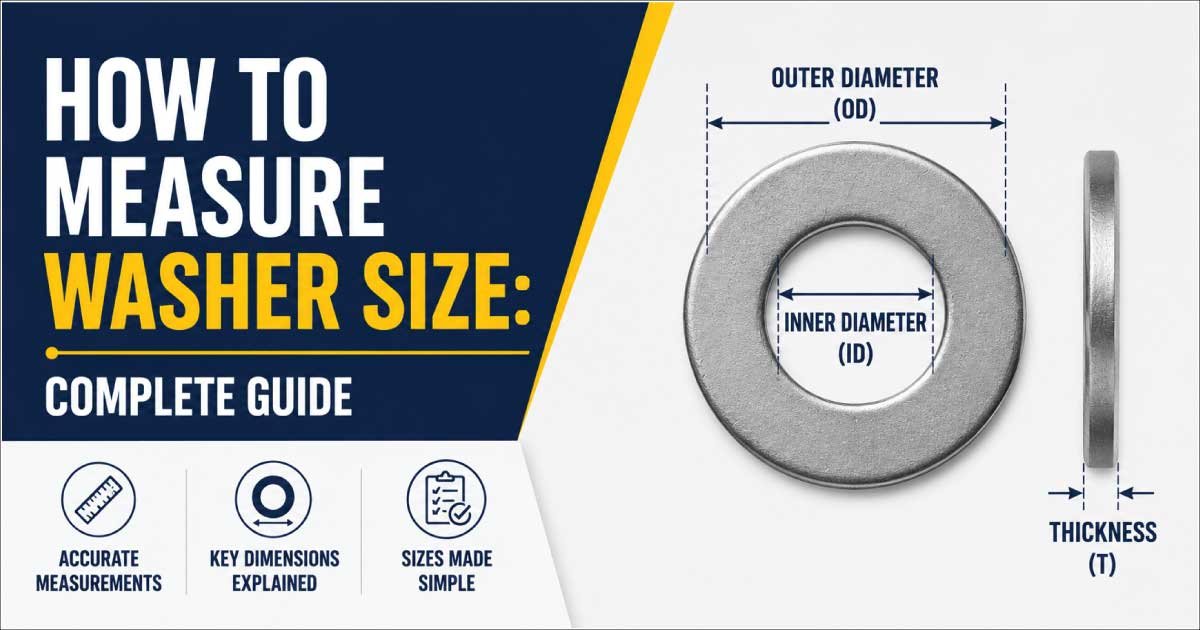
Before measuring a washer, it is important to understand the key dimensions used to identify its size. Washers are generally specified using three primary measurements: inside diameter, outside diameter, and thickness. Together, these dimensions determine whether a washer is compatible with a particular bolt, screw, or fastening application and whether it can provide adequate support and load distribution.
1. Inside Diameter (ID)
The inside diameter refers to the size of the hole located at the center of the washer. This measurement determines the maximum bolt, screw, or threaded fastener that can pass through the washer. Selecting the correct inside diameter ensures proper fitment and prevents installation problems.
2. Outside Diameter (OD)
The outside diameter is the total width of the washer measured from one outer edge to the opposite outer edge. This dimension affects the washer’s ability to distribute loads and protect the surface beneath the fastener.
3. Thickness
Thickness refers to the distance between the washer’s two flat surfaces. Washer thickness influences strength, rigidity, and load-bearing capacity. Thicker washers generally provide greater resistance to deformation under heavy loads.
These dimensions determine the washer size and application suitability. Measuring all three accurately is essential when selecting replacement washers or verifying specifications for engineering and maintenance projects.
How to Measure Washer Size
Measuring a washer involves determining all three primary dimensions accurately. A digital or vernier caliper is the preferred tool because it provides precise readings for inside diameter, outside diameter, and thickness. By measuring each dimension carefully, you can identify the correct washer size and ensure compatibility with your fastening system.
Step 1: Measure the Inside Diameter
The inside diameter is the size of the center hole through which the bolt, screw, or fastener passes. Since this dimension determines compatibility with the fastener, it is often considered the most important washer measurement.
How to Measure
To measure the inside diameter accurately, use a caliper and ensure the jaws contact the inner edges of the washer hole without applying excessive force.
- Open the caliper jaws.
- Place them inside the washer hole.
- Expand until both sides touch the hole.
- Read the measurement.
Example
If the inside hole measures approximately 10 mm, the washer is designed for an M10 bolt or fastener.
The inside diameter is often the most important washer measurement because it determines which bolt or screw can pass through it. An incorrectly sized hole may prevent installation or allow excessive movement within the assembly.
Step 2: Measure the Outside Diameter
The outside diameter is the total width of the washer measured across its outer edges. This measurement affects how the washer distributes force and how much surface area it covers beneath the bolt head or nut.
How to Measure
Position the washer carefully between the caliper jaws and ensure the measurement is taken across the widest part of the washer.
- Place the washer between the caliper jaws.
- Measure from one outer edge to the opposite outer edge.
- Record the measurement.
Example
If the washer measures 30 mm from edge to edge, the outside diameter is:
30 mm OD
The outside diameter influences load distribution and surface coverage. Larger outside diameters generally spread forces over a wider area, helping to reduce stress on softer materials and improve joint stability.
Step 3: Measure Washer Thickness
Thickness is another important dimension because it affects the washer’s strength, stiffness, and ability to withstand loads without deforming. Different applications require different washer thicknesses depending on the amount of force involved.
How to Measure
Use a caliper to measure the distance between the washer’s two flat surfaces. Ensure the washer is positioned squarely between the jaws for the most accurate reading.
- Position the washer between the caliper jaws.
- Measure its thickness.
- Record the result.
Example
A reading of 2 mm indicates:
2 mm thick washer
Thicker washers are often used in heavy-duty applications where greater load-bearing capability is required. They provide improved resistance to bending, deformation, and wear, making them suitable for construction, industrial machinery, automotive assemblies, and structural fastening systems.
Understand The Washer Size Designations
Washers are typically identified according to the bolt or screw size they are designed to fit. Although a washer has specific physical dimensions such as inside diameter, outside diameter, and thickness, the nominal designation usually refers to the compatible fastener size. Understanding washer size designations makes it easier to select replacements and ensure compatibility with bolts, nuts, and fastening assemblies.
Example
A washer designed for an M10 bolt may have the following dimensions:
- Inside Diameter: 10.5 mm
- Outside Diameter: 20 mm
- Thickness: 2 mm
It would commonly be referred to as an:
M10 Washer
The nominal size generally corresponds to the bolt size rather than the actual hole diameter. Manufacturers often make the inside hole slightly larger than the bolt diameter to allow easy installation while maintaining proper alignment within the assembly.
Measuring Flat Washers
Flat washers are the most commonly used type of washer in mechanical, automotive, construction, and household applications. Their simple design makes them easy to measure and identify. To determine the size of a flat washer accurately, all three primary dimensions must be measured and recorded.
Measurement Process
When measuring a flat washer, collect the following dimensions to fully identify the washer size and ensure compatibility with the intended fastener.
Measure:
- Inside diameter
- Outside diameter
- Thickness
These three dimensions completely identify most flat washers. Accurate measurements are essential when replacing worn washers or selecting hardware for new installations.
Typical Flat Washer Example
- ID: 8.4 mm
- OD: 16 mm
- Thickness: 1.6 mm
This would typically fit an M8 bolt.
The slightly oversized inside diameter allows the washer to slide easily onto the bolt while still providing proper support and load distribution during tightening.
👉 How to Measure Bolt Size: A Complete Step-by-Step Guide explains how to measure diameter, length, thread pitch, and head size for accurate bolt identification. Read the full guide to learn easy methods and practical tips for selecting the correct Bolt Size for strong, safe, and reliable fastening in any project.
Measuring Fender Washers
Fender washers are similar to flat washers but feature a much larger outside diameter relative to the center hole. This design allows them to spread loads across a wider surface area, making them ideal for thin or soft materials that could otherwise become damaged under concentrated pressure.
Why Measure Carefully?
Because the outside diameter is significantly larger, it provides greater load distribution.
Accurate measurement of the outside diameter is especially important when identifying fender washers, as washers with similar inside diameters may have very different outside dimensions and load-spreading capabilities.
Measurement Steps
To identify a fender washer correctly, measure all major dimensions and compare them with standard washer charts if necessary.
- Measure the center hole.
- Measure the large outer diameter.
- Measure thickness.
Fender washers are commonly used with sheet metal, plastics, and thin materials. They are also frequently found in automotive bodywork, HVAC installations, roofing systems, and repair applications where additional surface support is required.
Measuring Lock Washers
Lock washers are designed to resist loosening caused by vibration, movement, or repeated loading. They are commonly used in machinery, vehicles, industrial equipment, and structural assemblies where maintaining fastener tension is critical for safety and performance.
Measurement Procedure
When measuring a lock washer, it is important to capture the key dimensions accurately, as these determine compatibility with the corresponding bolt and fastening application.
Measure:
- Inside diameter
- Outside diameter
- Material thickness
For split lock washers, ensure measurements are taken before compression.
Compressed or deformed lock washers may produce inaccurate readings. Measuring them in their original, uncompressed state provides the most reliable dimensions for identification and replacement.
Measuring Sealing Washers
Sealing washers are specialized washers that incorporate rubber, neoprene, silicone, or other sealing materials. They are designed not only to distribute loads but also to prevent leaks, moisture intrusion, dust penetration, and contamination around fastener holes.
Important Measurements
Because sealing washers contain both a metal component and a sealing element, several dimensions must be checked to ensure proper performance and compatibility.
- Inner diameter
- Outer diameter
- Overall thickness
- Seal thickness
These dimensions help ensure proper sealing performance. Selecting the correct sealing washer size is essential in plumbing systems, roofing installations, hydraulic equipment, automotive assemblies, and outdoor applications where leak prevention and environmental protection are critical requirements.
Metric Washer Measurements
Metric washers are sized according to metric bolt diameters.
Common metric washer sizes include:
| Washer Size | Typical Bolt Size |
|---|---|
| M4 | 4 mm Bolt |
| M5 | 5 mm Bolt |
| M6 | 6 mm Bolt |
| M8 | 8 mm Bolt |
| M10 | 10 mm Bolt |
| M12 | 12 mm Bolt |
| M16 | 16 mm Bolt |
| M20 | 20 mm Bolt |
Metric washers are widely used throughout the world.
👉 How to Remove a Stripped Bolt: Complete Guide explains simple and effective methods to extract damaged or rounded bolts without causing further damage. Read the full guide to learn step-by-step techniques, essential tools, and expert tips for safely removing a Stripped Bolt from metal surfaces in repair and maintenance work.
Imperial Washer Measurements
Imperial washers are sized in inches.
Common sizes include:
| Washer Size | Bolt Size |
|---|---|
| 1/4″ | 1/4″ Bolt |
| 5/16″ | 5/16″ Bolt |
| 3/8″ | 3/8″ Bolt |
| 1/2″ | 1/2″ Bolt |
| 5/8″ | 5/8″ Bolt |
| 3/4″ | 3/4″ Bolt |
These are commonly found in North America and older machinery.
How to Match a Washer to a Bolt
Matching a washer to the correct bolt size is essential for creating a secure and reliable fastening assembly. A properly selected washer allows the bolt to pass through easily while providing adequate support, load distribution, and surface protection. Choosing the wrong washer can result in poor load transfer, surface damage, or reduced fastening performance, especially in high-stress applications.
Step 1
The first step is to determine the diameter of the bolt that the washer will be used with. This measurement establishes the nominal washer size and serves as the foundation for selecting a compatible washer.
- Measure the bolt diameter.
A digital caliper provides the most accurate reading, although standard sizing charts can also be used if the bolt size is already known. Always measure the threaded portion of the bolt rather than the bolt head.
Step 2
Once the bolt diameter has been identified, select a washer with an inside diameter that is slightly larger than the bolt diameter. This small clearance allows the washer to slide onto the bolt without excessive looseness.
- Select a washer with a slightly larger inside diameter.
Manufacturers intentionally make washer holes slightly larger than the corresponding bolt size to simplify installation and accommodate minor manufacturing tolerances. The washer should fit comfortably while remaining properly centered around the bolt.
Step 3
After confirming the inside diameter, evaluate the washer’s outside diameter. The outside diameter determines how effectively the washer distributes clamping force across the surface and protects the material beneath the fastener.
- Verify that the outside diameter provides sufficient load distribution.
Applications involving soft materials, thin sheet metal, plastics, or composite materials often require washers with larger outside diameters to spread loads more effectively and reduce the risk of material damage.
Example
For an M12 bolt:
- Choose an M12 washer
- Confirm the hole diameter accommodates the bolt
- Verify the outside diameter suits the application
For example, a standard M12 washer may be suitable for general fastening tasks, while a larger fender washer may be preferred when additional load distribution is required. Always consider the application, material type, and expected loads when selecting a washer to ensure optimal performance, durability, and safety.
Common Washer Sizes
Some commonly used washer sizes include:
| Bolt Size | Washer ID | Typical OD |
|---|---|---|
| M6 | 6.4 mm | 12 mm |
| M8 | 8.4 mm | 16 mm |
| M10 | 10.5 mm | 20 mm |
| M12 | 13 mm | 24 mm |
| M16 | 17 mm | 30 mm |
| M20 | 21 mm | 37 mm |
Actual dimensions may vary depending on standards and manufacturer specifications.
👉 How to Measure Hex Nut Size: 4 Easy Ways with Size Charts explains how to accurately measure across flats, thread size, diameter, and height for perfect bolt matching. Read the full guide to learn simple step-by-step methods and use the Hex Nut Size Chart for quick identification, correct fitting, and reliable fastening in any mechanical project.
Common Mistakes When Measuring Washers
Measuring a washer may seem straightforward, but small mistakes can lead to selecting the wrong size and compromising the performance of the fastening assembly. Incorrect measurements may result in poor fitment, inadequate load distribution, surface damage, or premature fastener failure. Understanding and avoiding common measurement errors helps ensure accurate washer identification and reliable installation.
1. Measuring Only the Outside Diameter
Many people focus solely on the washer’s outside diameter because it is the easiest dimension to measure. However, the inside diameter is typically more important because it determines whether the washer will fit the intended bolt or screw. The inside diameter is often the most important dimension.
A washer with the correct outside diameter but an incorrect hole size may not fit the fastener properly. Always measure both the inside and outside diameters to ensure compatibility.
2. Ignoring Thickness
Washer thickness is sometimes overlooked during measurement, especially when replacing standard flat washers. However, thickness plays an important role in determining the washer’s strength, rigidity, and load-bearing capacity. Thickness affects load capacity and performance.
Using a washer that is too thin may lead to deformation under heavy loads, while an excessively thick washer may not be suitable for certain assemblies. Always include thickness in your measurements.
3. Using Damaged Washers
Washers that are bent, worn, corroded, or deformed can produce inaccurate measurements. Damage may alter the washer’s original dimensions and make identification more difficult. Bent or worn washers may provide inaccurate measurements.
Whenever possible, measure a new or undamaged washer. If only a damaged washer is available, inspect it carefully and take multiple measurements to estimate its original dimensions.
4. Confusing Metric and Imperial Sizes
Metric and imperial washers often appear very similar, particularly in medium-sized ranges. This can easily lead to selecting the wrong replacement if measurements are not verified correctly. Always verify the measurement system before purchasing replacements.
Using a metric washer on an imperial bolt, or vice versa, may result in improper fitment, excessive clearance, or installation difficulties. Always determine whether the fastener system uses millimeters or inches before ordering parts.
5. Estimating Without Measuring
One of the most common mistakes is assuming a washer size based on appearance alone. Even experienced technicians can misidentify washers when relying solely on visual inspection. Small differences can prevent proper fitment.
A difference of just a few millimeters can affect compatibility with bolts, nuts, and mating surfaces. Taking accurate measurements with a caliper eliminates uncertainty and helps ensure the correct washer is selected.
Accurate measurements eliminate unnecessary guesswork. By carefully measuring the inside diameter, outside diameter, and thickness while avoiding these common mistakes, you can select the correct washer size and maintain the strength, safety, and reliability of your fastening assembly.
Tips for Accurate Washer Measurement
For best results:
- Clean dirt, paint, and rust before measuring.
- Use a digital caliper whenever possible.
- Measure multiple times.
- Verify dimensions against standard charts.
- Record measurements immediately.
- Keep metric and imperial hardware separated.
These practices improve measurement accuracy and hardware selection.
Conclusion
Knowing how to measure washer size correctly is essential for selecting the right fastener components. The process involves measuring the inside diameter, outside diameter, and thickness of the washer. Together, these dimensions determine compatibility, load distribution, and overall performance.
Whether you’re repairing machinery, assembling furniture, working on automotive projects, or installing structural fasteners, accurate washer measurements help ensure safe, secure, and long-lasting connections. Taking a few minutes to measure properly can prevent installation problems and improve the reliability of your entire fastening system.
FAQs:
How Is a Washer Size Determined?
Washer size is mainly determined by its inside diameter, which must match the bolt or screw size it is used with. The outer diameter and thickness also matter for load distribution. Proper sizing ensures stability, prevents movement, and improves the overall strength of the fastening assembly in mechanical applications.
What Is the Most Important Washer Measurement?
The most important washer measurement is the inside diameter because it directly determines compatibility with the bolt or screw. If the inner hole is too small or too large, the washer will not function correctly. Proper fit ensures secure fastening, even load distribution, and prevents damage to connected materials.
Can I Use a Larger Washer?
Yes, you can use a larger washer if it helps distribute load more effectively across a wider surface. However, it must still fit properly under the bolt head or nut. Oversized washers are often used in structural applications to prevent material damage and improve joint strength and stability.
What Tool Is Best for Measuring Washers?
A digital caliper or vernier caliper is the best tool for measuring washers accurately. It allows precise measurement of inner diameter, outer diameter, and thickness. This ensures correct sizing, proper fitting with bolts, and reliable performance in mechanical, construction, and engineering applications where accuracy is essential.

Engineer Hassan is a Mechanical Engineer with 16+ years of hands-on experience in mechanical hardware, fasteners, and workshop tools. He focuses on size selection, thread identification, and measurement, helping users choose the correct components with accuracy and safety.