
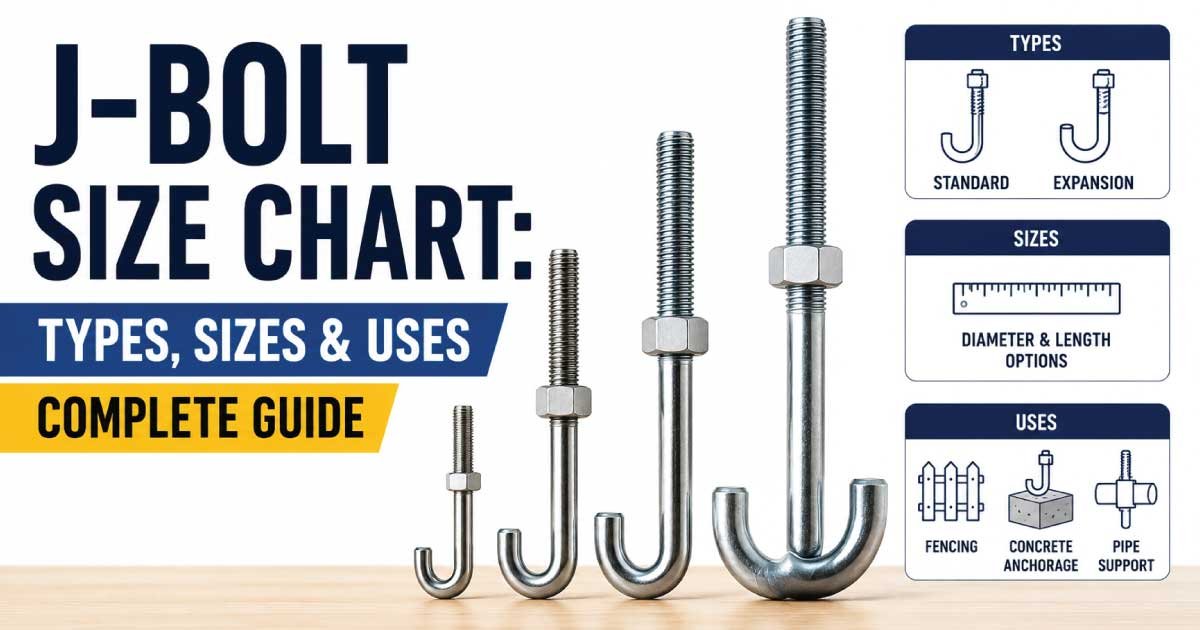
J-bolts are among the most widely used anchor fasteners in construction, utility installations, industrial machinery, and concrete foundation work. Their unique hook-shaped design provides excellent holding power, making them ideal for securing structures, equipment, and components to concrete and other materials.
Whether you are a contractor, engineer, fabricator, or DIY enthusiast, understanding J-bolt sizes and dimensions is essential for choosing the right anchor for your project.
In this complete guide, you’ll learn everything about J-bolt size charts, dimensions, materials, applications, load considerations, installation methods, and common mistakes to avoid.
What Is a J-Bolt?
A J-bolt is a threaded fastener bent into the shape of the letter “J.” One end contains machine threads that accept a nut and washer, while the opposite end forms a curved hook that becomes embedded in concrete or another base material.
The curved section acts as an anchor and prevents the bolt from pulling out when subjected to tension or vibration.
Because of their simple but effective design, J-bolts are commonly used as anchor bolts in construction and industrial applications.
Key Features of J-Bolts
- J-shaped hook for anchoring
- Threaded end for nuts and washers
- Available in many diameters and lengths
- Suitable for concrete installations
- Excellent pull-out resistance
- Available in multiple material grades
Parts of a J-Bolt
Understanding the various dimensions and components of a J-bolt is important when selecting hardware, interpreting engineering drawings, or replacing existing anchor bolts. Each part of a J-bolt serves a specific function that contributes to its strength, stability, and anchoring performance in structural and mechanical applications.
1. Threaded Section
The threaded section is located at the top of the J-bolt and is designed to receive a nut and washer. This portion allows structural components, base plates, machinery, or support brackets to be securely fastened. The thread length must be sufficient to accommodate the required hardware and provide proper clamping force. The threaded portion allows nuts and washers to secure structural components.
2. Straight Shank
The straight shank is the unthreaded section that extends between the threaded portion and the hook. It provides the necessary embedment depth within the concrete or anchoring material and helps transfer loads from the connected structure to the anchor point. This is the straight section between the threads and the hook.
3. Hook Section
The hook section forms the characteristic “J” shape of the bolt. This curved end is embedded within concrete and acts as the primary anchoring mechanism. The hook resists pullout forces and helps keep the bolt securely anchored under tension loads. The curved end provides anchoring strength inside concrete.
4. Bend Radius
The bend radius refers to the inside curvature of the hook section. This dimension affects how forces are distributed throughout the bolt and influences overall anchoring performance. A properly designed bend radius helps reduce stress concentrations and improves load-carrying capacity. The inside radius of the hook affects load distribution and anchoring performance.
5. Nut and Washer
Most J-bolt installations include a matching nut and washer on the threaded end. The washer helps distribute clamping force over a larger surface area, while the nut secures the attached component in place. Using correctly sized hardware improves stability and prevents localized stress damage. Most J-bolt installations use a matching nut and washer to distribute load evenly.
J-Bolt Size Chart (Imperial)
The following chart shows commonly available imperial J-bolt sizes.
| Diameter | Typical Length Range | Thread Length | Common Uses |
|---|---|---|---|
| 1/4″ | 4″–8″ | 1.5″–2″ | Light fixtures |
| 5/16″ | 4″–10″ | 2″ | Fence posts |
| 3/8″ | 6″–12″ | 2″–3″ | General anchoring |
| 1/2″ | 8″–18″ | 3″–4″ | Concrete foundations |
| 5/8″ | 10″–24″ | 4″ | Equipment mounting |
| 3/4″ | 12″–30″ | 4″–6″ | Structural steel |
| 7/8″ | 16″–36″ | 6″ | Industrial equipment |
| 1″ | 18″–48″ | 6″–8″ | Heavy machinery |
| 1-1/4″ | 24″–60″ | 8″ | Large structures |
| 1-1/2″ | 30″–72″ | 8″–12″ | High-load applications |
Metric J-Bolt Size Chart
Metric J-bolts are commonly used in international construction and manufacturing.
| Size | Typical Length |
|---|---|
| M6 | 100–200 mm |
| M8 | 100–250 mm |
| M10 | 150–300 mm |
| M12 | 200–400 mm |
| M16 | 250–500 mm |
| M20 | 300–600 mm |
| M24 | 400–800 mm |
| M30 | 500–1000 mm |
| M36 | 600–1200 mm |
Understand The J-Bolt Dimensions
When selecting a J-bolt, it is important to understand the key dimensions that affect strength, load capacity, and installation performance. Each dimension plays a role in how the bolt performs under tension, shear, and pull-out loads. Choosing the correct dimensions helps ensure a secure and reliable anchoring system for structural and mechanical applications.
1. Bolt Diameter
Bolt diameter is one of the most important dimensions because it directly affects the strength and load-carrying capacity of the J-bolt. Larger diameter bolts contain more material, allowing them to withstand greater forces without failure. The required diameter depends on the expected load and engineering specifications.
Larger diameters provide:
- Higher tensile strength
- Greater shear resistance
- Increased pull-out capacity
2. Overall Length
The overall length of a J-bolt is measured from the threaded end to the bottom of the hook. This dimension includes all major sections of the bolt and determines how deeply it can be embedded into concrete while still providing sufficient exposed threads for fastening.
Overall length includes:
- Threaded section
- Straight shank
- Hook section
Longer bolts provide deeper embedment and higher holding strength.
3. Thread Length
Thread length refers to the portion of the bolt that contains threads for attaching nuts and washers. Adequate thread length is necessary to ensure proper fastening and secure clamping of structural components. Insufficient threads can make installation difficult and reduce connection reliability.
Thread length determines how much of the bolt extends above the mounting surface. Insufficient thread length may prevent proper installation of nuts and washers.
4. Hook Length
The hook length is the curved section at the bottom of the J-bolt that provides mechanical anchoring within concrete. This feature helps resist pull-out forces and improves the overall holding strength of the anchor system.
The hook section provides mechanical anchoring within the concrete. Larger hooks generally improve pull-out resistance.
5. Embedment Depth
Embedment depth is the distance that the J-bolt extends into the concrete foundation or anchoring material. This dimension is critical because it determines how effectively loads are transferred from the structure to the concrete. Proper embedment helps maximize strength and prevents anchor failure.
Embedment depth refers to how deeply the J-bolt is installed into concrete. Proper embedment is essential for achieving full design strength.
Common Materials Used for J-Bolts
Material selection plays a critical role in the strength, durability, and corrosion resistance of a J-bolt. The choice of material should be based on the environmental conditions, load requirements, and expected service life of the installation. Using the appropriate material helps ensure reliable performance and reduces maintenance costs over time.
1. Carbon Steel
Carbon steel is the most commonly used material for J-bolts because it offers a good balance of strength, availability, and affordability. It is widely used in construction, machinery foundations, and general anchoring applications where corrosion exposure is limited or protective coatings are applied.
Advantages
- High strength
- Cost-effective
- Easy to manufacture
Disadvantages
- Susceptible to rust without coating
Although carbon steel provides excellent mechanical properties, it often requires painting, galvanizing, or other protective treatments when used outdoors.
2. Hot-Dip Galvanized Steel
Hot-dip galvanized steel J-bolts are coated with a thick layer of zinc that protects the underlying steel from moisture and corrosion. This makes them a popular choice for outdoor and industrial environments where long-term durability is important.
Advantages
- Excellent outdoor durability
- Good corrosion resistance
- Long service life
The zinc coating acts as a protective barrier and can significantly extend the service life of the J-bolt in harsh weather conditions.
3. Stainless Steel
Stainless steel J-bolts are designed for environments where corrosion resistance is a top priority. They contain chromium and other alloying elements that help prevent rust and chemical attack, making them suitable for marine, food-processing, and chemical applications.
Advantages
- Superior corrosion resistance
- Ideal for harsh environments
- Minimal maintenance
Common Grades
- 304 Stainless Steel
- 316 Stainless Steel
Grade 304 is commonly used for general corrosion resistance, while Grade 316 offers enhanced protection in marine and highly corrosive environments. Choosing the right stainless steel grade helps maximize performance and service life in demanding conditions.
👉 U-Bolt Size Chart: Dimensions, Types & Applications explains different U-bolt diameters, thread sizes, and bending dimensions used for pipe, automotive, and structural applications. Read the full guide to understand how to choose the right U-Bolt size for secure fastening, proper load support, and long-lasting performance in mechanical and construction work.
Common Applications of J-Bolts
J-bolts are widely used across numerous industries because they provide strong and reliable anchoring in concrete and other structural materials. Their unique hooked design helps resist pull-out forces, making them suitable for applications that require secure fastening, stability, and long-term durability.
1. Concrete Foundations
Concrete foundations are one of the most common uses for J-bolts. These anchor bolts are embedded into concrete during construction to provide a secure connection point for structural components. Properly installed J-bolts help transfer loads safely from the structure to the foundation.
J-bolts secure:
- Structural columns
- Base plates
- Support brackets
to concrete foundations.
2. Pole Installations
Utility companies and contractors frequently use J-bolts when installing poles and support structures. Their strong anchoring capability helps maintain stability under wind loads and other environmental forces.
Utility companies frequently use J-bolts for:
- Electrical poles
- Street lights
- Sign structures
3 .Industrial Machinery
Heavy industrial equipment often requires secure anchoring to prevent movement during operation. J-bolts help keep machinery firmly attached to concrete foundations, improving safety and reducing maintenance issues caused by vibration.
J-bolts help prevent:
- Vibration movement
- Equipment shifting
- Foundation damage
4. Agricultural Structures
J-bolts are commonly used in agricultural construction because they provide durable anchoring for buildings and support systems exposed to outdoor conditions. Their strength and reliability make them suitable for both small and large agricultural projects.
Common uses include:
- Barn construction
- Fence systems
- Livestock facilities
5. Marine Installations
Marine environments require corrosion-resistant anchoring hardware capable of withstanding moisture, saltwater, and harsh weather conditions. Stainless steel J-bolts are often selected for these applications because of their excellent durability and corrosion resistance.
Stainless steel J-bolts are widely used in:
- Docks
- Piers
- Coastal structures
These diverse applications demonstrate the versatility of J-bolts and their importance in construction, infrastructure, industrial operations, agriculture, and marine engineering.
How to Measure a J-Bolt
Proper measurement is essential when replacing or specifying a J-bolt. Accurate dimensions ensure the new bolt matches the existing installation and provides the required strength and anchoring performance. Several key measurements must be taken to identify the correct J-bolt size.
Step 1: Measure Diameter
The diameter is the thickness of the J-bolt shank and is one of the most important dimensions because it directly affects load-carrying capacity. Use a digital caliper or vernier caliper to obtain the most accurate measurement.
Use a caliper to measure the shank diameter.
Examples include:
- 1/2 inch
- 5/8 inch
- 3/4 inch
Step 2: Measure Overall Length
The overall length is measured from the top of the threaded end to the lowest point of the hook. This dimension includes the threaded section, straight shank, and curved hook, and determines the bolt’s embedment and installation capability. Measure from the threaded end to the bottom of the hook.
Step 3: Measure Thread Length
Thread length refers only to the portion of the bolt that contains threads. This measurement is important because it determines how much of the bolt is available for nuts, washers, and mounting components. Measure only the threaded section.
Step 4: Measure Hook Depth
Hook depth is the vertical distance from the bottom of the hook to the point where the curve begins. This dimension affects anchoring performance and pull-out resistance within the concrete. Measure the vertical depth of the curved section.
Step 5: Measure Hook Width
Hook width is the inside opening of the curved section. Measuring this dimension helps identify the exact J-bolt design and ensures compatibility with engineering specifications or replacement requirements. Measure the inside opening of the hook.
By accurately measuring the diameter, overall length, thread length, hook depth, and hook width, you can confidently select a replacement J-bolt that matches the original hardware and provides the required structural performance.
How to Choose the Right J-Bolt Size
Selecting the correct J-bolt size is essential for ensuring structural integrity, safety, and long-term performance. The appropriate size depends on several factors, including the load being supported, the thickness of the concrete foundation, environmental conditions, and project-specific engineering requirements. Careful selection helps prevent anchor failure and ensures reliable fastening.
1. Load Requirements
The expected load is one of the most important considerations when choosing a J-bolt. As load requirements increase, the bolt must be capable of handling greater tensile, shear, and pull-out forces. Larger and stronger J-bolts provide improved load-carrying capacity and greater structural reliability.
Heavier loads require:
- Larger diameters
- Deeper embedment
- Stronger materials
2. Concrete Thickness
The thickness of the concrete foundation directly affects J-bolt selection. The concrete must be deep enough to fully accommodate the hook section while maintaining sufficient concrete coverage around the anchor. Insufficient thickness can reduce anchoring strength and increase the risk of concrete cracking.
The concrete base must be thick enough to accommodate the hook.
3. Environmental Exposure
Environmental conditions play a major role in determining the appropriate J-bolt material. Exposure to moisture, chemicals, saltwater, or harsh weather can accelerate corrosion and shorten service life. Corrosion-resistant materials are recommended for outdoor and aggressive environments.
Outdoor applications should use:
- Galvanized steel
- Stainless steel
4. Project Specifications
Every construction or engineering project may have unique requirements regarding anchor size, material, embedment depth, and load capacity. Following project specifications ensures compliance with safety standards and structural design requirements.
Always follow:
- Engineering drawings
- Structural calculations
- Local building codes
By considering load requirements, concrete thickness, environmental exposure, and project specifications, you can select the correct J-bolt size for safe, durable, and reliable anchoring performance.
Common J-Bolt Installation Steps
Proper J-bolt installation is essential for achieving maximum anchoring strength and long-term structural reliability. Following the correct installation procedure helps ensure the bolt is positioned accurately, embedded securely, and capable of handling the intended loads. Careful attention during each step reduces the risk of alignment issues and anchor failure.
Step 1: Position the Bolt
Before concrete is poured, place the J-bolt in the exact location specified by the project design. Proper positioning is critical because any misalignment can make it difficult to install base plates, columns, or equipment later. Verify all measurements and locations before proceeding.
Place the J-bolt according to design requirements.
Step 2: Secure Alignment
Maintaining accurate spacing and alignment is important, especially when multiple J-bolts are used together. Templates or positioning fixtures are commonly used to keep bolts in place during concrete placement and curing.
Use templates when necessary to maintain spacing.
Step 3: Pour Concrete
Once the bolts are properly positioned, concrete can be poured around them. Care must be taken to ensure the hook section is completely surrounded by concrete and that no voids form around the anchor.
Ensure the hook is fully embedded.
Step 4: Allow Concrete to Cure
The concrete must reach sufficient strength before any loads are applied to the J-bolts. Curing times vary depending on the concrete mix, temperature, and project requirements, but adequate curing is essential for proper anchoring performance.
Follow recommended curing times.
Step 5: Install Equipment
After the concrete has cured, structural components, machinery, or mounting plates can be installed. Washers and nuts are placed on the threaded section to secure the equipment firmly to the foundation.
Attach washers, nuts, and structural components.
Step 6: Tighten Properly
The final step is tightening the nuts to the specified torque value. Proper torque ensures a secure connection without overstressing the bolt or connected components. Using a calibrated torque wrench helps achieve consistent and accurate results.
Use recommended torque values.
Following these installation steps helps ensure proper alignment, maximum holding strength, and reliable long-term performance of J-bolt anchor systems.
👉 Thrust Bearing Size Chart: Sizes Types, Applications explains different thrust bearing dimensions, load capacities, and industrial uses in automotive and machinery systems. Read the full guide to understand types, selection tips, and applications. Learn how to choose the right Thrust Bearing for durability, smooth performance, and efficient operation in projects.
Common J-Bolt Selection Mistakes
Selecting the wrong J-bolt can lead to installation problems, reduced load capacity, and even structural failure. Understanding these common mistakes helps ensure that the chosen anchor bolt provides the required strength, durability, and long-term performance for the application.
1. Choosing an Undersized Diameter
One of the most common mistakes is selecting a J-bolt with a diameter that is too small for the expected load. An undersized bolt may not provide sufficient tensile or shear strength, increasing the risk of failure under stress. This can lead to anchor failure.
2. Insufficient Embedment
Embedment depth plays a critical role in anchoring performance. If the J-bolt is not embedded deeply enough into the concrete, its pull-out resistance and load-carrying capacity are significantly reduced. Shallow installation reduces holding strength.
3 .Ignoring Corrosion
Environmental conditions should always be considered when selecting J-bolts. Standard carbon steel bolts may corrode quickly when exposed to moisture, chemicals, or saltwater, leading to reduced strength and premature failure. Outdoor applications require corrosion-resistant materials.
4. Incorrect Thread Projection
The threaded portion must extend far enough above the mounting surface to accommodate washers, nuts, and any connected components. Insufficient thread projection can make installation difficult or impossible. Too little thread may prevent proper fastening.
5. Improper Concrete Placement
Even a correctly sized J-bolt can perform poorly if it is installed incorrectly. Misalignment during concrete placement can create problems when mounting structural components, machinery, or base plates. Misaligned bolts create installation difficulties.
Benefits of Using J-Bolts
J-bolts are widely used because they provide a simple, reliable, and economical anchoring solution for many construction and industrial applications. Their unique hook design offers strong mechanical anchoring while remaining easy to install and maintain.
1. Excellent Anchoring Strength
The curved hook section helps resist pull-out forces by creating a strong mechanical connection within the concrete. This makes J-bolts highly effective for securing structural and mechanical components. Provides reliable pull-out resistance.
2. Cost-Effective
J-bolts have a straightforward design and are relatively inexpensive to manufacture. Their affordability makes them a popular choice for both small and large construction projects. Simple design keeps costs low.
3. Versatile
J-bolts can be used in a wide range of industries and applications, from building foundations to machinery anchoring. Their adaptability makes them one of the most commonly used anchor bolt types. Suitable for many industries and applications.
4. Long Service Life
When manufactured from galvanized steel or stainless steel, J-bolts can withstand harsh environmental conditions and provide years of reliable performance with minimal maintenance. Especially when galvanized or stainless steel versions are used.
5. Easy Installation
J-bolts can be positioned and secured during concrete placement without requiring specialized equipment. Their simple installation process helps save time and labor costs on construction projects. Can be installed during concrete placement with minimal tools.
Final Thoughts
J-bolts are among the most reliable anchor fasteners used in construction, utility work, manufacturing, and industrial installations. Understanding J-bolt size charts, dimensions, materials, and installation requirements helps ensure safe and durable connections. Whether you’re anchoring a structural column, mounting heavy machinery, or installing a utility pole, selecting the proper J-bolt size is essential for long-term performance and structural integrity.
FAQs:
What is a J-bolt used for?
J-bolts are commonly used to anchor structures, machinery, poles, and heavy equipment to concrete foundations. Their J-shaped design provides strong grip within concrete, ensuring stability and safety. They are widely used in construction, industrial setups, and structural applications where permanent and reliable anchoring is required for load-bearing support.
What size J-bolt should I use?
The correct J-bolt size depends on several factors, including load requirements, embedment depth, concrete thickness, and engineering design specifications. Larger loads require thicker and longer bolts. Always follow project guidelines or structural drawings to ensure proper strength, safety, and long-term durability in construction and anchoring applications.
Are J-bolts stronger than wedge anchors?
J-bolts and wedge anchors serve different purposes, but J-bolts often provide excellent long-term performance when cast into concrete. They offer strong resistance to pull-out forces. Wedge anchors are used after concrete is set, while J-bolts are ideal for permanent installations requiring high stability and structural strength.
Can J-bolts be used outdoors?
Yes, J-bolts can be used outdoors, especially when made from galvanized or stainless steel materials. These coatings protect against rust, moisture, and corrosion. Outdoor J-bolts are commonly used in fencing, construction, and structural anchoring applications where exposure to weather conditions requires enhanced durability and long-lasting performance.
What material is best for J-bolts?
Carbon steel J-bolts are suitable for indoor applications where corrosion is minimal. For outdoor or harsh environments, galvanized steel or stainless steel is preferred. These materials offer better resistance to rust and environmental damage, ensuring long-term strength, safety, and reliability in structural and industrial anchoring projects.

Engineer Hassan is a Mechanical Engineer with 16+ years of hands-on experience in mechanical hardware, fasteners, and workshop tools. He focuses on size selection, thread identification, and measurement, helping users choose the correct components with accuracy and safety.