
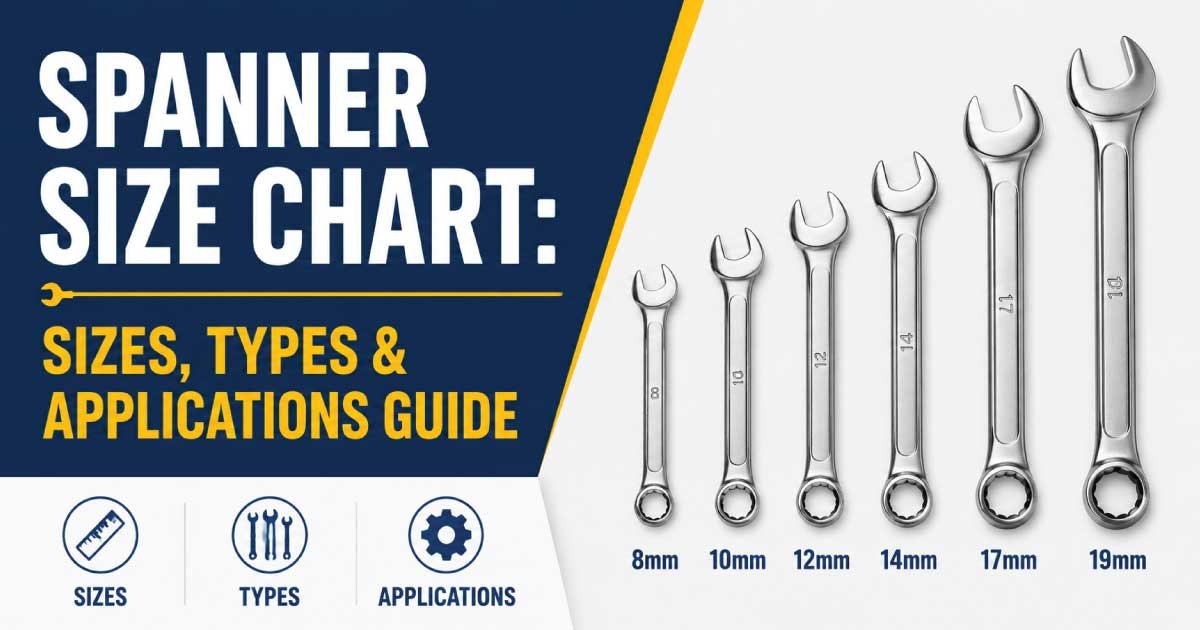
Spanners are essential hand tools used for tightening and loosening nuts, bolts, and fasteners in automotive, mechanical, plumbing, and construction work. Choosing the correct spanner size ensures a secure grip, prevents fastener damage, and makes work safer and more efficient.
This complete guide covers spanner sizes, measurement systems, conversion charts, common types of spanners, and tips for selecting the right size for any job.
What Is a Spanner?
A spanner is a hand tool designed to grip and turn nuts, bolts, and other fasteners. In North America, spanners are commonly called wrenches, while the term “spanner” is widely used in the UK, Europe, Asia, and many other regions.
Spanners come in various sizes and designs to fit different fastener dimensions and applications.
Common Uses of Spanners
- Automotive repairs
- Machinery maintenance
- Construction projects
- Plumbing work
- Bicycle repairs
- Industrial equipment servicing
- Home maintenance
Using the correct spanner size helps avoid rounding off bolt heads and improves torque transfer.
Understand The Spanner Sizes
Spanner sizes are determined by the distance across the flats (AF) of a nut or bolt head. This means the correct spanner must match the exact width of the fastener’s flat sides to ensure a secure grip and proper torque application. Using the right size helps prevent slipping, rounding of edges, and damage to both the tool and fastener.
For example:
- A 10 mm spanner fits a 10 mm nut or bolt head.
- A 13 mm spanner fits a 13 mm nut or bolt head.
Spanners are manufactured in different measurement systems depending on regional and industrial standards. Selecting the correct system is essential for compatibility and safe fastening.
Spanners are commonly available in:
- Metric sizes (millimeters)
- SAE sizes (inches)
- Whitworth sizes (older British standards)
Each system is used in specific industries and machinery types, so understanding these standards helps ensure accurate tool selection and efficient mechanical work.
Metric Spanner Size Chart
Metric spanners are the most common type used worldwide.
| Spanner Size (mm) | Common Applications |
|---|---|
| 6 mm | Small appliances |
| 7 mm | Hose clamps |
| 8 mm | Automotive trim |
| 9 mm | Light machinery |
| 10 mm | Automotive repairs |
| 11 mm | Mechanical maintenance |
| 12 mm | Equipment assembly |
| 13 mm | Vehicle components |
| 14 mm | Suspension parts |
| 15 mm | Industrial equipment |
| 16 mm | Machinery repair |
| 17 mm | Wheel components |
| 18 mm | Automotive applications |
| 19 mm | Heavy-duty repairs |
| 21 mm | Lug nuts |
| 22 mm | Industrial machinery |
| 24 mm | Construction equipment |
| 27 mm | Heavy machinery |
| 30 mm | Industrial maintenance |
| 32 mm | Large fasteners |
SAE Spanner Size Chart
SAE spanners are measured in inches and are commonly found on older American vehicles and machinery.
| SAE Size | Decimal Equivalent |
|---|---|
| 1/4″ | 0.250″ |
| 5/16″ | 0.313″ |
| 3/8″ | 0.375″ |
| 7/16″ | 0.438″ |
| 1/2″ | 0.500″ |
| 9/16″ | 0.563″ |
| 5/8″ | 0.625″ |
| 11/16″ | 0.688″ |
| 3/4″ | 0.750″ |
| 13/16″ | 0.813″ |
| 7/8″ | 0.875″ |
| 15/16″ | 0.938″ |
| 1″ | 1.000″ |
| 1-1/16″ | 1.063″ |
| 1-1/8″ | 1.125″ |
| 1-1/4″ | 1.250″ |
Metric to SAE Spanner Conversion Chart
Sometimes you may need to substitute one system for another.
| Metric (mm) | SAE Equivalent |
|---|---|
| 8 mm | 5/16″ |
| 10 mm | 3/8″ |
| 11 mm | 7/16″ |
| 13 mm | 1/2″ |
| 14 mm | 9/16″ |
| 16 mm | 5/8″ |
| 17 mm | 11/16″ |
| 19 mm | 3/4″ |
| 21 mm | 13/16″ |
| 22 mm | 7/8″ |
| 24 mm | 15/16″ |
| 27 mm | 1-1/16″ |
| 30 mm | 1-3/16″ |
| 32 mm | 1-1/4″ |
Always use the exact size whenever possible to avoid damaging fasteners.
Common Types of Spanners
Different mechanical tasks require different spanner designs to ensure proper grip, torque application, and accessibility. Each type of spanner is engineered for specific working conditions, fastener types, and levels of force. Understanding these variations helps improve efficiency, reduce tool wear, and prevent damage to nuts and bolts.
1. Open-End Spanner
An open-end spanner features U-shaped jaws that grip two opposite sides of a nut or bolt. It is one of the most commonly used spanners due to its simple design and ease of use in tight or partially accessible areas.
Advantages
- Quick positioning
- Easy access in tight spaces
- Lightweight design
Common Uses
- Plumbing
- Automotive maintenance
- Machinery repair
2. Ring Spanner
A ring spanner completely surrounds the fastener head, providing a more secure and stable grip compared to open-end designs. This enclosed structure allows better torque application and reduces the chance of slipping during heavy-duty tightening or loosening.
Advantages
- Better grip
- Less slipping
- Higher torque capability
Common Uses
- Automotive repairs
- Industrial maintenance
- Heavy-duty fastening
3. Combination Spanner
A combination spanner includes an open-end on one side and a ring end on the other, offering two tools in one. This dual-purpose design makes it highly practical for mechanics and technicians who need flexibility during different stages of repair work.
Advantages
- Versatile
- Convenient
- Commonly used by mechanics
Common Uses
- Vehicle repairs
- Workshop maintenance
- General mechanical work
4. Adjustable Spanner
An adjustable spanner features a movable jaw that can be resized to fit different fastener dimensions. This makes it a practical tool when multiple spanner sizes are not available. It is especially useful for quick adjustments and fieldwork.
Advantages
- One tool fits many sizes
- Convenient for field repairs
Common Uses
- Home maintenance
- Plumbing
- Emergency repairs
5. Socket Spanner
Socket spanners use interchangeable sockets to fit various fastener sizes. They are commonly used with ratchets or torque tools, allowing faster operation and improved torque transfer compared to traditional spanners.
Advantages
- Fast operation
- Better torque transfer
- Greater versatility
Common Uses
- Automotive repair
- Industrial maintenance
- Machinery servicing
6. Box Spanner
A box spanner is a tubular tool designed to fit over nuts and bolts, especially in deep or recessed areas where other spanners cannot reach. It is often used in applications requiring straight alignment and deep access.
Advantages
- Deep access
- Compact design
Common Uses
- Spark plugs
- Recessed fasteners
- Engine maintenance
How to Measure Spanner Size
If the size marking on a spanner is missing or worn out, you can still identify the correct size using simple manual measurement methods. Since spanners are designed to fit the distance across the flats (AF) of a nut or bolt head, accurate measurement is essential for proper fit, safety, and effective torque application.
Method 1: Measure the Nut Across Flats
The most accurate way to determine spanner size is by measuring the nut or bolt head across its flat sides. This ensures the spanner matches the exact width needed for a secure grip without slipping or rounding the edges.
Tools Required
- Digital caliper
- Vernier caliper
- Precision ruler
Steps
- Measure across the flats.
- Record the measurement.
- Match it to a spanner size chart.
Example:
A measurement of 13 mm requires a 13 mm spanner.
Method 2: Measure the Bolt Head
Another simple method is measuring the bolt head directly. This is useful when the nut is not accessible or when working with standalone bolts. The measurement across the flat sides will usually correspond to the correct spanner size needed for the job. The measured dimension typically corresponds to the required spanner size.
Using precise tools like calipers ensures better accuracy compared to rulers, helping you select the correct spanner and avoid damage to fasteners during tightening or loosening tasks.
👉 What Is a Ratchet? Sizes, Types, Uses and Materials explains how this essential hand tool works for tightening and loosening bolts efficiently. Read the full guide to explore ratchet sizes, drive types, materials, and practical applications. Learn how a Ratchet improves speed, control, and performance in mechanical and repair work.
Most Common Spanner Sizes
Certain spanner sizes are used far more frequently than others because they match the most common nut and bolt dimensions found in vehicles, machinery, and household equipment. Keeping these standard sizes in your toolkit ensures you can handle most repair and maintenance tasks efficiently without constantly searching for the right tool.
1. Common Metric Sizes
Metric spanners are widely used in modern vehicles, machinery, and industrial applications. These sizes are standard in most countries and cover a large range of everyday fastening jobs. A basic metric spanner set usually includes these essential sizes.
- 8 mm
- 10 mm
- 12 mm
- 13 mm
- 14 mm
- 17 mm
- 19 mm
2. Common SAE Sizes
SAE (inch-based) spanners are commonly used in older American vehicles, agricultural equipment, and certain industrial machines. Although less common in modern systems, they are still essential for working on legacy equipment and imported machinery.
- 3/8″
- 7/16″
- 1/2″
- 9/16″
- 5/8″
- 3/4″
These commonly used spanner sizes cover most household, automotive, and workshop tasks, making them essential for both professionals and DIY users.
How to Choose the Right Spanner Size
Selecting the correct spanner size is essential for safe, efficient, and damage-free fastening. The right fit ensures proper grip on nuts and bolts, improves torque application, and reduces the risk of slipping or rounding fastener edges. Since different tasks require different tools, understanding how to choose correctly helps improve overall performance and tool life.
1. Match the Fastener Exactly
The spanner must fit the nut or bolt perfectly with a snug, secure grip. A proper fit ensures full contact with the flat surfaces of the fastener, allowing force to be applied evenly without slippage.
A loose fit can:
- Round off corners
- Cause slipping
- Damage components
2. Consider the Application
Different tasks require different types of spanners based on access, strength, and working conditions. Choosing the right design improves efficiency and makes the job easier and safer.
Examples:
- Plumbing: Adjustable spanner
- Automotive repair: Combination spanner
- Heavy machinery: Ring spanner
- Tight spaces: Open-end spanner
3. Consider Torque Requirements
Some applications require higher torque to tighten or loosen fasteners. In such cases, spanners that provide full contact with the nut or bolt head are more effective and safer to use. Ring spanners and socket spanners are ideal for high-torque jobs because they reduce the chance of slipping.
High-torque applications benefit from ring spanners and socket spanners because they provide better contact with the fastener.
4. Choose Quality Tools
The quality of the spanner also plays an important role in performance and durability. High-quality tools are manufactured with stronger materials and precise tolerances, ensuring better grip and longer service life even under frequent or heavy use.
High-quality spanners offer:
- Better durability
- Improved grip
- Greater accuracy
- Longer service life
Choosing the right spanner size and type ensures safer operation, reduces wear on tools, and improves efficiency in all types of mechanical and repair work.
👉 Pipe Wrench Size Chart: Types, Uses and Complete Guide helps you understand different pipe wrench sizes, jaw capacity, and proper applications for plumbing and mechanical work. Read the full guide to learn how to choose the right Pipe Wrench for tight gripping, heavy-duty tasks, and efficient pipe handling in any project.
Common Spanner Size Mistakes
Using spanners incorrectly or selecting the wrong size can lead to damaged fasteners, broken tools, and unsafe working conditions. Many of these mistakes are common in both DIY and professional work, but they can easily be avoided by paying attention to proper sizing, tool selection, and correct usage techniques.
1. Using the Wrong Size
One of the most frequent mistakes is using a spanner that does not match the fastener size exactly. Even a slightly oversized spanner can fail to grip properly, leading to slipping and rounding of the nut or bolt corners. This not only damages the fastener but also makes future removal more difficult. Always verify the size before applying force.
2. Mixing Metric and SAE Tools
Metric and SAE spanners may look similar in size, but they are based on completely different measurement systems. Using the wrong system can result in a poor fit, which increases the risk of stripping or damaging the fastener. Metric and SAE sizes may appear similar but are not identical.
3. Using Adjustable Spanners Incorrectly
Adjustable spanners are useful, but improper adjustment is a common cause of tool failure. If the jaws are not tightly set to the fastener, the tool can slip during use, damaging both the spanner and the fastener head. Always tighten the adjustable jaw securely before use.
4. Applying Excessive Force
Applying too much force on a stuck fastener is another common mistake. This can damage both the tool and the component being worked on. Instead of forcing the spanner, proper techniques and supporting tools should be used.
If a fastener is stuck:
- Use penetrating oil
- Verify the correct size
- Consider a breaker bar
Avoid using excessive force with undersized tools, as this increases the risk of rounding, breakage, and injury.
👉 Hammer Size Chart: Complete Guide to Hammer Types and Sizes explains different hammer sizes, head weights, and types used in construction, woodworking, and mechanical tasks. Read the full guide to understand how to choose the right Hammer for accuracy, safety, and efficiency in every project.
Benefits of Using the Correct Spanner Size
Using the correct spanner size is essential for achieving safe, accurate, and efficient fastening. When the tool fits the fastener properly, it ensures better control, reduces damage, and improves overall performance. Whether in household repairs, automotive work, or industrial maintenance, correct spanner selection provides clear and important advantages.
1. Improved Safety
A correctly sized spanner fits securely onto the nut or bolt, reducing the risk of slipping during use. This improves control while applying force and helps prevent hand injuries or accidental damage to nearby components. Safe tool engagement is especially important when working with high torque. Reduces slipping and hand injuries.
2. Better Fastener Protection
Proper spanner sizing helps protect fasteners from damage such as rounding or stripping. When the tool fully grips the flat surfaces of the nut or bolt, force is distributed evenly, preventing deformation and making future removal easier. Prevents rounding and stripping.
3. Increased Efficiency
Using the right size spanner makes work faster and more efficient. A proper fit eliminates the need for repeated adjustments or repositioning, allowing smoother tightening or loosening of fasteners. This improves workflow and reduces effort during repair tasks. Makes repairs faster and easier.
4. Accurate Torque Application
Correct spanner sizing ensures that torque is applied evenly and effectively. This improves fastening reliability and helps maintain proper tension in mechanical assemblies. Accurate torque application is especially important in automotive and industrial applications. Improves fastening reliability.
5. Longer Tool Life
When the spanner fits correctly, it experiences less stress and wear during use. This extends the life of both the tool and the fastener, reducing the need for frequent replacements and ensuring consistent performance over time. Reduces wear on both tools and fasteners.
Final Thoughts
Understanding spanner sizes is essential for anyone working with vehicles, machinery, plumbing systems, or construction projects. A reliable spanner size chart helps you quickly identify the correct tool, prevent fastener damage, and improve work efficiency. Whether you’re a DIY enthusiast, mechanic, engineer, or tradesperson, keeping a complete spanner size reference nearby will help you complete jobs safely, accurately, and professionally.
FAQs:
What is the most common spanner size?
The 10 mm spanner is one of the most commonly used sizes in automotive and mechanical work. It is frequently used for small bolts, brackets, and engine parts. Because of its wide usage, it is usually included in almost every spanner set for professional mechanics and DIY users alike.
Are spanners and wrenches the same?
Yes, spanners and wrenches refer to the same tool in different regions. In countries like the UK, India, and Pakistan, the term “spanner” is commonly used, while “wrench” is used in the United States. Both tools perform the same function of tightening or loosening nuts and bolts effectively.
Can I use an adjustable spanner instead of a fixed-size spanner?
Yes, an adjustable spanner can be used instead of a fixed-size spanner in many cases. However, fixed-size spanners provide a more precise fit, better torque control, and reduce the risk of slipping or rounding the bolt head. Adjustable spanners are more versatile but slightly less secure.
Which spanner type provides the best grip?
Ring spanners and socket spanners generally provide the best grip because they fully enclose the fastener head. This design allows even force distribution and reduces slipping or damage. They are especially useful for high-torque applications where strong grip, safety, and precision are required during tightening or loosening operations.
What size spanner is used for car wheel nuts?
Most passenger vehicles use wheel nut sizes of 17 mm, 19 mm, 21 mm, or 22 mm. The exact size depends on the car manufacturer and model. Using the correct spanner size is essential for safely removing or tightening wheel nuts without damaging the bolts or affecting wheel alignment.

Engineer Hassan is a Mechanical Engineer with 16+ years of hands-on experience in mechanical hardware, fasteners, and workshop tools. He focuses on size selection, thread identification, and measurement, helping users choose the correct components with accuracy and safety.