
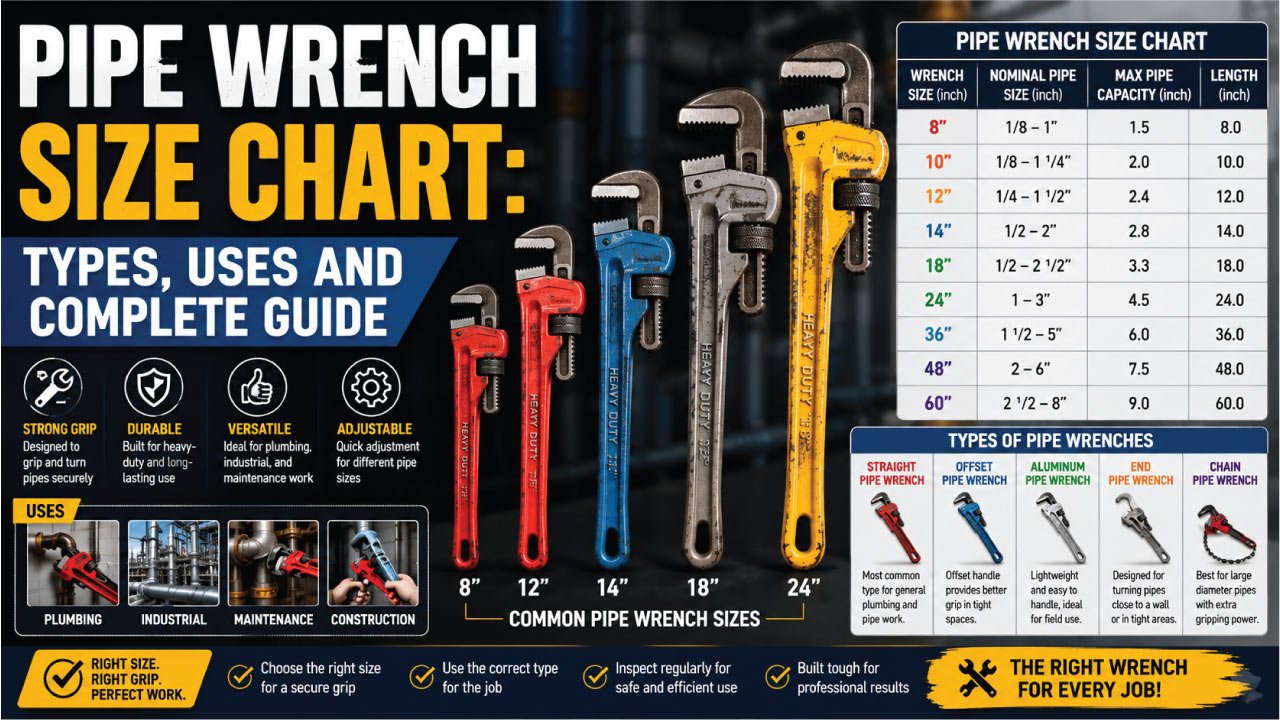
A pipe wrench is one of the most important hand tools used in plumbing, construction, mechanical work, and industrial maintenance. It is specially designed to grip and turn pipes, fittings, and round surfaces that regular wrenches cannot handle properly. Choosing the correct pipe wrench size is important because the wrong size can damage pipes, reduce grip strength, and make work harder.
In this complete guide, you will learn about pipe wrench sizes, types, uses, measurements, and how to select the right wrench for different jobs. This guide is useful for plumbers, mechanics, DIY users, and beginners.
What Is a Pipe Wrench?
A pipe wrench is an adjustable wrench with serrated jaws designed to grip round metal pipes tightly. The teeth bite into the pipe surface and provide a strong hold while tightening or loosening pipe connections.
Pipe wrenches are commonly used for:
- Plumbing work
- Gas pipe installation
- Mechanical maintenance
- HVAC systems
- Construction projects
- Industrial pipe fitting
The tool usually has:
- A fixed jaw
- A movable jaw
- An adjustment nut
- A long handle for leverage
Pipe Wrench Size Chart
The following pipe wrench size chart shows common wrench lengths and the recommended pipe diameter range they can handle.
| Pipe Wrench Size | Maximum Pipe Capacity | Common Uses |
|---|---|---|
| 6 Inch | Up to 3/4 inch pipe | Small plumbing repairs |
| 8 Inch | Up to 1 inch pipe | Household plumbing |
| 10 Inch | Up to 1-1/2 inch pipe | Light mechanical work |
| 12 Inch | Up to 2 inch pipe | General plumbing jobs |
| 14 Inch | Up to 2 inch pipe | Pipe installation |
| 18 Inch | Up to 2-1/2 inch pipe | Heavy plumbing work |
| 24 Inch | Up to 3 inch pipe | Industrial applications |
| 36 Inch | Up to 5 inch pipe | Large pipelines |
| 48 Inch | Up to 6 inch pipe | Industrial and oil field work |
This chart may vary slightly depending on the manufacturer and pipe wrench design.
Pipe Wrench Types
Pipe wrenches are available in several designs, each made for specific working conditions and pipe-handling tasks. Choosing the correct type improves gripping performance, accessibility, and safety. Different wrench styles are commonly used in plumbing, industrial maintenance, and mechanical repair depending on the pipe size and workspace limitations.
1. Straight Pipe Wrench
This is the most common type of pipe wrench used in plumbing and maintenance work. It features a straight handle with adjustable serrated jaws that provide a strong grip on round pipes and threaded fittings during tightening or loosening tasks.
Best for:
- Tightening pipes
- Loosening threaded fittings
- General maintenance
2. Offset Pipe Wrench
An offset wrench has angled jaws designed to improve access in difficult or awkward working positions. Its shape allows users to grip pipes more effectively when straight pipe wrenches cannot fit properly.
Advantages:
- Better access
- Improved grip
- Useful around corners
3. End Pipe Wrench
This type is specially designed for reaching pipes located close to walls or inside confined spaces. Its jaw arrangement allows easier access where standard straight pipe wrenches may not operate efficiently.
Common uses:
- Pipe repair near walls
- Narrow workspaces
4. Chain Pipe Wrench
A chain pipe wrench uses a heavy-duty chain instead of fixed jaws, allowing it to grip large or irregularly shaped objects securely. It is commonly used in industrial environments where strong holding power is required.
Suitable for:
- Large pipes
- Odd-shaped objects
- Heavy industrial work
5. Strap Pipe Wrench
A strap pipe wrench uses a rubber or fabric strap to grip surfaces without causing scratches or damage. It is ideal for delicate materials and polished finishes that require careful handling.
Ideal for:
- Plastic pipes
- Polished pipes
- Delicate surfaces
Pipe Wrench Size Conversion Chart
Some users prefer metric measurements instead of inches. The following table shows common pipe wrench sizes in both systems.
| Inches | Millimeters |
|---|---|
| 6″ | 150 mm |
| 8″ | 200 mm |
| 10″ | 250 mm |
| 12″ | 300 mm |
| 14″ | 350 mm |
| 18″ | 450 mm |
| 24″ | 600 mm |
| 36″ | 900 mm |
| 48″ | 1200 mm |
How to Choose the Right Pipe Wrench Size
Selecting the correct pipe wrench size is important for safety, efficiency, and proper gripping performance. The ideal wrench depends on pipe diameter, available workspace, material type, and the amount of torque required. Using the right size reduces slipping, prevents pipe damage, and makes plumbing or maintenance work much easier.
1. Pipe Diameter
The capacity of the pipe wrench should always match the size of the pipe being handled. A wrench that is too small may slip or fail to provide enough gripping force, while an oversized wrench can damage smaller pipes and fittings. The wrench capacity must match the pipe diameter. Using a small wrench on a large pipe reduces grip strength.
2. Working Space
The amount of available working space plays a major role when choosing a pipe wrench size. Compact wrenches are easier to use in tight or restricted areas, while larger models work better in open spaces where more leverage is needed. Small spaces require compact pipe wrenches such as 6-inch or 8-inch models. Large open areas allow the use of longer wrenches.
3. Material Type
Different pipe materials require different levels of gripping pressure and handling care. Applying too much force on soft materials can cause damage, while harder materials may require stronger gripping power.
Examples:
- Plastic pipes need gentle grip
- Steel pipes need stronger grip
- Copper pipes require careful handling
4. Torque Requirements
Torque requirements determine how much leverage is needed to loosen or tighten pipe fittings effectively. Longer pipe wrenches generate more force, making them suitable for stubborn or tightly connected pipes. Longer pipe wrenches provide greater leverage and torque.
For stubborn pipe fittings:
- Use 18-inch or larger models
- Apply steady pressure
- Avoid excessive force
👉 Explore the complete Machine Screw Size Chart with detailed information about screw sizes, thread types, dimensions, and common applications. Learn how to choose the correct machine screw for mechanical, electrical, and DIY projects. Read the full guide to improve fastening accuracy and hardware selection.
Common Pipe Wrench Uses
Pipe wrenches are essential tools used in plumbing, construction, industrial maintenance, and mechanical repair. Their strong gripping jaws make them ideal for handling round pipes and threaded fittings. Different industries rely on pipe wrenches for installation, maintenance, repair, and assembly tasks involving metal or plastic piping systems.
1. Plumbing
Plumbing is the most common application for pipe wrenches because they are specifically designed to grip and turn threaded pipes securely. Plumbers use them daily for installation, maintenance, and repair work in residential and commercial systems. The most common use is tightening and loosening threaded plumbing pipes.
2. Gas Line Installation
Pipe wrenches are widely used during gas line installation and repair because they provide the strong grip needed for secure threaded connections. Proper handling is important to ensure safe and leak-free gas systems. Pipe wrenches help assemble and repair gas supply lines.
3. HVAC Systems
HVAC technicians use pipe wrenches when working on heating, cooling, and ventilation systems that include metal piping and fittings. The tool helps tighten or remove connections during maintenance and installation tasks. Technicians use them for heating and cooling pipe systems.
4. Industrial Maintenance
Large pipe wrenches are commonly used in factories and industrial facilities where heavy machinery and large pipelines require regular servicing. Their strong leverage helps workers handle large fittings safely and efficiently. Factories use large pipe wrenches for machine and pipeline maintenance.
5. Automotive Repair
In automotive repair, smaller pipe wrenches are sometimes used for gripping round components, exhaust pipes, and stubborn fittings. Mechanics mainly use them when extra gripping power is needed on cylindrical parts. Some mechanics use small pipe wrenches for round fittings and exhaust systems.
Pipe Wrench Safety Tips
Using pipe wrenches safely is important because these tools apply high gripping force and torque during operation. Following proper safety practices helps prevent injuries, protects the tool from damage, and ensures better control when working with pipes, fittings, and heavy mechanical systems.
1. Wear Gloves
Gloves improve hand protection and provide a stronger grip while using pipe wrenches. They also help reduce hand fatigue and protect against sharp pipe edges, rough surfaces, and slipping during heavy-duty work. Gloves improve grip and protect hands from sharp edges.
2. Use Eye Protection
Safety glasses or goggles are important during pipe work because debris, rust, or small metal particles may become airborne while tightening, loosening, or cutting pipes. Eye protection helps prevent serious injuries. Metal particles or debris may fly during pipe work.
3. Inspect the Wrench Before Use
Checking the condition of the pipe wrench before starting work helps ensure safe and effective operation. Damaged or worn tools may slip during use and increase the risk of injury.
Check for:
- Worn teeth
- Cracks
- Loose adjustment nuts
4. Do Not Use Extensions
Adding extension pipes or “cheater bars” to the wrench handle can create excessive force that may damage the tool, break fittings, or cause sudden slipping injuries. Always use the correct wrench size instead of increasing leverage unsafely. Adding extension pipes to the handle may damage the wrench or cause injury.
Pipe Wrench Maintenance
Proper maintenance is essential for keeping pipe wrenches in good working condition and extending their lifespan. Regular care improves gripping performance, prevents rust, and ensures smooth operation during plumbing, industrial, and mechanical tasks. Well-maintained tools also provide safer handling and reduce the risk of slipping or damage during use.
1. Lubricate the Adjustment Nut
The adjustment nut controls jaw movement and should be lubricated regularly to maintain smooth and easy operation. Proper lubrication helps prevent stiffness, corrosion, and unnecessary wear on moving parts. Oil the adjustment mechanism regularly for smooth operation.
2. Clean After Use
Cleaning the wrench after each use removes dirt, grease, metal particles, and moisture that can damage the jaws or moving parts over time. Regular cleaning helps maintain strong gripping performance and tool durability. Remove dirt, grease, and rust from the jaws.
3. Store in Dry Areas
Pipe wrenches should always be stored in dry environments to prevent rust and corrosion. Moisture exposure can weaken the metal surface and reduce overall performance and lifespan. Moisture can cause rust and reduce performance.
4. Replace Worn Teeth
The teeth on a pipe wrench provide the gripping force needed to hold pipes securely. Worn or damaged teeth reduce grip strength, increase slipping risk, and make pipe handling less safe and efficient. Damaged teeth reduce gripping power and increase slipping risk.
Difference Between Pipe Wrench and Adjustable Wrench
Many beginners confuse these tools.
| Pipe Wrench | Adjustable Wrench |
|---|---|
| Designed for round pipes | Designed for nuts and bolts |
| Serrated jaws | Smooth jaws |
| Strong gripping force | Precision tightening |
| Can damage surfaces | Less surface damage |
Pipe wrenches are best for pipes, while adjustable wrenches are better for hex fasteners.
Conclusion
Understanding the pipe wrench size chart helps users choose the right tool for plumbing, maintenance, and industrial work. Pipe wrenches are available in many sizes ranging from compact 6-inch models to massive 48-inch industrial tools. Selecting the proper size improves grip strength, safety, and work efficiency.
Whether you are a homeowner, plumber, mechanic, or industrial worker, having the correct pipe wrench can make pipe installation and repair jobs easier and safer. Always choose the right size, use the wrench correctly, and maintain it properly for long-lasting performance.
👉 Discover the complete Hammer Size Chart with detailed information about hammer types, sizes, uses, and applications. Learn how to choose the right hammer for woodworking, construction, DIY, and metalwork projects. Read the full guide to improve accuracy, safety, and tool selection skills.
Frequently Asked Questions
What size pipe wrench is best for home use?
A 10-inch or 12-inch pipe wrench is considered the best choice for most home plumbing jobs. These sizes provide enough gripping power for common household pipes, faucets, and fittings while remaining easy to handle in tight spaces. They are ideal for DIY repairs, maintenance work, and general plumbing tasks.
Can pipe wrenches be used on plastic pipes?
Yes, pipe wrenches can be used on plastic pipes, but they are not always recommended because the sharp teeth may damage or crack the pipe surface. A strap wrench is usually safer for PVC or plastic materials since it provides grip without leaving marks or causing unnecessary pressure damage.
Why do pipe wrench teeth face backward?
Pipe wrench teeth are designed to face backward so they can grip tighter as more turning pressure is applied. This angled tooth design prevents slipping and increases holding strength on round pipes. The harder the user pulls, the stronger the wrench grips the pipe surface during operation.
What is the most common pipe wrench size?
The 12-inch pipe wrench is one of the most commonly used sizes because it offers a good balance between gripping power and portability. Professional plumbers and DIY users prefer it for general plumbing work, pipe fittings, repairs, and maintenance tasks involving medium-sized pipes commonly found in homes and workshops.
Are aluminum pipe wrenches strong?
Yes, aluminum pipe wrenches are strong enough for most professional and household plumbing applications. Although they are lighter than steel models, they still provide excellent durability and gripping power. Their lightweight design reduces user fatigue, making them popular among plumbers who use tools for long working hours.

Engineer Hassan is a Mechanical Engineer with 16+ years of hands-on experience in mechanical hardware, fasteners, and workshop tools. He focuses on size selection, thread identification, and measurement, helping users choose the correct components with accuracy and safety.