
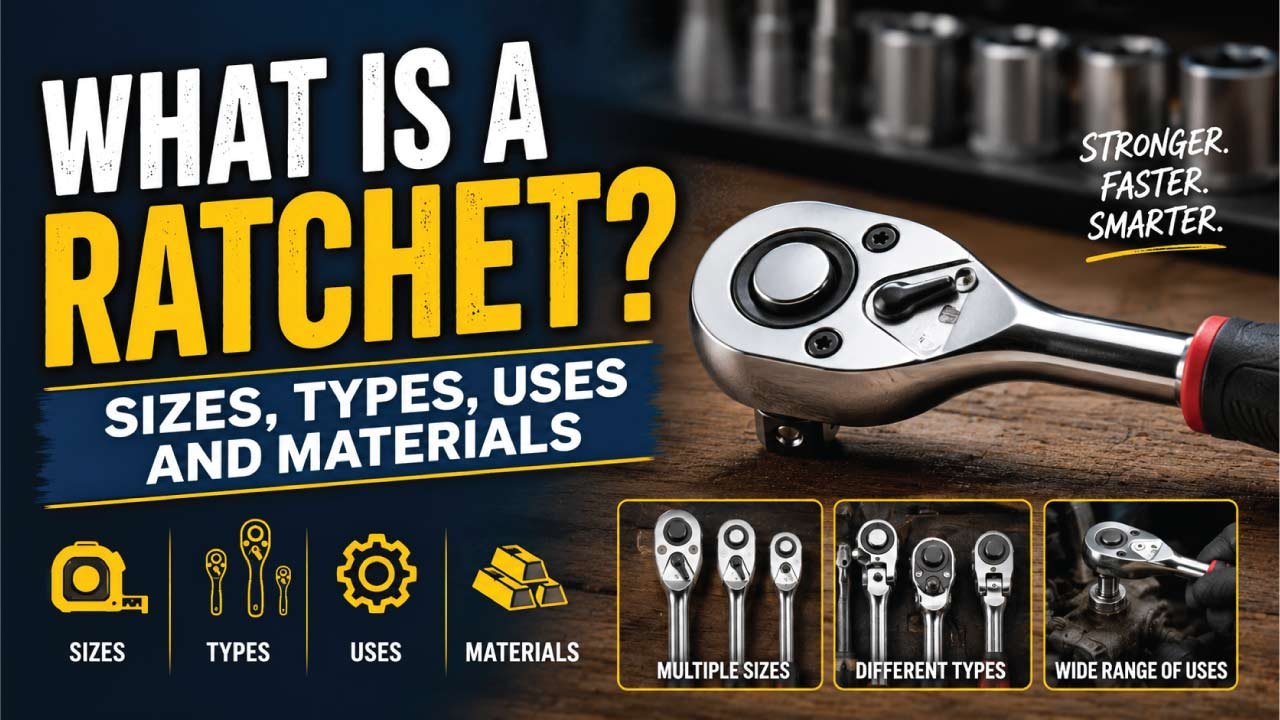
A ratchet is one of the most important hand tools used in mechanical work, automotive repair, construction, and DIY projects. It allows users to tighten or loosen nuts and bolts quickly without removing the tool after every turn. Ratchets save time, improve efficiency, and make work easier in tight spaces.
Whether you are a beginner, mechanic, or workshop professional, understanding ratchet sizes, types, uses, and materials helps you choose the right tool for different jobs. In this complete guide, you will learn everything about ratchets in simple and easy language.
What Is a Ratchet?
A ratchet is a socket-driving hand tool that uses a gear-and-pawl mechanism. This mechanism allows the handle to move back and forth while turning the socket in only one direction.
Unlike a regular wrench, a ratchet does not need to be removed and repositioned after each turn. This makes it faster and more convenient for tightening or loosening fasteners.
Ratchets are commonly used with sockets of different sizes to work on bolts, nuts, and machine parts.
Main Parts of a Ratchet
Understanding the main parts of a ratchet helps users operate the tool correctly and safely. Every component has a specific function that improves grip, torque, control, and efficiency. Knowing these parts also helps beginners choose the right ratchet for mechanical, automotive, and household repair tasks.
1. Handle
The handle is the long section of the ratchet that users hold while applying force to tighten or loosen fasteners. It provides grip, comfort, and leverage during operation. Longer handles generate higher torque, while rubber-coated handles improve comfort and reduce hand fatigue during extended mechanical work.
2. Ratchet Head
The ratchet head is the top part of the tool that houses the internal ratcheting mechanism. It allows continuous turning without removing the socket after each movement. Ratchet heads come in different styles, including fixed head, flex head, and swivel head designs for tight spaces.
3. Drive Square
The drive square is the square-shaped metal end where sockets are attached securely. It transfers torque from the ratchet to the socket and fastener. Common drive sizes include 1/4-inch, 3/8-inch, 1/2-inch, and 3/4-inch, each designed for different fastening strength and application requirements.
4. Direction Switch
The direction switch is a small lever located on the ratchet head that changes the rotation direction. Users can quickly switch between tightening and loosening fasteners without removing the tool. This feature improves speed, convenience, and efficiency when working in automotive or mechanical repair jobs.
5. Gear Mechanism
The gear mechanism is the internal system made of gears and pawls that produces the ratcheting action. It allows rotation in one direction while preventing movement in the opposite direction. Fine-tooth gear systems provide smoother operation, better precision, and easier use in confined working spaces.
How Does a Ratchet Work?
A ratchet works using a toothed gear and pawl mechanism. When the handle moves in one direction, the pawl locks into the gear teeth and turns the socket. When moved backward, the pawl slips over the teeth without turning the socket.
This allows continuous movement without removing the tool from the fastener.
Ratchet Size Chart
Ratchets come in different drive sizes for various applications.
| Ratchet Size | Common Name | Typical Uses |
|---|---|---|
| 1/4 inch | Small Ratchet | Electronics, bicycles, small fasteners |
| 3/8 inch | Medium Ratchet | Automotive repair, general maintenance |
| 1/2 inch | Large Ratchet | Heavy-duty mechanical work |
| 3/4 inch | Industrial Ratchet | Large machinery and trucks |
| 1 inch | Extra Heavy-Duty | Industrial and construction equipment |
1/4-Inch Ratchet
The 1/4-inch ratchet is the smallest commonly used ratchet size and is mainly designed for precision work. It is ideal for handling small fasteners in tight or hard-to-reach spaces where larger tools cannot fit properly. Mechanics and DIY users often choose this ratchet for light-duty tasks that require accuracy and smooth control.
Features
- Lightweight
- Easy to control
- Fits tight spaces
- Used with small sockets
Common Uses
- Electronics repair
- Bicycle maintenance
- Appliance work
- Small engine repairs
This size is perfect for delicate tasks where precision matters more than torque.
3/8-Inch Ratchet
The 3/8-inch ratchet is considered the most versatile ratchet size because it provides a perfect balance between strength and control. It is widely used by both professionals and home users for medium-duty applications. This ratchet works well with a large range of socket sizes, making it a common choice for everyday mechanical tasks.
Features
- Balanced size and power
- Suitable for medium-duty work
- Widely available sockets
Common Uses
- Automotive maintenance
- Motorcycle repair
- Household projects
- Mechanical work
Many professionals consider this the best all-around ratchet size.
1/2-Inch Ratchet
The 1/2-inch ratchet is built for heavy-duty applications where higher torque and stronger leverage are required. It is commonly used for loosening tight bolts and working on larger mechanical components. Due to its durability and long handle design, this ratchet is popular in automotive shops, industrial maintenance, and construction work.
Features
- Strong handle
- Larger sockets
- Greater leverage
- Heavy-duty construction
Common Uses
- Truck repair
- Suspension work
- Industrial maintenance
- Large bolts and nuts
This size handles stubborn or heavily tightened fasteners.
3/4-Inch and 1-Inch Ratchets
The 3/4-inch and 1-inch ratchets are very large tools mainly used in industrial and heavy machinery applications. These ratchets are designed to deliver extremely high torque for oversized fasteners. Because of their size and strength, they are commonly found in factories, construction sites, mining operations, and heavy equipment maintenance shops.
Common Uses
- Heavy equipment
- Construction machinery
- Mining equipment
- Agricultural machines
They are built for extremely high torque requirements.
Types of Ratchets
There are many types of ratchets designed for different situations. Each type offers unique features that improve speed, access, comfort, or torque depending on the task. Choosing the correct ratchet type helps increase efficiency and makes mechanical work easier in tight or demanding working conditions.
1. Standard Ratchet
The standard ratchet is the most common and widely used ratchet design. It features a fixed head and simple mechanism that provides reliable performance for everyday tasks. This type is popular among mechanics, DIY users, and homeowners because it is durable, easy to use, and suitable for many repair applications.
Features
- Fixed head
- Simple construction
- Durable design
Uses
- General repairs
- Automotive work
- Home maintenance
2. Flex Head Ratchet
A flex head ratchet has a pivoting head that allows users to work at different angles. This design improves access in tight spaces where straight ratchets cannot operate comfortably. Mechanics often use flex head ratchets inside crowded engine bays and complex machinery where bolts are difficult to reach directly.
Features
- Adjustable head angle
- Better reach
- Improved access
Uses
- Tight engine compartments
- Hard-to-reach bolts
- Confined spaces
3. Stubby Ratchet
Stubby ratchets are short and compact tools designed for working in narrow or restricted spaces. Their smaller size makes them easier to handle where longer ratchets cannot fit. These ratchets are ideal for delicate mechanical work, dashboard repairs, and compact engine areas requiring precise movement and limited swing space.
Features
- Small handle
- Lightweight
- Fits narrow spaces
Uses
- Dashboard repair
- Compact engines
- Small machinery
4. Long Handle Ratchet
Long handle ratchets are designed to provide greater leverage and increased torque during heavy-duty work. The extended handle helps users loosen stubborn or tightly fastened bolts with less physical effort. These ratchets are commonly used in automotive repair, industrial maintenance, and suspension work involving larger fasteners.
Features
- Extended reach
- Higher torque
- Better leverage
Uses
- Tight bolts
- Heavy-duty repairs
- Suspension work
5. Extendable Ratchet
Extendable ratchets feature telescoping handles that can be adjusted to different lengths depending on the job requirements. Users can shorten the handle for compact spaces or extend it for extra leverage. This flexible design makes the tool useful for mobile mechanics, automotive repair, and handling heavy fasteners.
Features
- Adjustable length
- Increased flexibility
- Portable design
Uses
- Automotive repair
- Mobile tool kits
- Heavy fasteners
6. Swivel Head Ratchet
Swivel head ratchets are designed with rotating heads that move in multiple directions for maximum flexibility. This design allows users to work around obstacles and reach bolts at difficult angles. They are especially useful in crowded engine compartments, plumbing systems, and tight mechanical workspaces.
Features
- Maximum flexibility
- Improved maneuverability
- Better angle access
Uses
- Engine work
- Plumbing
- Tight workspaces
7. Pneumatic Ratchet
A pneumatic ratchet uses compressed air power to rotate sockets quickly and reduce manual effort. These tools are commonly found in professional garages and industrial workshops because they improve speed and efficiency during repetitive fastening tasks. Pneumatic ratchets are especially useful for high-volume automotive repair work.
Features
- Fast operation
- Reduced manual effort
- High efficiency
Uses
- Professional garages
- Industrial workshops
- Production lines
These are commonly used by automotive technicians.
8. Electric Ratchet
Electric ratchets are battery-powered tools designed to speed up fastening and loosening tasks with minimal effort. They provide cordless convenience and reduce hand fatigue during repetitive work. Electric ratchets are widely used in automotive service, construction projects, and home maintenance where portability and quick operation are important.
Features
- Cordless operation
- Fast socket rotation
- Portable convenience
Uses
- Automotive service
- Construction work
- Home projects
Electric ratchets reduce user fatigue during repetitive work.
👆 Pipe Wrench Size Chart: Types, Uses and Complete Guide is a detailed expert guide to understanding pipe wrench sizes, types, and practical applications in plumbing and repair work. Read the full post to choose the right wrench, improve grip accuracy, and handle pipes safely and efficiently like a professional.
Ratchet Materials
Ratchets are made from strong metals that can withstand repeated pressure, torque, and heavy mechanical use. The material used in a ratchet directly affects its durability, strength, corrosion resistance, and overall lifespan. High-quality ratchets are designed to handle demanding tasks without bending, cracking, or wearing out quickly.
1. Chrome Vanadium Steel
Chrome vanadium steel is the most commonly used material for manufacturing ratchets and other hand tools. It offers an excellent balance of strength, durability, and corrosion resistance. Professional mechanics and tool manufacturers prefer this material because it performs reliably under continuous use and high torque conditions.
Benefits
- High strength
- Corrosion resistance
- Long lifespan
- Durable under pressure
This material is widely used in professional-grade tools.
2. Chrome Molybdenum Steel
Chrome molybdenum steel is stronger and tougher than standard chrome vanadium steel. It is specially designed to handle extreme stress, heavy impact, and demanding industrial applications. Ratchets made from this material are commonly used in professional workshops, construction sites, and heavy-duty automotive repair environments.
Benefits
- Excellent toughness
- High impact resistance
- Suitable for industrial use
Often used in heavy-duty ratchets and impact tools.
3. Alloy Steel
Some ratchets are manufactured using special alloy steel blends that combine strength, durability, and affordability. These ratchets are commonly found in mid-range tools and general home tool kits. Alloy steel provides reliable performance for everyday repairs while keeping the tool cost lower than premium-grade materials.
Benefits
- Good durability
- Cost-effective
- Reliable performance
Used in mid-range tools and home tool kits.
Ratchet Handle Materials
The handle grip also affects comfort and safety.
Common Handle Materials
| Material | Benefits |
|---|---|
| Rubber Grip | Comfortable and non-slip |
| Plastic Grip | Lightweight and affordable |
| Metal Handle | Strong and durable |
| Foam Grip | Soft and comfortable |
Common Uses of Ratchets
Ratchets are widely used in automotive repair, construction, industrial maintenance, and home improvement projects. Their ability to tighten or loosen fasteners quickly makes them one of the most important hand tools for professionals and DIY users working with nuts, bolts, and mechanical components.
1. Automotive Repair
Ratchets are essential tools in automotive repair because they help mechanics remove and tighten bolts quickly and efficiently. Different ratchet sizes are used for engine components, wheels, and suspension systems. Their compact design also allows easy access to tight spaces inside vehicles.
Common Jobs
- Tire changes – Ratchets help remove and tighten lug nuts efficiently during tire replacement or repair work.
- Engine repair – Mechanics use ratchets for loosening and tightening engine bolts and components.
- Brake maintenance – Ratchets simplify brake pad replacement and brake system servicing tasks.
- Suspension work – Suspension bolts and fasteners are commonly removed using heavy-duty ratchets.
2. Construction Work
Construction workers use ratchets for assembling structures, installing equipment, and fastening mechanical systems. Ratchets provide speed and strong torque, making them valuable on construction sites. Heavy-duty ratchets are commonly used when working with steel frameworks and industrial-grade hardware installations.
Common Jobs
- Steel structures – Ratchets are used for tightening bolts in metal framing and structural assembly.
- Mechanical systems – Workers use ratchets during HVAC and piping system installations.
- Equipment installation – Ratchets help secure industrial and construction equipment safely and efficiently.
3. Industrial Maintenance
Factories and workshops rely on ratchets for regular machine servicing and equipment maintenance. Ratchets improve repair speed and reduce downtime in industrial operations. High-quality ratchets are important for handling heavy machinery, production equipment, and mechanical systems in demanding work environments.
Common Jobs
- Machinery repair – Ratchets are used to remove damaged parts and install replacement components.
- Equipment assembly – Industrial workers use ratchets during machine and equipment setup procedures.
- Conveyor maintenance – Ratchets help tighten and service conveyor system fasteners and components.
4. Home DIY Projects
Ratchets are also popular among homeowners and DIY users for everyday repair and maintenance tasks. Their simple operation and versatility make them useful for furniture assembly, bicycle repairs, and appliance maintenance. Compact ratchet sets are especially helpful for small household projects and repairs.
Common Jobs
- Bike repair – Ratchets help tighten bicycle bolts and adjust mechanical components easily.
- Furniture installation – DIY users use ratchets for assembling furniture quickly and securely.
- Appliance maintenance – Ratchets assist in repairing and servicing household appliances and equipment.
👆 Hammer Size Chart: Complete Guide to Hammer Types and Sizes is a detailed expert guide to understanding hammer sizes, types, and real-world uses in construction and DIY work. Read the full post to choose the right hammer, improve accuracy, and handle every task safely and efficiently like a professional.
Advantages of Ratchets
Ratchets are popular hand tools because they improve speed, efficiency, and comfort during fastening tasks. Their ratcheting mechanism allows continuous operation without removing the tool after every turn, making them highly useful for automotive repair, construction work, industrial maintenance, and household projects.
1. Faster Operation
Ratchets allow users to tighten or loosen fasteners continuously without lifting the socket after every rotation. This saves significant time compared to traditional wrenches. The quick back-and-forth motion improves workflow and makes repetitive mechanical tasks much faster and more convenient.
2. Better Efficiency
The ratcheting mechanism improves overall work efficiency by reducing unnecessary hand movement and effort. Users can complete repair and assembly tasks more quickly with less physical strain. This makes ratchets extremely useful for professional mechanics, construction workers, and DIY users handling multiple fasteners.
3. Access to Tight Spaces
Ratchets work very well in narrow or confined spaces where standard wrenches cannot rotate fully. Fine-tooth ratchets require only a small swing arc, making them ideal for engine compartments, machinery, and compact mechanical systems with limited working clearance.
4. Versatility
Ratchets are highly versatile tools because they can work with many socket sizes and attachments. Users can easily switch sockets for different fastener sizes and applications. Extensions, universal joints, and adapters further increase the ratchet’s flexibility for various repair and maintenance jobs.
5. Improved Comfort
Ratchets reduce hand fatigue during repetitive tightening and loosening tasks by minimizing wrist movement and physical effort. Ergonomic handles provide a better grip and improved comfort during long working hours. This helps users maintain better control and productivity while performing mechanical or repair work.
Disadvantages of Ratchets
Although ratchets offer many advantages, they also have some limitations that users should understand. Factors such as torque capacity, gear wear, maintenance needs, and cost can affect performance and durability, especially when the tool is heavily used in professional mechanical or industrial applications.
1. Limited Torque
Small ratchets are not designed for extremely high-torque applications. Applying excessive force can damage the internal mechanism or break the tool completely. Heavy-duty fasteners often require breaker bars or larger ratchets that can safely handle greater tightening and loosening force.
2. Gear Wear
The internal gear and pawl mechanism can wear out over time due to repeated use and heavy pressure. Worn gears may slip during operation, reducing efficiency and safety. Low-quality ratchets usually wear faster, especially when used in demanding automotive or industrial environments.
3. Maintenance Required
Ratchets require regular cleaning and lubrication to maintain smooth performance and prevent rust or internal damage. Dirt, dust, and metal particles can affect the ratcheting mechanism over time. Proper maintenance helps extend tool lifespan and ensures reliable operation during mechanical work.
4. More Expensive
High-quality ratchets made from durable materials and fine-tooth gear systems can be expensive compared to basic hand tools. Professional-grade ratchets often cost more because they offer better durability, smoother operation, and higher performance for automotive, industrial, and construction applications.
Ratchet vs Wrench
Many beginners confuse ratchets with regular wrenches.
| Feature | Ratchet | Wrench |
|---|---|---|
| Speed | Faster | Slower |
| Socket Use | Yes | Usually no |
| Tight Space Access | Better | Limited |
| Repositioning Needed | No | Yes |
| Torque Strength | Moderate to High | High |
Ratchets are generally preferred for repetitive tasks and confined spaces.
👆 Drill Size Chart: Complete Guide To Standard Drill Sizes is an essential expert guide to understanding drill bit sizes, standards, and accurate applications in metal, wood, and construction work. Read the full post to choose the right drill size, avoid fitting errors, and achieve precise results like a professional.
Ratchet Maintenance Tips
Proper ratchet maintenance improves tool performance, increases lifespan, and prevents internal damage. Regular cleaning, lubrication, and correct storage help keep the ratcheting mechanism smooth and reliable. Well-maintained ratchets also provide better safety and efficiency during automotive, industrial, and household repair tasks.
1. Clean Regularly
Ratchets should be cleaned after every use to remove dirt, grease, dust, and metal particles from the tool surface and internal mechanism. Accumulated debris can reduce smooth operation and damage internal gears over time. Using a clean cloth and mild cleaner helps maintain proper functionality.
2. Lubricate the Mechanism
Applying light machine oil or lubricant to the internal gears and moving parts keeps the ratchet operating smoothly. Proper lubrication reduces friction, prevents excessive wear, and improves gear performance. Regular oiling is especially important for ratchets used frequently in automotive and industrial environments.
3. Store Properly
Ratchets should always be stored in a dry and organized toolbox to protect them from moisture, dust, and accidental damage. Proper storage prevents rust formation and keeps the tool in good condition. Using protective tool cases or drawers also helps improve organization and tool lifespan.
4. Avoid Overloading
Ratchets are not designed to handle excessive force unless specifically built as heavy-duty models. Using a ratchet as a breaker bar can damage the internal gear mechanism or break the tool completely. For extremely tight fasteners, a breaker bar or torque tool is the safer option.
Common Ratchet Problems
Ratchets can develop issues over time.
| Problem | Cause |
|---|---|
| Slipping gears | Worn teeth |
| Stuck mechanism | Dirt buildup |
| Weak movement | Lack of lubrication |
| Broken handle | Excessive force |
Regular inspection helps prevent major damage.
How to Choose the Right Ratchet
Choosing the correct ratchet is important for safety, efficiency, and smooth performance during repair or maintenance work. The ideal ratchet depends on factors such as drive size, tooth count, handle length, material quality, and available working space for the specific application.
1. Consider Drive Size
The drive size determines the ratchet’s strength and compatibility with different socket sizes. Small 1/4-inch ratchets are ideal for light-duty work, while 3/8-inch and 1/2-inch ratchets handle medium and heavy-duty applications. Choosing the correct drive size improves performance and prevents tool damage.
2. Check Tooth Count
The tooth count affects how smoothly the ratchet operates in confined spaces. Ratchets with higher tooth counts require less swing movement, making them easier to use in tight areas. Fine-tooth ratchets also provide better precision and smoother operation during automotive and mechanical repair tasks.
3. Evaluate Handle Length
Handle length influences leverage and torque output during fastening work. Longer handles provide greater turning force, making it easier to loosen tight bolts and nuts. Shorter handles are more suitable for compact spaces where maneuverability and control are more important than maximum torque.
4. Choose Quality Materials
Ratchets made from high-quality chrome vanadium steel or alloy steel offer better strength, durability, and corrosion resistance. Professional-grade materials reduce wear and increase tool lifespan. Strong materials are especially important for heavy-duty automotive, industrial, and construction applications with frequent use.
5. Think About Workspace
The size and accessibility of the workspace play an important role when selecting a ratchet. Compact ratchets and flex-head designs work better in narrow or restricted areas. Larger ratchets may provide more torque but can be difficult to use in crowded engine bays or machinery.
👆 Reamer Size Chart: Complete Guide with PDF is a detailed expert guide to understanding reamer size charts, types, and precise machining applications. Read the full post to select the correct reamer size, improve hole accuracy, and achieve professional-level finishing results in metalworking with confidence and ease.
Best Ratchet Tooth Count
Ratchets come with different gear tooth counts.
| Tooth Count | Performance |
|---|---|
| 24 Teeth | Basic operation |
| 72 Teeth | Smooth movement |
| 90+ Teeth | Fine precision in tight spaces |
Higher tooth count ratchets require less swing angle.
Safety Tips When Using Ratchets
Safety is very important when using ratchets and other hand tools because improper use can cause injuries, damaged fasteners, or broken tools. Following proper safety practices helps improve control, efficiency, and overall workplace safety. Always inspect tools before use and apply the correct technique for every repair or maintenance task.
- Wear safety gloves
- Use the correct socket size
- Avoid damaged tools
- Do not use extension pipes improperly
- Keep hands away from pinch points
Using the right technique reduces injury risks.
Conclusion
Ratchets are essential tools for mechanics, construction workers, technicians, and DIY users. Their ability to tighten and loosen fasteners quickly makes them one of the most efficient hand tools available.
Understanding ratchet sizes, types, uses, and materials helps you choose the right tool for every project. Small 1/4-inch ratchets work well for precision jobs, while larger 1/2-inch models handle heavy-duty repairs. Different styles such as flex head, swivel head, and electric ratchets provide additional convenience for specialized tasks.
By selecting high-quality materials and maintaining the tool properly, a good ratchet can provide years of reliable performance.
FAQs:
What is a ratchet used for?
A ratchet is mainly used for tightening and loosening nuts and bolts quickly using a socket attachment. It is commonly used in automotive repair, construction, and mechanical work. The ratcheting mechanism allows continuous movement in one direction without removing the tool, making work faster, easier, and more efficient in tight spaces.
Which ratchet size is best for beginners?
The 3/8-inch ratchet is considered the best choice for beginners because it offers a perfect balance of power and control. It is versatile enough for automotive, household, and general mechanical tasks. This size is easy to handle, widely available, and works with many socket sizes, making it ideal for learning basic tool use.
What is tooth count in a ratchet?
Tooth count refers to the number of teeth inside the ratchet’s gear mechanism. Higher tooth counts mean smoother operation and smaller swing angles, which helps in tight spaces. For example, 72-tooth or 90-tooth ratchets provide better precision, while lower tooth counts are stronger but require more handle movement per turn.
Can ratchets be used for loosening tight bolts?
Yes, ratchets can loosen tight bolts, but they have limits. For moderately tight fasteners, they work well and save time. However, extremely tight or rusted bolts may require a breaker bar for extra torque. Using excessive force on a ratchet can damage its internal gear mechanism and reduce tool life.
What is the difference between a socket and a ratchet?
A ratchet is the handle tool with a gear mechanism, while a socket is the detachable head that fits onto bolts and nuts. The ratchet drives the socket to turn fasteners. Both work together, but the ratchet provides motion and control, while sockets determine the size and fit of the fastener.
How long does a ratchet last?
A ratchet can last many years if it is made from high-quality materials and properly maintained. Regular cleaning, lubrication, and correct usage greatly extend its lifespan. However, heavy use, dirt buildup, or excessive force can reduce durability. Professional-grade ratchets often last longer than cheaper, low-quality versions.
Do expensive ratchets make a difference?
Yes, expensive ratchets usually offer better durability, smoother operation, and higher tooth counts for precision work. They are made from stronger materials like chrome vanadium or chrome molybdenum steel. While budget ratchets work for light tasks, professional-grade tools perform better under heavy use and last significantly longer.

Engineer Hassan is a Mechanical Engineer with 16+ years of hands-on experience in mechanical hardware, fasteners, and workshop tools. He focuses on size selection, thread identification, and measurement, helping users choose the correct components with accuracy and safety.