
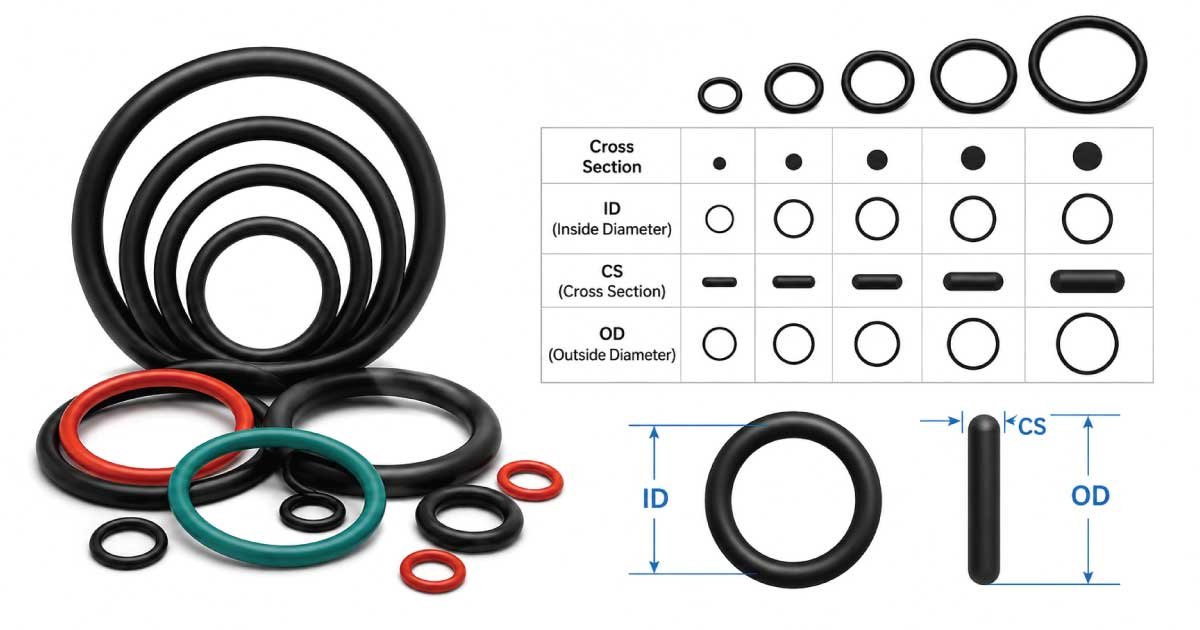
Choosing the correct O-Ring size is essential for creating reliable seals in hydraulic systems, pneumatic equipment, automotive engines, industrial machinery, plumbing, and many other applications.
Even a slight difference in an O-ring’s inside diameter or cross-section can lead to fluid leaks, pressure loss, premature wear, or costly equipment failures.
Because O-rings are available in numerous standard and metric sizes, understanding how to measure, select, and install the right seal is critical for both maintenance professionals and first-time users.
In this complete guide, you will learn how O-ring sizes are determined, how to read an O-ring size chart, the most common international standards, measurement techniques, material options, groove design considerations, and practical selection tips.
Whether you are an engineer, mechanic, manufacturer, student, or DIY enthusiast, this guide provides the technical knowledge and real-world recommendations needed to choose the correct O-ring for reliable, long-lasting sealing performance.
What Is an O-Ring?
An O-ring is one of the most widely used sealing components in mechanical systems. Despite its simple circular design, it plays a critical role in preventing leaks between two mating surfaces. Choosing the correct O-ring size is essential because even a high-quality material cannot perform effectively if the dimensions are incorrect. This guide explains O-ring sizing, measurements, materials, and selection principles to help readers make informed decisions.
An O-ring is a circular elastomer seal with a round cross-section. It is installed inside a groove where it becomes compressed between two parts. This compression creates a reliable seal that prevents liquids, gases, or air from escaping while also keeping contaminants out.
O-rings are used in countless industries because they are affordable, easy to install, and highly effective. They are commonly found in:
- Hydraulic systems
- Pneumatic equipment
- Automotive engines
- Industrial pumps
- Valves
- Compressors
- Plumbing systems
- Medical equipment
Although they appear simple, selecting the correct size requires careful attention to several measurements and industry standards.
Why O-Ring Size Matters
Selecting the correct O-ring size is just as important as selecting the correct material. A poorly sized O-ring may fail prematurely even if it is made from premium rubber. Engineers focus on dimensional accuracy because proper compression directly affects sealing performance, equipment reliability, and maintenance costs.
An oversized O-ring may become twisted during installation or experience excessive compression, causing accelerated wear. Conversely, an undersized O-ring may not create enough sealing force, allowing fluid or gas to leak.
Correct sizing provides several important benefits:
- Prevents fluid leakage
- Reduces maintenance costs
- Improves equipment lifespan
- Maintains operating pressure
- Prevents contamination
- Minimizes unexpected downtime
- Supports consistent sealing performance
Proper sizing also ensures compatibility with standardized grooves and housings used in industrial equipment.
Understand The O-Ring Dimensions
Before selecting an O-ring, it is important to understand the three primary dimensions used in all sizing standards. Manufacturers worldwide specify O-rings using these measurements because they directly determine how the seal fits inside its groove.
Inside Diameter (ID)
The inside diameter is the distance measured across the center opening of the O-ring from one inner edge to the opposite inner edge.
This dimension determines how tightly the O-ring fits around shafts, tubes, or pistons. A correctly selected inside diameter helps keep the seal properly positioned during assembly.
Outside Diameter (OD)
The outside diameter measures the total diameter from one outer edge to the opposite outer edge.
Although many sizing systems focus primarily on inside diameter and cross-section, outside diameter is often calculated for inspection, quality control, and groove verification.
The relationship is:
OD = ID + (2 × Cross Section)
Cross-Section Diameter (CS)
The cross-section diameter refers to the thickness of the rubber ring itself.
This dimension has a major influence on:
- Compression
- Sealing pressure
- Groove dimensions
- Service life
- Assembly force
Even a small difference in cross-section can significantly affect sealing performance.
Standard O-Ring Size Chart
Most industrial O-rings follow standardized dimensions to simplify replacement and manufacturing. International standards ensure that O-rings from different manufacturers remain interchangeable when the same specification is used.
Below is a general reference chart showing common metric O-ring sizes.
| Inside Diameter (mm) | Cross Section (mm) | Outside Diameter (mm) |
|---|---|---|
| 3 | 1 | 5 |
| 5 | 1.5 | 8 |
| 8 | 2 | 12 |
| 10 | 2 | 14 |
| 12 | 2 | 16 |
| 15 | 2.5 | 20 |
| 20 | 3 | 26 |
| 25 | 3 | 31 |
| 30 | 3.5 | 37 |
| 40 | 4 | 48 |
This chart provides a general overview. Manufacturers may offer hundreds or even thousands of standard sizes depending on the applicable specification, such as metric or inch-based systems. Always verify the exact dimensions required for your equipment before ordering replacements.
Common O-Ring Standards
Several international organizations have established dimensional standards for O-rings. These standards improve compatibility across manufacturers and simplify maintenance for industrial equipment operating worldwide.
AS568 Standard
The AS568 standard is one of the most widely recognized inch-based O-ring sizing systems. It defines standardized inside diameters and cross-section dimensions for hundreds of O-ring sizes used throughout North America and many international industries.
It is commonly used in:
- Hydraulic equipment
- Aerospace systems
- Industrial machinery
- Automotive components
ISO 3601 Standard
ISO 3601 is the primary international standard for metric O-rings. It specifies dimensions, tolerances, quality requirements, and inspection methods to ensure consistent sealing performance across different manufacturers.
Many global manufacturers produce O-rings according to ISO 3601, making replacements readily available for metric equipment.
DIN Standards
DIN standards are widely used in European industries and often complement ISO specifications. They establish dimensional consistency for seals used in machinery, industrial automation, and manufacturing equipment.
Many European machines specify DIN-compliant O-rings for maintenance and replacement purposes.
How to Measure an O-Ring
Accurate measurement is essential when replacing an existing O-ring whose part number is unavailable. Using precise measuring tools helps identify the correct replacement size while minimizing installation problems and sealing failures.
Before measuring, clean the O-ring thoroughly to remove dirt, oil, or debris that could affect measurement accuracy.
Step 1: Measure Inside Diameter
Lay the O-ring on a flat surface without stretching it.
Use a digital caliper to measure the inside opening from one inner edge directly across to the opposite side.
Avoid pulling or deforming the rubber during measurement because stretching changes the dimensions.
Step 2: Measure Cross Section
Measure the thickness of the rubber using the caliper jaws.
Take several measurements around the O-ring because worn seals may have uneven thickness due to compression or aging.
The largest undamaged section usually provides the most accurate result.
Step 3: Calculate Outside Diameter
If necessary, calculate the outside diameter using the standard formula.
Outside Diameter = Inside Diameter + (2 × Cross Section)
This calculation is useful when comparing manufacturer specifications or verifying groove dimensions.
Example O-Ring Measurement
Understanding the measurement process becomes easier through a practical example.
Suppose an existing O-ring has:
- Inside Diameter = 30 mm
- Cross Section = 3 mm
The outside diameter is calculated as:
OD = 30 + (2 × 3)
OD = 36 mm
These three dimensions can then be compared with standard size charts to identify the closest standard replacement.
Choose The the Correct O-Ring Size
Selecting the right O-ring involves more than matching dimensions. Engineers also consider operating pressure, temperature, chemical exposure, groove design, and installation requirements to ensure long-term sealing performance.
Several factors should always be evaluated before choosing a replacement.
Operating Pressure
Higher system pressure generally requires careful groove design and adequate O-ring compression. Extremely high-pressure applications may also require backup rings to prevent extrusion.
Pressure ratings depend on:
- Material hardness
- Groove clearance
- Temperature
- Fluid type
- System design
Operating Temperature
Temperature greatly influences rubber flexibility and sealing performance.
Very high temperatures can harden elastomers, while extremely low temperatures may reduce elasticity, increasing the likelihood of leakage.
Always select an O-ring material whose temperature rating exceeds the expected operating conditions.
Chemical Compatibility
The sealing material must resist the chemicals present in the application.
Common media include:
- Hydraulic oil
- Fuel
- Water
- Steam
- Air
- Refrigerants
- Solvents
- Acids
A chemically incompatible material may swell, crack, soften, or deteriorate quickly.
Dynamic or Static Applications
Static seals remain stationary after installation, while dynamic seals move during operation.
Examples of static applications include:
- Pipe flanges
- Valve covers
- End caps
- Pressure vessels
Dynamic applications include:
- Hydraulic cylinders
- Pneumatic pistons
- Rotating shafts
- Pump components
Dynamic applications generally require stricter sizing accuracy because friction and movement accelerate wear.
Common O-Ring Materials
Material selection is equally important as dimensional accuracy. Different elastomers provide varying resistance to temperature, chemicals, wear, and environmental conditions. Choosing the appropriate material ensures the O-ring performs reliably throughout its intended service life.
| Material | Temperature Range | Common Applications |
|---|---|---|
| Nitrile (NBR) | -40°C to 120°C | Hydraulic systems |
| Viton (FKM) | -20°C to 200°C | Fuel and chemical systems |
| Silicone | -60°C to 230°C | Food and medical equipment |
| EPDM | -50°C to 150°C | Water and steam systems |
| Neoprene | -40°C to 120°C | Refrigeration equipment |
Each material has unique advantages and limitations. Material compatibility should always be confirmed alongside size selection to achieve reliable sealing performance.
O-Ring Groove Design
A correctly designed groove is just as important as selecting the proper O-ring size. Even a perfectly sized O-ring may leak if the groove dimensions are incorrect. Engineers carefully design grooves to achieve the right amount of compression, prevent seal movement, and accommodate thermal expansion during operation.
The groove must provide enough space for the O-ring to deform without being excessively compressed. Groove width, depth, and surface finish all influence sealing performance. In dynamic applications, smoother groove surfaces reduce friction and extend seal life, while static applications can tolerate slightly different design parameters.
The table below highlights the primary groove design considerations.
| Groove Feature | Importance | Typical Recommendation |
|---|---|---|
| Groove Width | Allows proper seal expansion | Slightly wider than O-ring cross-section |
| Groove Depth | Controls compression | Typically 15–30% compression |
| Surface Finish | Reduces wear | Smooth machined finish |
| Corner Radius | Prevents cutting | Rounded edges preferred |
| Clearance Gap | Prevents extrusion | Minimize where possible |
When designing new equipment, manufacturers typically follow ISO 3601 or AS568 groove recommendations to ensure compatibility with standardized O-ring sizes.
👉 Our comprehensive Spring Washer size chart provides an Expert Guide and Professional Guide to help engineers, mechanics, and DIY users choose the correct size every time.
O-Ring Compression Principles
Compression is the force that enables an O-ring to create a leak-tight seal. When installed, the O-ring is squeezed between two mating surfaces. This deformation allows it to fill small surface imperfections and maintain sealing pressure even when operating conditions change.
Too little compression can result in leakage because the seal does not fully contact the mating surfaces. Excessive compression, however, increases friction, accelerates wear, and shortens service life. Engineers generally target moderate compression levels based on whether the application is static or dynamic.
Typical compression recommendations include:
- Static face seals: 20–30%
- Static radial seals: 15–25%
- Dynamic reciprocating seals: 10–20%
- Rotary seals: 8–16%
Following these guidelines improves sealing efficiency while reducing unnecessary stress on the elastomer.
Working Principle of O-Rings
Although O-rings have a simple shape, their sealing mechanism is based on well-established engineering principles. Proper compression combined with system pressure allows the seal to become more effective as operating pressure increases.
Initially, mechanical compression forms the primary seal. Once the system becomes pressurized, the fluid or gas pushes the O-ring against the low-pressure side of the groove. This pressure-assisted sealing action improves contact between the elastomer and metal surfaces.
This self-energizing characteristic explains why O-rings are used extensively in hydraulic cylinders, pneumatic systems, pumps, and industrial valves where pressure varies during normal operation.
How to Select an O-Ring
Selecting the correct O-ring requires evaluating several operating conditions rather than relying only on size. Professional engineers consider the complete application to ensure reliable performance throughout the equipment’s service life.
A systematic selection process helps avoid common sealing failures.
- Identify the correct inside diameter.
- Confirm the required cross-section.
- Check groove dimensions.
- Determine operating pressure.
- Verify operating temperature.
- Select a chemically compatible material.
- Consider static or dynamic movement.
- Review applicable industry standards.
Using this step-by-step approach minimizes replacement errors and improves long-term reliability.
Practical Selection Example
A practical example demonstrates how professionals choose an O-ring for industrial equipment.
Consider a hydraulic cylinder operating at 180 bar with hydraulic oil and a maximum temperature of 90°C. The measured groove requires an O-ring with a 25 mm inside diameter and a 3 mm cross-section.
In this case:
- Size: 25 × 3 mm
- Material: Nitrile (NBR)
- Application: Dynamic hydraulic seal
- Standard: ISO 3601 Metric O-ring
Because NBR offers excellent resistance to petroleum-based hydraulic oils and performs well within the operating temperature range, it is a suitable choice for this application.
Common O-Ring Applications
O-rings are used in nearly every industry where fluid or gas sealing is required. Their versatility allows them to function effectively in both low-pressure consumer products and demanding industrial systems.
Common applications include:
- Hydraulic cylinders
- Pneumatic actuators
- Water pumps
- Air compressors
- Industrial valves
- Automotive engines
- Fuel injection systems
- Heat exchangers
They are also widely used in aerospace, medical devices, food-processing equipment, and chemical processing plants due to their reliability and compact design.
Advantages of O-Rings
O-rings remain one of the most popular sealing solutions because they provide dependable performance while keeping manufacturing and maintenance costs relatively low. Their standardized sizes also simplify replacement across different industries.
Some of the major advantages include:
- Simple installation process
- Low manufacturing cost
- Compact design
- Excellent sealing efficiency
- Suitable for static and dynamic applications
- Available in many materials
- Standardized global sizes
- Minimal maintenance requirements
These benefits make O-rings an economical solution for countless mechanical systems.
Limitations of O-Rings
Despite their many strengths, O-rings are not suitable for every operating condition. Understanding their limitations helps engineers choose more appropriate sealing solutions when necessary.
Potential disadvantages include:
- Sensitive to incorrect installation
- Can twist during assembly
- Material compatibility is critical
- Excessive pressure may cause extrusion
- High-speed rotary applications require careful design
- Aging can reduce elasticity over time
Recognizing these limitations during equipment design improves long-term sealing performance.
👉 Need the right dimensions? Visit our detailed Lock Washer size chart to access an Expert Guide and Professional Guide for accurate size selection.
Common O-Ring Failures
Most O-ring failures occur because of incorrect installation, improper sizing, unsuitable materials, or poor operating conditions rather than manufacturing defects. Regular inspection helps identify problems before they lead to equipment failure.
The following table summarizes common failure modes.
| Failure Type | Possible Cause | Recommended Solution |
|---|---|---|
| Leakage | Incorrect size | Verify dimensions |
| Cracking | Excessive temperature | Choose heat-resistant material |
| Swelling | Chemical incompatibility | Select compatible elastomer |
| Extrusion | High pressure | Install backup ring |
| Abrasion | Excessive friction | Improve lubrication |
| Flattening | Compression set | Replace worn O-ring |
Understanding these failure patterns simplifies troubleshooting and reduces maintenance downtime.
Installation Best Practices
Proper installation significantly influences O-ring service life. Even correctly sized seals can fail prematurely if damaged during assembly or installed without adequate lubrication.
Professional maintenance teams generally follow these practices:
- Clean all sealing surfaces thoroughly.
- Inspect grooves for scratches or burrs.
- Apply the recommended lubricant.
- Avoid twisting the O-ring during installation.
- Use plastic installation tools whenever possible.
- Never stretch the O-ring excessively.
- Replace damaged seals immediately.
- Confirm proper seating before reassembly.
Following these procedures reduces the risk of cutting, pinching, or premature seal failure.
Maintenance and Inspection Tips
Routine maintenance extends O-ring service life and reduces unexpected equipment failures. Inspection intervals depend on operating conditions, pressure cycles, chemical exposure, and environmental factors.
Maintenance professionals typically inspect seals for visible damage whenever equipment is disassembled. Even minor defects can develop into significant leaks if left uncorrected.
During inspection, check for:
- Surface cracks
- Hardening
- Permanent flattening
- Cuts or tears
- Swelling
- Abrasion
- Chemical attack
- Loss of elasticity
Replacing aging O-rings during scheduled maintenance is usually more cost-effective than waiting for an unexpected breakdown.
Buying Guide for O-Rings
Purchasing the correct O-ring involves more than choosing the nearest size. Buyers should verify technical specifications carefully to ensure compatibility with the intended application.
Before placing an order, consider the following:
- Confirm inside diameter and cross-section.
- Verify the required material grade.
- Check operating temperature limits.
- Review pressure requirements.
- Confirm chemical compatibility.
- Ensure compliance with ISO or AS568 standards.
- Purchase from reputable manufacturers.
- Keep spare seals in proper storage conditions.
Selecting quality products from reliable suppliers reduces the risk of inconsistent dimensions and material defects.
Conclusion
Selecting the correct O-ring size is essential for achieving reliable sealing performance in hydraulic, pneumatic, automotive, plumbing, and industrial applications. Accurate measurement of the inside diameter and cross-section, combined with proper material selection and adherence to recognized standards such as ISO 3601 or AS568, greatly reduces the risk of leakage and premature seal failure.
Equally important are correct groove design, careful installation, and routine inspection, all of which contribute to longer service life and lower maintenance costs. Whether you are a DIY user replacing a simple seal or an engineer specifying components for industrial machinery, understanding O-ring dimensions and selection principles will help you choose the right seal with confidence.
By applying the guidance in this complete guide, you can improve equipment reliability, minimize downtime, and ensure consistent sealing performance across a wide range of operating conditions.
👉 Looking for more accurate dimensions? Explore our Timing Belt Size Chart collection for an Expert Guide and Professional Guide to selecting the correct mechanical component.
Frequently Asked Questions
What is the most important O-ring dimension?
The inside diameter and cross-section are the two most important dimensions because they determine how the O-ring fits within the groove and how much compression is achieved during installation. While the outside diameter can be calculated, correct ID and cross-section measurements are essential for preventing leakage, excessive wear, and installation difficulties. Always compare these dimensions with the applicable standard before purchasing a replacement.
How do I know if my O-ring is too small?
An undersized O-ring often stretches excessively during installation and may not remain properly seated inside the groove. Common symptoms include leakage, movement during operation, uneven compression, and premature wear. Measuring the original seal with a digital caliper and comparing the dimensions with a standard O-ring size chart is the most reliable way to verify proper sizing.
Which O-ring material is best for hydraulic systems?
Nitrile (NBR) is the most commonly used material for hydraulic systems because it provides excellent resistance to petroleum-based oils, good wear characteristics, and cost-effective performance. However, applications involving extreme temperatures, aggressive chemicals, or synthetic fluids may require materials such as FKM, EPDM, or other specialized elastomers. Material selection should always match the operating environment.
Can I reuse an old O-ring?
Reusing an O-ring is generally not recommended, especially in critical sealing applications. Once compressed, elastomers can develop compression set, lose elasticity, or suffer microscopic damage that may not be visible during inspection. Installing a new O-ring during maintenance is usually inexpensive compared with the potential cost of fluid leakage, equipment damage, or production downtime.
Why do O-rings fail prematurely?
Premature failures usually result from incorrect sizing, poor installation, excessive temperature, chemical incompatibility, contamination, or operating pressures beyond the seal’s design limits. Improper groove dimensions and insufficient lubrication can also contribute to rapid wear. Following proper engineering practices during selection, installation, and maintenance significantly improves service life and overall equipment reliability.
How should O-rings be stored?
O-rings should be stored in a cool, clean, and dry environment away from direct sunlight, ozone, electric motors, and heat sources. Exposure to ultraviolet light and excessive temperatures can accelerate material aging. Keeping seals in their original packaging and avoiding unnecessary stretching or compression during storage helps preserve their elasticity and sealing performance.

Engineer Hassan is a Mechanical Engineer with 16+ years of hands-on experience in mechanical hardware, fasteners, and workshop tools. He focuses on size selection, thread identification, and measurement, helping users choose the correct components with accuracy and safety.