
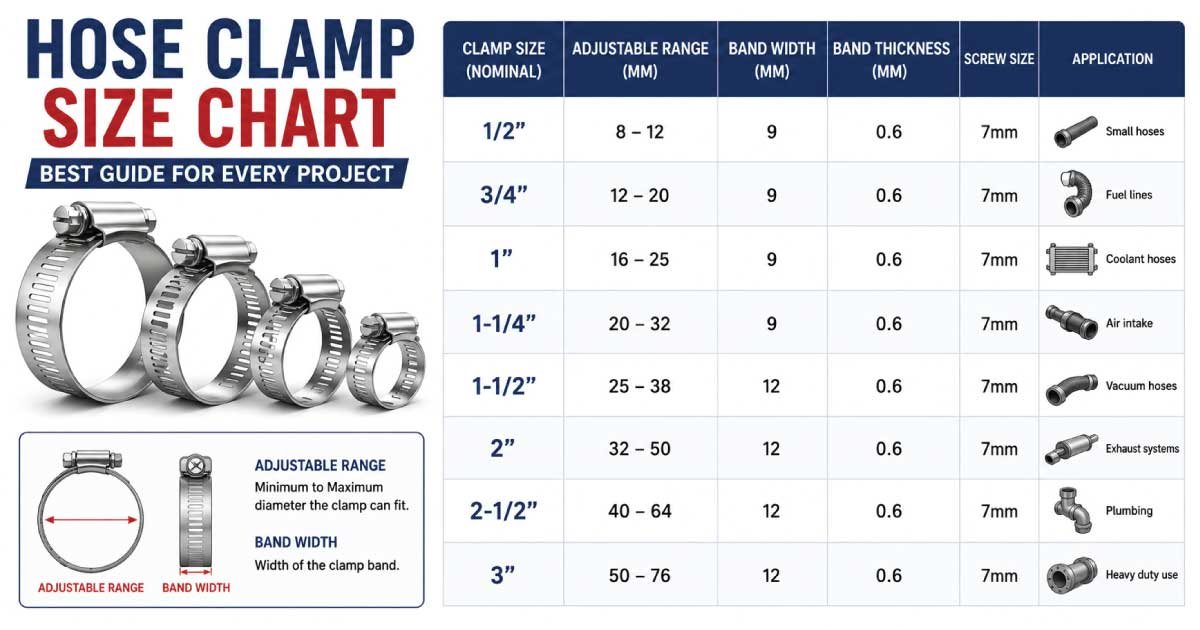
A hose clamp may seem like a simple fastening device, but choosing the correct size is essential for creating a secure, leak-free connection. Whether you’re working on an automotive cooling system, industrial machinery, plumbing installation, or garden irrigation, the right clamp size directly affects performance, durability, and safety.
This practical guide explains how to use a Hose Clamp Size Chart, measure hoses correctly, understand clamp dimensions, and choose the best clamp for your application. Instead of simply listing sizes, you will learn how professionals select clamps, avoid common sizing mistakes, and ensure long-lasting performance in real-world conditions.
Why Hose Clamp Size Matters
Selecting the correct hose clamp size is far more important than many people realize. A clamp that is too small may never fit over the hose, while an oversized clamp can fail to provide enough clamping force. Both situations often lead to leaks, hose damage, or even complete connection failure.
Proper sizing offers several important advantages:
- Creates a uniform sealing pressure
- Prevents coolant, water, oil, or air leaks
- Reduces hose wear and deformation
- Extends the service life of both the hose and fitting
- Improves equipment reliability
In industrial maintenance, technicians rarely choose a clamp based solely on the hose’s advertised size. Instead, they measure the hose’s outside diameter after installation because wall thickness varies significantly between hose types. This simple practice greatly improves clamp selection accuracy.
Quick Hose Clamp Size Chart
A hose clamp size chart provides the minimum and maximum diameter that each clamp can securely tighten. Most manufacturers identify clamps by their adjustment range rather than by the hose’s nominal inside diameter.
The following chart covers many common worm-drive hose clamp sizes.
| Clamp Size | Minimum Diameter | Maximum Diameter | Typical Hose Size |
|---|---|---|---|
| #4 | 6 mm | 16 mm | Small vacuum hose |
| #6 | 10 mm | 20 mm | Fuel hose |
| #8 | 13 mm | 23 mm | Air hose |
| #10 | 16 mm | 27 mm | Coolant hose |
| #12 | 20 mm | 32 mm | Radiator hose |
| #16 | 25 mm | 40 mm | Plumbing hose |
| #20 | 30 mm | 50 mm | Water hose |
| #24 | 35 mm | 57 mm | Industrial hose |
| #28 | 40 mm | 64 mm | Heavy-duty hose |
| #32 | 45 mm | 70 mm | Large coolant hose |
| #36 | 55 mm | 78 mm | Process piping |
| #40 | 60 mm | 89 mm | Industrial systems |
| #48 | 70 mm | 102 mm | Large transfer hose |
| #56 | 83 mm | 114 mm | Heavy equipment |
| #64 | 95 mm | 127 mm | Large industrial pipe |
Always compare the installed outside diameter of the hose with the clamp’s adjustment range instead of relying only on the hose label.
How Hose Clamp Sizes Are Listed
Understanding manufacturer specifications helps prevent ordering the wrong clamp. Although different brands may use slightly different numbering systems, most provide similar measurement information.
Manufacturers generally specify:
- Minimum tightening diameter
- Maximum opening diameter
- Band width
- Band thickness
- Screw size
- Material grade
- Recommended torque
For example:
| Specification | Example |
|---|---|
| Clamp Number | #24 |
| Adjustment Range | 35–57 mm |
| Band Width | 12 mm |
| Material | Stainless Steel 304 |
| Screw Type | Slotted/Hex |
| Recommended Torque | 5–7 Nm |
These specifications are far more useful than the clamp number alone because numbering systems can differ between manufacturers.
Understand the Important Clamp Dimensions
Every hose clamp contains several dimensions that influence its holding ability. Understanding these measurements makes selecting the proper clamp much easier, especially for industrial or automotive repairs.
Adjustment Range
The adjustment range is the most important dimension. It indicates the smallest and largest diameter the clamp can tighten around.
For reliable performance, the installed hose diameter should sit near the middle of this range rather than at either extreme. This provides better thread engagement and more consistent clamping pressure.
Band Width
Band width affects how pressure is distributed around the hose.
Typical widths include:
| Band Width | Common Uses |
|---|---|
| 8 mm | Small hoses |
| 10 mm | Fuel lines |
| 12 mm | Automotive hoses |
| 16 mm | Heavy-duty systems |
| 20 mm | Industrial applications |
Wider bands spread pressure over a larger surface area, reducing the risk of cutting into soft rubber hoses.
Band Thickness
Band thickness contributes to the clamp’s overall strength and resistance to stretching.
Typical thickness ranges include:
- 0.5 mm
- 0.6 mm
- 0.7 mm
- 0.8 mm
Thicker bands generally perform better in high-pressure or high-vibration environments, although they require slightly more tightening torque.
Screw Housing
The screw housing transfers tightening force to the band.
Common housing styles include:
- Worm-drive
- Hex-head
- Slotted
- Combination drive
- Quick-release
Professionals often prefer hex-head designs because they provide better torque control and reduce the likelihood of screwdriver slippage during installation.
How to Read a Hose Clamp Size Chart
Many beginners mistakenly compare the clamp size directly with the hose’s inside diameter. In reality, the clamp tightens around the hose’s outside diameter after it is installed on the fitting.
The correct reading process is straightforward.
Step 1: Measure the hose’s outside diameter after installation.
Step 2: Compare that measurement with the clamp’s minimum and maximum adjustment range.
Step 3: Choose a clamp where the measured diameter falls near the center of the adjustment range.
For example:
Installed hose outside diameter:
38 mm
Available clamps:
- 30–45 mm
- 35–57 mm
- 40–64 mm
The 35–57 mm clamp is generally the best choice because 38 mm falls comfortably within its working range, leaving sufficient adjustment in both directions.
How to Measure a Hose for Clamp Selection
Correct measurement eliminates guesswork and helps prevent leaks after installation. Even experienced technicians verify measurements before ordering replacement clamps because hose dimensions often change with age, pressure, and temperature.
Measure the Outside Diameter
This is the preferred measurement method.
Tools commonly used include:
- Vernier caliper
- Digital caliper
- Flexible measuring tape
- Outside diameter gauge
Measure the hose after placing it over the fitting since the fitting expands the hose to its working size.
Using a Flexible Tape
If calipers are unavailable, wrap a flexible tape around the hose.
Measure the circumference and convert it to diameter using the formula:
Diameter = Circumference ÷ 3.1416
Example:
Circumference = 125.6 mm
Diameter =
125.6 ÷ 3.1416
≈ 40 mm
This method provides sufficiently accurate results for most maintenance applications.
Measuring an Existing Clamp
When replacing a clamp, don’t assume the old one is correct.
Instead:
- Remove the clamp
- Measure the installed hose diameter
- Check the adjustment range stamped on the clamp
- Compare it with manufacturer specifications
Older clamps may have stretched or been incorrectly installed, making them unreliable references for replacement.
👉 Explore our detailed Flange Size Chart for accurate specifications, an Expert Guide, and a Professional Guide that helps you avoid common sizing mistakes.
Choosing the Correct Hose Clamp Size
Selecting the proper size involves more than simply finding a clamp that fits. Environmental conditions, hose material, operating pressure, and temperature all influence the best choice.
Professional technicians usually evaluate the complete installation rather than only the hose diameter.
Match the Installed Diameter
The clamp should operate near the middle of its adjustment range.
Advantages include:
- Better sealing pressure
- Improved thread engagement
- Easier future adjustment
- Reduced band distortion
A clamp tightened near its maximum limit often delivers less consistent pressure.
Consider Operating Pressure
Higher-pressure systems require stronger clamps with higher clamping force.
Examples include:
| Application | Typical Pressure |
|---|---|
| Garden hose | Low |
| Household plumbing | Medium |
| Fuel systems | Medium |
| Hydraulic return lines | Medium-High |
| Turbocharger hoses | High |
| Industrial process piping | High |
High-pressure systems frequently use heavy-duty T-bolt clamps instead of standard worm-drive clamps because they provide more uniform compression.
Account for Temperature Changes
Temperature affects both the hose and the clamp.
Rubber expands and contracts during heating and cooling cycles, which changes the clamping force.
For high-temperature environments, consider:
- Stainless steel construction
- Constant-tension clamps
- Spring clamps
- Heavy-duty T-bolt clamps
These designs maintain more consistent pressure despite thermal expansion.
Evaluate Hose Material
Different hose materials compress differently under clamp pressure. Soft silicone hoses require smoother band edges to prevent cutting. Reinforced rubber hoses tolerate higher clamping loads. Plastic tubing often requires lower tightening torque to avoid cracking. Matching the clamp style to the hose material helps prevent premature wear and ensures a longer service life for the entire connection.
Common Hose Clamp Sizing Mistakes
Even high-quality hose clamps can fail if they are incorrectly sized or installed. Many leaks blamed on poor-quality clamps are actually caused by simple measurement errors or improper tightening. Understanding these common mistakes helps prevent costly repairs, improves safety, and extends the service life of both the clamp and the hose.
Using the Hose Inside Diameter
One of the most common mistakes is selecting a clamp based on the hose’s inside diameter (ID). Since the clamp wraps around the outside of the hose after it is fitted over a pipe or fitting, the outside diameter (OD) is the measurement that matters.
For example, a 25 mm inside diameter radiator hose may have an outside diameter of 35–40 mm once installed. Choosing a clamp based on the inside diameter would result in a clamp that is too small.
Over-Tightening the Clamp
Applying excessive torque may seem like a good way to prevent leaks, but it often causes more problems than it solves. Over-tightening can crush the hose, strip the clamp threads, damage fittings, or permanently deform the clamp band.
Good installation practice includes:
- Tighten only to the manufacturer’s recommended torque.
- Check for uniform compression around the hose.
- Stop tightening once the leak is eliminated.
- Reinspect after the system reaches operating temperature.
Choosing an Oversized Clamp
A clamp that barely tightens around the hose may not provide enough clamping force. When the adjustment screw is near its maximum limit, the band may not distribute pressure evenly, increasing the risk of leaks and vibration-related loosening.
Ignoring Environmental Conditions
Moisture, chemicals, vibration, and extreme temperatures all affect clamp performance. Selecting a standard zinc-plated clamp for a marine or chemical-processing environment often leads to corrosion and early failure. Material selection should always match the operating conditions.
👉 For trusted dimensions and professional recommendations, visit our complete Spring Pin Size Chart, where every article includes an Expert Guide and Professional Guide for better decision-making.
Hose Clamp Materials and Standards
The material used in a hose clamp determines its corrosion resistance, strength, operating temperature, and overall lifespan. Understanding common materials and industry standards helps you select a clamp that performs reliably in your specific application.
Common Hose Clamp Materials
Different materials offer different advantages depending on the environment.
| Material | Advantages | Typical Applications |
|---|---|---|
| Zinc-Plated Steel | Economical, good strength | Indoor plumbing, general repairs |
| Stainless Steel 201 | Moderate corrosion resistance | Automotive repairs |
| Stainless Steel 304 | Excellent corrosion resistance | Food processing, marine, plumbing |
| Stainless Steel 316 | Superior resistance to saltwater and chemicals | Marine, chemical plants |
| Galvanized Steel | Good outdoor durability | Agricultural equipment |
Stainless steel is generally the preferred choice for long-term reliability, especially where moisture or chemicals are present.
Industry Standards
Several international standards help ensure compatibility and quality.
| Standard | Purpose |
|---|---|
| ISO | International manufacturing requirements |
| DIN | German engineering standards |
| SAE | Automotive clamp specifications |
| ASTM | Material quality standards |
| BS | British engineering standards |
| JIS | Japanese industrial standards |
Buying clamps manufactured to recognized standards provides greater confidence in their dimensions, material quality, and performance.
Hose Clamp Applications
Hose clamps are used in nearly every industry where flexible hoses connect to rigid fittings. Although the basic function remains the same, clamp selection varies depending on pressure, temperature, vibration, and environmental conditions.
Automotive Systems
Automotive applications include:
- Radiator hoses
- Heater hoses
- Fuel lines
- Air intake systems
- Turbocharger piping
Cooling systems often experience repeated heating and cooling cycles, making constant-tension or spring clamps an excellent choice because they compensate for thermal expansion.
Industrial Equipment
Factories use hose clamps on:
- Compressed air systems
- Hydraulic return lines
- Cooling systems
- Chemical transfer hoses
- Process water piping
Industrial maintenance teams typically choose stainless steel clamps to reduce corrosion and minimize downtime.
Residential Plumbing
Homeowners commonly use hose clamps for:
- Washing machine hoses
- Garden irrigation
- Water pumps
- Pool filtration systems
- Drain connections
Selecting corrosion-resistant materials is particularly important for outdoor installations exposed to weather.
Marine Applications
Boats and marine equipment require clamps that resist constant exposure to saltwater. Stainless Steel 316 is widely recommended because it offers outstanding corrosion resistance and a long service life in harsh marine environments.
👉 Discover the latest Nut Size Chart along with an Complete Guide, designed to simplify size selection for every mechanical application.
Buying Considerations
Purchasing the right hose clamp involves more than matching the diameter. A quality clamp should suit the operating conditions, provide reliable sealing, and remain easy to maintain over time. Considering several factors before buying helps prevent premature failures and unnecessary replacement costs.
Check Size Compatibility
Always verify:
- Installed hose outside diameter
- Clamp adjustment range
- Band width
- Clearance around the installation
Choosing a clamp with the correct adjustment range ensures proper tightening without placing unnecessary stress on the screw mechanism.
Select the Right Material
Material selection should match the operating environment.
For example:
- Indoor plumbing: Zinc-plated steel may be sufficient.
- Automotive cooling: Stainless Steel 304 is a reliable option.
- Marine equipment: Stainless Steel 316 is preferred.
- Chemical plants: Use corrosion-resistant stainless steel compatible with the chemicals involved.
Consider Operating Temperature
Temperature affects both hose flexibility and clamp performance.
Typical temperature ranges include:
| Clamp Material | Approximate Temperature Range |
|---|---|
| Zinc-Plated Steel | -20°C to 100°C |
| Stainless Steel | -50°C to 300°C |
| Heavy-Duty T-Bolt Clamp | Up to 400°C (application dependent) |
Always confirm the manufacturer’s specifications when working in high-temperature environments.
Evaluate Clamp Style
Different clamp designs serve different purposes.
| Clamp Type | Best Use |
|---|---|
| Worm-Drive | General-purpose applications |
| Spring Clamp | Automotive cooling systems |
| T-Bolt Clamp | High-pressure systems |
| Ear Clamp | Permanent installations |
| Wire Clamp | Low-pressure hoses |
Choosing the correct clamp style often improves sealing performance more than simply increasing clamp size.
Balance Cost and Durability
Lower-cost clamps may work well for temporary repairs, but high-quality stainless steel clamps generally provide better long-term value by reducing maintenance, minimizing corrosion, and extending service life.
Maintenance and Inspection Tips
Proper maintenance helps hose clamps maintain consistent sealing pressure and prevents unexpected failures. Routine inspection is especially important in systems exposed to vibration, pressure fluctuations, or harsh environments.
Regular inspections should include both the clamp and the hose because damage to either component can cause leaks.
Recommended maintenance practices include:
- Inspect clamps for rust or corrosion.
- Check screw threads for wear.
- Look for cracked or swollen hoses.
- Verify that clamps have not loosened due to vibration.
- Replace damaged clamps immediately.
- Clean debris from exposed screw threads.
- Retorque clamps after initial heat cycles if recommended by the manufacturer.
In preventive maintenance programs, replacing an aging clamp during scheduled service is often less expensive than repairing equipment damaged by a sudden hose failure.
Conclusion
Selecting the correct Hose Clamp Size Chart is one of the simplest yet most important steps in creating a secure, leak-free hose connection. By measuring the installed outside diameter, understanding the clamp’s adjustment range, and choosing the right material and clamp style, you can significantly improve system reliability and reduce maintenance costs.
Whether you are working on automotive repairs, industrial machinery, plumbing systems, or marine equipment, proper sizing and installation help prevent leaks, protect hoses from damage, and extend the life of the entire assembly.
Following recognized standards, inspecting clamps regularly, and replacing worn components when necessary ensures safe and dependable performance. With the practical guidance provided in this complete guide, you can confidently select the right hose clamp for virtually any application.
Frequently Asked Questions
What size hose clamp should I use?
The correct hose clamp size depends on the hose’s outside diameter after it is installed on the fitting. Measure the installed outside diameter using a caliper or measuring tape, then choose a clamp whose adjustment range comfortably includes that measurement. Ideally, the hose diameter should fall near the middle of the clamp’s adjustment range for the best sealing performance and future adjustment.
Can I use a larger hose clamp instead of the exact size?
Using a slightly larger clamp is acceptable only if the hose diameter remains well within the clamp’s adjustment range. An excessively large clamp may not provide enough clamping force, may tighten unevenly, and can loosen over time. Selecting a clamp designed for your measured hose diameter always produces more reliable and longer-lasting results.
Are stainless steel hose clamps better than zinc-plated clamps?
Stainless steel hose clamps generally offer better corrosion resistance, longer service life, and improved durability in wet, outdoor, marine, or chemical environments. Zinc-plated clamps are usually more economical and suitable for dry indoor applications. The best material depends on the operating environment, expected lifespan, and maintenance requirements.
How tight should a hose clamp be?
A hose clamp should be tightened enough to create a secure seal without crushing the hose or damaging the fitting. Follow the manufacturer’s recommended torque whenever possible. Over-tightening can shorten hose life, strip the clamp threads, or deform the clamp band, while under-tightening may allow leaks to develop.
When should I replace a hose clamp?
Replace a hose clamp if it shows signs of corrosion, cracked housing, stripped threads, bent bands, or loss of clamping force. Clamps should also be replaced whenever they no longer maintain a reliable seal or if the hose itself is being replaced after years of service. Installing a new clamp with a new hose is considered good maintenance practice.
Can the same hose clamp be reused?
Many worm-drive hose clamps can be reused if they remain free from corrosion, thread damage, and band deformation. However, clamps that have been heavily tightened, exposed to corrosive environments, or permanently deformed should be replaced. Reusing a damaged clamp increases the risk of leaks and unexpected failures, particularly in high-pressure or safety-critical systems.

Engineer Hassan is a Mechanical Engineer with 16+ years of hands-on experience in mechanical hardware, fasteners, and workshop tools. He focuses on size selection, thread identification, and measurement, helping users choose the correct components with accuracy and safety.