

Spring washers are small components, but they play a critical role in the reliability and longevity of mechanical assemblies. Whether you are designing industrial machinery, assembling automotive parts, or working on everyday maintenance, choosing the correct spring washer size is essential. A mismatched washer can lead to loosening, vibration issues, or even joint failure over time.
This complete guide will walk you through everything you need to know about spring washer size charts from understanding how spring washers work to reading size charts, selecting the right dimensions, and avoiding common mistakes. By the end, you’ll be confident in choosing the correct spring washer for any application.
What Is a Spring Washer?
A spring washer, often referred to as a split lock washer, is a mechanical fastening component used to maintain tension and prevent loosening in bolted joints. It is specifically designed to counteract vibration, thermal expansion, and dynamic loads that can otherwise reduce clamping force over time.
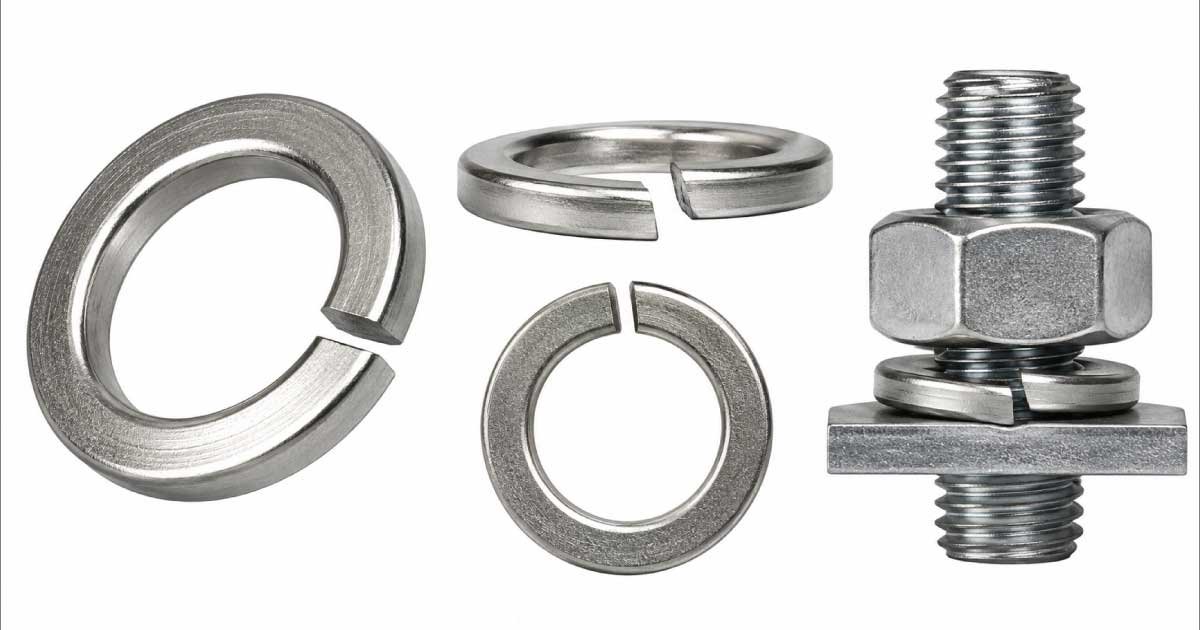
A spring washer (also called a split lock washer) is a type of mechanical washer designed to prevent nuts and bolts from loosening due to vibration, thermal expansion, or dynamic loads. Unlike flat washers, spring washers apply a continuous axial force that maintains tension in the fastener assembly.
The most common type is the helical spring washer, which has a split and a slightly twisted shape. When compressed, it acts like a spring, increasing friction and resisting rotation of the nut or bolt.
Why Spring Washer Size Matters
Selecting the correct spring washer size is critical for ensuring reliable fastening performance and long-term joint stability. Size directly influences how effectively the washer generates spring force, distributes load, and resists loosening under operational stresses such as vibration or repeated loading.
Using the correct spring washer size is not just a matter of fit it directly affects performance. An undersized washer may not sit properly under the bolt head or nut, while an oversized washer may not generate enough spring force.
Correct sizing ensures:
- Proper load distribution
- Consistent clamping force
- Effective vibration resistance
- Longer fastener life
- Compliance with engineering standards
This is where a spring washer size chart becomes indispensable.
Key Dimensions in a Spring Washer Size Chart
Before using a spring washer size chart, it’s essential to understand the key dimensions it lists. These measurements define how the washer fits, performs, and reacts under load. Knowing what each parameter means helps you select the right washer for secure, reliable fastening.
Before diving into size charts, it’s important to understand the main dimensions listed. Most charts include the following parameters:
1. Nominal Size (Bolt Size)
The nominal size indicates the bolt or screw diameter the spring washer is intended to match. It is usually expressed in metric sizes such as M4, M6, or M10, ensuring compatibility with standard fasteners and proper alignment during assembly.
This refers to the diameter of the bolt or screw the washer is designed to fit, such as M4, M6, M10, etc.
2. Inner Diameter (ID)
The inner diameter defines the hole size of the washer. It must be slightly larger than the bolt shank so the washer can be installed smoothly while still fitting snugly enough to function effectively without unwanted movement.
The inner diameter must be slightly larger than the bolt’s shank to allow easy installation without excessive play.
3. Outer Diameter (OD)
The outer diameter controls the surface area over which the load is spread. A properly sized OD helps prevent surface damage, improves load distribution, and enhances the overall stability of the fastened joint.
The outer diameter determines how the load is distributed over the clamped surface.
4. Thickness
Washer thickness directly influences its stiffness and ability to generate spring force. Thicker washers generally provide higher resistance to loosening, while thinner washers offer less preload but may suit lighter-duty applications.
Thickness affects the spring force generated when the washer is compressed.
5. Free Height
Free height is the washer’s height in its uncompressed state. This dimension is important because it affects how much the washer can deflect under load, directly influencing its spring action and vibration-resisting capability.
This is the height of the washer before it is compressed. It plays a role in determining deflection and spring action.
Standard Spring Washer Size Chart (Metric)
A metric spring washer size chart provides standardized dimensional references that help engineers, technicians, and buyers select the correct washer for a given bolt size. While values may vary slightly by manufacturer or standard, these charts serve as a reliable baseline for design, maintenance, and procurement decisions.
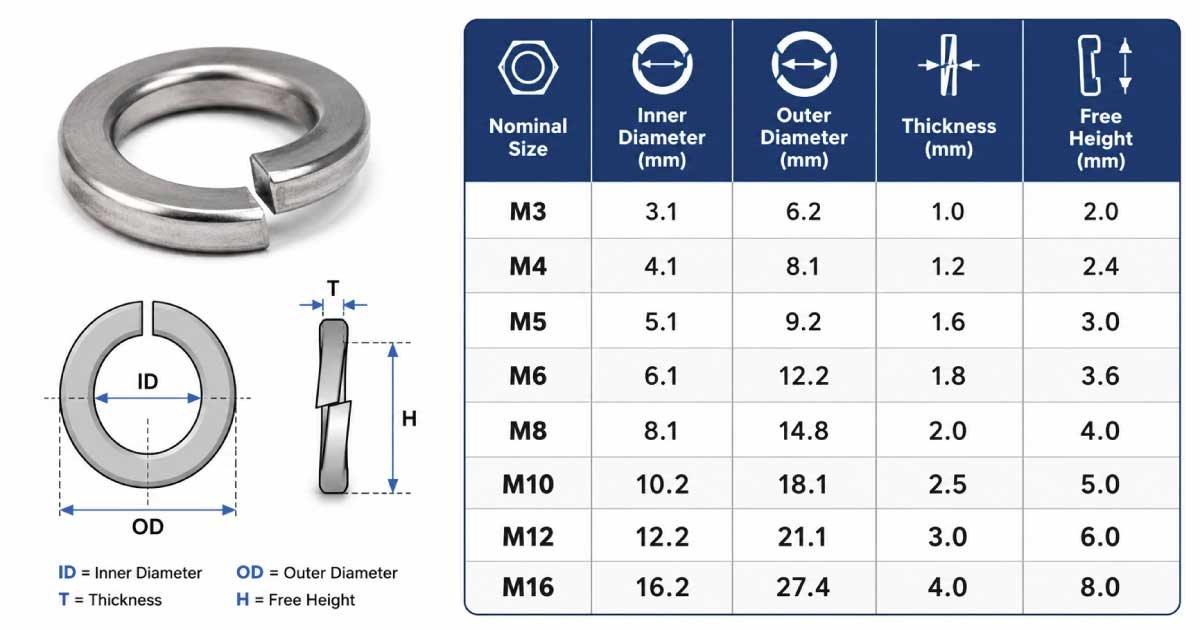
Below is a typical metric spring washer size chart used in many industries. Actual values may vary slightly depending on the standard or manufacturer.
| Nominal Size | Inner Diameter (mm) | Outer Diameter (mm) | Thickness (mm) | Free Height (mm) |
|---|---|---|---|---|
| M3 | 3.1 | 6.2 | 1.0 | 2.0 |
| M4 | 4.1 | 8.1 | 1.2 | 2.4 |
| M5 | 5.1 | 9.2 | 1.6 | 3.0 |
| M6 | 6.1 | 12.2 | 1.8 | 3.6 |
| M8 | 8.1 | 14.8 | 2.0 | 4.0 |
| M10 | 10.2 | 18.1 | 2.5 | 5.0 |
| M12 | 12.2 | 21.1 | 3.0 | 6.0 |
| M16 | 16.2 | 27.4 | 4.0 | 8.0 |
This chart gives a general reference, but always confirm dimensions against the applicable standard or supplier specification.
Standard Spring Washer Size
Spring washer dimensions and performance characteristics are governed by established standards to ensure consistency and interchangeability across manufacturers. These standards define tolerances, materials, and geometry, making it easier to source compatible components for global projects and regulated industries.
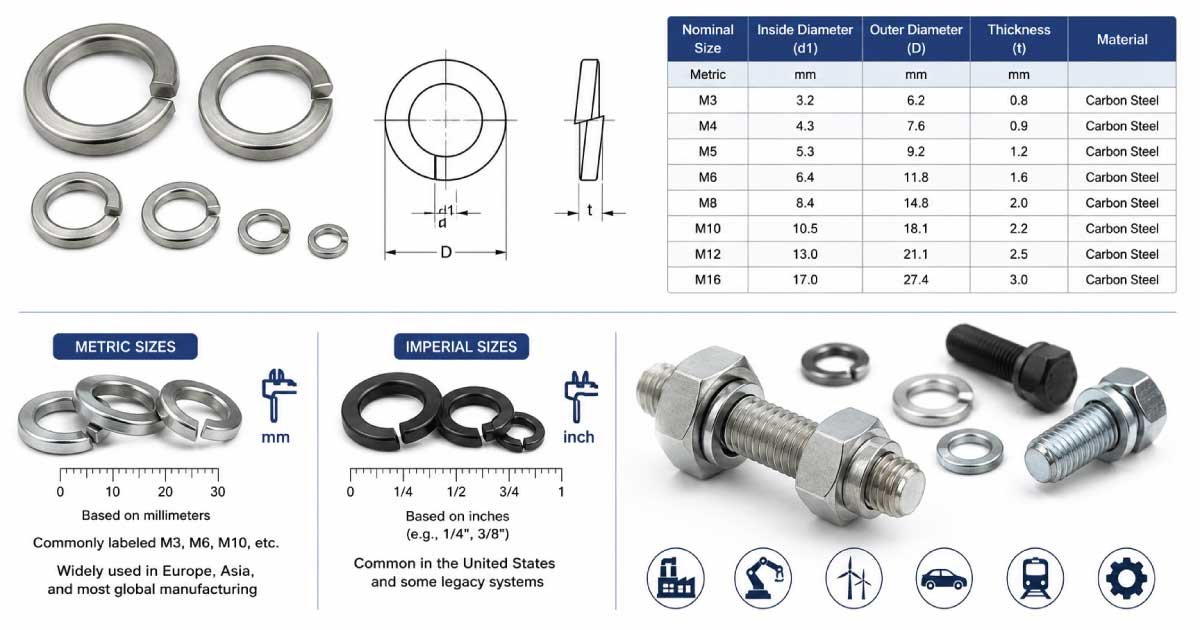
Some of the most widely used include:
- DIN 127 – A German standard commonly referenced worldwide for split spring washers
- ISO 7980 – An international standard published by the International Organization for Standardization
- ASME B18.21.1 – A widely used standard in North America
When reviewing a spring washer size chart, always check which standard it follows. Dimensions can vary slightly between standards, even for the same nominal size.
Metric vs. Imperial Spring Washer Sizes
Spring washers are produced in both metric and imperial measurement systems, and understanding the difference is essential for proper fit and performance. Using the wrong system can result in loose assemblies, uneven loading, or reduced vibration resistance in critical applications.
Metric Sizes
- Based on millimeters
- Commonly labeled M3, M6, M10, etc.
- Widely used in Europe, Asia, and most global manufacturing
Imperial Sizes
- Based on inches (e.g., 1/4″, 3/8″)
- Common in the United States and some legacy systems
A metric spring washer should never be substituted with an imperial one unless dimensions are verified and compatible.
How to Choose the Right Spring Washer Size
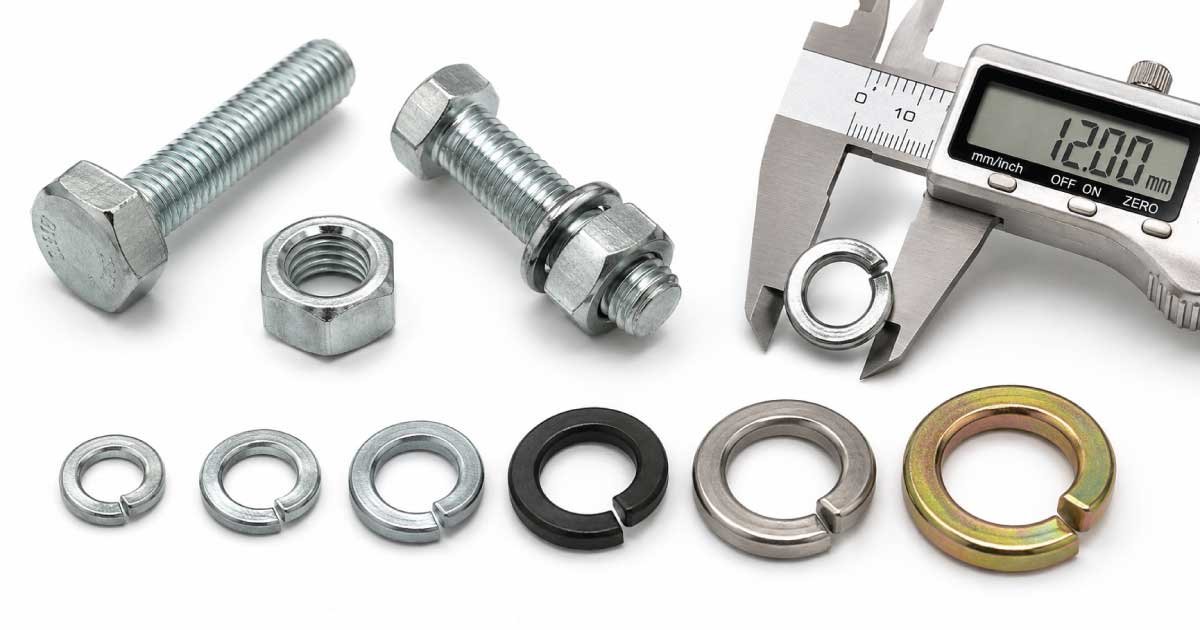
Reading a Manufacturer’s Spring Washer Size Chart
A manufacturer’s spring washer size chart often provides more than just dimensional data. These additional details help engineers evaluate performance, durability, and suitability for specific applications, allowing more informed decisions when selecting washers for demanding or regulated environments.
Manufacturer charts may include additional data beyond basic dimensions, such as:
- Load-deflection curves
- Hardness ratings
- Surface finishes (zinc-plated, black oxide, plain)
- Recommended torque ranges
When comparing charts from different suppliers, ensure they are based on the same standard. A DIN-based washer may not match an ISO-based washer exactly.
Common Mistakes to Avoid
Despite their simplicity, spring washers are frequently misapplied. Errors in sizing or selection can reduce fastening reliability, shorten service life, or lead to joint failure. Being aware of common mistakes helps prevent performance issues and costly rework.
Here are some common pitfalls:
- Assuming “close enough” fit
A washer that almost fits can reduce clamping force or cause uneven loading. - Ignoring washer thickness
Thickness directly affects spring action and locking performance. - Mixing standards unknowingly
DIN, ISO, and ASME washers may look similar but differ in dimensions. - Over-reliance on spring washers
In high-vibration applications, additional locking methods (nylock nuts, thread lockers) may be required.
Are Spring Washers Always Necessary?
Spring washers are commonly specified in many fastening applications, but they are not universally required. Advances in fastening technology have introduced alternatives that can outperform spring washers in certain conditions, especially where vibration, safety, or long-term reliability is critical.
While spring washers are widely used, they are not always the best solution. In some modern engineering applications, alternatives such as serrated flange nuts or chemical thread lockers provide better performance.
However, spring washers remain popular because they are:
- Simple and inexpensive
- Easy to install and replace
- Effective for moderate vibration and load conditions
Choosing the right size from a reliable spring washer size chart ensures they perform as intended.
Final Thoughts
A spring washer may be a small component, but selecting the correct size has a significant impact on joint reliability and safety. By understanding the key dimensions, recognizing applicable standards, and learning how to read a spring washer size chart, you can make informed decisions for any mechanical assembly.
Whether you’re working with standard M6 bolts or large industrial fasteners, always verify washer dimensions, material, and standard compliance before installation. When used correctly, spring washers provide a simple yet effective solution to one of engineering’s most common challenges keeping fasteners tight.
If you treat the spring washer size chart as a design tool rather than an afterthought, your assemblies will be stronger, safer, and more durable.
👉 Looking for the correct needle bearing size? This Needle Bearing Size Chart includes standard dimensions, bore sizes, outside diameters, widths, load ratings, and selection tips. Read the full guide to compare bearing sizes, understand specifications, and download the PDF for quick reference.

Engineer Hassan is a Mechanical Engineer with 16+ years of hands-on experience in mechanical hardware, fasteners, and workshop tools. He focuses on size selection, thread identification, and measurement, helping users choose the correct components with accuracy and safety.