
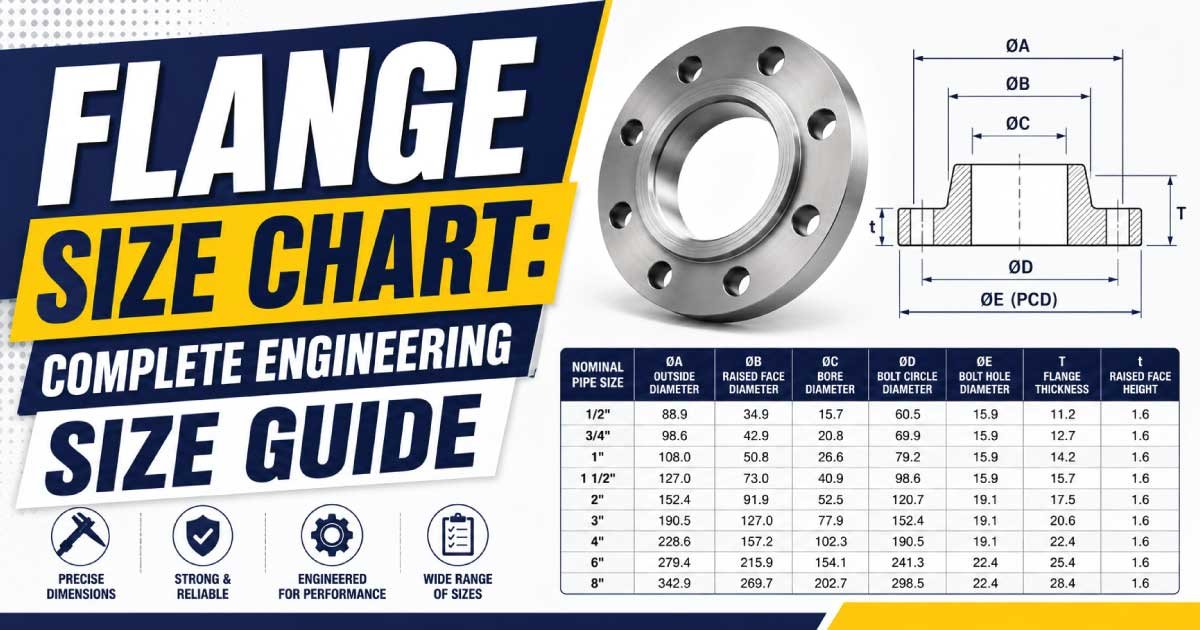
Flanges are essential piping components used to connect pipes, valves, pumps, fittings, and other equipment in industrial systems.
They provide a secure, leak-proof joint while allowing easy inspection, maintenance, and replacement of piping components. Choosing the correct flange size ensures proper sealing, pressure handling, and compatibility with the connected piping system.
This complete guide explains flange dimensions, standard size charts, measurement methods, common flange types, and selection tips.
What Is a Flange?
A flange is a circular or square mechanical component with bolt holes used to connect two piping sections or equipment together. A gasket is placed between mating flanges to create a pressure-tight seal. Flanges are widely used in oil and gas, chemical processing, water treatment, power generation, food processing, and HVAC systems because they provide strong, reliable, and serviceable pipe connections.
Key Functions
- Connects pipes securely
- Supports high-pressure systems
- Provides leak-proof sealing
- Simplifies maintenance
- Allows equipment replacement
- Improves piping flexibility
Common Types of Flanges
Different piping applications require different flange designs depending on pressure rating, temperature, pipe material, and installation method. Understanding flange types helps ensure proper selection for long-lasting and reliable piping systems.
1. Weld Neck Flange
The weld neck flange has a long tapered hub that is welded directly to the pipe. Its design distributes stress evenly, making it ideal for high-pressure and high-temperature applications where strength and reliability are critical.
Advantages
- Excellent strength
- Superior pressure resistance
- Reduced stress concentration
- Long service life
- Suitable for critical applications
2. Slip-On Flange
Slip-on flanges slide over the pipe before welding on both the inside and outside. They are easier to install than weld neck flanges and are commonly used in low- and medium-pressure piping systems.
Benefits
- Easy installation
- Lower installation cost
- Good alignment
- Suitable for moderate pressure
- Widely available
3. Blind Flange
Blind flanges are solid plates without a center bore. They seal the end of a pipeline, pressure vessel, or valve opening while allowing future expansion or maintenance.
Common Applications
- Pressure testing
- Pipeline termination
- Equipment isolation
- Maintenance shutdowns
- Future piping expansion
4. Socket Weld Flange
Socket weld flanges are designed for small-diameter, high-pressure piping systems. The pipe fits into a recessed socket before welding, creating a smooth bore with excellent flow characteristics.
ANSI Flange Size Chart (Class 150)
The following table shows common ANSI Class 150 flange dimensions.
| Nominal Pipe Size | Outside Diameter (in) | Bolt Circle (in) | Number of Bolt Holes |
|---|---|---|---|
| 1/2″ | 3.50 | 2.38 | 4 |
| 3/4″ | 3.88 | 2.75 | 4 |
| 1″ | 4.25 | 3.12 | 4 |
| 1-1/4″ | 4.62 | 3.50 | 4 |
| 1-1/2″ | 5.00 | 3.88 | 4 |
| 2″ | 6.00 | 4.75 | 4 |
| 3″ | 7.50 | 6.00 | 4 |
| 4″ | 9.00 | 7.50 | 8 |
| 6″ | 11.00 | 9.50 | 8 |
| 8″ | 13.50 | 11.75 | 8 |
| 10″ | 16.00 | 14.25 | 12 |
| 12″ | 19.00 | 17.00 | 12 |
Metric Flange Size Chart
Metric flanges are commonly used in European, Asian, and ISO piping systems.
| Nominal Size (DN) | Outside Diameter (mm) | Bolt Circle (mm) | Bolt Holes |
|---|---|---|---|
| DN15 | 95 | 65 | 4 |
| DN20 | 105 | 75 | 4 |
| DN25 | 115 | 85 | 4 |
| DN32 | 140 | 100 | 4 |
| DN40 | 150 | 110 | 4 |
| DN50 | 165 | 125 | 4 |
| DN65 | 185 | 145 | 4 |
| DN80 | 200 | 160 | 8 |
| DN100 | 220 | 180 | 8 |
| DN150 | 285 | 240 | 8 |
| DN200 | 340 | 295 | 12 |
| DN250 | 405 | 355 | 12 |
Understanding Flange Dimensions
Flange dimensions determine compatibility between connected piping components. Each measurement affects sealing performance, pressure handling, and bolt alignment. Understanding these dimensions is essential when selecting replacement flanges or designing new piping systems.
1. Nominal Pipe Size (NPS)
Nominal Pipe Size identifies the pipe diameter the flange is designed to fit. Although called “nominal,” the value does not always match the actual outside diameter of the pipe, so standard charts should always be referenced.
2. Outside Diameter (OD)
The outside diameter is the total diameter of the flange. It determines the overall size of the component and provides enough surface area for bolt holes and gasket seating.
3. Bolt Circle Diameter (BCD)
The bolt circle diameter measures the circle passing through the center of all bolt holes. Correct bolt circle dimensions ensure proper alignment between mating flanges during installation.
4. Bolt Hole Diameter
Bolt holes must match the selected bolt size while providing adequate clearance for installation. Incorrect bolt hole dimensions can prevent proper assembly and reduce joint reliability.
How to Measure a Flange
Proper measurement is necessary when replacing existing flanges or selecting compatible components. Accurate measurements reduce installation errors and prevent leakage after assembly.
Step 1: Measure Outside Diameter
Use a measuring tape or caliper to determine the flange’s outside diameter.
Tips
- Measure across the widest point
- Keep the tape straight
- Record dimensions accurately
- Compare with standard charts
Step 2: Measure Bolt Circle
Measure from the center of one bolt hole to the center of the opposite bolt hole for even-numbered bolt patterns. This determines the bolt circle diameter used for flange selection.
Step 3: Count Bolt Holes
Count the total number of bolt holes and measure their diameter. These measurements help identify the flange standard and ensure compatibility with mating flanges.
Common Flange Materials
Material selection depends on pressure, temperature, corrosion resistance, and the type of fluid being transported. Choosing the proper material significantly improves flange performance and service life.
Carbon Steel Flanges
Carbon steel flanges are widely used because they provide excellent strength at an economical cost.
Advantages
- High strength
- Cost-effective
- Good machinability
- Suitable for industrial pipelines
- Excellent durability
Stainless Steel Flanges
Stainless steel flanges offer superior corrosion resistance, making them ideal for harsh environments and sanitary applications.
Benefits
- Rust resistant
- Excellent durability
- Hygienic surface
- High temperature resistance
- Long service life
Alloy Steel Flanges
Alloy steel flanges are designed for extreme pressure and temperature applications where additional mechanical strength is required.
Applications of Flanges
Flanges are used in almost every piping industry because they provide reliable, removable connections that simplify maintenance and equipment replacement while maintaining leak-free performance.
Oil and Gas Industry
Flanges connect pipelines, valves, pumps, and pressure vessels operating under high pressure and demanding environmental conditions.
Common uses include:
- Refineries
- Offshore platforms
- Gas pipelines
- Storage facilities
- Petrochemical plants
Water Treatment Plants
Water treatment facilities use flanges to connect pumps, filters, valves, and piping systems while allowing easy inspection and maintenance.
Applications include:
- Water distribution systems
- Filtration units
- Pump stations
- Chemical dosing systems
- Wastewater treatment plants
How to Choose the Correct Flange Size
Selecting the correct flange size is essential for creating a safe, leak-free, and efficient piping system. The flange must match the pipe size, pressure rating, flange face, bolt pattern, and material specifications. Choosing the wrong size can result in leaks, poor alignment, excessive stress, and costly repairs. Always verify dimensions using the appropriate flange standard before purchasing or installing a flange.
Selection Checklist
- Measure the nominal pipe size (NPS or DN)
- Verify the pressure class
- Match the flange face type
- Check the bolt circle diameter
- Confirm the number of bolt holes
- Measure bolt hole diameter
- Select the correct flange material
- Verify gasket compatibility
- Consider operating temperature
- Follow applicable piping standards
📐 Explore Latest Size Guide 👉 Roller Chain Size Chart: Ultimate Guide to Chain Sizes
Flange Pressure Classes
Pressure class indicates the maximum pressure a flange can safely handle at specified operating temperatures. Higher pressure classes generally have thicker bodies, larger hubs, and stronger bolt configurations to withstand demanding applications.
Common ANSI Pressure Classes
The most widely used pressure ratings include:
- Class 150
- Class 300
- Class 400
- Class 600
- Class 900
- Class 1500
- Class 2500
Higher pressure classes are commonly used in oil refineries, power plants, chemical processing facilities, and high-pressure steam systems.
Flange Face Types
The flange face determines how the gasket seals between two mating flanges. Selecting the proper face type improves sealing performance and prevents leakage under operating pressure.
1. Raised Face (RF)
Raised Face flanges have a slightly elevated sealing surface that concentrates gasket pressure, making them the most common choice for industrial piping systems.
Advantages
- Excellent sealing
- Widely available
- Suitable for most applications
- Easy gasket installation
- Cost-effective
2. Flat Face (FF)
Flat Face flanges have a completely flat sealing surface and are typically used with cast iron flanges or low-pressure piping systems where uniform gasket compression is required.
3. Ring Type Joint (RTJ)
RTJ flanges contain precision-machined grooves that accommodate metallic ring gaskets. They are designed for extremely high-pressure and high-temperature applications where maximum sealing reliability is required.
Flange Standards
Flanges are manufactured according to internationally recognized standards to ensure compatibility between piping components from different manufacturers. Understanding these standards helps avoid installation problems and ensures proper system performance.
ANSI / ASME Standards
ANSI and ASME standards are commonly used in North America and define flange dimensions, pressure classes, materials, and manufacturing tolerances.
Typical standards include:
- ASME B16.5
- ASME B16.47
- ASME B16.36
- ASME B16.48
DIN Standards
DIN flanges are widely used throughout Europe and many international industrial projects.
JIS Standards
Japanese Industrial Standards (JIS) are commonly used in Asian manufacturing and industrial piping systems.
ISO Standards
ISO standards help maintain global compatibility by providing internationally recognized specifications for piping components.
📐 Explore Latest Size Guide 👉 Feeler Gauge Sizes and Their Practical Uses
Common Flange Materials and Their Applications
Selecting the correct flange material ensures reliable performance under different operating conditions such as high pressure, corrosive fluids, and elevated temperatures.
| Material | Best For | Advantages |
|---|---|---|
| Carbon Steel | General industrial piping | Strong and economical |
| Stainless Steel | Food, chemical, marine | Corrosion resistant |
| Alloy Steel | High-pressure systems | Excellent strength |
| Cast Iron | Low-pressure water systems | Affordable |
| Duplex Stainless Steel | Offshore and chemical plants | High corrosion resistance |
| PVC | Water supply systems | Lightweight and corrosion resistant |
Common Flange Installation Mistakes
Improper installation is one of the most common causes of flange leakage and premature failure. Following correct assembly procedures significantly improves joint reliability and gasket performance.
Avoid these mistakes:
- Using the wrong gasket
- Uneven bolt tightening
- Incorrect bolt torque
- Damaged flange faces
- Misaligned piping
- Mixing incompatible flange standards
- Reusing damaged gaskets
- Dirty sealing surfaces
- Incorrect bolt length
- Ignoring manufacturer torque specifications
Flange Maintenance Tips
Routine maintenance helps identify wear before it causes leaks or system failure. Regular inspections improve safety and extend the service life of piping components.
Maintenance recommendations include:
- Inspect for corrosion
- Check gasket condition
- Tighten loose bolts
- Clean flange faces
- Replace damaged bolts
- Inspect for cracks
- Verify alignment
- Monitor operating pressure
- Replace worn gaskets
- Schedule routine inspections
Preventive maintenance minimizes downtime and reduces repair costs.
Advantages of Using Standard Flanges
Standardized flanges simplify installation and ensure compatibility across different piping systems. Their interchangeable design reduces maintenance time and improves long-term reliability.
Major advantages include:
- Leak-proof connections
- Easy maintenance
- Quick equipment replacement
- High pressure resistance
- Excellent sealing performance
- Standardized dimensions
- Wide material selection
- Long service life
- Improved system safety
- Reduced maintenance costs
📐 Explore Latest Size Guide 👉 Oil Seal Size Chart: Ultimate Guide to Standard Sizes
Signs a Flange Needs Replacement
Even high-quality flanges eventually wear due to pressure, corrosion, and environmental conditions. Replacing damaged flanges promptly prevents leaks and equipment damage.
Common warning signs include:
- Visible corrosion
- Cracked flange body
- Warped sealing face
- Persistent leakage
- Loose bolts
- Damaged bolt holes
- Excessive vibration
- Surface pitting
- Gasket blowouts
- Difficulty maintaining proper bolt torque
Regular inspections help detect these problems before they become critical.
Flange Applications Across Industries
Flanges are widely used because they provide strong, detachable pipe connections in systems operating under various temperatures and pressures.
Chemical Processing Plants
Chemical plants use corrosion-resistant flanges to safely transport acids, solvents, and other aggressive chemicals while maintaining leak-free connections.
Power Generation
Power plants rely on flanges in steam lines, cooling systems, boilers, and turbines where high-pressure performance is essential.
Marine Industry
Ships and offshore platforms use stainless steel and duplex flanges for seawater piping, fuel systems, and hydraulic equipment because of their corrosion resistance.
Food and Beverage Industry
Sanitary stainless steel flanges are used in food processing plants to maintain hygienic piping systems that are easy to clean and inspect.
What to Keep in Mind Flange Size
Selecting the correct flange size is essential for maintaining safe, efficient, and leak-free piping systems. By understanding flange dimensions, pressure classes, face types, materials, and international standards, engineers and technicians can confidently choose the right flange for any application.
Using accurate flange size charts, following proper installation procedures, and performing regular maintenance helps maximize equipment reliability, reduce operating costs, and extend the service life of industrial piping systems across oil and gas, chemical processing, water treatment, power generation, marine, and manufacturing industries.
FAQs:
How do I identify the correct flange size?
To identify the correct flange size, measure the nominal pipe size, outside diameter, bolt circle diameter, bolt hole diameter, and the number of bolt holes. Compare these measurements with ANSI, ASME, DIN, or JIS flange size charts to ensure proper compatibility, sealing performance, and safe installation in your piping system.
What is the difference between NPS and DN?
NPS (Nominal Pipe Size) is the inch-based pipe sizing system commonly used in North America, while DN (Diameter Nominal) is the metric designation used internationally. Although the numbering differs, both systems identify compatible pipe and flange sizes rather than the exact physical dimensions of the components.
Which flange type is used most often?
The Raised Face (RF) flange is the most widely used flange type in industrial piping systems. It provides excellent gasket sealing, supports a wide range of pressure classes, and is compatible with many gasket materials, making it suitable for oil and gas, chemical, water, and power generation applications.
Can different flange standards be connected together?
Different flange standards generally should not be connected because they often have different dimensions, bolt patterns, pressure ratings, and sealing surfaces. Mixing standards can lead to improper alignment and leakage. Only specially designed transition or adapter flanges should be used when compatibility between standards is required.
How long do industrial flanges last?
Industrial flanges can remain in service for several decades when correctly selected, installed, and maintained. Their lifespan depends on factors such as material quality, operating pressure, temperature, corrosion exposure, fluid type, installation practices, and routine inspections to prevent wear, leaks, and premature component failure.

Engineer Hassan is a Mechanical Engineer with 16+ years of hands-on experience in mechanical hardware, fasteners, and workshop tools. He focuses on size selection, thread identification, and measurement, helping users choose the correct components with accuracy and safety.