
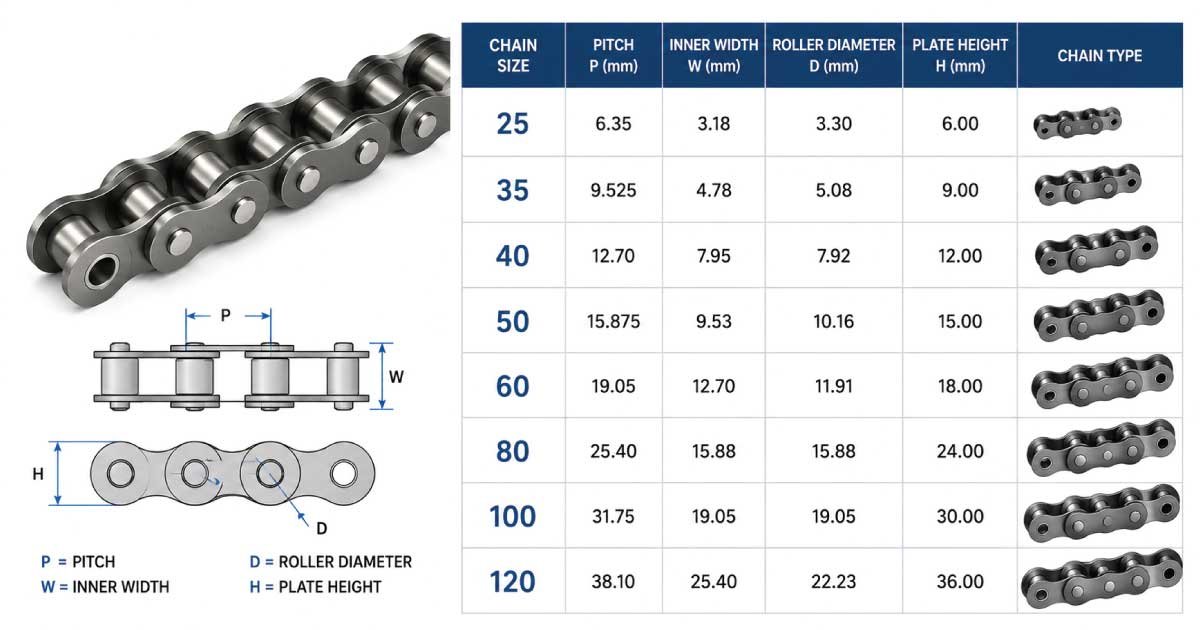
Roller chains are among the most widely used power transmission components in industrial machinery, agricultural equipment, motorcycles, conveyors, and manufacturing systems.
Choosing the correct roller chain size is essential for ensuring efficient power transfer, reducing wear, minimizing downtime, and extending equipment life.
This guide explains roller chain sizes, dimensions, measurement methods, and selection criteria using practical examples and detailed charts suitable for beginners and professionals alike.
What Is a Roller Chain?
A roller chain is a mechanical power transmission chain made of interconnected steel links, pins, bushings, and rollers. It transfers rotational motion from one sprocket to another while maintaining accurate speed ratios.
Selecting the correct chain size ensures maximum efficiency, smoother operation, reduced maintenance costs, and improved equipment reliability across various industrial and automotive applications.
A standard roller chain consists of alternating inner and outer links connected through hardened steel pins. The rollers rotate around bushings, reducing friction as they engage with sprocket teeth.
Roller chains are commonly used in:
- Industrial conveyors
- Motorcycles
- Agricultural machinery
- Packaging equipment
- Printing presses
- Mining equipment
- Food processing machinery
- Material handling systems
- Construction equipment
Compared to belts, roller chains provide positive engagement without slipping, making them ideal for heavy-duty power transmission.
Why Roller Chain Size Matters
Selecting the proper roller chain size directly affects machine efficiency, operating safety, load capacity, and service life. An incorrectly sized chain may stretch prematurely, increase sprocket wear, create excessive vibration, or even fail under heavy loads. Understanding sizing standards helps users make informed replacement and design decisions.
Choosing the wrong chain can result in:
- Poor power transmission
- Increased noise
- Chain jumping
- Premature sprocket wear
- Frequent maintenance
- Higher operating costs
- Unexpected equipment downtime
Proper sizing improves:
- Transmission efficiency
- Equipment lifespan
- Operational reliability
- Lubrication performance
- Safety
- Energy efficiency
Roller Chain Size Chart
The following ANSI roller chain size chart covers the most commonly used single-strand roller chains.
| ANSI Chain Size | Pitch (in) | Roller Diameter (in) | Width Between Plates (in) | Pin Diameter (in) | Average Tensile Strength (lbs) |
|---|---|---|---|---|---|
| #25 | 0.250 | 0.130 | 0.125 | 0.091 | 930 |
| #35 | 0.375 | 0.200 | 0.188 | 0.141 | 2,100 |
| #40 | 0.500 | 0.312 | 0.312 | 0.156 | 3,700 |
| #41 | 0.500 | 0.306 | 0.250 | 0.141 | 2,000 |
| #50 | 0.625 | 0.400 | 0.375 | 0.200 | 4,900 |
| #60 | 0.750 | 0.469 | 0.500 | 0.234 | 7,000 |
| #80 | 1.000 | 0.625 | 0.625 | 0.312 | 12,500 |
| #100 | 1.250 | 0.750 | 0.750 | 0.375 | 19,000 |
| #120 | 1.500 | 0.875 | 1.000 | 0.437 | 27,000 |
| #140 | 1.750 | 1.000 | 1.000 | 0.500 | 38,000 |
| #160 | 2.000 | 1.125 | 1.250 | 0.562 | 50,000 |
Dimensions may vary slightly depending on manufacturer specifications.
Understanding Chain Numbers
Roller chain numbers may appear confusing initially, but they follow standardized sizing systems that identify pitch, roller dimensions, and overall chain capacity. Learning how these numbers are assigned makes it much easier to identify replacement chains, match compatible sprockets, and avoid installation errors.
For ANSI roller chains:
- First number indicates the pitch.
- Last digit indicates chain style.
Examples:
| Chain | Pitch |
|---|---|
| #25 | 1/4 inch |
| #35 | 3/8 inch |
| #40 | 1/2 inch |
| #50 | 5/8 inch |
| #60 | 3/4 inch |
| #80 | 1 inch |
Generally, larger chain numbers indicate:
- Greater load capacity
- Larger rollers
- Stronger pins
- Thicker side plates
- Increased tensile strength
Major Roller Chain Dimensions
Every roller chain includes several critical dimensions that determine compatibility with sprockets, operating performance, and load capacity. Understanding these measurements helps engineers, mechanics, and maintenance professionals accurately identify existing chains or specify new chains for different machinery and industrial applications.
The most important dimensions include:
Chain Pitch
Pitch is the distance between the centers of two consecutive pins. It is the most important measurement when selecting a replacement chain.
Common pitches include:
- 1/4 inch
- 3/8 inch
- 1/2 inch
- 5/8 inch
- 3/4 inch
- 1 inch
- 1-1/4 inch
- 1-1/2 inch
The sprocket pitch must always match the chain pitch.
Roller Diameter
Roller diameter determines how the chain engages with sprocket teeth and affects wear characteristics. Proper roller dimensions ensure smooth rotation, reduce friction, improve load distribution, and help maximize both sprocket and chain service life under continuous operating conditions.
Larger rollers generally:
- Reduce contact pressure
- Improve durability
- Increase load capacity
- Lower wear rates
Width Between Plates
This measurement represents the internal width available for sprocket teeth. It must precisely match the sprocket design to ensure smooth engagement, prevent binding, reduce uneven loading, and maintain efficient power transmission throughout the entire operating cycle.
Too narrow:
- Chain will not fit.
Too wide:
- Excessive side movement occurs.
Pin Diameter
Pins carry much of the chain’s tensile load while allowing the links to articulate smoothly around sprockets. Selecting the proper pin diameter contributes significantly to chain strength, fatigue resistance, and overall durability in demanding applications.
Larger pins provide:
- Higher strength
- Better fatigue resistance
- Longer service life
Overall Width
Overall chain width becomes especially important when equipment has limited installation space. Designers must verify available clearance before selecting replacement chains to prevent interference with guards, machine frames, or nearby rotating components.
Always measure available clearance before replacing an existing chain.
ANSI Roller Chain Standards
ANSI standards establish consistent roller chain dimensions, manufacturing tolerances, and performance requirements, allowing chains and sprockets from different manufacturers to remain interchangeable. Following these standards simplifies maintenance, replacement, and equipment design while ensuring dependable power transmission performance.
ANSI roller chains are widely used throughout:
- North America
- South America
- Industrial manufacturing
- Agriculture
- Construction
- Mining
- Transportation equipment
Benefits include:
- Easy replacement
- Universal compatibility
- Reliable quality
- Standardized dimensions
- Improved equipment interchangeability
ISO Roller Chain Standards
Many international industries rely on ISO roller chain standards instead of ANSI specifications. Although similar in appearance, ISO chains have different dimensions and numbering systems. Understanding these differences helps prevent compatibility issues when servicing imported equipment or globally manufactured machinery.
ISO chains are common in:
- Europe
- Asia
- Australia
- International manufacturing facilities
Always verify whether your machine requires ANSI or ISO chain before purchasing replacements.
Single vs Multi-Strand Chains
Roller chains are available in single-strand and multiple-strand configurations depending on power transmission requirements. While both operate similarly, multi-strand chains provide increased load capacity without increasing chain pitch, making them suitable for heavy-duty industrial equipment.
Single-Strand Chains
Single-strand chains are the most common type used for light to medium-duty applications. Their simple design offers reliable performance, easier installation, lower cost, and straightforward maintenance while meeting the needs of many industrial and commercial machines.
Common applications include:
- Motorcycles
- Conveyor systems
- Pumps
- Compressors
- Small machinery
Advantages:
- Lower cost
- Easier maintenance
- Lightweight
- Readily available
Double-Strand Chains
Double-strand chains feature two parallel rows of links working together to transmit greater power than a comparable single-strand chain. They are commonly selected when equipment requires additional strength without increasing sprocket pitch or machine size.
Typical applications include:
- Heavy conveyors
- Industrial drives
- Packaging equipment
- Manufacturing machinery
Advantages include:
- Higher load capacity
- Longer lifespan
- Better shock resistance
Triple-Strand Chains
Triple-strand chains are designed for high-power industrial drives where exceptional strength and durability are essential. They distribute loads across three rows of links, reducing stress on individual components while supporting demanding operating conditions.
They are often used in:
- Steel mills
- Mining machinery
- Cement plants
- Large industrial drives
Although more expensive, they provide excellent performance under continuous heavy loads.
How to Measure Roller Chain
Accurate roller chain measurement is essential when replacing worn chains or identifying unknown chain sizes. Measuring multiple dimensions instead of relying on one value ensures compatibility with existing sprockets and helps eliminate costly ordering mistakes.
To identify an unknown chain:
- Measure the pitch.
- Measure roller diameter.
- Measure inside width.
- Measure pin diameter.
- Count the number of chain strands.
- Compare measurements with an ANSI or ISO size chart.
Avoid measuring heavily worn sections because chain elongation may affect accuracy.
Tools Needed for Measurement
Proper measuring tools improve accuracy and simplify chain identification. Using precision instruments helps maintenance professionals verify dimensions quickly, reduce errors, and ensure replacement chains match original specifications without unnecessary trial and error.
Recommended tools include:
- Digital caliper
- Steel ruler
- Vernier caliper
- Chain wear gauge
- Measuring tape
- Inspection light
High-quality measuring tools provide more reliable results, particularly when working with industrial equipment.
How to Choose Chain Size
Choosing the correct roller chain size involves more than matching the existing chain number. You must evaluate load capacity, operating speed, sprocket size, shaft alignment, lubrication conditions, environmental factors, and expected service life. A properly selected chain improves efficiency, minimizes wear, and reduces maintenance costs over the long term.
When selecting a roller chain, consider the following factors:
- Required horsepower
- Operating speed (RPM)
- Chain pitch
- Center distance
- Number of sprocket teeth
- Shock loading
- Working environment
- Lubrication method
- Duty cycle
- Safety factor
If replacing an existing chain, always verify its dimensions instead of relying solely on the stamped chain number, especially if the chain has experienced excessive wear or modifications.
👉 Our comprehensive Socket Head Cap Screw Size Chart provides an Expert Guide and Professional Guide to help engineers, mechanics, and DIY users choose the correct size every time.
Load Capacity Basics
Every roller chain has a maximum recommended working load and an average tensile strength. While tensile strength indicates the force required to break the chain, the working load represents the safe operating limit. Designing within recommended load limits significantly increases chain life and reduces the risk of unexpected failures.
General guidelines include:
- Use working load instead of tensile strength for design.
- Consider shock loads during startup and stopping.
- Apply an appropriate service factor for demanding applications.
- Replace chains showing excessive elongation or damaged components.
For heavy-duty machinery, selecting the next larger chain size often provides improved durability and reliability.
Speed Considerations
Operating speed greatly influences roller chain performance, wear rate, and lubrication requirements. Higher chain speeds generate more heat, increase friction, and demand better lubrication systems. Matching chain size with operating speed helps maintain smooth power transmission while preventing premature wear and unnecessary maintenance.
As chain speed increases:
- Lubrication becomes more critical.
- Wear may accelerate without proper maintenance.
- Heat generation increases.
- Noise levels may rise.
- Accurate sprocket alignment becomes essential.
Machines operating at high speeds often benefit from precision-manufactured chains and hardened sprockets.
Horsepower Selection
Horsepower is one of the primary factors used to determine the appropriate roller chain size. Manufacturers publish horsepower ratings based on chain pitch, sprocket size, rotational speed, and service conditions. Selecting a chain with adequate horsepower capacity ensures safe and efficient operation throughout its expected service life.
A simplified relationship is:
Power = Torque × Speed
Where:
- Power = Horsepower or kilowatts
- Torque = Rotational force
- Speed = Shaft RPM
Always include a service factor when calculating required chain capacity, especially for applications with shock loads or continuous operation.
👉 For precise measurements and industry-standard dimensions, read our updated Cotter Pin Size Chart, featuring an Expert Guide and Professional Guide for reliable results.
Roller Chain Formula
Several engineering formulas help determine proper roller chain selection, chain length, and drive performance. While manufacturers often provide design software and selection tables, understanding these basic equations allows engineers and technicians to verify calculations and optimize chain-driven systems.
Pitch Length Formula
The approximate chain length can be estimated using:
Chain Length = (2 × Center Distance ÷ Pitch) + (Number of Teeth on Large Sprocket + Number of Teeth on Small Sprocket) ÷ 2
This formula provides an initial estimate before final adjustment during installation.
Chain Speed Formula
Chain speed can be calculated as:
Chain Speed = Pitch × Number of Teeth × RPM
Maintaining appropriate chain speed helps improve efficiency and reduce wear.
Roller Chain Materials
The material used in roller chain construction directly affects strength, corrosion resistance, fatigue life, and overall performance. Different materials are available to suit standard industrial environments, food processing facilities, outdoor equipment, and corrosive operating conditions.
Common materials include:
| Material | Typical Application |
|---|---|
| Carbon Steel | General industrial machinery |
| Alloy Steel | Heavy-duty equipment |
| Stainless Steel | Food processing and marine environments |
| Nickel-Plated Steel | Light corrosion resistance |
| Zinc-Coated Steel | Outdoor equipment |
| Engineering Plastic Chains | Lightweight conveying systems |
Selecting the proper material improves durability while reducing maintenance requirements.
👉 Discover the latest Woodruff Key Size Chart along with an Expert Guide and Professional Guide designed to simplify size selection for every mechanical application.
Roller Chain Lubrication
Proper lubrication is one of the most important maintenance practices for extending roller chain life. Lubricants reduce friction between pins and bushings, minimize wear, dissipate heat, and protect against corrosion. Even premium chains can fail prematurely without consistent and appropriate lubrication.
Common lubrication methods include:
- Manual oil application
- Drip lubrication
- Oil bath lubrication
- Oil stream systems
- Automatic lubrication systems
Lubrication intervals depend on operating conditions, speed, temperature, and contamination levels.
Common Roller Chain Applications
Roller chains are used across numerous industries because they provide dependable power transmission, excellent efficiency, and long service life. Their versatility makes them suitable for light-duty equipment as well as demanding industrial machinery operating under continuous or heavy loads.
Typical applications include:
- Conveyor systems
- Agricultural machinery
- Motorcycles
- Forklifts
- Textile machinery
- Packaging equipment
- Printing presses
- Food processing equipment
- Woodworking machinery
- Construction equipment
- Mining equipment
- Industrial automation
Each application may require different chain sizes, lubrication methods, and maintenance schedules.
Installation Best Practices
Correct installation is essential for maximizing roller chain performance and service life. Improper alignment, incorrect tension, or damaged sprockets can quickly lead to excessive wear, vibration, and chain failure. Careful installation reduces maintenance needs and improves overall equipment reliability.
Follow these installation practices:
- Align sprockets accurately.
- Inspect sprocket teeth before installation.
- Adjust proper chain tension.
- Lubricate before startup.
- Avoid twisting the chain.
- Install connecting links correctly.
- Rotate the system manually before operation.
After installation, monitor the chain during initial operation and readjust tension if necessary.
Maintenance Tips
Routine maintenance keeps roller chains operating efficiently while reducing unexpected downtime and repair costs. Regular inspections help identify wear before serious damage occurs, allowing timely replacement of worn components and maintaining safe machine operation.
A simple maintenance routine includes:
- Inspect chain elongation regularly.
- Check lubrication levels.
- Clean accumulated dirt and debris.
- Inspect sprocket wear.
- Verify alignment.
- Monitor chain tension.
- Replace worn connecting links.
- Remove rust immediately.
Preventive maintenance often costs far less than emergency repairs or production interruptions.
Common Sizing Mistakes
Many roller chain problems result from incorrect sizing or installation rather than manufacturing defects. Understanding common mistakes helps users avoid premature wear, reduced efficiency, and costly equipment failures while ensuring dependable long-term performance.
Frequent mistakes include:
- Choosing chain based only on appearance.
- Ignoring operating load.
- Mixing ANSI and ISO chains.
- Installing worn chains on new sprockets.
- Replacing only one worn component.
- Operating without lubrication.
- Using excessive chain tension.
- Ignoring shaft misalignment.
Careful measurement and adherence to manufacturer recommendations greatly reduce these issues.
Signs of Chain Wear
Roller chains gradually wear during normal operation, but recognizing early warning signs allows timely maintenance before severe damage develops. Regular inspections improve safety, reduce downtime, and help maintain efficient power transmission across industrial and mechanical systems.
Replace the chain if you observe:
- Excessive elongation
- Rust or corrosion
- Cracked side plates
- Worn rollers
- Bent pins
- Stiff or frozen links
- Abnormal vibration
- Increased operating noise
Ignoring these warning signs can damage both the chain and sprockets.
Conclusion
Selecting the correct roller chain size is essential for achieving reliable power transmission, maximizing equipment efficiency, and extending component life. By understanding chain dimensions, ANSI and ISO standards, load capacity, speed requirements, lubrication practices, and maintenance procedures, users can confidently choose the right chain for any application.
Whether you are maintaining industrial machinery, designing mechanical systems, or replacing a worn chain, using an accurate roller chain size chart and following proper installation and maintenance practices will reduce downtime, improve safety, and deliver consistent long-term performance.
Frequently Asked Questions
What does roller chain pitch mean?
Roller chain pitch is the distance between the centers of two adjacent pins. It is the most important measurement used to identify chain size because the sprocket pitch must exactly match the chain pitch. Even small differences can cause poor engagement, accelerated wear, and unreliable power transmission.
Can I replace an ANSI chain with an ISO chain?
Although ANSI and ISO roller chains often look similar, their dimensions and numbering systems differ. In most cases, they are not directly interchangeable. Always verify the manufacturer’s specifications and sprocket compatibility before replacing one standard with the other to avoid installation and performance problems.
How often should a roller chain be lubricated?
Lubrication frequency depends on operating speed, load, environmental conditions, and chain type. High-speed industrial drives may require continuous lubrication, while slower applications can often be lubricated periodically. Regular inspection is the best way to determine whether additional lubrication is needed for reliable operation.
How do I know if my roller chain is worn out?
Common indicators include excessive chain elongation, noisy operation, rust, stiff links, cracked plates, worn rollers, and poor sprocket engagement. Measuring chain stretch against manufacturer recommendations is one of the most accurate methods for determining when replacement is necessary.
Why is proper chain tension important?
Correct chain tension ensures smooth power transmission while reducing unnecessary stress on the chain, sprockets, bearings, and shafts. Chains that are too tight wear rapidly, while loose chains may jump teeth, vibrate excessively, or fail unexpectedly during operation.

Engineer Hassan is a Mechanical Engineer with 16+ years of hands-on experience in mechanical hardware, fasteners, and workshop tools. He focuses on size selection, thread identification, and measurement, helping users choose the correct components with accuracy and safety.