
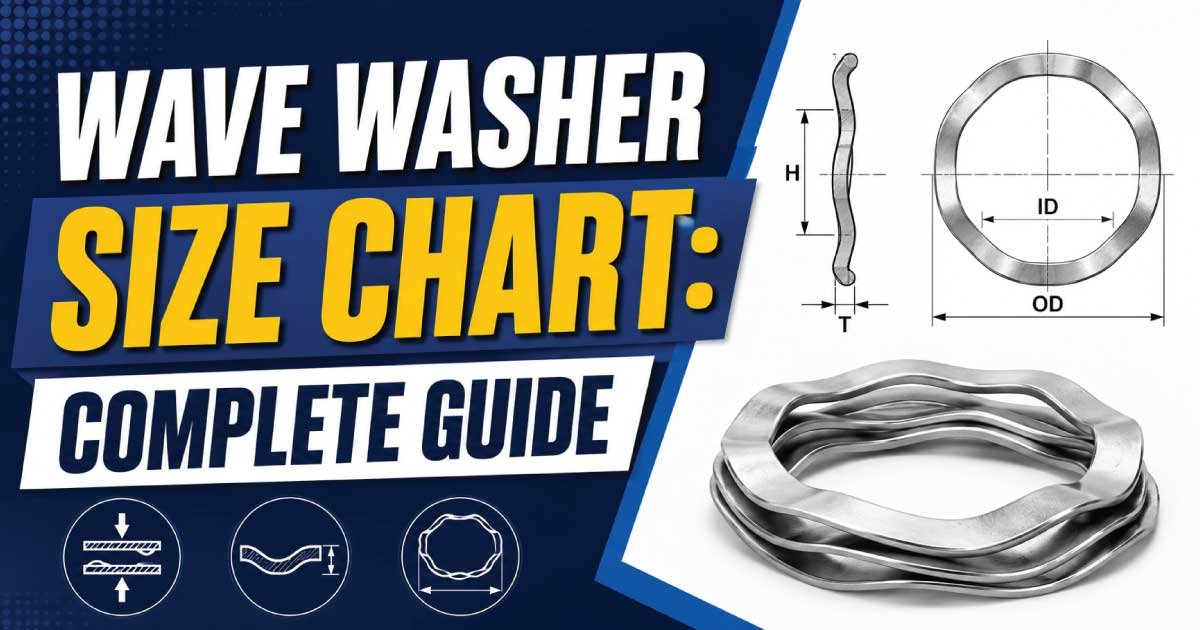
Wave washers are spring washers designed to provide a controlled amount of preload, compensate for thermal expansion, absorb vibration, and maintain consistent pressure between assembled components.
Their wave-shaped profile allows them to compress under load while occupying minimal axial space. Wave washers are widely used in bearings, automotive systems, electrical equipment, aerospace components, medical devices, and industrial machinery.
This guide explains standard wave washer sizes, dimensions, materials, types, and common applications.
What Is a Wave Washer?
A wave washer is a thin metal washer formed into a wave-like shape around its circumference. Unlike flat washers, wave washers act as springs, applying continuous axial force to compensate for movement, vibration, wear, and thermal expansion within an assembly.
Key features include:
- Spring-like wave profile
- Provides continuous preload
- Reduces vibration
- Compensates for thermal expansion
- Lightweight design
- Available in metric and imperial sizes
Why Wave Washer Size Matters
Choosing the correct wave washer size ensures proper spring force, load distribution, and component alignment. An incorrectly sized washer may provide insufficient preload or excessive force, leading to premature wear or assembly failure.
Benefits of proper sizing include:
- Consistent spring force
- Improved vibration resistance
- Better bearing performance
- Reduced component wear
- Longer service life
- Reliable equipment operation
Metric Wave Washer Size Chart
The following table lists common metric wave washer sizes used in mechanical and industrial assemblies.
| Nominal Size | Inner Diameter (ID) | Outer Diameter (OD) | Thickness |
|---|---|---|---|
| M3 | 3.2 mm | 7 mm | 0.30 mm |
| M4 | 4.3 mm | 9 mm | 0.40 mm |
| M5 | 5.3 mm | 10 mm | 0.50 mm |
| M6 | 6.4 mm | 12 mm | 0.60 mm |
| M8 | 8.4 mm | 16 mm | 0.80 mm |
| M10 | 10.5 mm | 20 mm | 1.00 mm |
| M12 | 13 mm | 24 mm | 1.20 mm |
| M16 | 17 mm | 30 mm | 1.50 mm |
| M20 | 21 mm | 37 mm | 2.00 mm |
SAE Wave Washer Size Chart
Imperial wave washers are commonly used in North American machinery, automotive systems, and industrial equipment.
| Nominal Size | Inner Diameter | Outer Diameter | Thickness |
|---|---|---|---|
| #6 | 0.144″ | 0.312″ | 0.012″ |
| #8 | 0.170″ | 0.375″ | 0.015″ |
| #10 | 0.196″ | 0.437″ | 0.018″ |
| 1/4″ | 0.260″ | 0.500″ | 0.020″ |
| 5/16″ | 0.322″ | 0.625″ | 0.025″ |
| 3/8″ | 0.385″ | 0.750″ | 0.030″ |
| 1/2″ | 0.510″ | 1.000″ | 0.040″ |
Main Parts of a Wave Washer
Although wave washers are simple components, each dimension contributes to their spring performance and load characteristics.
1. Inner Diameter (ID)
The inner diameter fits around the bolt, shaft, or bearing seat. It should provide adequate clearance while maintaining proper alignment during installation and operation.
2. Outer Diameter (OD)
The outer diameter determines the contact area between the washer and the mating surface. A properly selected OD distributes loads evenly while maintaining stability under compression.
3. Wave Height
Wave height determines the amount of spring deflection available before the washer becomes fully compressed. Different wave heights provide different load capacities and spring characteristics depending on the application.
4. Material Thickness
Material thickness directly affects spring force and durability. Thicker wave washers generally provide higher load capacity but require greater compression force during installation.
Common Types of Wave Washers
Wave washers are available in several configurations to meet different load, space, and performance requirements.
Single Wave Washer
Single wave washers feature one continuous wave around the circumference. They are suitable for light preload applications where limited spring force is required and installation space is restricted.
Advantages include:
- Compact design
- Lightweight
- Low spring force
- Easy installation
Multi-Wave Washer
Multi-wave washers contain several evenly spaced waves that provide greater flexibility and more uniform load distribution than single-wave designs. They are commonly used in bearings and precision mechanical assemblies.
Benefits include:
- Smooth load distribution
- Increased flexibility
- Better vibration absorption
- Consistent preload
Crest-to-Crest Wave Washer
Crest-to-crest wave washers are constructed by stacking multiple wave layers together. This design increases load capacity while maintaining compact dimensions, making them suitable for high-performance mechanical systems.
Nested Wave Washer
Nested wave washers consist of multiple individual wave washers stacked together. They provide significantly higher spring loads and are commonly used in heavy-duty industrial equipment requiring greater preload forces.
Common Wave Washer Materials
Material selection affects corrosion resistance, spring performance, fatigue life, and operating temperature.
1. Carbon Steel
Carbon steel wave washers offer excellent strength and affordability for general industrial applications. Protective coatings are often applied to improve corrosion resistance.
2. Stainless Steel
Stainless steel wave washers provide outstanding corrosion resistance and are commonly used in marine equipment, medical devices, food processing machinery, and outdoor applications.
Advantages include:
- Excellent corrosion resistance
- Long service life
- Hygienic properties
- Low maintenance
3. Alloy Spring Steel
Alloy spring steel is heat-treated to deliver exceptional elasticity, fatigue resistance, and long-term spring performance. It is widely used in demanding automotive, aerospace, and industrial applications.
Common Applications of Wave Washers
Wave washers are widely used wherever controlled spring force, vibration reduction, or preload maintenance is required in compact assemblies.
Major applications include:
- Ball bearings
- Electric motors
- Gearboxes
- Automotive steering systems
- Suspension assemblies
- Pumps
- Valves
- Aerospace components
- Medical equipment
- Industrial machinery
How to Choose the Correct Wave Washer Size
Selecting the correct wave washer size requires considering the shaft diameter, available installation space, required spring force, operating conditions, and load requirements. The washer must provide enough preload without being completely compressed during operation. Proper selection improves equipment reliability and prevents premature component failure.
1. Measure the Shaft or Bolt Diameter
The inner diameter of the wave washer should match the shaft, bolt, or bearing size. A washer with an incorrect inner diameter may create alignment problems or fail to provide proper support.
Important measurements include:
- Shaft diameter
- Bolt diameter
- Inner diameter of washer
- Available clearance
- Assembly dimensions
2. Check the Required Spring Load
Wave washers are selected based on the amount of force they need to provide when compressed. Heavy-duty applications require stronger washers, while precision equipment may require lighter spring forces.
Consider:
- Required preload force
- Compression distance
- Operating vibration
- Load variations
- Equipment requirements
3. Select the Correct Washer Thickness
Thickness affects the spring rate and load capacity of a wave washer. Thicker materials provide higher force but require more compression space.
General guidelines:
- Thin washers → Low spring force
- Medium thickness → General applications
- Thick washers → Heavy-duty applications
4. Consider Operating Conditions
Environmental conditions influence material selection and washer performance. Applications exposed to moisture, chemicals, or high temperatures may require specialized materials.
Common environments include:
- Industrial machinery
- Automotive systems
- Marine equipment
- Aerospace components
- Electrical devices
Wave Washer Load Capacity Chart
The load capacity of a wave washer depends on material, size, thickness, and wave design. The following values provide general guidelines.
| Washer Size | Light Load | Medium Load | Heavy Load |
|---|---|---|---|
| M3 | 5–15 N | 15–30 N | 30–50 N |
| M5 | 10–30 N | 30–60 N | 60–100 N |
| M8 | 30–80 N | 80–150 N | 150–250 N |
| M10 | 50–120 N | 120–250 N | 250–400 N |
| M12 | 80–200 N | 200–400 N | 400–700 N |
| M16 | 150–400 N | 400–800 N | 800–1200 N |
Wave Washer Material Comparison
Choosing the correct material improves spring performance, corrosion resistance, and durability in different working environments.
| Material | Strength | Corrosion Resistance | Common Applications |
|---|---|---|---|
| Carbon Steel | High | Moderate | General machinery |
| Stainless Steel | High | Excellent | Marine and outdoor equipment |
| Spring Steel | Very High | Moderate | Automotive and industrial systems |
| Phosphor Bronze | Medium | Excellent | Electrical and precision equipment |
Advantages of Wave Washers
Wave washers provide several mechanical advantages compared with standard flat washers. Their spring action allows them to maintain pressure and compensate for movement in assemblies.
Advantages include:
- Provides continuous preload
- Reduces vibration effects
- Compensates for thermal expansion
- Requires minimal installation space
- Improves bearing performance
- Reduces noise
- Maintains component contact
- Extends equipment life
Limitations of Wave Washers
Although wave washers are useful in many applications, they have certain limitations that must be considered during design and installation.
Common limitations include:
- Limited load capacity compared with coil springs
- Can lose spring force over time
- Incorrect sizing reduces performance
- Not suitable for extreme compression
- Requires accurate measurement
How to Install a Wave Washer
Proper installation ensures the washer provides the intended spring force and maintains reliable performance throughout the service life of the assembly.
Basic Installation Steps
- Clean the mounting surfaces.
- Select the correct washer size.
- Place the wave washer between mating components.
- Ensure proper alignment.
- Apply the required compression.
- Check the final assembly movement.
- Confirm the washer is not fully flattened.
📏 View Accurate Size Guide 👉 Complete Nut Guide: Types, Sizes, Uses & Materials
Wave Washer Installation Positions
Wave washers can be installed in different positions depending on the required spring action and available space.
Between Bearing and Housing
Wave washers are commonly installed between bearings and housings to remove play, maintain preload, and improve smooth operation.
Applications include:
- Electric motors
- Gear systems
- Rotating assemblies
- Precision equipment
Between Fastener and Component
Wave washers can be placed under nuts, bolts, or screws to maintain pressure and reduce loosening caused by vibration.
Common uses include:
- Machinery panels
- Electrical equipment
- Automotive components
Maintenance Tips for Wave Washers
Although wave washers require minimal maintenance, regular inspection helps identify fatigue, corrosion, or loss of spring performance.
Maintenance recommendations:
- Inspect for cracks or deformation
- Check corrosion damage
- Replace flattened washers
- Avoid reusing damaged washers
- Maintain proper installation pressure
- Use compatible materials
Common Installation Mistakes
Incorrect installation can reduce the effectiveness of a wave washer and may cause premature failure of the assembly.
Avoid these mistakes:
- Using the wrong washer size
- Installing upside down
- Over-compressing the washer
- Using damaged washers
- Selecting incorrect material
- Ignoring load requirements
- Mixing incompatible metals
- Installing without proper clearance
Wave Washer vs Flat Washer
Wave washers and flat washers serve different purposes despite having a similar appearance.
| Feature | Wave Washer | Flat Washer |
|---|---|---|
| Main Function | Spring preload | Load distribution |
| Shape | Wavy profile | Flat surface |
| Vibration Resistance | Excellent | Limited |
| Spring Action | Yes | No |
| Load Compensation | Yes | No |
| Common Use | Bearings and machinery | Bolts and screws |
Wave Washer vs Belleville Washer
Both washers provide spring force, but their designs and applications differ.
| Feature | Wave Washer | Belleville Washer |
|---|---|---|
| Shape | Curved waves | Conical disc |
| Load Capacity | Medium | Very High |
| Space Requirement | Low | Low |
| Deflection | Greater | Limited |
| Applications | Bearings, electronics | Heavy machinery |
📏 View Accurate Size Guide 👉 Bolt Diameter, Thread & Length Explained Simply
Industries That Use Wave Washers
Wave washers are used in many industries where compact spring action and reliable preload are required.
Major industries include:
- Automotive manufacturing
- Aerospace engineering
- Electronics production
- Medical equipment
- Robotics
- Industrial machinery
- Electrical equipment
- Appliance manufacturing
- Precision engineering
Final Overview Of Wave Washers Size
Wave washers are essential mechanical components that provide controlled spring force, vibration resistance, and preload maintenance in compact assemblies.
Choosing the correct size, material, thickness, and load capacity ensures reliable performance and extends equipment life.
From automotive systems and industrial machinery to precision electronics and aerospace applications, properly selected wave washers improve stability, reduce maintenance needs, and provide dependable fastening solutions in demanding environments.
📏 View Accurate Size Guide 👉 Washer Types and Sizes: Flat, Spring & Lock
FAQs:
What is a wave washer used for?
A wave washer is used to provide spring force, maintain preload, absorb vibration, and compensate for slight movement between assembled components. It is widely used in bearings, electric motors, automotive assemblies, pumps, and industrial machinery to reduce looseness, improve stability, and extend the service life of mechanical systems.
Are wave washers better than flat washers?
Wave washers and flat washers serve different purposes. Wave washers provide spring action, maintain consistent preload, and reduce vibration, while flat washers primarily distribute load and protect surfaces from damage. The better choice depends on whether the application requires spring force, vibration control, or simple load distribution.
How do I measure a wave washer?
To measure a wave washer, determine its inner diameter, outer diameter, material thickness, wave height, and free height. These dimensions ensure the washer fits correctly within the assembly and delivers the required spring force, preload, and reliable performance for the intended mechanical application.
Can wave washers be reused?
Yes, wave washers can sometimes be reused if they retain their original shape, dimensions, and spring characteristics without signs of fatigue, cracking, or permanent deformation. However, replacing worn or damaged washers is recommended, especially in high-load or safety-critical applications where consistent preload is essential.
What material is best for wave washers?
Spring steel is the most common material for wave washers because it offers excellent elasticity, strength, and fatigue resistance. Stainless steel is preferred in corrosive or moisture-prone environments due to its superior rust resistance, making it ideal for marine, food processing, and outdoor industrial applications.

Engineer Hassan is a Mechanical Engineer with 16+ years of hands-on experience in mechanical hardware, fasteners, and workshop tools. He focuses on size selection, thread identification, and measurement, helping users choose the correct components with accuracy and safety.