
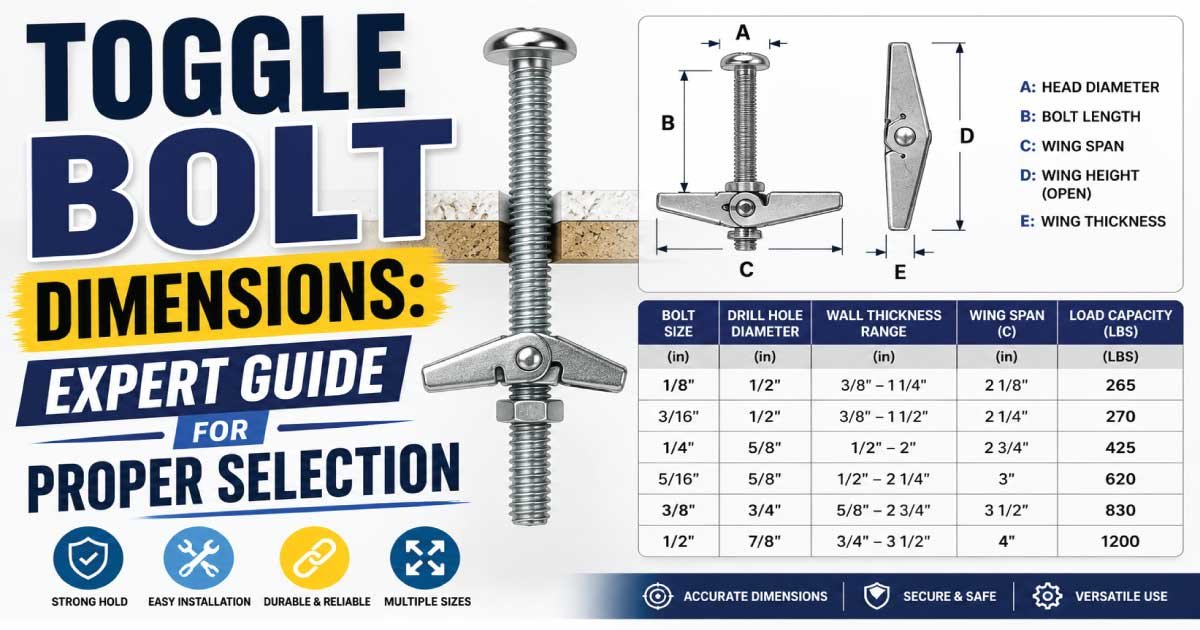
Toggle bolts are heavy-duty hollow wall anchors designed to securely fasten objects to drywall, plaster, hollow block, and other cavity walls.
Their spring-loaded wings expand behind the wall, distributing the load over a larger surface area for superior holding strength.
Choosing the correct toggle bolt size is essential for safely mounting shelves, cabinets, televisions, mirrors, and other heavy fixtures.
This guide explains standard toggle bolt sizes, dimensions, materials, weight capacities, and selection methods.
What Is a Toggle Bolt?
A toggle bolt is a mechanical fastener consisting of a machine screw and a pair of spring-loaded wings. After passing through a drilled hole, the wings automatically open behind the hollow wall, creating a strong anchor that resists pull-out and supports heavier loads than ordinary screws.
Key features include:
- Spring-loaded folding wings
- High holding strength
- Suitable for hollow walls
- Reusable machine screw
- Easy installation
- Available in multiple lengths and diameters
Why Toggle Bolt Size Matters
Selecting the proper toggle bolt size ensures the mounted object remains secure without damaging the wall. An undersized anchor may fail under load, while an oversized one requires unnecessarily large holes and may weaken the mounting surface.
Benefits of correct sizing include:
- Improved holding strength
- Better load distribution
- Reduced wall damage
- Increased safety
- Reliable installation
- Longer service life
Toggle Bolt Size Chart
The following table lists the most common toggle bolt sizes used for residential and commercial installations.
| Bolt Diameter | Wing Size | Common Bolt Lengths | Typical Applications |
|---|---|---|---|
| 1/8″ | Small | 2″–3″ | Picture frames |
| 3/16″ | Medium | 2″–4″ | Curtain rods |
| 1/4″ | Medium | 2-1/2″–5″ | Shelves |
| 5/16″ | Large | 3″–6″ | Wall cabinets |
| 3/8″ | Extra Large | 3″–6″ | TV mounts |
| 1/2″ | Heavy Duty | 4″–8″ | Commercial fixtures |
Approximate Toggle Bolt Weight Capacity Chart
Actual holding capacity depends on wall condition, drywall thickness, and installation quality. The values below are general guidelines.
| Bolt Size | Drywall (1/2″) | Drywall (5/8″) |
|---|---|---|
| 1/8″ | Up to 30 lbs | Up to 35 lbs |
| 3/16″ | Up to 50 lbs | Up to 60 lbs |
| 1/4″ | Up to 70 lbs | Up to 80 lbs |
| 5/16″ | Up to 90 lbs | Up to 100 lbs |
| 3/8″ | Up to 100 lbs | Up to 120 lbs |
| 1/2″ | Up to 120 lbs | Up to 150 lbs |
Parts of a Toggle Bolt
Understanding the components of a toggle bolt helps ensure proper installation and reliable performance in hollow-wall applications.
1. Machine Screw
The machine screw passes through the mounted object and threads into the toggle wings. It is available in various diameters and lengths to accommodate different wall thicknesses and fixture sizes.
2. Spring Wings
The spring-loaded wings fold together during insertion through the drilled hole and automatically expand once inside the wall cavity. They distribute the load over a larger area, significantly increasing holding strength.
3. Wing Hinge
The hinge connects the two wings and allows them to fold and expand smoothly. A durable hinge ensures reliable operation during installation and helps maintain proper alignment behind the wall surface.
Common Toggle Bolt Materials
Material selection affects strength, corrosion resistance, and long-term durability. Choosing the correct material depends on the installation environment and expected load.
1. Zinc-Plated Steel
Zinc-plated steel toggle bolts are the most commonly used option for indoor applications. The zinc coating provides moderate corrosion resistance while maintaining excellent strength and affordability.
Advantages include:
- Cost-effective
- Good strength
- Rust-resistant coating
- Widely available
2. Stainless Steel
Stainless steel toggle bolts provide excellent corrosion resistance and are ideal for humid environments, bathrooms, kitchens, marine applications, and outdoor installations where moisture exposure is common.
Benefits include:
- Superior corrosion resistance
- Long service life
- High strength
- Low maintenance
3. Carbon Steel
Carbon steel toggle bolts offer excellent mechanical strength and are commonly used in heavy-duty indoor installations. Protective coatings are usually applied to reduce the risk of corrosion.
Common Types of Toggle Bolts
Several types of hollow-wall anchors are available, each designed for specific installation requirements.
1. Standard Spring Toggle Bolt
The traditional spring toggle bolt uses folding metal wings that expand behind the wall after insertion. It remains one of the strongest and most reliable anchors for hollow-wall applications.
2. Strap Toggle Anchor
Strap toggle anchors use a plastic retaining strap with a steel channel that locks behind the wall. They offer easier installation and often provide greater holding strength than traditional spring toggles.
3. Snap Toggle Anchor
Snap toggle anchors feature a heavy-duty steel channel secured with plastic straps that snap off after installation. These anchors are widely used for mounting televisions, cabinets, grab bars, and other heavy fixtures.
Common Applications of Toggle Bolts
Toggle bolts are widely used when mounting objects to hollow walls where ordinary screws cannot provide sufficient holding strength. Their expanding wings create a secure anchor behind the wall surface.
Major applications include:
- Wall-mounted televisions
- Floating shelves
- Bathroom mirrors
- Curtain rods
- Kitchen cabinets
- Towel bars
- Coat hooks
- Light fixtures
- Office equipment
- Decorative wall panels
How to Choose the Correct Toggle Bolt Size
Selecting the correct toggle bolt size is essential for creating a secure and long-lasting installation. The anchor should match the weight of the mounted object, drywall thickness, mounting hole diameter, and screw length. Proper sizing minimizes the risk of pull-out and wall damage while ensuring reliable performance.
1. Determine the Weight of the Object
The first step is calculating the total weight of the item being mounted. Always choose a toggle bolt with a load capacity that exceeds the actual weight to provide an adequate safety margin and improve long-term reliability.
Examples include:
- Picture frames
- Mirrors
- Floating shelves
- Television brackets
- Wall cabinets
- Decorative panels
2. Measure the Wall Thickness
Wall thickness determines the minimum bolt length required for the spring wings to open completely behind the wall. Most residential drywall is either 1/2 inch or 5/8 inch thick, but plaster and other wall materials may require longer bolts.
Common wall materials include:
- 1/2″ drywall
- 5/8″ drywall
- Plaster walls
- Hollow concrete block
- Hollow brick
3. Choose the Correct Bolt Length
The bolt must be long enough to pass through the mounted object, the wall thickness, and still allow the toggle wings to expand fully behind the wall. Insufficient length prevents proper engagement and reduces holding strength.
Consider:
- Fixture thickness
- Wall thickness
- Washer thickness
- Wing clearance
4. Select the Proper Bolt Diameter
Larger bolt diameters generally provide greater holding strength but require larger installation holes. Choose a diameter that matches the required load while minimizing unnecessary wall damage.
Popular sizes include:
- 1/8″
- 3/16″
- 1/4″
- 5/16″
- 3/8″
- 1/2″
Recommended Drill Bit Size Chart
The drill hole must be large enough for the folded toggle wings to pass through the wall while maintaining adequate support around the anchor.
| Toggle Bolt Size | Recommended Drill Bit |
|---|---|
| 1/8″ | 3/8″ |
| 3/16″ | 1/2″ |
| 1/4″ | 5/8″ |
| 5/16″ | 7/8″ |
| 3/8″ | 7/8″ |
| 1/2″ | 1-1/4″ |
Toggle Bolt Weight Capacity Comparison
Actual load capacity depends on wall material, installation quality, and load direction. The following table provides a general comparison.
| Bolt Size | Light Fixtures | Shelves | Heavy Equipment |
|---|---|---|---|
| 1/8″ | Excellent | Limited | Not Recommended |
| 3/16″ | Excellent | Good | Limited |
| 1/4″ | Excellent | Very Good | Good |
| 5/16″ | Excellent | Excellent | Very Good |
| 3/8″ | Excellent | Excellent | Excellent |
| 1/2″ | Excellent | Excellent | Heavy Duty |
🔧 Read Detailed Size Guide 👉 Heavy Hex Nut Guide: Definition, Dimensions, Sizes, Materials
Advantages of Toggle Bolts
Toggle bolts are among the strongest fasteners for hollow-wall installations because they distribute the load across a large area behind the wall. Their design provides excellent pull-out resistance and dependable long-term support.
Advantages include:
- High holding strength
- Excellent load distribution
- Reliable pull-out resistance
- Suitable for hollow walls
- Easy installation
- Available in many sizes
- Durable steel construction
- Cost-effective solution
Limitations of Toggle Bolts
Although toggle bolts provide excellent strength, they are not suitable for every installation. Understanding their limitations helps ensure safe and effective use.
Common limitations include:
- Require larger drill holes
- Difficult to reuse after removal
- Wings cannot be retrieved from inside the wall
- Limited adjustment after installation
- Not suitable for solid concrete without appropriate anchors
How to Install a Toggle Bolt
Proper installation is essential for achieving the maximum holding capacity of a toggle bolt. Follow the manufacturer’s instructions and use the correct drill bit size for the selected anchor.
Basic Installation Steps
- Mark the mounting location.
- Drill the recommended hole size.
- Thread the bolt through the fixture.
- Attach the toggle wings.
- Fold the wings together.
- Insert the assembly into the wall.
- Tighten the bolt until secure.
- Do not overtighten.
Maintenance Tips for Toggle Bolt Installations
Although toggle bolts require very little maintenance, periodic inspections help ensure the mounted fixture remains secure, especially in high-use environments.
Maintenance recommendations:
- Check bolt tightness regularly.
- Inspect mounted fixtures.
- Replace damaged anchors.
- Watch for drywall cracks.
- Avoid overloading.
- Tighten loose hardware promptly.
Common Installation Mistakes
Incorrect installation can reduce the anchor’s holding strength and increase the risk of fixture failure. Careful preparation and proper sizing help prevent these issues.
Avoid these mistakes:
- Using the wrong drill bit size
- Selecting an undersized anchor
- Choosing a bolt that is too short
- Over-tightening the screw
- Exceeding the weight rating
- Installing into damaged drywall
- Misaligning the mounting hole
- Ignoring manufacturer recommendations
🔧 Read Detailed Size Guide 👉 Lock Nut Guide: Types, Uses, Benefits & How to Install
Toggle Bolt vs Molly Bolt
Both toggle bolts and molly bolts are designed for hollow-wall installations, but they differ in design and load capacity.
| Feature | Toggle Bolt | Molly Bolt |
|---|---|---|
| Holding Strength | Very High | High |
| Installation | Moderate | Easy |
| Best for Heavy Loads | Yes | Moderate |
| Drill Hole Size | Larger | Smaller |
| Reusable Screw | Yes | Limited |
| Common Applications | TVs, cabinets, shelves | Pictures, mirrors, light fixtures |
Industries That Use Toggle Bolts
Toggle bolts are widely used in residential, commercial, and institutional buildings where secure fastening to hollow walls is required.
Major applications include:
- Residential construction
- Commercial offices
- Hospitals
- Schools
- Hotels
- Retail stores
- Warehouses
- Interior renovation projects
- Electrical installations
- HVAC mounting systems
Closing Thoughts about Toggle bolts Size
Toggle bolts are one of the most reliable fastening solutions for hollow-wall installations, offering exceptional holding strength and dependable support for heavy fixtures.
By selecting the correct bolt size, length, diameter, and drill bit, you can achieve a secure installation while minimizing wall damage.
Whether mounting shelves, televisions, cabinets, mirrors, or commercial equipment, properly installed toggle bolts provide long-lasting performance, improved safety, and excellent load-bearing capability.
🔧 Read Detailed Size Guide 👉 Hex Nut Sizes, Dimensions, Grades & How to Measure
FAQs:
What is a toggle bolt used for?
Toggle bolts are designed to securely mount heavy objects to hollow walls, including drywall, plaster, and hollow concrete block. They are commonly used for installing shelves, televisions, mirrors, cabinets, curtain rods, lighting fixtures, and other wall-mounted items that require a strong and reliable anchor for safe support.
How much weight can a toggle bolt hold?
The weight capacity of a toggle bolt depends on its size, wall material, drywall thickness, and installation quality. Smaller toggle bolts may support about 30 pounds, while larger heavy-duty versions can hold 100 to 150 pounds or more when installed correctly under suitable conditions.
Can toggle bolts be reused?
The machine screw of a toggle bolt can often be reused if it remains in good condition. However, the spring-loaded wings usually fall behind the wall once removed, making them difficult to recover. In most cases, new toggle wings are required for proper and secure reinstallation.
What drill bit size should I use for a toggle bolt?
Always use the drill bit size recommended by the toggle bolt manufacturer or listed in the corresponding size chart. The hole should be large enough for the folded wings to pass through easily while remaining small enough to ensure a secure, stable, and reliable installation.
Are toggle bolts stronger than plastic wall anchors?
Yes, toggle bolts generally provide much greater holding strength than plastic wall anchors. Their spring-loaded wings expand behind the wall, distributing the load over a larger surface area. This design makes them ideal for supporting heavier fixtures and applications that require maximum stability and reliable long-term performance.

Engineer Hassan is a Mechanical Engineer with 16+ years of hands-on experience in mechanical hardware, fasteners, and workshop tools. He focuses on size selection, thread identification, and measurement, helping users choose the correct components with accuracy and safety.