
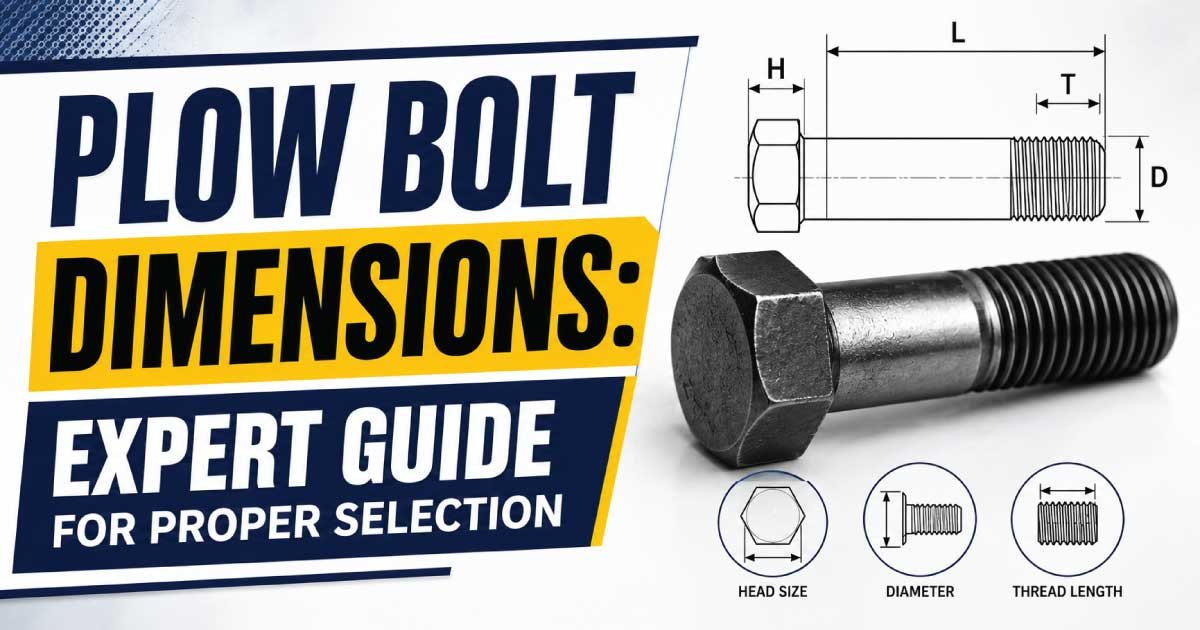
Plow bolts are heavy-duty fasteners specifically designed for securing cutting edges, blades, moldboards, and wear parts on construction, mining, agricultural, and earthmoving equipment.
Their countersunk flat head sits flush with the surface, preventing damage during operation and ensuring smooth material movement.
Selecting the correct plow bolt size improves equipment durability, reduces maintenance, and enhances safety. This guide explains standard plow bolt sizes, dimensions, grades, materials, and applications.
What Is a Plow Bolt?
A plow bolt is a specialized bolt featuring a flat countersunk head with a square neck beneath the head. The square neck locks into the mounting hole, preventing the bolt from turning while the nut is tightened. This design creates a smooth surface that minimizes wear and protects equipment operating in abrasive environments.
Key features include:
- Flat countersunk head
- Square neck for anti-rotation
- High-strength construction
- Available in metric and imperial sizes
- Designed for heavy-duty equipment
- Excellent wear resistance
Why Plow Bolt Size Matters
Using the correct plow bolt size ensures proper clamping force, secure attachment, and maximum service life. An undersized bolt may loosen or fail under heavy loads, while an oversized bolt may not fit the mounting holes correctly.
Benefits of proper sizing include:
- Secure equipment assembly
- Improved wear resistance
- Reduced maintenance
- Better load distribution
- Increased operational safety
- Longer component life
Plow Bolt Size Chart (Imperial Sizes)
The following table shows the most commonly used SAE plow bolt sizes for heavy equipment.
| Bolt Diameter | Thread Size | Common Length Range | Typical Applications |
|---|---|---|---|
| 3/8″ | 16 UNC | 1″–3″ | Light-duty equipment |
| 1/2″ | 13 UNC | 1″–4″ | Snow plows |
| 5/8″ | 11 UNC | 1-1/2″–5″ | Loader buckets |
| 3/4″ | 10 UNC | 2″–6″ | Bulldozers |
| 7/8″ | 9 UNC | 2″–6″ | Graders |
| 1″ | 8 UNC | 2″–8″ | Excavators |
| 1-1/8″ | 7 UNC | 3″–8″ | Mining equipment |
| 1-1/4″ | 7 UNC | 3″–10″ | Heavy earthmoving |
| 1-1/2″ | 6 UNC | 4″–12″ | Large construction machinery |
Metric Plow Bolt Size Chart
Metric plow bolts are commonly used on European, Asian, and international heavy equipment.
| Bolt Size | Thread Pitch | Common Length Range | Typical Applications |
|---|---|---|---|
| M10 | 1.5 mm | 25–80 mm | Small machinery |
| M12 | 1.75 mm | 30–100 mm | Agricultural equipment |
| M16 | 2.0 mm | 40–120 mm | Loader buckets |
| M20 | 2.5 mm | 50–150 mm | Excavators |
| M24 | 3.0 mm | 60–180 mm | Bulldozers |
| M30 | 3.5 mm | 80–220 mm | Mining machinery |
| M36 | 4.0 mm | 100–250 mm | Heavy industrial equipment |
Main Parts of a Plow Bolt
Understanding the different parts of a plow bolt helps ensure proper installation and compatibility with equipment.
1. Flat Countersunk Head
The flat countersunk head sits flush with the working surface after installation. This prevents the bolt head from protruding, reducing wear and allowing blades or cutting edges to move smoothly through soil, gravel, snow, or other materials without obstruction.
2. Square Neck
Located directly beneath the head, the square neck fits into a matching square hole. It prevents the bolt from rotating while the nut is tightened, making installation easier and ensuring a secure connection under heavy vibration and impact loads.
3. Threaded Shank
The threaded shank extends through the mounted components and engages with the nut. Thread length varies depending on bolt size and application, providing sufficient grip for heavy-duty equipment while maintaining proper clamping force.
Common Plow Bolt Grades
Plow bolts are manufactured in different strength grades depending on the intended application. Higher grades provide greater tensile strength and improved resistance to impact, vibration, and wear.
Grade 5 Plow Bolts
Grade 5 plow bolts are medium-strength fasteners commonly used on agricultural equipment, trailers, and light construction machinery. They provide reliable performance in moderate-duty applications while offering a cost-effective fastening solution.
Advantages include:
- Good tensile strength
- Affordable
- Easy availability
- Suitable for medium-duty equipment
Grade 8 Plow Bolts
Grade 8 plow bolts are manufactured from heat-treated alloy steel and provide significantly higher strength than Grade 5 bolts. They are commonly used on bulldozers, graders, excavators, mining equipment, and other heavy-duty machinery exposed to severe operating conditions.
Benefits include:
- High tensile strength
- Excellent wear resistance
- Greater load capacity
- Long service life
Common Plow Bolt Materials
Material selection depends on operating conditions, corrosion exposure, and mechanical loading. Choosing the correct material improves durability and reduces replacement frequency.
1. Carbon Steel
Carbon steel is the most commonly used material for plow bolts due to its strength, affordability, and excellent performance in construction and agricultural applications. Heat treatment further improves hardness and wear resistance.
2. Alloy Steel
Alloy steel plow bolts are designed for demanding environments requiring superior strength and toughness. They perform exceptionally well in mining, quarrying, and heavy earthmoving operations where high impact loads are common.
3. Stainless Steel
Stainless steel plow bolts provide excellent corrosion resistance and are suitable for marine, chemical, and highly corrosive environments. Although less common than alloy steel, they are preferred where rust prevention is critical.
Common Applications of Plow Bolts
Plow bolts are used wherever a flush fastening surface is required to reduce wear and improve equipment performance. Their specialized design makes them indispensable in heavy industries.
Major applications include:
- Bulldozer cutting edges
- Snow plows
- Motor graders
- Loader buckets
- Excavator buckets
- Mining equipment
- Agricultural machinery
- Road construction equipment
- Scrapers
- Earthmoving machinery
How to Choose the Correct Plow Bolt Size
Selecting the correct plow bolt size is essential for maintaining secure connections, reducing wear, and ensuring the safe operation of heavy equipment. The bolt must match the mounting hole, material thickness, load requirements, and equipment manufacturer’s specifications to provide maximum holding strength and long service life.
1. Measure the Bolt Diameter
The bolt diameter should match the diameter of the mounting hole. Using the correct diameter ensures proper fitment, prevents movement during operation, and distributes loads evenly across the connected components.
Check the following:
- Bolt diameter
- Mounting hole size
- Head diameter
- Square neck dimensions
- Manufacturer specifications
2. Select the Correct Bolt Length
Bolt length should be sufficient to pass through all connected materials while allowing enough threads for the nut to engage securely. Excessively long bolts may interfere with moving parts, while short bolts reduce holding strength.
Consider:
- Material thickness
- Washer thickness
- Nut height
- Required thread engagement
3. Choose the Appropriate Grade
Different applications require different bolt strength grades. Heavy-duty machinery exposed to impact, vibration, and high loads should use higher-grade plow bolts for maximum reliability and safety.
Common grades include:
- Grade 5
- Grade 8
- Class 8.8
- Class 10.9
- Class 12.9
4. Consider the Operating Environment
Environmental conditions influence material selection and protective coatings. Equipment operating in wet, muddy, snowy, or corrosive environments benefits from corrosion-resistant finishes that extend bolt life.
Typical environments include:
- Construction sites
- Mining operations
- Agriculture
- Snow removal
- Marine environments
- Chemical plants
Plow Bolt Thread Size Chart
The following chart lists common thread specifications used for SAE plow bolts.
| Bolt Diameter | UNC Thread | Threads Per Inch (TPI) |
|---|---|---|
| 3/8″ | UNC | 16 |
| 1/2″ | UNC | 13 |
| 5/8″ | UNC | 11 |
| 3/4″ | UNC | 10 |
| 7/8″ | UNC | 9 |
| 1″ | UNC | 8 |
| 1-1/8″ | UNC | 7 |
| 1-1/4″ | UNC | 7 |
| 1-1/2″ | UNC | 6 |
Recommended Tightening Torque Guide
Proper tightening torque helps maintain the required clamping force while preventing bolt failure or thread damage. Always follow the equipment manufacturer’s torque specifications whenever available.
| Bolt Size | Grade 5 (Approx.) | Grade 8 (Approx.) |
|---|---|---|
| 3/8″ | 31 ft-lb | 44 ft-lb |
| 1/2″ | 75 ft-lb | 110 ft-lb |
| 5/8″ | 150 ft-lb | 215 ft-lb |
| 3/4″ | 265 ft-lb | 380 ft-lb |
| 7/8″ | 430 ft-lb | 600 ft-lb |
| 1″ | 640 ft-lb | 900 ft-lb |
Plow Bolt Material Comparison
Selecting the proper material improves durability and reduces maintenance costs. Each material offers different levels of strength and corrosion resistance.
| Material | Strength | Corrosion Resistance | Typical Applications |
|---|---|---|---|
| Carbon Steel | High | Moderate | Construction equipment |
| Alloy Steel | Very High | Moderate | Mining machinery |
| Stainless Steel | High | Excellent | Marine and chemical industries |
🔧 Read Detailed Size Guide 👉 Nylon Insert Lock Nut: Sizes, Dimensions & Uses Explained
Advantages of Plow Bolts
Plow bolts are specifically engineered for demanding applications where a flush fastening surface is required. Their unique design improves equipment performance and reduces wear during continuous operation.
Advantages include:
- Flush countersunk head
- High load capacity
- Excellent vibration resistance
- Secure square neck design
- Long service life
- Available in multiple grades
- Easy replacement
- Reliable performance in harsh environments
Limitations of Plow Bolts
Although plow bolts are highly effective for heavy-duty equipment, they are designed for specialized applications and may not be suitable for every fastening requirement.
Common limitations include:
- Require matching countersunk holes
- More expensive than standard bolts
- Limited use in general construction
- Proper torque is essential
- Specialized replacement parts may be required
How to Install a Plow Bolt
Correct installation ensures maximum clamping force and minimizes the risk of bolt loosening during operation. Always inspect both the bolt and mounting hole before installation.
Basic Installation Steps
- Clean the mounting hole.
- Insert the plow bolt into the countersunk hole.
- Ensure the square neck seats properly.
- Install the washer and nut.
- Tighten the nut evenly.
- Apply the recommended torque.
- Recheck torque after initial equipment use.
Maintenance Tips for Plow Bolts
Routine inspection helps prevent unexpected equipment failures and extends the service life of plow bolts operating under severe conditions.
Maintenance recommendations:
- Inspect bolts regularly.
- Check for loose nuts.
- Replace worn or damaged bolts.
- Remove rust and debris.
- Verify tightening torque.
- Inspect cutting edges for wear.
- Replace missing hardware immediately.
Common Installation Mistakes
Improper installation can reduce bolt performance and lead to premature failure. Following best practices improves safety and minimizes maintenance costs.
Avoid these mistakes:
- Using the wrong bolt size
- Selecting the incorrect grade
- Over-tightening the nut
- Under-tightening the connection
- Reusing damaged bolts
- Ignoring corrosion
- Installing in worn mounting holes
- Skipping torque checks
🔧 Read Detailed Size Guide 👉 Jam Nut Sizes: How to Pick for Secure Fastening
Plow Bolt vs Carriage Bolt
Although both bolts have a square neck beneath the head, they are designed for different applications.
| Feature | Plow Bolt | Carriage Bolt |
|---|---|---|
| Head Style | Flat countersunk | Rounded dome |
| Surface Finish | Flush | Raised |
| Square Neck | Yes | Yes |
| Heavy Equipment Use | Excellent | Limited |
| Wear Resistance | High | Moderate |
| Primary Applications | Cutting edges and blades | Wood and general construction |
What You Should Remember
Plow bolts are specialized heavy-duty fasteners designed to withstand the demanding conditions of construction, mining, agriculture, and earthmoving equipment.
Selecting the correct size, grade, material, and thread specification ensures secure fastening, improved wear resistance, and extended equipment life.
By following proper installation practices and routine maintenance, plow bolts deliver dependable performance, reduce downtime, and help maintain the efficiency and safety of critical machinery.
🔧 Read Detailed Size Guide 👉 Wing Nut Dimensions and Practical Uses Guide
FAQs:
What is a plow bolt used for?
Plow bolts are used to secure cutting edges, grader blades, bucket edges, moldboards, and wear plates on heavy construction, mining, agricultural, and snow removal equipment. Their countersunk head creates a smooth, flush surface that reduces wear, prevents material buildup, and improves the durability of high-abrasion equipment components.
What grades are plow bolts available in?
Plow bolts are commonly manufactured in Grade 5, Grade 8, and metric property classes 8.8, 10.9, and 12.9. Higher-grade bolts provide greater tensile strength, improved durability, and better resistance to heavy loads, making them ideal for demanding industrial, mining, and construction equipment applications.
Why do plow bolts have a square neck?
The square neck fits into a matching square hole beneath the countersunk head, preventing the bolt from turning while the nut is tightened. This anti-rotation feature allows quick installation with a single wrench, improves fastening security, and helps maintain a tight connection under heavy operating conditions and vibration.
Can I replace a plow bolt with a standard bolt?
No, standard bolts are not suitable replacements for plow bolts. They lack the countersunk head needed for a flush surface and the square neck that prevents rotation. Using a standard bolt can reduce fastening reliability, increase wear, and compromise the performance and safety of heavy equipment components.
How do I know which plow bolt size to use?
Choose a plow bolt by matching the mounting hole diameter, material thickness, thread specification, bolt length, and strength grade with the equipment manufacturer’s recommendations. Selecting the correct size ensures proper fit, adequate clamping force, reliable performance, and safe long-term operation in demanding working environments.

Engineer Hassan is a Mechanical Engineer with 16+ years of hands-on experience in mechanical hardware, fasteners, and workshop tools. He focuses on size selection, thread identification, and measurement, helping users choose the correct components with accuracy and safety.