
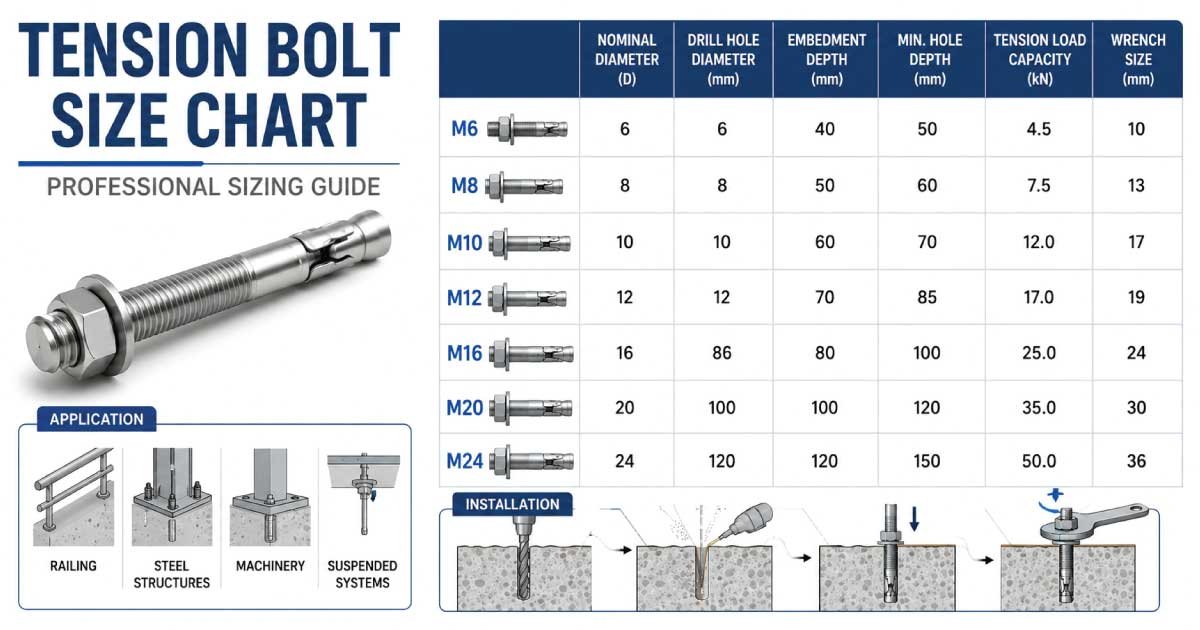
Selecting the correct tension bolt size is far more important than simply matching thread dimensions. In structural construction, heavy machinery, automotive assemblies, and industrial equipment, a properly sized tension bolt ensures reliable clamping force, minimizes joint movement, and prevents costly failures.
Choosing the wrong diameter, length, or strength grade can lead to loose connections, fatigue cracks, or even complete structural failure.
This comprehensive guide explains how to understand a tension bolt size chart, measure bolts correctly, compare common standards, and select the right bolt for different applications.
Whether you are a mechanic, maintenance technician, engineer, contractor, or purchasing professional, this guide provides practical information that helps you make informed decisions instead of relying on guesswork.
Why Tension Bolt Size Matters
A tension bolt is designed to hold two or more components together by stretching slightly during tightening. This elastic stretching creates preload, which keeps the joint securely clamped even when exposed to vibration, changing loads, or thermal expansion. The bolt size directly influences the amount of preload that can be safely achieved.
Using an undersized bolt may result in insufficient clamping force, allowing joint movement and premature loosening. An oversized bolt may increase costs, require larger holes, and create installation challenges without providing meaningful performance improvements. Engineers therefore select bolt sizes based on calculated loads, safety factors, material strength, and environmental conditions.
Proper sizing also improves:
- Joint reliability
- Equipment lifespan
- Vibration resistance
- Maintenance intervals
- Worker safety
- Structural integrity
Professionals rarely select a bolt based only on thread diameter. Instead, they consider tensile strength, grip length, proof load, material grade, and the type of joint being assembled.
Quick Tension Bolt Size Chart
The following chart provides commonly used metric tension bolt sizes. Actual dimensions and capacities may vary slightly depending on ISO, DIN, or manufacturer specifications, but this serves as a reliable reference for most engineering applications.
| Bolt Size | Thread Pitch (mm) | Hole Diameter (mm) | Typical Tensile Area (mm²) | Common Applications |
|---|---|---|---|---|
| M6 | 1.0 | 6.6 | 20.1 | Light machinery |
| M8 | 1.25 | 9.0 | 36.6 | Equipment covers |
| M10 | 1.5 | 11.0 | 58.0 | Machine frames |
| M12 | 1.75 | 13.5 | 84.3 | Structural joints |
| M16 | 2.0 | 17.5 | 157 | Heavy machinery |
| M20 | 2.5 | 22.0 | 245 | Steel structures |
| M24 | 3.0 | 26.0 | 353 | Bridges and cranes |
| M30 | 3.5 | 33.0 | 561 | Industrial equipment |
| M36 | 4.0 | 39.0 | 817 | Heavy structural assemblies |
This chart offers a quick starting point when selecting bolt dimensions, but the final choice should always be verified against engineering calculations and applicable design standards.
How to Read Size Charts
A tension bolt size chart contains much more information than bolt diameter alone. Understanding each column allows users to choose bolts that match both mechanical requirements and installation conditions.
The first column identifies the nominal diameter, such as M12 or M20. The second lists thread pitch, indicating the distance between adjacent threads. The clearance hole diameter helps determine drilling requirements, while the tensile stress area estimates the effective cross-sectional area resisting tensile loads.
When reading any bolt chart, pay attention to:
- Nominal diameter
- Thread pitch
- Tensile stress area
- Clearance hole size
- Strength grade
- Recommended tightening torque
- Material specification
Ignoring any one of these values can result in improper preload or unsafe joint performance.
Important Bolt Dimensions
Understanding bolt dimensions is essential because every measurement contributes to overall joint performance. Selecting the correct diameter alone is not sufficient if the grip length, thread engagement, or head dimensions are incorrect.
The most important measurements include:
| Dimension | Description | Why It Matters |
|---|---|---|
| Diameter | Outside thread diameter | Determines load capacity |
| Length | Under-head to end | Ensures full engagement |
| Thread Pitch | Distance between threads | Matches mating threads |
| Grip Length | Unthreaded portion | Supports clamping |
| Head Size | Across flats | Determines wrench size |
| Thread Length | Threaded section | Affects engagement depth |
Professional installers verify each dimension before assembly because replacing a wrongly sized bolt after installation can be expensive and time-consuming.
How to Measure a Tension Bolt
Correct measurement eliminates ordering mistakes and ensures compatibility with existing equipment. While measuring appears straightforward, overlooking one dimension can result in bolts that either bottom out or fail to develop sufficient preload.
Follow this process:
Measure Thread Diameter
Use a digital caliper to measure the outside diameter of the threads.
Common metric diameters include:
- M8
- M10
- M12
- M16
- M20
- M24
Always measure across the thread crests rather than between the valleys.
Measure Bolt Length
Hex-head bolts are measured from beneath the head to the tip. Countersunk bolts are measured from the top of the head because the head becomes part of the installed length.
Determine Thread Pitch
A thread pitch gauge provides the most accurate reading. If unavailable, measure the distance occupied by ten threads and divide by ten.
For example:
15 mm ÷ 10 threads = 1.5 mm pitch
Check Thread Engagement
Adequate engagement typically equals at least one bolt diameter in steel joints. Softer materials such as aluminum often require greater engagement to prevent thread stripping.
Metric and Imperial Comparison
Industrial facilities often use both metric and imperial fasteners. Selecting the wrong system is a common maintenance mistake because similar diameters can appear interchangeable while having incompatible thread forms.
| Metric Size | Approximate Imperial Equivalent |
|---|---|
| M6 | 1/4 inch |
| M8 | 5/16 inch |
| M10 | 3/8 inch |
| M12 | 1/2 inch |
| M16 | 5/8 inch |
| M20 | 3/4 inch |
| M24 | 1 inch |
Although these sizes appear similar, thread pitch differences prevent proper engagement. Never force metric bolts into imperial threads or vice versa, as this damages both the bolt and the mating component.
Choosing the Correct Size
Selecting the right tension bolt involves evaluating more than diameter alone. Engineers balance load requirements, material strength, environmental exposure, and installation conditions to achieve reliable long-term performance.
Several practical factors influence bolt selection.
Working Load
Estimate the maximum tensile load the joint will experience during normal operation. Include static loads, dynamic forces, vibration, shock loading, and any safety factors specified by applicable design codes.
Bolt Strength Grade
High-strength bolts can safely carry greater preload than standard carbon steel bolts. Common metric grades include:
| Grade | Typical Applications |
|---|---|
| 4.6 | Light-duty assemblies |
| 5.8 | General machinery |
| 8.8 | Industrial equipment |
| 10.9 | Heavy machinery |
| 12.9 | High-performance mechanical assemblies |
Higher grades improve tensile strength but may require stricter tightening procedures to prevent overloading.
Joint Material
The materials being clamped affect bolt selection significantly. Steel joints generally permit higher preload than aluminum or plastic components, which may deform under excessive tightening.
Environmental Conditions
Outdoor installations require corrosion-resistant materials. Marine environments often justify stainless steel or specially coated bolts, while high-temperature applications may require alloy steel specifically designed for elevated temperatures.
Bolt Material Comparison
The bolt material determines corrosion resistance, strength, durability, and service life. Selecting the wrong material often results in premature failures even when the bolt size is correct.
| Material | Advantages | Limitations | Typical Uses |
|---|---|---|---|
| Carbon Steel | Economical | Moderate corrosion resistance | General machinery |
| Alloy Steel | High strength | Requires protective coatings | Heavy equipment |
| Stainless Steel | Excellent corrosion resistance | Lower strength in some grades | Marine equipment |
| Zinc-Plated Steel | Affordable corrosion protection | Coating wears over time | Indoor applications |
| Hot-Dip Galvanized | Excellent outdoor durability | Larger thread tolerances | Structural steel |
Professionals generally select material first based on environmental exposure before finalizing bolt dimensions and strength grade.
👉 Need the right dimensions? Visit our detailed Thrust Bearing Size Chart to access an Detailed Guide and Professional Guide for accurate size selection.
Industry Standards
International standards ensure compatibility between bolts, nuts, tools, and engineering calculations. Purchasing standardized fasteners simplifies maintenance while reducing the risk of incompatible replacements.
Common standards include:
| Standard | Purpose |
|---|---|
| ISO 4014 | Hex head bolts |
| ISO 898-1 | Mechanical properties |
| DIN 931 | Partially threaded bolts |
| DIN 933 | Fully threaded bolts |
| ASTM A325 | Structural bolts |
| ASTM A490 | High-strength structural bolts |
| ASME B18.2 | Inch-series bolts |
| BS EN 14399 | High-strength preloaded bolts |
Always confirm which standard your equipment manufacturer specifies before ordering replacement bolts.
Common Sizing Problems
Incorrect bolt sizing is one of the leading causes of joint failures in industrial equipment. Even when installation torque is correct, an improperly selected bolt may not provide sufficient preload or fatigue resistance.
The table below highlights common issues encountered during maintenance and assembly.
| Problem | Likely Cause | Recommended Solution |
|---|---|---|
| Bolt loosens frequently | Diameter too small | Increase bolt size or preload |
| Threads strip | Insufficient engagement | Use longer bolt |
| Bolt breaks during tightening | Incorrect grade | Select appropriate strength class |
| Joint movement | Low clamping force | Increase preload after engineering review |
| Bolt bends | Excessive shear loading | Redesign joint or use dowels |
Recognizing these symptoms early helps prevent more serious equipment damage and reduces unplanned downtime.
Maintenance and Inspection
Even a correctly selected tension bolt requires routine inspection to maintain safe and reliable performance. Over time, vibration, repeated loading, corrosion, temperature changes, and environmental contaminants can reduce bolt preload. Preventive maintenance helps identify these issues before they lead to joint failure, equipment damage, or safety hazards.
During routine inspections, maintenance personnel should examine both the bolt and the joint. A bolt that appears undamaged may still have lost preload due to settling, gasket compression, or repeated thermal cycling. Regular inspections significantly reduce unexpected downtime and improve equipment reliability.
Key inspection points include:
- Check for visible corrosion or rust.
- Inspect threads for wear or deformation.
- Verify bolt torque where recommended.
- Look for damaged washers or nuts.
- Examine the joint for movement or gaps.
- Replace bolts showing cracks or severe wear.
Inspection frequency depends on operating conditions. High-vibration equipment typically requires more frequent checks than static structural connections.
Recommended Inspection Schedule
A planned maintenance schedule ensures bolts remain secure throughout their service life. The following table provides general recommendations that can be adjusted according to manufacturer guidelines and operating conditions.
| Application | Inspection Interval | Recommended Action |
|---|---|---|
| General machinery | Every 6 months | Visual inspection and torque check |
| Heavy industrial equipment | Every 3 months | Torque verification and thread inspection |
| Structural steel | Annually | Complete bolt inspection |
| Marine equipment | Every 2–3 months | Inspect for corrosion and replace damaged hardware |
| High-vibration machinery | Monthly | Check preload and joint movement |
| Critical safety equipment | As specified by maintenance plan | Full inspection and documentation |
Following a consistent inspection schedule minimizes unexpected failures and extends the service life of both the bolts and the assembled components.
👉 Our comprehensive V-Belt Size Chart provides an Expert Guide and Professional Guide to help engineers, mechanics, and DIY users choose the correct size every time.
Proper Installation Practices
Correct installation is just as important as choosing the proper tension bolt size. Even a high-quality bolt can fail prematurely if installed with incorrect torque, poor alignment, or damaged threads. Professional installation practices help achieve the required preload while protecting the fastener and the joint.
Before installation, clean the threads thoroughly and remove dirt, rust, old thread-locking compounds, or metal chips. Damaged threads should never be forced together because they increase friction and produce inaccurate tightening torque.
Professional recommendations include:
- Use calibrated torque wrenches.
- Tighten bolts in the specified sequence.
- Lubricate threads when recommended.
- Replace damaged nuts and washers.
- Never reuse torque-to-yield bolts.
- Verify final torque after installation if required.
Proper installation significantly improves joint reliability and reduces maintenance costs.
Torque and Preload Relationship
A tension bolt performs correctly only when tightened to achieve the intended preload. Torque is simply the method used to stretch the bolt within its elastic range. Too little preload allows joint movement, while excessive preload may permanently deform or break the bolt.
The basic engineering relationship is commonly expressed as:
Torque = K × F × D
Where:
- K = Nut factor (depends on lubrication)
- F = Desired preload
- D = Bolt diameter
For example:
An M16 bolt requiring 80,000 N preload with a nut factor of 0.20:
Torque = 0.20 × 80,000 × 0.016
Torque ≈ 256 N·m
This simplified calculation provides an estimate. Actual tightening values should always follow the equipment manufacturer’s specifications or applicable engineering standards.
Common Installation Mistakes
Many tension bolt failures result from installation errors rather than manufacturing defects. Understanding these common mistakes helps prevent premature loosening, thread damage, and costly repairs.
| Mistake | Possible Result | Recommended Solution |
|---|---|---|
| Under-tightening | Loose joint | Apply specified torque |
| Over-tightening | Bolt yielding or fracture | Use calibrated torque wrench |
| Mixed bolt grades | Uneven load distribution | Use identical fasteners |
| Dirty threads | Incorrect preload | Clean before assembly |
| Reusing damaged bolts | Unexpected failure | Replace with new bolts |
| Incorrect washer selection | Joint embedding | Use proper hardened washers |
Even experienced technicians benefit from following standardized installation procedures instead of relying solely on experience.
👉 For precise measurements and industry-standard dimensions, read our updated U-Bolt Size Chart, featuring an Expert Guide and Professional Guide for reliable results.
Troubleshooting Common Problems
When a bolted joint begins to fail, identifying the root cause is more effective than simply replacing the bolt. Many recurring failures originate from improper sizing, installation errors, or unsuitable materials rather than the bolt itself.
The troubleshooting guide below helps identify common symptoms and practical solutions.
| Symptom | Likely Cause | Practical Solution |
|---|---|---|
| Bolt repeatedly loosens | Low preload or vibration | Increase preload or use locking hardware |
| Corrosion around threads | Incompatible material or environment | Upgrade to corrosion-resistant material |
| Broken bolt | Excessive tensile load | Increase bolt size or grade |
| Bent bolt | Shear loading | Redesign joint or add locating pins |
| Damaged threads | Cross-threading | Replace damaged components |
| Uneven clamping | Incorrect tightening sequence | Tighten in proper pattern |
Correcting the underlying problem prevents repeated maintenance and improves long-term reliability.
Selecting the Right Material
Material selection directly affects bolt strength, corrosion resistance, temperature performance, and maintenance requirements. Choosing the right material often has a greater impact on service life than increasing bolt diameter.
The following comparison summarizes the most common options.
| Material | Strength | Corrosion Resistance | Best Applications |
|---|---|---|---|
| Carbon Steel | Good | Moderate | Indoor machinery |
| Alloy Steel | Excellent | Moderate | Heavy equipment |
| Stainless Steel 304 | Moderate | Excellent | Food processing |
| Stainless Steel 316 | Moderate | Outstanding | Marine environments |
| Hot-Dip Galvanized Steel | Good | Excellent | Outdoor structures |
For highly corrosive environments, stainless steel or galvanized bolts generally provide longer service life than untreated carbon steel.
Choosing the Correct Strength Grade
Strength grade determines how much preload a tension bolt can safely withstand. Increasing the grade without considering the joint design is not always beneficial because stronger bolts may transfer higher stresses to surrounding components.
General recommendations include:
- Grade 4.6 – Light-duty equipment
- Grade 5.8 – General engineering
- Grade 8.8 – Most industrial machinery
- Grade 10.9 – Heavy mechanical equipment
- Grade 12.9 – High-strength precision assemblies
Whenever replacing bolts, match both the size and strength grade unless an engineering review specifies otherwise.
Tension Bolts Applications
Tension bolts are used in countless industries because they provide dependable clamping force under demanding operating conditions. Although the required size varies, the engineering principles remain consistent across different applications.
Common applications include:
- Structural steel construction
- Industrial machinery
- Wind turbine assemblies
- Pressure vessels
- Heavy mining equipment
- Automotive suspension systems
- Agricultural machinery
- Bridge construction
- Pipeline flanges
- Manufacturing equipment
Each application requires selecting the proper diameter, length, material, and strength grade based on expected operating loads and environmental conditions.
Professional Buying Tips
Purchasing the correct tension bolt involves more than matching thread size. Reliable suppliers provide complete technical information, quality certifications, and traceability that help ensure consistent performance.
Before purchasing, consider the following:
- Verify the required engineering standard.
- Confirm the strength grade.
- Check the material specification.
- Measure the required grip length.
- Purchase from reputable manufacturers.
- Inspect packaging for identification markings.
- Avoid mixing different bolt grades in the same joint.
Investing in quality fasteners often reduces long-term maintenance costs and improves equipment reliability.
Replacement Guidelines
A tension bolt should not be considered a permanent component. Like many engineered parts, it has a practical service life that depends on loading conditions, environmental exposure, and maintenance practices.
Replace a tension bolt if you observe:
- Cracked or stretched shank
- Severely corroded surfaces
- Rounded or damaged threads
- Permanent bending
- Excessive wear beneath the head
- Unknown strength grade
- Repeated loosening after correct installation
Critical structural or safety-related bolts should always be replaced according to the equipment manufacturer’s maintenance schedule, even if no visible damage is present.
Conclusion
Selecting the correct tension bolt size is essential for achieving safe, reliable, and long-lasting bolted joints. A properly sized bolt provides the required preload, resists vibration, and helps prevent loosening, fatigue, and structural failure.
Successful bolt selection involves evaluating diameter, length, thread pitch, strength grade, material, environmental conditions, and applicable standards rather than focusing on thread size alone. Routine inspection, correct installation, and timely replacement are equally important for maintaining joint integrity throughout the equipment’s service life.
By understanding how to read a tension bolt size chart, measure bolts accurately, troubleshoot common problems, and choose the right material and grade, engineers, technicians, mechanics, and maintenance professionals can improve safety, reduce downtime, and extend equipment life. Using these best practices ensures that every bolted connection performs as intended under real-world operating conditions.
FAQs:
How do I know which tension bolt size is correct?
Select the bolt based on the required tensile load, joint thickness, hole diameter, material strength, and applicable engineering standards. Matching the existing bolt is helpful, but engineering calculations or manufacturer recommendations should always be used for critical applications. Never choose a bolt solely because it fits the hole.
Can I replace a Grade 8.8 bolt with Grade 10.9?
Not always. Although Grade 10.9 provides higher tensile strength, it also transfers greater stresses to the joint. Components designed for Grade 8.8 bolts may not safely withstand the increased preload. Always verify the equipment manufacturer’s specifications before upgrading the strength grade.
How often should tension bolts be retightened?
Retightening depends on the application. High-vibration machinery may require regular torque verification, while properly installed structural bolts often require only periodic visual inspections. Follow the maintenance schedule recommended by the equipment manufacturer or relevant engineering standards rather than tightening bolts unnecessarily.
What causes tension bolts to loosen over time?
Common causes include vibration, insufficient preload, joint settling, thermal expansion, improper tightening, damaged threads, and worn locking devices. Identifying the root cause is essential because simply tightening the bolt again may not permanently solve the problem.
Which material is best for outdoor installations?
For outdoor applications, hot-dip galvanized steel provides excellent corrosion protection for structural projects, while stainless steel—especially Grade 316—is preferred in marine or highly corrosive environments. Material selection should also consider load requirements, maintenance expectations, and overall project cost.
Can I reuse a removed tension bolt?
Reuse depends on the bolt’s condition and application. Bolts showing corrosion, thread damage, stretching, or permanent deformation should always be replaced. Torque-to-yield bolts and many critical structural fasteners are generally designed for one-time use and should not be reused.

Engineer Hassan is a Mechanical Engineer with 16+ years of hands-on experience in mechanical hardware, fasteners, and workshop tools. He focuses on size selection, thread identification, and measurement, helping users choose the correct components with accuracy and safety.