
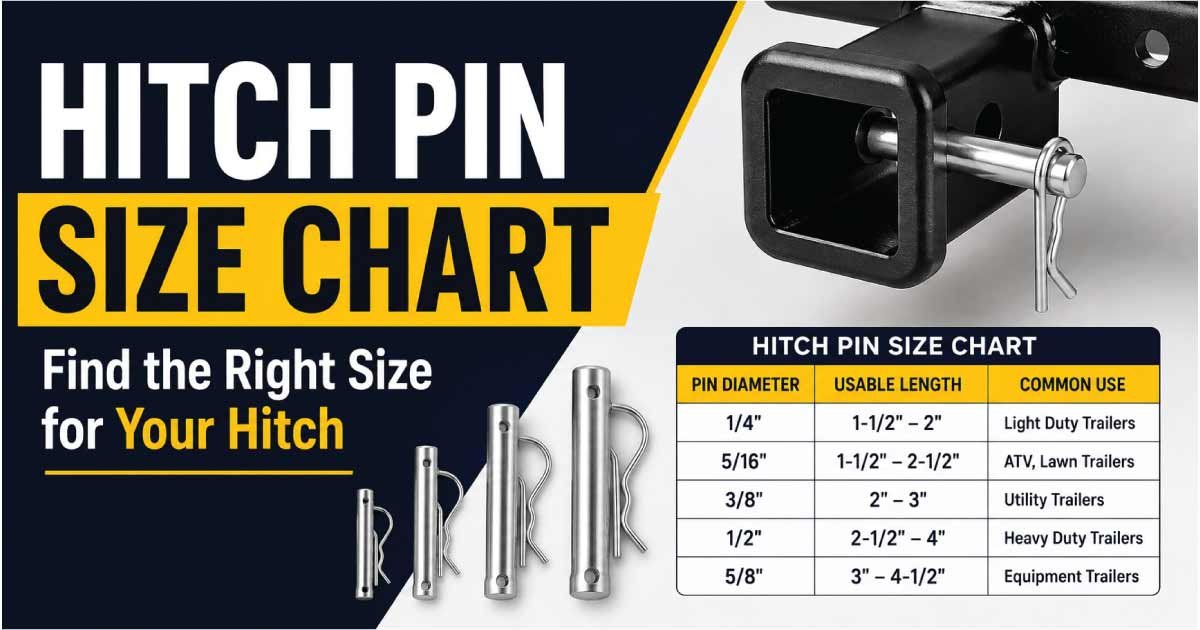
A hitch pin is a simple but important fastening component used to connect trailers, towing accessories, agricultural equipment, implements, and other machinery. It passes through aligned holes in a hitch receiver or coupling component and is secured with a clip, retaining pin, or locking mechanism.
Choosing the correct hitch pin size is essential for safe and reliable operation. The pin must have the correct diameter, usable length, head style, and retaining system for the hitch or equipment being used.
This hitch pin size chart explains common hitch pin diameters, lengths, receiver sizes, types, applications, measurement methods, and selection tips. Whether you need a pin for a trailer hitch, agricultural equipment, lawn tractor, or towing accessory, this guide will help you identify the right size.
What Is a Hitch Pin?
A hitch pin is a removable metal pin designed to secure two components that have aligned holes. In towing applications, it commonly connects an accessory or drawbar to a hitch receiver.
The pin passes through the receiver and the accessory, preventing the connected component from sliding out of position.
A typical hitch pin consists of:
- Pin shaft
- Head or shoulder
- Retaining clip
- Locking mechanism
- Handle or grip on some designs
Hitch pins are available in different diameters and lengths to match various hitch receiver sizes and applications.
They are used in:
- Trailer hitches
- Towing accessories
- Agricultural equipment
- Lawn and garden machinery
- Utility trailers
- Tractor implements
- Construction equipment
- Material-handling equipment
The correct pin must match the hitch or equipment specifications rather than being selected by appearance alone.
How Hitch Pin Sizes Are Measured
Hitch pin sizing is mainly determined by the diameter of the pin and the dimensions of the hitch or equipment holes.
Important measurements include:
- Pin diameter
- Usable shaft length
- Overall pin length
- Head diameter
- Hole diameter
- Receiver size
- Retaining-clip size
For towing applications, the pin diameter must match the receiver and accessory holes. A pin that is too small can create excessive movement, while a pin that is too large may not fit through the holes.
The usable length must also be sufficient to pass completely through the receiver and connected accessory while leaving room for the retaining mechanism.
Common Hitch Pin Size Chart
The following chart shows common hitch pin diameters and typical applications. Exact dimensions and load ratings vary by manufacturer and hitch design.
| Hitch Pin Diameter | Approx. Metric Diameter | Common Receiver/Application | Typical Use |
|---|---|---|---|
| 1/2 in | 12.7 mm | Small equipment | Light-duty towing |
| 5/8 in | 15.9 mm | 2 in receivers | General towing |
| 3/4 in | 19.1 mm | Heavy equipment | Heavy-duty applications |
| 7/8 in | 22.2 mm | Agricultural equipment | High-load equipment |
| 1 in | 25.4 mm | Large hitches | Heavy-duty towing |
| 1-1/8 in | 28.6 mm | Specialized equipment | Industrial applications |
| 1-1/4 in | 31.8 mm | Large agricultural equipment | Heavy machinery |
The table provides common reference sizes. The pin diameter, receiver hole, hitch class, and manufacturer’s rated capacity must all be compatible.
Hitch Pin Diameter Chart
Pin diameter is one of the most important dimensions because it determines whether the pin can physically pass through the aligned holes and contributes to its load-carrying capability.
| Pin Size | Diameter in mm | General Category |
|---|---|---|
| 1/2 inch | 12.7 mm | Small/light-duty |
| 5/8 inch | 15.9 mm | Standard/general-purpose |
| 3/4 inch | 19.1 mm | Heavy-duty |
| 7/8 inch | 22.2 mm | Heavy equipment |
| 1 inch | 25.4 mm | Large/heavy-duty |
| 1-1/8 inch | 28.6 mm | Specialized |
| 1-1/4 inch | 31.8 mm | Very heavy-duty |
A larger diameter does not automatically mean that a hitch assembly can tow a heavier load. The receiver, vehicle, accessory, pin material, hitch design, and rated capacity all need to be considered.
Common 1/2-Inch Hitch Pins
A 1/2-inch hitch pin has a nominal diameter of approximately 12.7 mm.
It is commonly used for smaller towing and equipment applications where the hitch system is designed around this diameter.
Typical uses include:
- Small utility equipment
- Lawn and garden equipment
- Compact towing accessories
- Light-duty agricultural implements
- Small trailer connections
Always verify that the hitch or implement specifically requires a 1/2-inch pin.
Common 5/8-Inch Hitch Pins
The 5/8-inch hitch pin has a diameter of approximately 15.9 mm and is one of the most common sizes in towing applications.
It is frequently associated with 2-inch hitch receivers, although the receiver size and pin diameter should always be confirmed from the manufacturer’s specifications.
Common applications include:
- Trailer ball mounts
- Bike racks
- Cargo carriers
- Tow accessories
- Utility trailers
- Hitch-mounted equipment
The pin must be long enough to pass through the receiver and accessory holes while allowing the retaining clip or locking mechanism to engage correctly.
3/4-Inch Hitch Pins
A 3/4-inch hitch pin measures approximately 19.1 mm in diameter.
It is commonly used for heavier equipment and agricultural or industrial applications where a larger pin is specified.
Applications may include:
- Agricultural implements
- Heavy equipment
- Large drawbars
- Machinery attachments
- Heavy-duty towing systems
A 3/4-inch pin should only be used when the connected equipment is designed for that size.
7/8-Inch and 1-Inch Hitch Pins
Larger hitch pins such as 7/8-inch and 1-inch sizes are used in heavy equipment and agricultural applications.
These pins provide a larger cross-sectional diameter and are commonly found in equipment designed for higher loads.
Potential applications include:
- Tractor implements
- Heavy agricultural equipment
- Large machinery
- Industrial towing systems
- Specialized drawbar connections
For high-load applications, do not select a pin solely because it is larger. The entire hitch system must be rated for the intended load.
Hitch Pin Length
Pin length is another important measurement.
A hitch pin must be long enough to pass through:
- The receiver wall
- The accessory or drawbar
- The opposite receiver wall
- The retaining mechanism
Common hitch pin lengths vary significantly depending on receiver design and application.
| Application | Typical Pin Size Range | Length Consideration |
|---|---|---|
| Small equipment | 1/2 in | Short to medium |
| Standard towing | 5/8 in | Medium |
| Heavy towing | 3/4 in | Medium to long |
| Agricultural equipment | 7/8–1 in | Long |
| Large machinery | 1–1-1/4 in | Long/specialized |
There is no single universal hitch pin length for each diameter. Receiver wall thickness, accessory thickness, and retaining design can all affect the required length.
How to Measure a Hitch Pin
If you need to replace an existing hitch pin, measuring the old pin can help identify the correct replacement.
Measure the Pin Diameter
Use a caliper to measure the diameter of the shaft.
Common measurements include approximately:
- 12.7 mm for 1/2 inch
- 15.9 mm for 5/8 inch
- 19.1 mm for 3/4 inch
- 22.2 mm for 7/8 inch
- 25.4 mm for 1 inch
Measure the Usable Length
Measure the section of the pin that passes through the hitch holes.
The usable length is more important than overall length when determining whether the pin will fit.
Measure the Hole Diameter
If the original pin is unavailable, measure the diameter of the receiver and accessory holes.
The replacement pin should match the specified hole size.
Check the Head and Retainer
Also inspect the pin head, retaining clip, or locking mechanism to make sure the replacement is compatible.
How to Choose the Correct Hitch Pin
Selecting the correct hitch pin requires checking the complete hitch assembly.
Match the Pin Diameter
The diameter should match the hitch receiver or equipment specification.
Do not force an oversized pin into a smaller hole.
Check the Pin Length
The pin must extend completely through the aligned holes and provide enough exposed area for the retaining mechanism.
Check the Hitch Receiver Size
Common receiver openings include sizes such as:
- 1-1/4 inch
- 2 inch
- 2-1/2 inch
- 3 inch
- 3-1/2 inch
Receiver size refers to the receiver tube dimensions and does not necessarily equal the hitch pin diameter.
Consider the Load Rating
Check the hitch, accessory, and pin specifications together.
The allowable towing capacity is limited by the weakest applicable component and the manufacturer’s ratings.
Choose the Correct Retaining System
The pin may use:
- Hairpin clip
- R-clip
- Locking clip
- Cotter-style retainer
- Keyed locking mechanism
Make sure the retainer is properly secured before using the equipment.
Discover More:
Hitch Pin Types
Different hitch pin designs are available for different applications.
Standard Hitch Pin
A standard hitch pin is a straight pin with a head and removable retaining clip.
It is simple, economical, and widely used.
Locking Hitch Pin
A locking hitch pin incorporates a keyed or integrated locking mechanism.
It can help prevent unauthorized removal of hitch-mounted accessories.
Common applications include:
- Bike racks
- Cargo carriers
- Ball mounts
- Towing accessories
Bent Hitch Pin
Some pins have a bent or offset design that makes them easier to handle or positions the retaining mechanism away from the receiver.
Heavy-Duty Hitch Pin
Heavy-duty hitch pins are designed for larger equipment and are manufactured to meet the requirements of the applicable hitch system.
They may use larger diameters, stronger materials, and specialized retaining systems.
Hitch Pin Materials
Hitch pins are commonly manufactured from strong steel materials because they are exposed to substantial loads and repeated use.
Common finishes and materials include:
- Carbon steel
- Zinc-plated steel
- Stainless steel
- Hardened steel
- Corrosion-resistant coatings
Zinc-Plated Steel
Zinc plating provides corrosion protection for general outdoor applications.
Stainless Steel
Stainless steel offers improved corrosion resistance, although the specific grade and mechanical properties should be considered before selecting it for a high-load application.
Hardened Steel
Some heavy-duty pins use specially treated steel to provide suitable strength and wear resistance.
The material should always be selected according to the manufacturer’s specifications and intended application.
Discover More:
Hitch Pin vs. Cotter Pin
A hitch pin and cotter pin serve different purposes.
A hitch pin is a primary fastening component designed to carry the load between two connected components.
A cotter pin or hairpin clip is commonly used as a retaining device to prevent a hitch pin from sliding out.
| Feature | Hitch Pin | Cotter/Retaining Pin |
|---|---|---|
| Primary purpose | Connects equipment | Retains another pin |
| Load function | Carries connection load | Usually prevents movement |
| Size | Larger | Usually smaller |
| Typical location | Hitch or drawbar | Pin retaining hole |
| Removal | Usually removable | Easily removable |
A retaining clip should not be substituted for the primary hitch pin.
Hitch Pin vs. Clevis Pin
Hitch pins and clevis pins are similar because both can pass through aligned holes, but they are not necessarily interchangeable.
A clevis pin is commonly used in machinery, linkages, and agricultural equipment. It often has a head and a cross-hole for a cotter pin or retaining clip.
A hitch pin is specifically designed for hitching or towing connections and may have a larger head or locking system.
Always use the fastener specified for the equipment.
Common Hitch Pin Applications
Hitch pins are used in many mechanical and towing systems.
Typical applications include:
- Trailer hitches
- Ball mounts
- Tow bars
- Cargo carriers
- Bike racks
- Agricultural implements
- Tractor attachments
- Lawn equipment
- Utility trailers
- Construction equipment
- Industrial machinery
Different applications can require significantly different pin sizes and load ratings.
Discover More:
Common Hitch Pin Sizing Mistakes
Incorrect hitch pin selection can create excessive movement or unsafe connections.
Avoid these common mistakes:
- Choosing a pin based only on appearance
- Using a smaller diameter pin than specified
- Selecting the wrong length
- Confusing receiver size with pin diameter
- Ignoring hitch load ratings
- Using a damaged or bent pin
- Failing to install the retaining clip
- Using an incompatible locking pin
- Modifying a pin to make it fit
- Using a general-purpose bolt as a substitute
A standard bolt is not automatically an acceptable replacement for a hitch pin. Hitch pins are specifically designed for their intended application and retaining arrangement.
How to Maintain a Hitch Pin
Regular inspection is important because hitch pins are often exposed to rain, dirt, road salt, mud, and repeated loading.
Check the pin for:
- Bending
- Excessive wear
- Corrosion
- Cracks
- Surface damage
- Deformation around the retaining hole
- Excessive clearance in the hitch
Clean dirt and rust from the pin and inspect the receiver holes for elongation or damage.
Replace a hitch pin if it is significantly worn, bent, cracked, or otherwise damaged.
Hitch Pin Safety Tips
Follow these basic practices when using hitch pins:
- Use the correct diameter.
- Verify the required length.
- Check the hitch’s load rating.
- Insert the pin completely through the aligned holes.
- Install the retaining clip or lock securely.
- Inspect the pin before each use.
- Replace damaged retaining hardware.
- Check for excessive movement.
- Keep the hitch connection properly aligned.
- Follow the vehicle and hitch manufacturer’s instructions.
For towing applications, the hitch, vehicle, trailer, accessory, and pin should all be operated within their respective rated capacities.
Frequently Asked Questions About Hitch Pins
What is the most common hitch pin size?
A 5/8-inch hitch pin is a very common size for many standard towing applications, particularly systems using 2-inch receiver tubes. However, hitch pin size depends on the specific receiver and accessory. Always verify the required diameter from the hitch manufacturer’s specifications.
What size hitch pin do I need for a 2-inch receiver?
Many 2-inch receiver systems use a 5/8-inch hitch pin, but this should not be assumed for every product. The correct pin diameter depends on the receiver and accessory design. Check the manufacturer’s specifications before purchasing a replacement hitch pin.
Are hitch pins universal?
Hitch pins are not universally interchangeable. They are available in different diameters, lengths, head designs, and locking arrangements. A pin that fits physically may not have the correct dimensions or rating for a particular hitch system. Always match the pin to the equipment specifications.
Can I use a bolt instead of a hitch pin?
A regular bolt should not automatically be used as a hitch pin. Hitch pins are designed specifically for towing and equipment connections and include suitable dimensions and retaining systems. Use only a replacement fastener approved or specified by the hitch or equipment manufacturer.
How do I know what size hitch pin I have?
Measure the shaft diameter with a caliper and compare it with common sizes such as 1/2, 5/8, 3/4, 7/8, or 1 inch. Also measure the usable length and check the hitch receiver specifications to confirm the correct replacement.
Conclusion
A hitch pin size chart provides a convenient reference for understanding common pin diameters and their typical applications. Sizes such as 1/2 inch, 5/8 inch, 3/4 inch, 7/8 inch, and 1 inch are commonly encountered across towing, agricultural, and equipment applications.
However, the correct hitch pin should never be selected by diameter alone. Check the receiver size, hole diameter, usable pin length, retaining mechanism, material, and rated capacity before installation.
For standard towing systems, a 5/8-inch pin is common, but the correct size always depends on the specific hitch and accessory. Using the manufacturer’s specifications and inspecting the pin regularly will help maintain a secure and reliable connection.

Engineer Hassan is a Mechanical Engineer with 16+ years of hands-on experience in mechanical hardware, fasteners, and workshop tools. He focuses on size selection, thread identification, and measurement, helping users choose the correct components with accuracy and safety.