
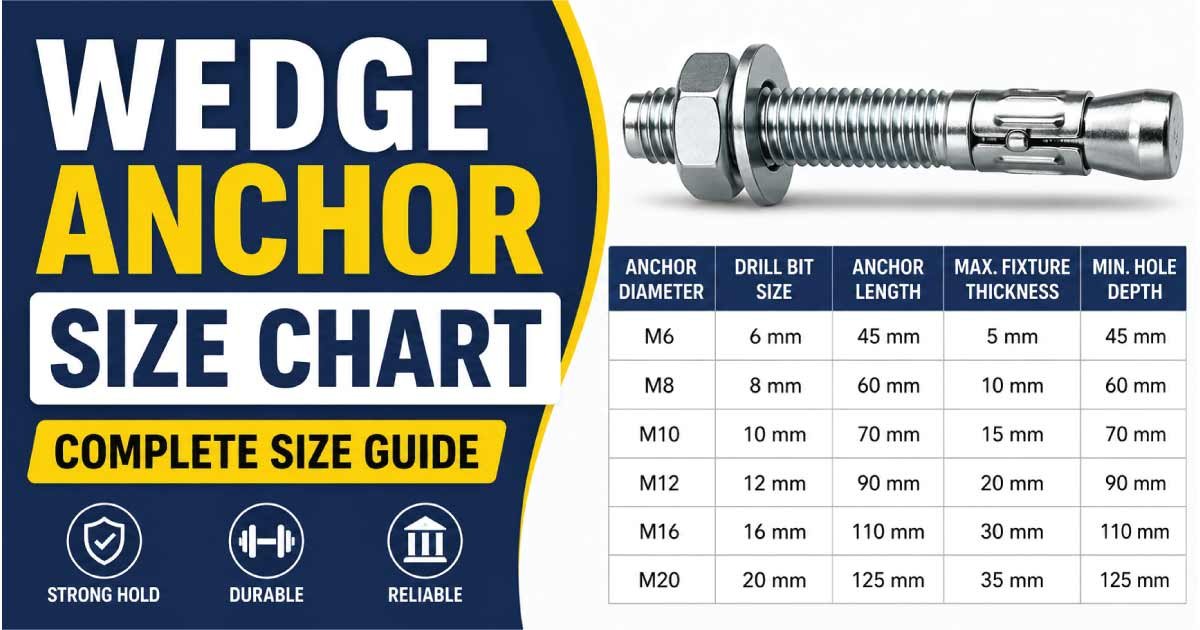
Wedge anchors are heavy-duty mechanical fasteners used to secure materials to concrete. They are commonly used for attaching structural steel, machinery, handrails, support brackets, equipment, and other fixtures to solid concrete surfaces.
Choosing the correct wedge anchor size is important because anchor diameter, length, embedment depth, fixture thickness, and concrete strength all affect the performance of the connection. Using an anchor that is too short may provide insufficient embedment, while an unnecessarily large anchor may be difficult to install and may not suit the base material.
This wedge anchor size chart explains common anchor diameters and lengths, embedment requirements, hole sizes, applications, installation methods, and selection factors to help you choose the right concrete anchor for your project.
What Is a Wedge Anchor?
A wedge anchor is a type of expansion anchor designed primarily for fastening into solid concrete. It consists of a threaded anchor body, expansion clip, nut, and washer.
When the nut is tightened, the threaded stud pulls the expansion mechanism upward, causing the expansion clip to press against the sides of the drilled concrete hole. This creates a mechanical connection between the anchor and the concrete.
Wedge anchors are commonly used where a strong, permanent attachment to concrete is required.
Typical applications include:
- Structural steel connections
- Machinery mounting
- Handrails and guardrails
- Metal brackets
- Equipment supports
- Racking systems
- Base plates
- Pipe supports
- Electrical equipment
- Concrete construction
Wedge anchors are generally intended for solid concrete. They are not automatically suitable for brick, hollow block, lightweight concrete, or other base materials.
How Wedge Anchor Sizes Are Determined
Wedge anchor sizes are normally identified by their nominal diameter and overall length.
For example, a 1/2 × 4-inch wedge anchor generally has a nominal diameter of 1/2 inch and an overall length of approximately 4 inches.
Important dimensions include:
- Anchor diameter
- Overall anchor length
- Minimum embedment depth
- Maximum fixture thickness
- Drill-hole diameter
- Thread length
- Washer diameter
- Nut size
The diameter affects the anchor’s load capacity, while the length determines whether sufficient embedment can be achieved after accounting for the fixture thickness.
Always use the manufacturer’s published installation data for exact embedment and load requirements.
Common Wedge Anchor Size Chart
The following chart provides common wedge anchor diameters and typical lengths used in concrete fastening. Exact minimum embedment, hole depth, fixture thickness, and load capacity vary by manufacturer and anchor design.
| Anchor Size | Nominal Diameter | Common Lengths | Typical Application |
|---|---|---|---|
| 1/4 in | 6.4 mm | 1-3/4–4 in | Light-duty fixtures |
| 5/16 in | 7.9 mm | 2–5 in | Brackets and supports |
| 3/8 in | 9.5 mm | 2-1/2–6 in | General concrete fastening |
| 1/2 in | 12.7 mm | 3–8 in | Equipment and structural work |
| 5/8 in | 15.9 mm | 4–10 in | Heavy-duty applications |
| 3/4 in | 19.1 mm | 4–12 in | Heavy structural connections |
| 7/8 in | 22.2 mm | 5–12 in | Large structural applications |
| 1 in | 25.4 mm | 6–16 in | Heavy industrial fastening |
| 1-1/4 in | 31.8 mm | 8–18 in | Specialized heavy-duty work |
These are representative size ranges, not universal specifications. Always check the manufacturer’s technical data before selecting an anchor for a load-bearing application.
Wedge Anchor Diameter Chart
Anchor diameter is one of the most important factors when selecting a wedge anchor. Larger-diameter anchors can generally provide greater load capacity when installed correctly in suitable concrete, but capacity also depends on embedment, concrete strength, spacing, edge distance, and anchor design.
| Nominal Diameter | Approx. Metric Diameter | General Category |
|---|---|---|
| 1/4 in | 6.4 mm | Light-duty |
| 5/16 in | 7.9 mm | Light/medium-duty |
| 3/8 in | 9.5 mm | Medium-duty |
| 1/2 in | 12.7 mm | Heavy-duty |
| 5/8 in | 15.9 mm | Heavy-duty |
| 3/4 in | 19.1 mm | Very heavy-duty |
| 7/8 in | 22.2 mm | Structural/heavy-duty |
| 1 in | 25.4 mm | Heavy industrial |
| 1-1/4 in | 31.8 mm | Specialized applications |
Diameter should never be used by itself to determine allowable load. Refer to the anchor manufacturer’s tested and published load data.
Wedge Anchor Lengths
Wedge anchors are available in many lengths because concrete fastening applications require different fixture thicknesses and embedment depths.
Common lengths may include:
- 1-3/4 inches
- 2 inches
- 2-1/2 inches
- 3 inches
- 3-1/2 inches
- 4 inches
- 5 inches
- 6 inches
- 8 inches
- 10 inches
- 12 inches
- 16 inches
The correct length depends on the thickness of the material being fastened and the required embedment depth.
A simple way to understand anchor length is:
Required anchor length ≈ fixture thickness + required embedment + allowance for washer and nut
This is only a selection concept. The actual manufacturer’s required minimum and maximum embedment, hole depth, and fixture thickness must be followed.
Understanding Wedge Anchor Embedment Depth
Embedment is the portion of the anchor that is installed into the concrete.
Adequate embedment is essential for achieving the rated performance of a wedge anchor. If the anchor is not installed deeply enough, the expansion mechanism may not develop the required holding capacity.
Embedment requirements vary according to:
- Anchor diameter
- Anchor manufacturer
- Anchor design
- Concrete strength
- Load direction
- Installation conditions
- Required performance
Some wedge anchors have published minimum embedment values, while others may offer different embedment options.
Never assume that all anchors of the same diameter require the same embedment depth.
Wedge Anchor Hole Size
The drilled hole must match the diameter specified by the anchor manufacturer.
For many wedge anchor systems, the required drill diameter corresponds closely to the nominal anchor diameter.
For example, a manufacturer may specify a drill bit size that matches the anchor’s nominal diameter. However, the exact requirement should always be checked in the product installation instructions.
Important drilling considerations include:
- Use the specified drill-bit diameter.
- Drill to the required hole depth.
- Remove dust and drilling debris.
- Keep the hole properly aligned.
- Avoid enlarging the hole unnecessarily.
- Use the drilling method specified by the manufacturer.
An incorrectly sized or poorly prepared hole can reduce anchor performance.
How Wedge Anchors Work
Wedge anchors use mechanical expansion to grip the concrete.
The basic process works as follows:
- A hole is drilled into solid concrete.
- The hole is cleaned.
- The wedge anchor is inserted.
- The anchor is driven to the required depth.
- The washer and nut are installed.
- The nut is tightened to the specified torque.
- The expansion clip engages the concrete.
- The fixture becomes mechanically secured to the concrete.
The expansion mechanism creates friction and mechanical interlock between the anchor and the concrete.
Proper installation is essential because an anchor installed incorrectly may not achieve its published load capacity.
How to Install a Wedge Anchor
Correct installation is critical for achieving reliable performance.
1. Mark the Location
Position the fixture and mark the locations where the anchors will be installed.
Check the manufacturer’s requirements for minimum edge distance and spacing.
2. Drill the Hole
Use the specified drill diameter and drilling method.
Drill deeper than the required embedment when the manufacturer’s instructions require additional hole depth for debris clearance.
3. Clean the Hole
Remove drilling dust and debris from the hole.
Depending on the manufacturer’s instructions, cleaning may involve brushing, blowing, vacuuming, or a combination of methods.
4. Insert the Anchor
Place the wedge anchor through the fixture and into the drilled hole.
Drive it to the required installation depth without damaging the threaded portion.
5. Install the Washer and Nut
Place the washer over the exposed threaded section and install the nut.
6. Tighten to the Specified Torque
Use a calibrated torque wrench where the manufacturer specifies a torque value.
Do not guess the tightening torque for a critical installation.
Wedge Anchor Spacing and Edge Distance
Anchor spacing and distance from concrete edges are important because concrete can crack or fail when anchors are installed too close together or too close to an edge.
Important factors include:
- Minimum anchor spacing
- Minimum edge distance
- Concrete thickness
- Concrete strength
- Embedment depth
- Applied load
- Anchor diameter
The required values vary by anchor type and manufacturer.
For structural or safety-critical applications, use the manufacturer’s engineering data and applicable building or design standards rather than relying on generic spacing rules.
Discover More:
Wedge Anchor Load Capacity
Wedge anchor load capacity depends on much more than anchor diameter.
Important factors include:
- Concrete compressive strength
- Anchor diameter
- Embedment depth
- Edge distance
- Anchor spacing
- Concrete thickness
- Installation quality
- Load direction
- Cracked or uncracked concrete
- Anchor material and design
Loads are commonly considered in terms of tension and shear.
Tension Loads
A tension load pulls the anchor away from the concrete surface.
Examples include fixtures subjected to upward or outward forces.
Shear Loads
A shear load acts parallel to the concrete surface.
Examples include brackets or equipment that place a horizontal force on the anchor.
The manufacturer’s published load tables should be used to determine allowable or design capacities for a specific anchor.
Wedge Anchor Material and Finish
Wedge anchors are available in different materials and finishes for different environmental conditions.
Carbon Steel
Carbon steel anchors are widely used for general indoor concrete fastening where environmental exposure is limited.
Zinc-Plated Steel
Zinc-plated wedge anchors provide improved corrosion resistance compared with untreated carbon steel and are common in general construction.
Stainless Steel
Stainless steel wedge anchors offer greater corrosion resistance and may be suitable for damp, outdoor, or corrosive environments, depending on the specific stainless grade.
Hot-Dip Galvanized
Hot-dip galvanized anchors provide a thicker protective coating and may be selected for certain outdoor or more demanding environments.
The correct material depends on the environment, exposure, load requirements, and applicable specifications.
Discover More:
Wedge Anchor Applications
Wedge anchors are widely used in construction and industrial installations.
Common applications include:
- Steel base plates
- Machinery mounting
- Handrails
- Guardrails
- Structural brackets
- Equipment supports
- Conveyor supports
- Pipe racks
- Electrical equipment
- Storage racks
- Signs and fixtures
- Metal framing
For each application, verify whether a wedge anchor is approved for the specific base material and loading conditions.
Wedge Anchor vs. Sleeve Anchor
Wedge anchors and sleeve anchors are both mechanical expansion anchors, but their construction and typical applications differ.
| Feature | Wedge Anchor | Sleeve Anchor |
|---|---|---|
| Expansion method | Wedge and clip | Sleeve expansion |
| Typical base material | Solid concrete | Concrete and some masonry applications |
| Heavy-duty use | Common | Light to medium/heavy depending on design |
| Installation | Pre-drilled hole | Pre-drilled hole |
| Load capacity | Often high | Varies by design |
| Typical use | Structural and equipment fastening | General-purpose fastening |
The correct anchor should be selected according to the specific substrate, load, and manufacturer’s approvals.
Wedge Anchor vs. Concrete Screw
Concrete screws and wedge anchors both fasten fixtures to concrete, but they work differently.
A concrete screw cuts or forms threads in the drilled hole, while a wedge anchor expands mechanically inside the concrete.
| Feature | Wedge Anchor | Concrete Screw |
|---|---|---|
| Installation principle | Mechanical expansion | Thread engagement |
| Removal | Generally removable | Generally removable |
| Installation speed | Moderate | Often fast |
| Heavy-duty applications | Common | Depends on product |
| Hole preparation | Drilling and cleaning | Drilling to specified size |
| Best use | High-strength mechanical fastening | Many general concrete fixtures |
Always verify the product’s tested capacity before selecting either system for structural applications.
Discover More:
Common Wedge Anchor Installation Mistakes
Incorrect installation can significantly reduce anchor performance.
Avoid these common mistakes:
- Using the wrong drill-bit size
- Drilling an insufficient hole depth
- Failing to clean the hole
- Installing too close to a concrete edge
- Ignoring minimum anchor spacing
- Using the wrong anchor length
- Under-tightening the nut
- Over-tightening the anchor
- Using an unsuitable anchor material
- Installing in unsuitable concrete or masonry
- Reusing damaged anchors
- Ignoring manufacturer instructions
A properly selected anchor can still perform poorly if it is installed incorrectly.
How to Choose the Correct Wedge Anchor Size
Use the following steps when selecting a wedge anchor.
Determine the Load
Identify the expected tension and shear loads.
For structural applications, obtain the required design loads before selecting the anchor.
Check the Concrete
Determine the concrete type, strength, thickness, and whether the application involves cracked or uncracked concrete where relevant.
Select the Diameter
Choose an anchor diameter based on the required capacity and manufacturer’s design data.
Determine the Embedment
Verify the required embedment for the selected anchor.
Calculate the Required Length
Consider the fixture thickness, washer and nut arrangement, and required embedment.
Check Spacing and Edge Distance
Make sure the selected anchor layout satisfies the manufacturer’s requirements.
Verify the Installation Torque
Use the manufacturer’s specified torque rather than relying on a generic value.
Wedge Anchor Safety Tips
Follow safe installation practices when working with concrete anchors.
- Wear appropriate eye protection when drilling concrete.
- Use suitable respiratory protection where required by the work environment.
- Inspect the drill and bit before use.
- Keep the anchor hole free of debris.
- Follow the manufacturer’s installation instructions.
- Use a calibrated torque wrench for specified torque values.
- Do not modify the anchor.
- Do not use visibly damaged anchors.
- Verify the substrate before drilling.
- Check for hidden electrical, plumbing, or other services before drilling.
For structural connections, installation should follow the applicable engineering specifications and local requirements.
Frequently Asked Questions About Wedge Anchors
What size wedge anchor should I use?
The correct wedge anchor size depends on the load, concrete strength, embedment depth, fixture thickness, spacing, and edge distance. Common diameters include 3/8, 1/2, 5/8, and 3/4 inch. Use the manufacturer’s published design data rather than selecting an anchor based on diameter alone.
How deep should a wedge anchor go into concrete?
The required embedment depth varies by anchor diameter, manufacturer, concrete condition, and product design. Always use the specified minimum embedment for the exact anchor being installed. The hole may also need additional depth beyond the embedment to accommodate drilling debris.
What drill bit size is needed for a wedge anchor?
The required drill-bit diameter is specified by the anchor manufacturer and commonly corresponds closely to the anchor’s nominal diameter. For example, a particular 1/2-inch wedge anchor may require a 1/2-inch drill bit. Always verify the exact product instructions before drilling.
Can wedge anchors be used in brick or block?
Standard wedge anchors are primarily designed for solid concrete and should not automatically be used in brick, hollow block, or other masonry. These materials may require different anchor systems. Check the manufacturer’s approved base materials before installation.
Are wedge anchors removable?
The fixture can generally be removed by taking off the nut and washer, but the installed anchor itself is not always easily removable without damaging or disturbing the concrete. If future removal is important, select an anchor system specifically suited to removable installations.
Conclusion
A wedge anchor size chart is a useful reference for comparing common anchor diameters and lengths, but selecting the correct concrete anchor requires more than matching dimensions. The concrete strength, anchor diameter, embedment depth, fixture thickness, spacing, edge distance, load, and installation method all affect performance.
Common sizes such as 3/8-inch, 1/2-inch, 5/8-inch, and 3/4-inch are widely used, while larger anchors are available for demanding industrial and structural applications.
For reliable results, choose an anchor specifically approved for the concrete condition and intended load. Follow the manufacturer’s drilling, hole-cleaning, embedment, spacing, and torque requirements. For structural or safety-critical connections, use the appropriate engineering specifications rather than relying on a general size chart alone.

Engineer Hassan is a Mechanical Engineer with 16+ years of hands-on experience in mechanical hardware, fasteners, and workshop tools. He focuses on size selection, thread identification, and measurement, helping users choose the correct components with accuracy and safety.