
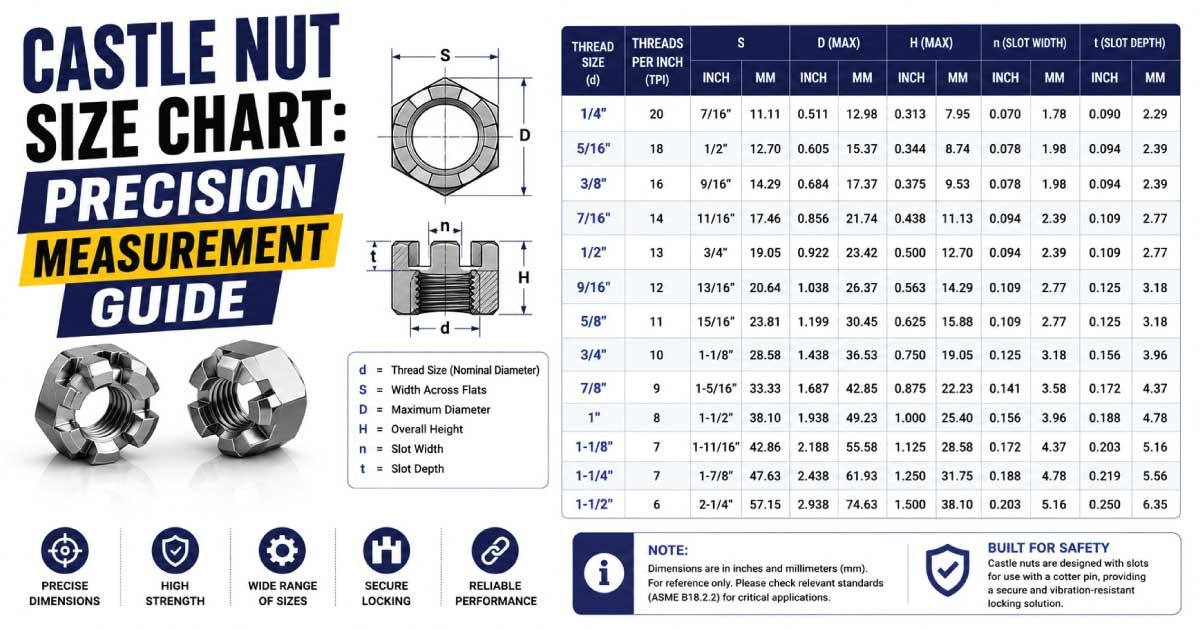
Castle nuts are specialized fastening components designed to prevent loosening in applications exposed to vibration, rotation, and dynamic loads.
They feature slots cut into one end of the nut that align with a drilled hole in the bolt or shaft, allowing a cotter pin to lock the assembly securely in place.
Castle nuts are commonly used in automotive, aerospace, agricultural machinery, construction equipment, and industrial applications. This guide explains standard castle nut sizes, dimensions, materials, thread types, and selection methods.
What Is a Castle Nut?
A castle nut, also called a castellated nut, is a hexagonal nut with evenly spaced slots machined into one end. After tightening the nut to the required torque, a cotter pin is inserted through the bolt hole and aligned slot, preventing the nut from rotating or loosening during operation.
Key features include:
- Slotted locking design
- Used with cotter pins
- Excellent vibration resistance
- Reusable fastening solution
- Available in metric and SAE sizes
- Suitable for high-load applications
Why Castle Nut Size Matters
Choosing the correct castle nut size ensures proper thread engagement, secure locking, and reliable performance. A mismatched nut may damage threads, reduce clamping force, or prevent proper cotter pin installation.
Benefits of selecting the correct size include:
- Secure fastening
- Improved safety
- Better load distribution
- Reduced vibration loosening
- Longer service life
- Easier maintenance
Castle Nut Size Chart (Metric)
The following table lists the most commonly used metric castle nut sizes.
| Thread Size | Thread Pitch | Across Flats (Approx.) | Typical Applications |
|---|---|---|---|
| M6 | 1.0 mm | 10 mm | Small machinery |
| M8 | 1.25 mm | 13 mm | Bicycles |
| M10 | 1.5 mm | 17 mm | Automotive assemblies |
| M12 | 1.75 mm | 19 mm | Suspension systems |
| M14 | 2.0 mm | 22 mm | Agricultural equipment |
| M16 | 2.0 mm | 24 mm | Industrial machinery |
| M20 | 2.5 mm | 30 mm | Heavy equipment |
| M24 | 3.0 mm | 36 mm | Construction machinery |
| M30 | 3.5 mm | 46 mm | Mining equipment |
Castle Nut Size Chart (SAE/Imperial)
Imperial castle nuts are widely used in North American automotive, agricultural, and industrial equipment.
| Thread Size | Threads Per Inch (TPI) | Wrench Size | Common Applications |
|---|---|---|---|
| 1/4″-20 | 20 | 7/16″ | Light-duty assemblies |
| 5/16″-18 | 18 | 1/2″ | Small equipment |
| 3/8″-16 | 16 | 9/16″ | Automotive repairs |
| 1/2″-13 | 13 | 3/4″ | Suspension components |
| 5/8″-11 | 11 | 15/16″ | Agricultural machinery |
| 3/4″-10 | 10 | 1-1/8″ | Construction equipment |
| 7/8″-9 | 9 | 1-5/16″ | Heavy machinery |
| 1″-8 | 8 | 1-1/2″ | Industrial equipment |
Main Parts of a Castle Nut
Castle nuts have a simple yet highly effective design that provides secure mechanical locking when used with a cotter pin.
1. Hexagonal Body
The hexagonal body allows the nut to be tightened using a standard wrench or socket. It provides the clamping force required to secure the joint while maintaining compatibility with conventional fastening tools.
2. Castellated Slots
The slots machined into the top of the nut align with the hole drilled through the bolt or shaft. Once aligned, a cotter pin passes through the opening to lock the nut and prevent rotation during service.
3. Internal Threads
The internal threads engage with the external bolt threads to create the fastening connection. Proper thread engagement is essential for achieving the required clamping force and maintaining long-term reliability.
Common Castle Nut Materials
Material selection depends on load requirements, environmental conditions, and corrosion resistance needs.
1. Carbon Steel
Carbon steel castle nuts are the most common choice for general industrial and automotive applications. They provide high strength, good durability, and cost-effective performance when combined with protective surface coatings.
Advantages include:
- High strength
- Affordable
- Widely available
- Suitable for heavy-duty applications
2. Stainless Steel
Stainless steel castle nuts offer excellent corrosion resistance, making them suitable for marine environments, food processing, chemical plants, and outdoor installations exposed to moisture.
Benefits include:
- Superior corrosion resistance
- Long service life
- Low maintenance
- Excellent appearance
3. Alloy Steel
Alloy steel castle nuts are heat-treated to achieve exceptional strength and fatigue resistance. They are commonly used in heavy machinery, construction equipment, and high-load mechanical assemblies.
📘 Explore Complete Size Guide 👉 Standard Needle Bearing Size Chart with PDF
Common Castle Nut Grades
Castle nuts are manufactured in different strength grades to match the mechanical properties of the bolts they are paired with.
Grade 5 Castle Nuts
Grade 5 castle nuts are suitable for medium-strength fastening applications found in agricultural equipment, trailers, and general machinery. They provide reliable performance under moderate loading conditions.
Grade 8 Castle Nuts
Grade 8 castle nuts are designed for high-strength applications where heavy loads, vibration, and impact forces are present. They are commonly used in automotive suspension systems, heavy equipment, and industrial machinery.
Advantages include:
- Higher tensile strength
- Improved wear resistance
- Excellent fatigue performance
- Long service life
Common Applications of Castle Nuts
Castle nuts are widely used wherever mechanical locking is required to prevent fastener loosening caused by vibration or rotational forces.
Major applications include:
- Automotive wheel hubs
- Suspension systems
- Steering components
- Trailer axles
- Agricultural machinery
- Construction equipment
- Industrial machinery
- Aerospace assemblies
- Marine equipment
- Heavy mechanical systems
How to Choose the Correct Castle Nut Size
Selecting the correct castle nut size is essential for creating a secure and reliable fastening assembly. The nut must match the bolt diameter, thread pitch, strength grade, and application requirements. Proper sizing ensures full thread engagement, correct cotter pin alignment, and dependable performance under vibration and heavy loads.
1. Match the Bolt Diameter
A castle nut must have the same nominal thread size as the bolt or threaded shaft. Using an incorrect size can damage the threads, reduce clamping force, and compromise the safety of the connection.
Check the following:
- Bolt diameter
- Thread size
- Thread pitch
- Thread standard
- Manufacturer specifications
2. Verify the Thread Type
Metric and SAE (imperial) threads are not interchangeable. Always identify the thread system before selecting a castle nut to ensure proper fit and reliable fastening.
Common thread standards include:
- Metric Coarse
- Metric Fine
- UNC
- UNF
- ISO
- DIN
3. Select the Appropriate Strength Grade
The strength grade of the castle nut should be compatible with the bolt grade. Using a lower-grade nut on a high-strength bolt may reduce the joint’s load-carrying capacity and increase the risk of failure.
Common grades include:
- Grade 2
- Grade 5
- Grade 8
- Class 8
- Class 10
- Class 12
4. Choose the Correct Material
Material selection depends on environmental conditions and application requirements. Corrosive environments may require stainless steel, while heavy-duty industrial applications often use heat-treated alloy steel.
Typical materials include:
- Carbon steel
- Alloy steel
- Stainless steel
- Zinc-plated steel
📘 Explore Complete Size Guide 👉 Pipe Size Chart: Complete Guide to Dimensions
Castle Nut Thread Size Reference Chart
The following table shows common thread sizes and their corresponding wrench sizes.
| Thread Size | Thread Pitch / TPI | Typical Wrench Size |
|---|---|---|
| M6 | 1.0 mm | 10 mm |
| M8 | 1.25 mm | 13 mm |
| M10 | 1.5 mm | 17 mm |
| M12 | 1.75 mm | 19 mm |
| M16 | 2.0 mm | 24 mm |
| 3/8″-16 | 16 TPI | 9/16″ |
| 1/2″-13 | 13 TPI | 3/4″ |
| 5/8″-11 | 11 TPI | 15/16″ |
Recommended Tightening Torque Chart
Applying the proper tightening torque helps maintain the required clamping force while ensuring the castle nut aligns correctly with the cotter pin hole. Always follow the equipment manufacturer’s torque specifications whenever available.
| Bolt Size | Grade 5 (Approx.) | Grade 8 (Approx.) |
|---|---|---|
| 3/8″ | 31 ft-lb | 44 ft-lb |
| 1/2″ | 75 ft-lb | 110 ft-lb |
| 5/8″ | 150 ft-lb | 215 ft-lb |
| 3/4″ | 265 ft-lb | 380 ft-lb |
| M10 | 49 Nm | 68 Nm |
| M12 | 85 Nm | 120 Nm |
| M16 | 210 Nm | 290 Nm |
Castle Nut Material Comparison
Choosing the right material improves durability, corrosion resistance, and long-term fastening performance.
| Material | Strength | Corrosion Resistance | Typical Applications |
|---|---|---|---|
| Carbon Steel | High | Moderate | Automotive and industrial equipment |
| Alloy Steel | Very High | Moderate | Heavy machinery |
| Stainless Steel | High | Excellent | Marine and outdoor equipment |
| Zinc-Plated Steel | High | Good | General-purpose applications |
Advantages of Castle Nuts
Castle nuts are widely used because they provide a dependable mechanical locking method without requiring adhesives or special locking inserts. Their simple design makes them suitable for safety-critical applications.
Advantages include:
- Excellent vibration resistance
- Positive mechanical locking
- Reusable design
- High load capacity
- Easy inspection
- Reliable performance
- Compatible with cotter pins
- Long service life
Limitations of Castle Nuts
Although highly effective, castle nuts require additional components and proper installation to function correctly. Understanding their limitations helps ensure safe and reliable fastening.
Common limitations include:
- Require drilled bolts or shafts
- Need cotter pins for locking
- Slower installation
- Slightly higher cost than standard hex nuts
- Precise slot alignment required
How to Install a Castle Nut
Proper installation is essential to achieve the required clamping force while ensuring the cotter pin locks the nut securely.
Basic Installation Steps
- Thread the castle nut onto the bolt.
- Tighten the nut to the specified torque.
- Align a castellated slot with the bolt hole.
- Insert the cotter pin through the hole.
- Bend both ends of the cotter pin securely.
- Verify the nut cannot rotate.
- Inspect the completed assembly.
Maintenance Tips for Castle Nuts
Routine inspection helps maintain safe operation in applications exposed to vibration, heavy loads, and harsh environments.
Maintenance recommendations:
- Inspect cotter pins regularly.
- Replace bent or damaged cotter pins.
- Check tightening torque.
- Inspect threads for wear.
- Remove corrosion.
- Replace damaged nuts immediately.
- Follow scheduled maintenance intervals.
📘 Explore Complete Size Guide 👉 What Is Dowel Pin? Size Chart, Types and How to Choose
Common Installation Mistakes
Incorrect installation can reduce fastening security and increase the risk of loosening during operation.
Avoid these mistakes:
- Using the wrong thread size
- Mixing metric and SAE threads
- Reusing damaged cotter pins
- Applying incorrect torque
- Misaligning castellated slots
- Omitting the cotter pin
- Using worn nuts
- Ignoring corrosion
Castle Nut vs Nylon Lock Nut
Although both prevent loosening, they use different locking mechanisms and are suited to different applications.
| Feature | Castle Nut | Nylon Lock Nut |
|---|---|---|
| Locking Method | Cotter pin | Nylon insert |
| Reusable | Yes | Limited |
| High Temperature | Excellent | Limited |
| Vibration Resistance | Excellent | Very Good |
| Requires Drilled Bolt | Yes | No |
| Common Applications | Automotive hubs, steering | General machinery |
Industries That Use Castle Nuts
Castle nuts are widely used in industries where secure mechanical locking is essential for safety and reliability.
Major industries include:
- Automotive manufacturing
- Railway equipment
- Aerospace
- Marine engineering
- Agriculture
- Construction
- Mining
- Industrial machinery
- Heavy equipment
- Power generation
Wrapping Up
Castle nuts provide one of the most reliable mechanical locking methods for applications where vibration, rotation, and heavy loads can cause conventional nuts to loosen.
By selecting the correct size, material, thread type, and strength grade, and by installing a new cotter pin correctly, you can ensure a secure, long-lasting fastening solution.
Whether used in automotive suspension systems, agricultural equipment, industrial machinery, or aerospace assemblies, properly installed castle nuts improve safety, reduce maintenance, and deliver dependable performance in demanding operating conditions.
FAQs:
What is a castle nut used for?
A castle nut is used to secure bolts or threaded shafts in applications where vibration or movement could loosen standard nuts. Its slotted design allows a cotter pin to pass through both the nut and a drilled bolt hole, creating a reliable mechanical lock for improved safety and long-term fastening performance.
What is the difference between a castle nut and a castellated nut?
There is no functional difference between a castle nut and a castellated nut. Both terms refer to the same type of slotted locking nut designed to work with a cotter pin. The different names are simply regional or industry preferences, while their design and performance remain identical.
Can a castle nut be reused?
Yes, a castle nut can generally be reused if its threads, slots, and overall condition remain free from wear or damage. However, the cotter pin should always be replaced with a new one after removal because reused cotter pins may lose strength and fail to provide a secure locking mechanism.
Why does a castle nut require a cotter pin?
A cotter pin is essential because it locks the castle nut in place after proper tightening. The pin passes through the aligned slots in the nut and the drilled hole in the bolt, preventing the nut from rotating, loosening under vibration, or backing off during service and operation.
How do I choose the correct castle nut size?
Choose a castle nut that matches the bolt diameter, thread pitch, thread standard, and required strength grade. After tightening to the recommended torque, ensure one of the nut slots aligns with the drilled bolt hole so the cotter pin can be installed securely for safe, reliable fastening.

Engineer Hassan is a Mechanical Engineer with 16+ years of hands-on experience in mechanical hardware, fasteners, and workshop tools. He focuses on size selection, thread identification, and measurement, helping users choose the correct components with accuracy and safety.