
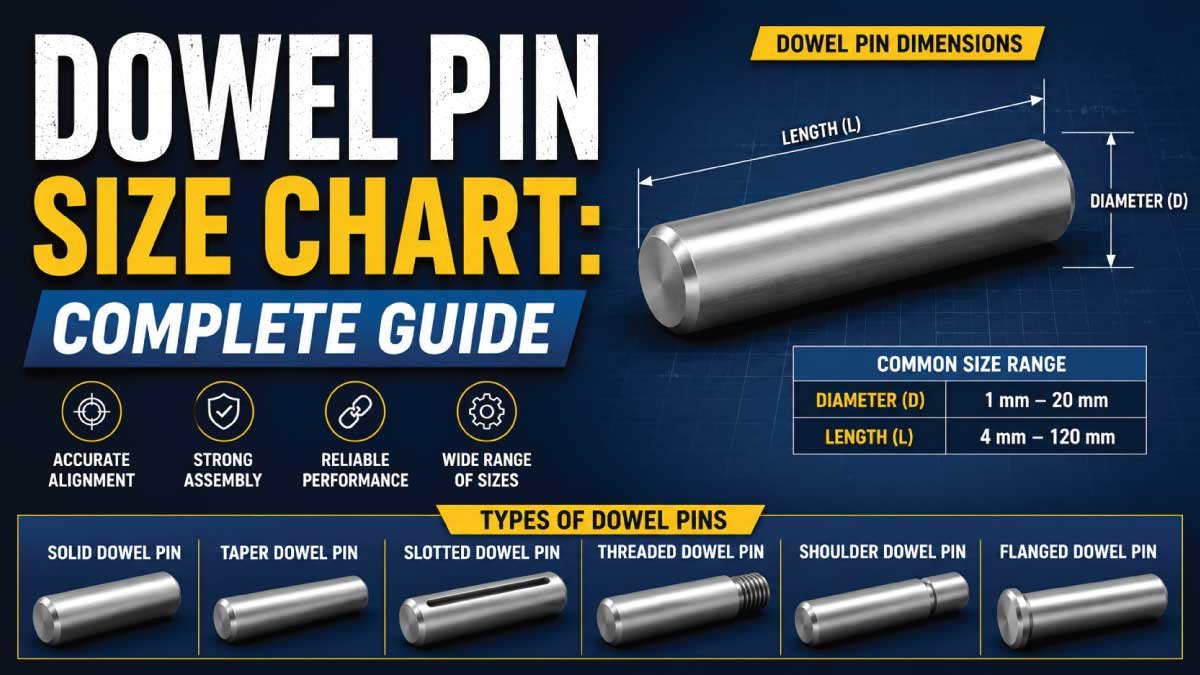
Dowel pins are small cylindrical fasteners used to align, locate, or join machine parts with high precision. They are widely used in automotive work, woodworking, machinery, furniture making, and industrial manufacturing. Choosing the correct dowel pin size is important because even a small sizing mistake can affect alignment, strength, and performance.
In this complete guide, you will learn about standard dowel pin sizes, metric and inch dimensions, materials, applications, tolerances, installation tips, and how to select the correct dowel pin for your project.
What Is a Dowel Pin?
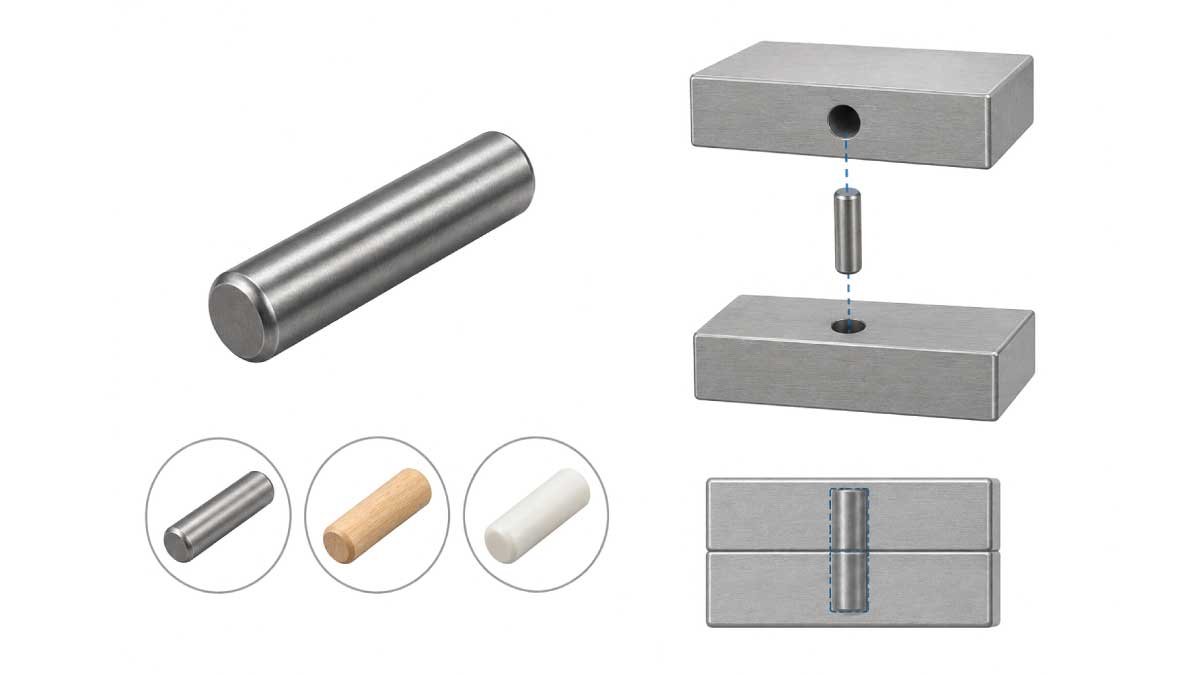
A dowel pin is a solid cylindrical rod usually made from metal, wood, or plastic. It is inserted into matching holes between two parts to keep them aligned accurately.
Dowel pins are commonly used for:
- Machine assembly
- Precision alignment
- Furniture joints
- Automotive components
- Tooling fixtures
- Industrial equipment
Unlike screws or bolts, dowel pins mainly provide positioning and alignment rather than clamping force.
Standard Dowel Pin Size Chart
Below is a common inch dowel pin size chart used in mechanical and industrial applications.
| Dowel Pin Diameter | Length Range | Common Applications |
|---|---|---|
| 1/16 inch | 1/8 – 1 inch | Electronics, precision devices |
| 3/32 inch | 1/4 – 1 inch | Small assemblies |
| 1/8 inch | 1/4 – 2 inch | Light machinery |
| 5/32 inch | 1/2 – 2 inch | Automotive components |
| 3/16 inch | 1/2 – 3 inch | Fixtures and alignment |
| 1/4 inch | 1/2 – 4 inch | Machine assembly |
| 5/16 inch | 1 – 5 inch | Heavy-duty applications |
| 3/8 inch | 1 – 6 inch | Industrial equipment |
| 1/2 inch | 1 – 8 inch | Large machinery |
| 5/8 inch | 2 – 10 inch | Structural alignment |
Metric Dowel Pin Size Chart
Metric dowel pins are commonly used in Europe and Asia.
| Metric Size | Diameter (mm) | Common Lengths |
|---|---|---|
| M2 | 2 mm | 4 – 20 mm |
| M3 | 3 mm | 6 – 30 mm |
| M4 | 4 mm | 8 – 40 mm |
| M5 | 5 mm | 10 – 50 mm |
| M6 | 6 mm | 12 – 60 mm |
| M8 | 8 mm | 16 – 80 mm |
| M10 | 10 mm | 20 – 100 mm |
| M12 | 12 mm | 25 – 120 mm |
| M16 | 16 mm | 30 – 150 mm |
| M20 | 20 mm | 40 – 200 mm |
Standard Dowel Pin Size Chart pdf
A standard dowel pin size chart PDF is a useful reference for engineers, machinists, and manufacturers to quickly identify precise pin dimensions. It includes common diameters, length ranges, and tolerances for both metric and imperial sizes. This chart helps ensure accurate alignment, strong assembly fitting, and reliable performance in mechanical and industrial applications.
Types of Dowel Pins
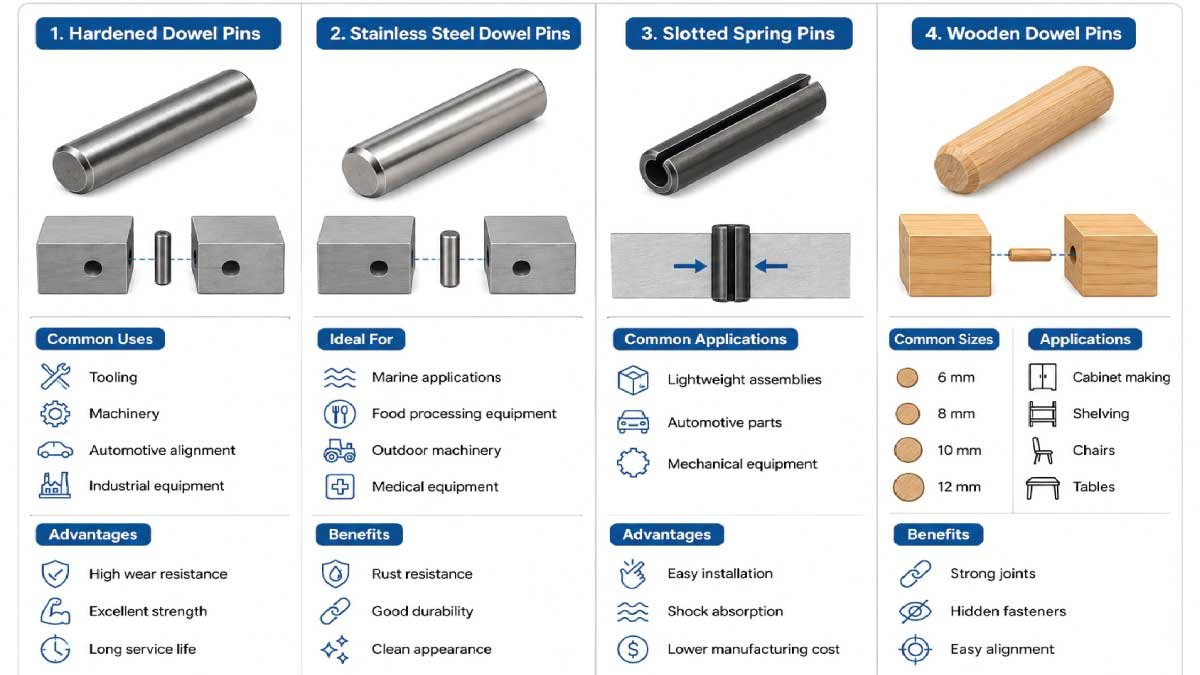
Dowel pins are small cylindrical fasteners used to align, position, or hold machine parts together with high accuracy. Different types are designed for specific mechanical, industrial, and woodworking applications. Choosing the right dowel pin ensures strong alignment, durability, and reliable performance in assemblies.
1. Hardened Dowel Pins
Hardened dowel pins are heat-treated steel pins designed for high-strength and precision applications. They are commonly used in heavy-duty environments where accurate alignment and resistance to wear are essential for long-term performance.
Common uses include:
- Tooling
- Machinery
- Automotive alignment
- Industrial equipment
Advantages:
- High wear resistance
- Excellent strength
- Long service life
2. Stainless Steel Dowel Pins
Stainless steel dowel pins are designed to resist corrosion, moisture, and rust. They are ideal for environments where hygiene, durability, and exposure to water or chemicals are important factors.
They are ideal for:
- Marine applications
- Food processing equipment
- Outdoor machinery
- Medical equipment
Benefits include:
- Rust resistance
- Good durability
- Clean appearance
3. Slotted Spring Pins
Slotted spring pins are flexible pins that compress slightly during installation, making them easier to fit into holes. They provide good grip and shock absorption, especially in lightweight mechanical assemblies.
Common applications:
- Lightweight assemblies
- Automotive parts
- Mechanical equipment
Advantages:
- Easy installation
- Shock absorption
- Lower manufacturing cost
4. Wooden Dowel Pins
Wooden dowel pins are commonly used in furniture making and carpentry to create strong and hidden joints between wooden parts. They help maintain alignment while keeping the structure clean and aesthetically pleasing.
Common sizes include:
- 6 mm
- 8 mm
- 10 mm
- 12 mm
Applications:
- Cabinet making
- Shelving
- Chairs
- Tables
Benefits:
- Strong joints
- Hidden fasteners
- Easy alignment
Dowel Pin Tolerances
Tolerance refers to the allowed variation in dowel pin diameter. Precision applications require very tight tolerances.
Common dowel pin tolerances:
| Tolerance Type | Typical Accuracy |
|---|---|
| Standard | ±0.001 inch |
| Precision | ±0.0005 inch |
| Oversized | Slightly larger diameter |
| Undersized | Slightly smaller diameter |
Precision dowel pins are often ground to extremely accurate dimensions.
Recommended Reading:
Press Fit vs Slip Fit Dowel Pins
Understanding the difference between press fit and slip fit dowel pins is important for proper assembly design. The fit type determines how tightly the pin sits inside the hole, which directly affects strength, alignment accuracy, and ease of maintenance in mechanical systems.
1. Press Fit
A press fit dowel pin is designed to be inserted into a hole with force. The tight interference between the pin and the hole creates a strong, permanent connection that prevents movement during operation. This type is widely used where high precision and stability are required.
Characteristics:
- Tight fit
- Permanent positioning
- High accuracy
Common in:
- Machinery
- Tooling fixtures
- Precision alignment
2. Slip Fit
Slip fit dowel pins are designed to slide easily into and out of the hole without requiring force. This makes them ideal for applications where components need to be assembled, adjusted, or removed frequently.
Benefits:
- Easy assembly
- Simple removal
- Faster maintenance
Used for:
- Temporary alignment
- Serviceable components
Standard Dowel Pin Hole Sizes
Hole size depends on the desired fit. Typical recommendations:
| Pin Diameter | Press Fit Hole | Slip Fit Hole |
|---|---|---|
| 1/8 inch | 0.1245 inch | 0.1255 inch |
| 1/4 inch | 0.2495 inch | 0.2505 inch |
| 3/8 inch | 0.3745 inch | 0.3755 inch |
| 1/2 inch | 0.4995 inch | 0.5005 inch |
Proper hole sizing prevents loose fits or installation damage.
Common Dowel Pin Applications
Dowel pins are widely used across many industries because they provide accurate alignment, strong positioning, and reliable assembly support. Their simple cylindrical design makes them essential for both heavy-duty mechanical systems and delicate precision equipment.
1. Automotive Industry
In the automotive industry, dowel pins are used to ensure precise alignment between different engine and mechanical components. Proper alignment helps reduce vibration, wear, and mechanical failure, improving overall vehicle performance and durability.
Used for:
- Engine alignment
- Transmission assembly
- Brake systems
- Gearbox positioning
Automotive systems rely on precise alignment to reduce wear.
2. Industrial Machinery
Industrial machines depend on dowel pins to maintain accurate positioning of components during operation. They help ensure repeatability and stability in high-load and high-precision manufacturing environments.
Applications include:
- CNC machines
- Industrial presses
- Manufacturing fixtures
- Conveyor systems
3. Furniture Manufacturing
In furniture production, wooden dowel pins are commonly used to create strong and hidden joints. They help align wooden parts accurately while maintaining a clean and professional finish without visible fasteners.
Common furniture uses:
- Cabinets
- Beds
- Tables
- Chairs
They improve alignment while maintaining a clean appearance.
4. Aerospace Industry
Aerospace applications require extremely high precision and reliability. Dowel pins are used to ensure exact alignment of structural and mechanical components in systems where even small errors can affect performance and safety.
Used in:
- Structural assemblies
- Engine components
- Precision tooling
5. Electronics
In electronics, small dowel pins are used to position delicate components with high accuracy. They help maintain alignment in compact assemblies where precision is critical for proper functionality.
Applications include:
- Circuit assemblies
- Sensors
- Precision instruments
Recommended Reading
How to Measure a Dowel Pin
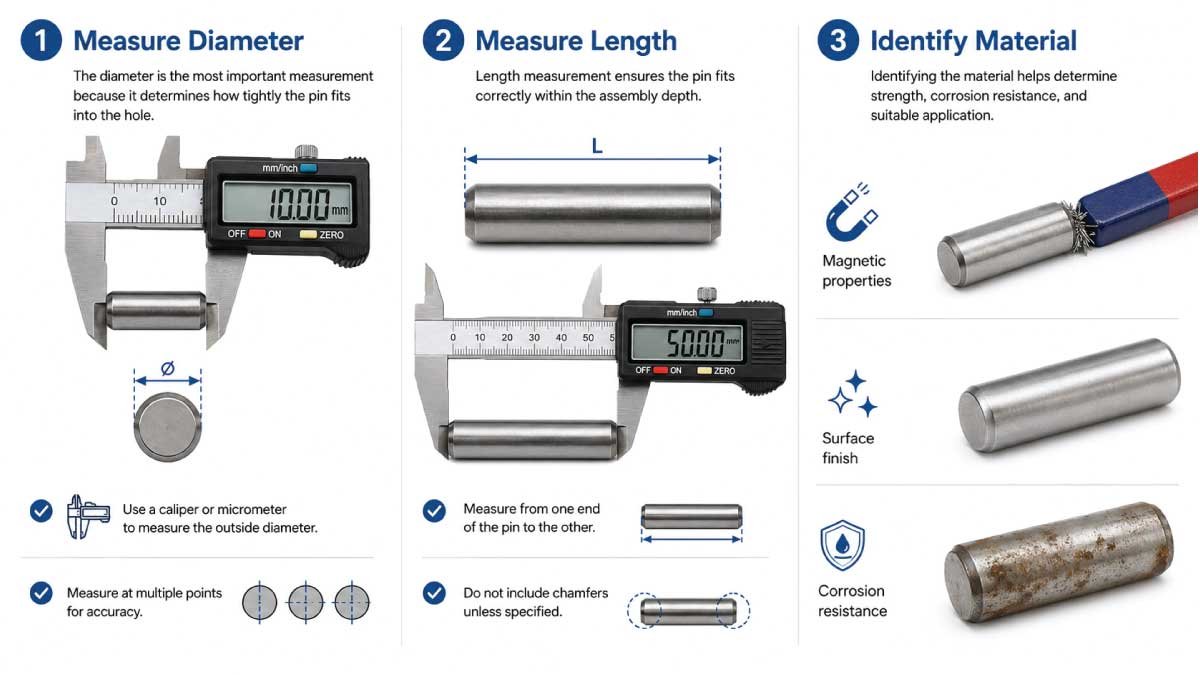
Correct measurement of a dowel pin is essential for proper replacement, fit, and assembly accuracy. Even small measurement errors can cause misalignment or loose fitting in mechanical and woodworking applications. Using proper tools ensures reliable and precise results.
1. Measure Diameter
The diameter is the most important measurement because it determines how tightly the pin fits into the hole. It should be measured accurately using precision tools to avoid installation issues. Use a caliper or micrometer to measure the outside diameter. Measure at multiple points for accuracy.
2. Measure Length
Length measurement ensures the pin fits correctly within the assembly depth. It must be measured carefully from end to end to avoid incorrect sizing during installation. Measure from one end of the pin to the other. Do not include chamfers unless specified.
3. Identify Material
Identifying the material helps determine strength, corrosion resistance, and suitable application. Different materials perform differently under load, moisture, and temperature conditions.
Check for:
- Magnetic properties
- Surface finish
- Corrosion resistance
This helps identify steel, stainless steel, or plastic pins.
How to Choose the Correct Dowel Pin Size
Choosing the correct dowel pin size is important for achieving accurate alignment, strong positioning, and long-lasting performance in mechanical assemblies. The right selection depends on load conditions, precision requirements, environmental exposure, and maintenance needs. Proper sizing ensures stability and prevents misalignment or mechanical failure in engineering applications.
1. Load Requirements
Load capacity is a key factor in selecting dowel pins. Heavy-duty applications require larger and stronger pins that can withstand stress without bending or breaking. For high-stress systems, hardened steel dowel pins are recommended because they offer superior strength, durability, and resistance to deformation under continuous load conditions.
2. Alignment Precision
Precision is critical in assemblies where exact positioning is required. Tight-tolerance dowel pins are used in such applications to ensure accurate alignment between components. Loose tolerances can lead to misalignment, vibration, and reduced system efficiency. Proper fit ensures smooth operation and maintains the integrity of mechanical assemblies.
3. Environmental Conditions
Environmental exposure greatly affects dowel pin performance. In wet, humid, or corrosive environments, stainless steel dowel pins are preferred due to their resistance to rust and chemical damage. Carbon steel pins without protective coatings may corrode over time, reducing strength and reliability in harsh working conditions.
4. Ease of Maintenance
Maintenance requirements also influence dowel pin selection. Slip-fit dowel pins are easier to install and remove, making them suitable for components that require frequent servicing. In contrast, press-fit dowel pins provide a stronger, more permanent connection but are harder to remove during maintenance or repair work.
Advantages of Dowel Pins
Dowel pins are widely used in mechanical and engineering applications due to their simplicity, strength, and reliability. They provide several important benefits that improve assembly performance and structural accuracy.
1. High Precision
Dowel pins ensure precise alignment between connected components. Their accurate positioning helps maintain consistent geometry in assemblies, which is essential in machinery, tools, and engineered systems where even small deviations can affect performance and functionality.
2. Strong Positioning
Dowel pins offer excellent resistance to movement under load. Once installed, they securely hold components in place, preventing shifting or misalignment. This makes them ideal for applications requiring stable and reliable mechanical positioning.
3. Simple Design
The cylindrical and straightforward design of dowel pins makes them easy to manufacture, install, and replace. Their simplicity reduces assembly complexity and allows for quick installation without requiring specialized tools or complicated procedures.
4. Cost Effective
Dowel pins are an economical fastening solution compared to more complex alignment systems. They provide high performance at a low cost, making them suitable for both small-scale and large industrial applications where budget efficiency is important.
5. Long Service Life
Hardened dowel pins offer excellent resistance to wear, pressure, and deformation. This ensures long service life even in demanding mechanical environments. Their durability reduces replacement frequency and improves overall system reliability and maintenance efficiency.
Recommended Reading
Common Dowel Pin Problems
Improper sizing, poor installation, or unsuitable material selection can lead to several performance issues in dowel pin applications. These problems can reduce accuracy, weaken assemblies, and shorten the service life of mechanical or structural components.
1. Loose Fit
A loose fit occurs when the dowel pin does not sit tightly inside the hole. This usually happens due to oversized holes or worn-out components. It reduces the effectiveness of alignment and can affect overall system stability.
Can lead to:
- Vibration
- Misalignment
- Reduced accuracy
2. Difficult Installation
Installation problems occur when the hole is too tight or improperly machined. Forcing a pin into an undersized hole can damage both the pin and the surrounding material, leading to assembly failure.
3. Corrosion
Corrosion is a common issue for carbon steel dowel pins when used in humid or wet environments. Rust formation weakens the pin and affects performance over time. Stainless steel pins are often used to prevent this problem.
4. Pin Breakage
Pin breakage can occur when excessive loads are applied or when the wrong material is selected for the application. This can result in sudden failure and damage to connected components.
Dowel Pin Installation Tips
Proper installation is essential for ensuring strong alignment, durability, and reliable performance. Following correct procedures helps prevent damage and extends the life of both the pin and the assembly.
1. Clean the Holes
Before installation, ensure all holes are free from dirt, oil, and debris. Clean surfaces allow proper fitting and reduce the risk of misalignment or damage.
2. Use Proper Tools
Always use suitable tools such as an arbor press or soft hammer for installation. Avoid using excessive force or inappropriate tools that may damage the pin. Avoid striking hardened pins directly with steel hammers.
3. Align Components Carefully
Proper alignment of components is essential before inserting the dowel pin. Misalignment can cause stress, deformation, or damage to both the pin and surrounding parts.
4. Avoid Excessive Force
Applying too much force during installation can deform the pin or damage the hole. Gentle and controlled installation ensures long-term reliability and proper fit.
Dowel Pin Standards
Several international standards define dowel pin dimensions.
Common standards include:
| Standard | Description |
|---|---|
| ISO 8734 | Hardened cylindrical dowel pins |
| DIN 6325 | Precision dowel pins |
| ASME B18.8.2 | Inch dowel pin standards |
| ISO 2338 | Parallel pins |
These standards ensure compatibility between components.
Dowel Pin vs Roll Pin
Dowel pins and roll pins are both used for alignment and fastening in mechanical assemblies, but they are designed for different purposes. Understanding their differences helps in selecting the right type for strength, flexibility, and installation requirements.
1. Dowel Pins
Dowel pins are solid cylindrical fasteners designed for precise alignment between components. They provide strong, rigid positioning and are commonly used where accuracy and stability are critical in mechanical assemblies.
Key characteristics:
- Solid construction
- High precision
- Strong alignment capability
2. Roll Pins
Roll pins, also known as spring pins, are hollow and slotted fasteners that compress slightly during installation. This flexibility allows them to absorb vibration and shock, making them suitable for dynamic or high-impact applications.
Key characteristics:
- Hollow and slotted
- Compress during installation
- Better for vibration absorption
3. Key Difference Summary
Dowel pins are best for precision alignment and rigid positioning, while roll pins are better suited for applications where flexibility, vibration resistance, and easy installation are required.
Conclusion
Dowel pins are essential components for accurate alignment and strong positioning in machinery, woodworking, automotive systems, and industrial equipment. Selecting the correct dowel pin size improves performance, durability, and assembly precision.
Whether you are working with inch or metric dowel pins, understanding dimensions, tolerances, materials, and installation methods helps ensure reliable results. Using the proper dowel pin chart and fit type can prevent alignment problems and extend equipment life.
Recommended Reading
FAQs:
What is the standard size of a dowel pin?
Dowel pins come in a range of standard sizes depending on imperial and metric systems. In imperial measurements, common sizes range from 1/16 inch to 1 inch. In metric systems, sizes typically range from 2 mm to 20 mm. The exact size used depends on the application, load, and precision requirements.
What material is best for dowel pins?
The best material depends on the working conditions. Hardened steel is widely used because it provides high strength, precision, and wear resistance. For environments exposed to moisture or chemicals, stainless steel is preferred due to its excellent corrosion resistance. Material selection directly affects durability and performance.
Are dowel pins reusable?
Reusability depends on the type of fit. Slip-fit dowel pins are generally reusable because they can be removed without significant damage. However, press-fit dowel pins are tightly installed and may get deformed or damaged during removal, making them less suitable for reuse in precision assemblies.
What is the purpose of a dowel pin?
Dowel pins are used to accurately align and position components in mechanical assemblies. They ensure precise fitting between parts in machinery, furniture, molds, and engineering structures. Their main purpose is to maintain stability, prevent movement, and improve alignment accuracy in assembled systems.
How do you install a dowel pin?
Dowel pins are installed by first ensuring the hole is correctly sized and aligned. Depending on the fit type, they are inserted either by hand (slip-fit) or pressed in using a tool or soft hammer (press-fit). Proper alignment is essential to avoid damage and ensure accurate positioning of components.

Engineer Hassan is a Mechanical Engineer with 16+ years of hands-on experience in mechanical hardware, fasteners, and workshop tools. He focuses on size selection, thread identification, and measurement, helping users choose the correct components with accuracy and safety.