
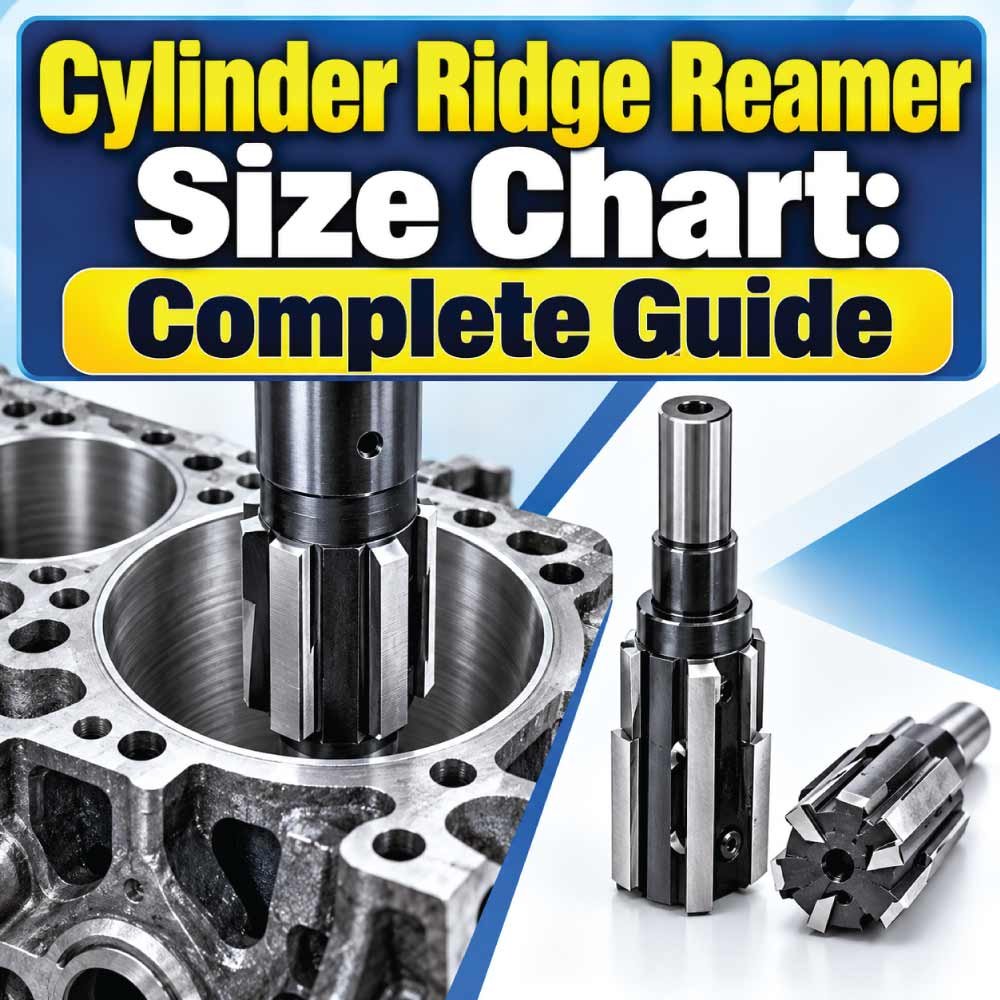
A cylinder ridge reamer is an engine rebuilding tool used to remove the worn ridge that can develop near the top of a cylinder bore. Choosing the correct size matters because the tool must fit the cylinder diameter while allowing the cutter to remove only the unwanted ridge.
This cylinder ridge reamer size chart explains common working ranges, bore dimensions, tool types, important measurements, and selection considerations. It also covers how ridge reamers work, how to measure a cylinder before choosing one, and common mistakes to avoid during engine rebuilding.
What Is a Cylinder Ridge Reamer?
A cylinder ridge reamer is a specialized engine service tool designed to remove the ridge formed at the upper portion of a cylinder bore. This ridge develops because piston rings normally travel through most of the cylinder but do not reach the very top of the bore.
Over time, the area above the upper ring’s normal travel can remain relatively unworn while the section below it experiences repeated piston movement. The difference in wear can create a noticeable step or ridge.
A ridge reamer uses an adjustable cutting mechanism to remove this raised material so that engine components can be serviced more safely.
The tool is particularly useful during:
- Engine rebuilding
- Piston removal
- Cylinder inspection
- Piston ring replacement
- Connecting-rod service
- Older engine overhaul work
- Automotive machine-shop operations
The important measurement is generally the cylinder bore diameter, not the overall physical length of the reamer.
Cylinder Ridge Reamer Size Chart
Cylinder ridge reamers are generally specified by the range of cylinder bore diameters they can accommodate. Different manufacturers produce different ranges, so there is no single universal ridge reamer size.
The following chart shows documented examples of common working ranges and representative applications.
| Reamer Size / Working Range | Approx. Metric Range | Typical Application | Important Note |
|---|---|---|---|
| 2-9/16–5 in | 65.1–127.0 mm | Large-range engine service | Verify tool design and cutter configuration |
| 2-11/16–5-5/16 in | 68.3–134.9 mm | Automotive and general engine rebuilding | Wide adjustable range |
| 3–5 in | 76.2–127.0 mm | Engine overhaul and rebuilding | Common large-bore range |
| 3–4-1/2 in | 76.2–114.3 mm | Compatible automotive engines | Suitable only within specified bore range |
| 2-1/2–4-3/4 in | 63.5–120.7 mm | Older and general-purpose engine work | Verify exact model specifications |
These ranges are tool-specific rather than universal standard sizes. For example, a widely used ridge reamer design is specified for approximately 2-11/16 to 5-5/16 inches, equivalent to about 68.3 to 134.9 mm. Other tools are designed for ranges such as 3 to 5 inches.
Always compare the actual cylinder bore with the manufacturer’s stated operating range before using a particular reamer.
Understanding Cylinder Ridge Reamer Dimensions
The term “size” can be confusing because a ridge reamer has several different dimensions.
The most important dimension for selection is the cylinder bore diameter range. Other physical dimensions affect handling and accessibility but do not necessarily determine whether the tool fits a cylinder.
Cylinder Bore Diameter
Cylinder bore diameter is the internal diameter of the cylinder in which the piston travels.
For a ridge reamer, the adjustable jaws or guides must accommodate this diameter. If the cylinder is outside the tool’s operating range, the reamer should not be forced into position.
Working Range
The working range describes the smallest and largest cylinder diameters that a particular reamer can accommodate.
For example, a tool rated at:
2-11/16 to 5-5/16 inches
has a working range from approximately:
- 2.6875 inches minimum
- 5.3125 inches maximum
- 68.3 mm minimum
- 134.9 mm maximum
This is more useful for selection than the overall dimensions of the tool.
Cutter Dimensions
The cutter is the component that actually removes the ridge. Some designs use a carbide cutter, while other tools may use replaceable cutting components.
The cutter’s exact dimensions and replacement specifications depend on the tool model. They should not be assumed from the overall reamer size.
Types of Cylinder Ridge Reamers
Cylinder ridge reamers differ mainly in their adjustment mechanisms, operating ranges, cutter arrangements, and intended applications.
Adjustable Cylinder Ridge Reamers
Adjustable ridge reamers are designed to accommodate different cylinder bore diameters.
They normally use an adjustable jaw, guide, or similar mechanism that allows the tool to be positioned inside different bore sizes.
This design is useful for workshops that service multiple engine types because one tool may cover a relatively broad diameter range.
Wide-Range Ridge Reamers
Wide-range models are intended to cover a large span of cylinder diameters.
A documented example has a range of approximately 2-11/16 to 5-5/16 inches, providing coverage from about 68.3 to 134.9 mm.
These tools can be useful when working with engines that have substantially different bore diameters.
Large-Bore Ridge Reamers
Some ridge reamers are designed around larger cylinder diameters, such as approximately 3 to 5 inches.
These can be appropriate for compatible automotive, industrial, or larger engine applications, provided the tool’s design and cutter configuration are suitable.
Specialized Ridge Reamers
Certain ridge reamers may be designed around particular engine applications or older equipment.
A specialized tool may have a narrower operating range but provide a suitable configuration for a particular cylinder design.
How Cylinder Ridge Reamers Work
A ridge reamer removes the raised portion at the top of the cylinder bore using a controlled cutting action.
The basic process involves positioning the tool inside the cylinder, adjusting the guides to the bore, positioning the cutter against the ridge, and gradually removing the unwanted material.
Many modern ridge reamers use features such as:
- Adjustable cutting mechanisms
- Spring-loaded cutters
- Rollers or guides
- Stabilizing springs
- Carbide cutting edges
- Fine adjustment mechanisms
- Rigid jaw assemblies
A spring-loaded cutter can help maintain contact with the cylinder contour while the tool is rotated. Stabilizing features can also reduce chatter during cutting.
The objective is not to enlarge the entire cylinder bore. The cutter should remove the ridge sufficiently for the intended engine service operation while avoiding unnecessary material removal.
Why Cylinder Ridge Removal Is Important
A pronounced ridge can interfere with piston removal because the upper portion of the piston and rings may encounter the unworn area of the bore.
If the piston is forced through a substantial ridge, the piston rings can be placed under unwanted stress.
Ridge removal can therefore be an important preparation step during certain engine rebuilds.
Common reasons for using a ridge reamer include:
- Creating clearance for piston removal
- Removing accumulated cylinder ridge
- Preparing an engine for overhaul
- Replacing pistons or rings
- Inspecting worn cylinder bores
- Preparing components for further machining
However, ridge removal does not repair a worn or damaged cylinder. If the bore has excessive wear, taper, scoring, cracking, or other damage, further inspection and machining may be required.
How to Measure Cylinder Bore Size for a Ridge Reamer
Correct measurement is essential when selecting a ridge reamer.
Do not select a tool simply because its name contains “large,” “standard,” or “universal.” Check the actual cylinder diameter and compare it with the tool’s published working range.
Step 1: Clean the Cylinder
Remove loose carbon, dirt, oil, and debris from the cylinder.
A dirty surface can interfere with accurate measurement and may make it more difficult to determine where the ridge begins.
Step 2: Identify the Cylinder Bore
Determine the internal diameter of the cylinder.
The measurement should represent the actual bore diameter rather than the outside diameter of the cylinder block.
Step 3: Use an Appropriate Measuring Tool
Depending on the required accuracy, a mechanic may use:
- Inside micrometer
- Dial bore gauge
- Telescoping gauge with an outside micrometer
- Appropriate precision bore-measuring equipment
A basic ruler or tape measure is generally unsuitable for accurate engine bore measurement.
Step 4: Measure at Multiple Locations
Cylinder wear may not be uniform.
Measurements at different heights and orientations can help identify taper and out-of-round conditions. This is especially important when the engine is already being inspected for rebuilding.
Step 5: Compare the Measurement With the Reamer Range
Once the bore diameter is known, compare it with the manufacturer’s specified operating range.
For example, if a reamer is rated from 2-11/16 to 5-5/16 inches, the cylinder must fall within that range.
Cylinder Ridge Reamer Size Selection Guide
Selecting the right ridge reamer involves more than matching one number.
| Selection Factor | What to Check | Why It Matters |
|---|---|---|
| Bore diameter | Actual cylinder ID | Determines basic tool compatibility |
| Working range | Minimum and maximum bore | Prevents selecting an undersized or oversized tool |
| Cutter type | Carbide or specified replacement cutter | Affects cutting capability |
| Guide design | Jaw, roller, or guide arrangement | Influences stability |
| Adjustment | Fine or coarse adjustment | Helps control cutter position |
| Cylinder access | Block and bore configuration | Determines whether the tool can be positioned correctly |
| Replacement parts | Cutter and wear components | Important for long-term use |
| Engine application | Automotive, industrial, specialty | Confirms suitability |
Choose a Range That Covers the Bore
The cylinder should fall comfortably within the specified operating range.
Do not assume that a tool rated close to the bore will automatically work properly. The complete tool configuration must also allow proper positioning of the cutter and guides.
Consider the Cutter
The cutter is one of the most important components.
A replaceable carbide cutter can provide a durable cutting edge, but the exact cutter specification must match the reamer.
Check Accessibility
The physical configuration of the cylinder block can affect how easily the ridge reamer can be installed.
A tool may technically cover the bore diameter but still be unsuitable if surrounding engine components prevent proper positioning.
Also Read:
Cylinder Ridge Reamer vs Cylinder Hone
A ridge reamer and cylinder hone perform completely different jobs.
A ridge reamer cuts the raised ridge at the top of the cylinder, while a cylinder hone is used to refine or restore the cylinder surface under appropriate rebuilding procedures.
| Feature | Cylinder Ridge Reamer | Cylinder Hone |
|---|---|---|
| Primary purpose | Remove cylinder ridge | Hone cylinder surface |
| Main action | Cutting | Abrasive finishing |
| Typical location | Upper cylinder ridge | Cylinder wall |
| Main concern | Controlled ridge removal | Bore geometry and surface finish |
| Used for | Ridge removal before service | Finishing or surface preparation |
| Typical adjustment | Bore diameter and cutter position | Stone or abrasive pressure/range |
A ridge reamer should not be treated as a substitute for cylinder honing.
If a cylinder requires dimensional correction, surface finishing, or restoration of proper bore geometry, the appropriate machining or honing procedure must be determined separately.
Important Cylinder Ridge Reamer Features
Different designs offer different features. Understanding them helps when comparing tools.
Spring-Loaded Cutter
A spring-loaded cutter can follow the cylinder contour and help maintain controlled contact with the ridge.
This can make adjustment more manageable during operation.
Stabilizer Spring
A stabilizing spring can help reduce movement or chatter while the tool is being rotated.
Less chatter can contribute to smoother and more controlled cutting.
Rollers
Some ridge reamers use rollers that contact the cylinder surface and help the tool rotate more smoothly.
Offset Jaw Guides
Offset guides can help maintain rigidity across the tool’s adjustment range.
Carbide Cutter
Carbide cutters are used in many ridge reamer designs because they provide a durable cutting edge for controlled material removal.
The exact cutter material and configuration should always be verified for the specific model.
Common Cylinder Ridge Reamer Sizes in Inches and Millimeters
Because many engine tools are sold using inch-based specifications, metric conversions are useful when working with metric measurements.
| Inch Size | Millimeter Equivalent |
|---|---|
| 2-1/2 in | 63.5 mm |
| 2-9/16 in | 65.1 mm |
| 2-11/16 in | 68.3 mm |
| 3 in | 76.2 mm |
| 3-1/2 in | 88.9 mm |
| 4 in | 101.6 mm |
| 4-1/2 in | 114.3 mm |
| 4-3/4 in | 120.7 mm |
| 5 in | 127.0 mm |
| 5-5/16 in | 134.9 mm |
These are diameter conversions, not separate standard ridge reamer sizes. A tool must still be checked against its actual published working range.
Also Read:
Common Mistakes When Choosing a Ridge Reamer
Selecting the wrong tool can cause problems during engine service.
Choosing by Engine Size Alone
Engine displacement does not directly tell you the cylinder bore diameter.
Two engines with similar displacement can have different bore and stroke dimensions.
Always use the actual cylinder bore measurement or the engine’s documented bore specification.
Ignoring the Working Range
A reamer must be designed for the cylinder diameter.
Using a tool outside its specified range can prevent proper guide and cutter positioning.
Assuming Every Universal Reamer Is the Same
“Universal” or “wide range” descriptions vary between manufacturers.
Always check the actual minimum and maximum bore dimensions.
Removing Too Much Material
The objective is controlled ridge removal, not aggressive enlargement of the cylinder.
Excessive cutting can alter the cylinder geometry unnecessarily.
Skipping Bore Inspection
A ridge can indicate normal wear, but it can also accompany significant taper, scoring, or other cylinder problems.
Removing the ridge does not eliminate the need for inspection.
Tips for Using a Cylinder Ridge Reamer
A few basic practices can improve control and reduce the chance of damaging the cylinder.
- Clean the bore before positioning the tool.
- Measure the cylinder before selecting the reamer.
- Confirm the tool’s minimum and maximum range.
- Position the guides securely against the bore.
- Adjust the cutter gradually.
- Avoid aggressive cutting pressure.
- Use the tool according to its manufacturer instructions.
- Inspect the cylinder after ridge removal.
- Replace worn or damaged cutters rather than forcing a dull cutter.
- Check for taper, out-of-round wear, scoring, and other damage during the rebuild.
The goal is controlled material removal, not speed.
Also Read:
When Should You Replace the Ridge Reamer Cutter?
A ridge reamer cutter is a wear component and eventually requires replacement.
Signs that a cutter may need attention include:
- Poor cutting performance
- Excessive force required during operation
- Chatter that cannot be corrected through proper adjustment
- Visible cutter damage
- Rounded or worn cutting edges
- Uneven ridge removal
A replacement cutter must be compatible with the exact reamer model.
Do not assume that cutters from two visually similar tools are interchangeable.
Frequently Asked Questions
What size ridge reamer do I need?
Choose a ridge reamer whose specified working range includes the actual cylinder bore diameter. Measure the bore and compare it with the manufacturer’s minimum and maximum range.
What is a common cylinder ridge reamer range?
One commonly documented design covers approximately 2-11/16 to 5-5/16 inches, or about 68.3 to 134.9 mm. Other models cover ranges such as 3 to 5 inches, so specifications vary.
Can a ridge reamer remove the entire cylinder ridge?
A properly adjusted ridge reamer can remove the unwanted raised portion of the cylinder ridge. The amount of cutting should remain controlled and appropriate for the intended engine service.
Does a ridge reamer enlarge the cylinder bore?
Its purpose is to remove the ridge rather than intentionally enlarge the complete cylinder bore. Excessive cutting should be avoided because cylinder geometry is important to engine operation.
Is a ridge reamer the same as a cylinder hone?
No. A ridge reamer uses a cutter to remove the ridge, while a cylinder hone uses abrasives to work on the cylinder surface.
Can I use a ridge reamer on any engine?
Not automatically. The tool must match the cylinder bore diameter, physical configuration, cutter design, and intended application. Always verify compatibility before use.
How do I know if the cylinder needs more than ridge removal?
Inspect for excessive taper, out-of-round wear, deep scoring, cracking, corrosion, or other damage. If the bore is outside acceptable dimensional limits, additional machining may be required.
Are ridge reamer sizes measured by bore diameter?
Yes. The key size specification is generally the cylinder bore diameter range the tool can accommodate.
Final Cylinder Ridge Reamer Size Selection Checklist
Before using or purchasing a ridge reamer, verify these points:
- Measure the cylinder bore diameter.
- Convert the measurement to the unit used by the tool specification if necessary.
- Confirm the reamer’s minimum and maximum working range.
- Check the cutter type and availability of replacements.
- Consider access around the cylinder bore.
- Inspect the cylinder for wear and damage.
- Use controlled cutter adjustment.
- Do not remove unnecessary cylinder material.
- Follow the specific tool manufacturer’s operating instructions.
A cylinder ridge reamer is a relatively specialized tool, so the correct size is determined primarily by the cylinder bore diameter and the reamer’s working range. A wide-range model may cover several engine applications, while a specialized model may be better suited to a narrower bore range.
The most reliable approach is to measure the cylinder accurately, compare that measurement with the tool’s published specifications, and confirm that the cutter and guide arrangement are appropriate for the engine being serviced.

Engineer Hassan is a Mechanical Engineer with 16+ years of hands-on experience in mechanical hardware, fasteners, and workshop tools. He focuses on size selection, thread identification, and measurement, helping users choose the correct components with accuracy and safety.