
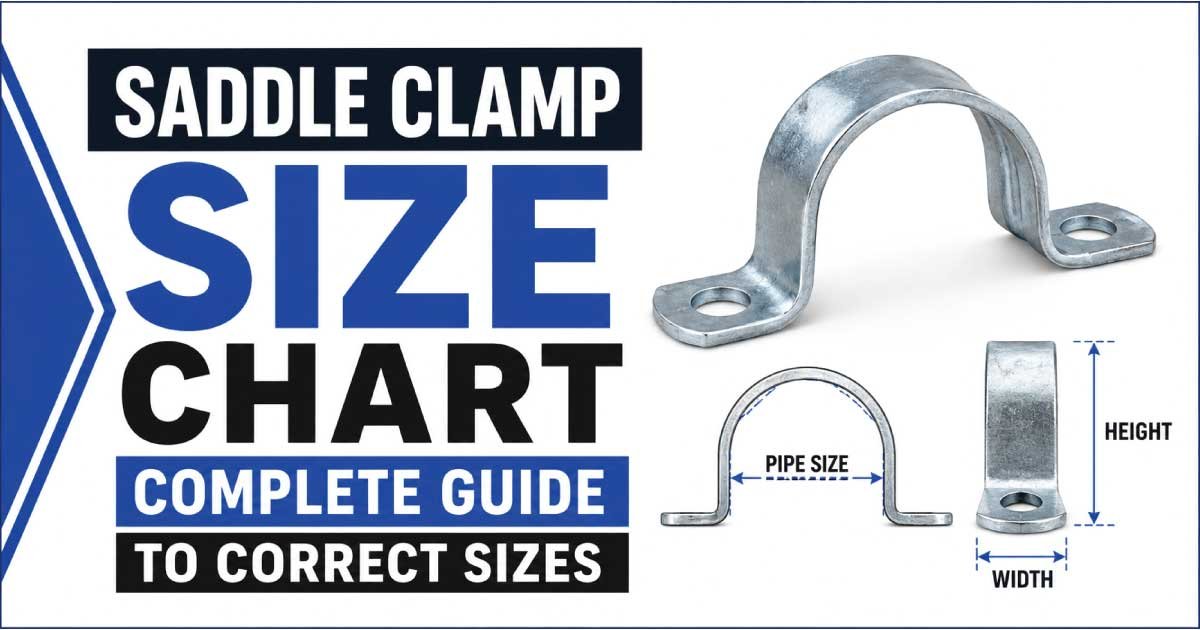
Saddle clamps are simple but versatile fastening components used to secure pipes, tubes, cables, hoses, conduit, and other cylindrical objects to a surface. Their curved saddle-shaped body fits around the outside of the material while screws, bolts, or other fasteners hold the clamp against the mounting surface.
Choosing the correct saddle clamp size depends primarily on the outside diameter of the pipe, tube, cable, or conduit being supported. Other important factors include clamp width, hole size, material, mounting surface, load, and environmental conditions.
This complete saddle clamp size chart and guide explains common sizes, dimensions, materials, applications, installation methods, measurement techniques, and how to select the right saddle clamp.
What Is a Saddle Clamp?
A saddle clamp is a curved fastening device designed to hold a round or cylindrical object securely against a surface.
The curved portion of the clamp forms a saddle around the object. Depending on the design, the clamp may be attached using:
- Screws
- Bolts
- Nuts
- Washers
- Threaded studs
- Welding
- Integrated mounting holes
Saddle clamps are commonly used for:
- Pipes
- Tubing
- Electrical conduit
- Hydraulic lines
- Pneumatic tubing
- Cables
- Hoses
- Automotive lines
- Irrigation pipes
- Industrial piping
The clamp size is normally selected according to the outside diameter of the object being secured.
How Does a Saddle Clamp Work?
A saddle clamp works by placing its curved body around or against a cylindrical component and fastening it to a supporting surface.
For a typical two-hole saddle clamp, the clamp is positioned over a pipe or cable and screws are installed through the mounting holes.
When tightened, the clamp applies pressure around the pipe and prevents unwanted:
- Movement
- Vibration
- Sagging
- Rotation
- Shifting
The clamp should hold the component securely without crushing, cutting, or excessively deforming it.
Saddle Clamp Size Chart
Saddle clamps are available in many sizes, and the exact dimensions depend on the clamp style and manufacturer. The table below provides a general reference based on common nominal outside diameters.
| Saddle Clamp Size | Approx. Outside Diameter | Common Application |
|---|---|---|
| 1/4 in | 0.25 in / 6.35 mm | Small tubing and cable |
| 3/8 in | 0.375 in / 9.53 mm | Tubing and wire |
| 1/2 in | 0.50 in / 12.7 mm | Small pipe and conduit |
| 5/8 in | 0.625 in / 15.9 mm | Tubing |
| 3/4 in | 0.75 in / 19.1 mm | Pipe and conduit |
| 1 in | 1.00 in / 25.4 mm | Small pipe |
| 1-1/4 in | 1.25 in / 31.8 mm | Plumbing and conduit |
| 1-1/2 in | 1.50 in / 38.1 mm | Pipe and tubing |
| 2 in | 2.00 in / 50.8 mm | Plumbing and industrial pipe |
| 2-1/2 in | 2.50 in / 63.5 mm | Larger pipe |
| 3 in | 3.00 in / 76.2 mm | Industrial piping |
| 4 in | 4.00 in / 101.6 mm | Large pipe |
Note: Saddle clamp dimensions are not universally standardized by nominal size. Always check the manufacturer’s actual inside diameter, mounting-hole spacing, hole diameter, material thickness, and overall dimensions.
Metric Saddle Clamp Size Chart
Metric saddle clamps are commonly selected according to the outside diameter of the pipe, tube, cable, or conduit.
| Clamp Size | Approx. Diameter | Typical Application |
|---|---|---|
| 6 mm | 6 mm | Small tubing |
| 8 mm | 8 mm | Cable and tubing |
| 10 mm | 10 mm | Small pipe |
| 12 mm | 12 mm | Tubing |
| 16 mm | 16 mm | Conduit and tubing |
| 20 mm | 20 mm | Pipe and conduit |
| 25 mm | 25 mm | Plumbing |
| 32 mm | 32 mm | Pipe |
| 40 mm | 40 mm | Tubing and pipe |
| 50 mm | 50 mm | Industrial pipe |
| 63 mm | 63 mm | Larger pipe |
| 75 mm | 75 mm | Industrial piping |
| 90 mm | 90 mm | Large pipe |
| 100 mm | 100 mm | Large installations |
Metric saddle clamps may also be manufactured in sizes that correspond to specific tubing, conduit, or pipe standards.
What Does Saddle Clamp Size Mean?
The listed saddle clamp size usually refers to the nominal diameter of the component the clamp is designed to secure.
For example, a clamp listed as:
1-inch saddle clamp
is generally intended for a component with an outside diameter around 1 inch.
However, this does not mean every 1-inch saddle clamp has exactly the same internal dimensions.
Different manufacturers may provide slightly different:
- Inside diameters
- Body widths
- Mounting-hole sizes
- Hole spacing
- Material thickness
- Overall height
Therefore, always check the actual dimensional drawing when an exact fit is required.
How to Measure for a Saddle Clamp
Measuring the component before purchasing a clamp is the best way to achieve a proper fit.
Step 1: Measure the Outside Diameter
Use a caliper to measure the outside diameter of the pipe, tube, conduit, hose, or cable.
For a round component, measure directly across its widest point.
Step 2: Check the Clamp Inside Diameter
The inside diameter of the saddle should accommodate the component without excessive looseness.
Step 3: Measure Mounting Hole Diameter
Check the diameter of the screw or bolt hole.
Step 4: Measure Hole Spacing
For a two-hole saddle clamp, measure the center-to-center distance between the mounting holes.
Step 5: Check Clamp Height
Make sure there is sufficient clearance between the mounted component and the supporting surface.
Saddle Clamp Dimensions
Several dimensions may be important when selecting a clamp.
Inside Diameter
This is the curved opening that fits around the pipe or tube.
It is usually the most important dimension for determining whether the clamp fits.
Overall Width
The width of the clamp body affects its contact area and mounting arrangement.
Overall Height
Height determines the distance between the mounting surface and the center or outside of the pipe.
Mounting Hole Diameter
The mounting holes determine which screws or bolts can be used.
Mounting Hole Spacing
Two-hole saddle clamps require sufficient space between the holes for proper installation.
Material Thickness
Thicker clamp material can provide greater rigidity, although actual load capacity depends on the entire clamp design.
Discover More: Set Screw Size Chart: Complete Expert Size Guide
Types of Saddle Clamps
There are several types of saddle clamps designed for different applications.
Two-Hole Saddle Clamp
Two-hole saddle clamps have a mounting hole on each side of the saddle.
They are commonly used for:
- Pipes
- Conduit
- Tubing
- Cables
- Hoses
They provide a stable mounting arrangement and are easy to install.
One-Hole Saddle Clamp
A one-hole saddle clamp uses a single mounting point.
These clamps are commonly used for lighter-duty applications where quick installation is important.
Plastic Saddle Clamp
Plastic saddle clamps are lightweight and resistant to many forms of corrosion.
They are commonly used for:
- Electrical cables
- Small tubing
- Irrigation
- Low-load applications
- Indoor installations
Metal Saddle Clamp
Metal saddle clamps provide greater mechanical strength and are commonly used for pipes, conduit, industrial tubing, and mechanical installations.
Saddle Clamp Materials
The material of a saddle clamp should be selected according to the application and environment.
Stainless Steel Saddle Clamp
Stainless steel clamps provide excellent corrosion resistance.
They are commonly used in:
- Outdoor applications
- Marine environments
- Food-processing equipment
- Chemical environments
- Plumbing
- Industrial installations
Galvanized Steel Saddle Clamp
Galvanized steel provides corrosion protection through a zinc coating.
It is commonly used for:
- Construction
- Outdoor piping
- Electrical conduit
- General industrial applications
Carbon Steel Saddle Clamp
Carbon steel clamps provide good mechanical strength and are commonly used in general industrial applications.
A protective finish may be added to improve corrosion resistance.
Plastic Saddle Clamp
Plastic clamps are lightweight and electrically nonconductive.
They can be useful when corrosion resistance and electrical isolation are more important than maximum mechanical strength.
Saddle Clamp for Pipe
Saddle clamps are frequently used to secure pipes to:
- Walls
- Floors
- Ceilings
- Frames
- Structural members
- Equipment
When selecting a pipe saddle clamp, consider:
- Pipe outside diameter
- Pipe material
- Pipe weight
- Fluid weight
- Temperature
- Vibration
- Support spacing
- Mounting surface
A heavy pipe carrying fluid may require a stronger clamp and more frequent support points than a lightweight tube.
Saddle Clamp for Electrical Conduit
Electrical conduit is commonly secured using saddle-style clamps.
The clamp size should match the outside diameter of the conduit, not simply the nominal trade size.
This distinction is important because conduit trade size and actual outside diameter are not always identical.
Always verify the actual conduit diameter before selecting a clamp.
Saddle Clamp for Cable
Saddle clamps can also be used to organize and secure cables.
For cable applications, the clamp should:
- Fit without crushing the cable
- Avoid damaging insulation
- Provide sufficient support
- Resist vibration
- Match the cable diameter
For sensitive cables, a rubber-lined clamp or cushioned clamp may be more appropriate.
Saddle Clamp for Hose
Hoses can be secured using saddle-style clamps when the clamp provides sufficient clearance and does not damage the hose.
Avoid excessive tightening because a rigid clamp can deform the hose.
For hydraulic, pneumatic, or high-pressure systems, use a support clamp specifically rated for the application.
Rubber-Lined Saddle Clamps
Rubber-lined saddle clamps have a protective elastomer layer between the metal clamp and the pipe or tube.
The lining can help:
- Reduce vibration
- Prevent metal-to-metal contact
- Protect surface finishes
- Reduce noise
- Improve grip
- Reduce abrasion
They are especially useful for automotive lines, hydraulic tubing, electrical conduit, and vibration-sensitive installations.
Saddle Clamp vs U-Bolt Clamp
Saddle clamps and U-bolt clamps are both used to secure cylindrical components, but their designs are different.
| Feature | Saddle Clamp | U-Bolt Clamp |
|---|---|---|
| Main shape | Curved saddle | U-shaped bolt |
| Mounting | Usually screws/bolts | Nuts on threaded legs |
| Installation | Simple surface mounting | Requires access to both legs |
| Common use | Pipe, cable, conduit | Pipe and structural mounting |
| Load capacity | Depends on design | Often suitable for heavier loads |
| Surface protection | Optional lining | Often uses saddle plate |
A saddle clamp is often more convenient when mounting a pipe directly against a wall or flat surface.
Discover More: Blind Rivet Size Chart: Pro Detailed Reference Guide
Saddle Clamp vs Pipe Clamp
The term “pipe clamp” describes a broad category of pipe-support products.
A saddle clamp is one specific style of pipe clamp.
Other pipe-support designs include:
- Split-ring clamps
- U-bolt clamps
- Two-piece clamps
- Cushioned clamps
- Heavy-duty pipe clamps
- Hanger clamps
The best option depends on the pipe size, load, mounting arrangement, and environment.
How to Choose the Correct Saddle Clamp Size
Choosing the correct saddle clamp starts with accurate measurement.
1. Measure the Outside Diameter
Measure the actual outside diameter of the pipe, tube, conduit, hose, or cable.
2. Select the Appropriate Clamp Size
Choose a clamp designed for that diameter.
3. Check the Internal Clearance
Make sure the clamp is not excessively tight.
4. Check Mounting Holes
Verify that the mounting holes accommodate the selected screws or bolts.
5. Consider the Load
Heavy pipes and equipment require stronger clamps.
6. Consider Vibration
For vibrating machinery, a rubber-lined clamp may reduce movement and noise.
7. Select the Material
Choose stainless steel, galvanized steel, carbon steel, or plastic based on the environment.
8. Check the Mounting Surface
Make sure the screws or anchors are suitable for the wall, frame, concrete, or other supporting surface.
Discover More: Solid Rivet Size Chart: Powerful Engineering Handbook
Saddle Clamp Installation Guide
Installing a saddle clamp is generally straightforward.
Step 1: Position the Component
Place the pipe, tube, conduit, or cable where it needs to be supported.
Step 2: Position the Saddle Clamp
Place the curved section around the component.
Step 3: Mark the Mounting Holes
Mark the screw or bolt locations through the clamp.
Step 4: Prepare the Mounting Surface
Drill holes or prepare threaded mounting points as required.
Step 5: Install the Fasteners
Insert the screws or bolts through the clamp.
Step 6: Tighten Evenly
Tighten the fasteners evenly to secure the component.
Step 7: Check the Installation
Make sure the component is secure without excessive compression or deformation.
Common Saddle Clamp Installation Mistakes
Using the Wrong Size
A clamp that is too small can damage the component.
A clamp that is too large may allow excessive movement.
Over-Tightening
Excessive tightening can deform:
- Plastic pipe
- Thin tubing
- Cable insulation
- Rubber hose
Incorrect Fasteners
The mounting screws or bolts must be appropriate for the clamp and substrate.
Ignoring Vibration
Rigid metal-to-metal contact can create noise and wear in vibrating systems.
Insufficient Support
Long pipe or tubing runs may require multiple clamps at appropriate intervals.
Saddle Clamp Spacing
The correct spacing between clamps depends on the component and installation conditions.
Factors include:
- Pipe material
- Pipe diameter
- Pipe weight
- Fluid weight
- Temperature
- Vibration
- Horizontal or vertical installation
- Local building or engineering requirements
Large or heavy pipes generally require closer support than small lightweight tubing.
For plumbing, HVAC, industrial piping, and structural applications, follow the relevant installation requirements rather than relying on a generic spacing value.
Saddle Clamp Applications
Saddle clamps are used across many industries.
Common applications include:
- Plumbing
- HVAC
- Electrical installation
- Automotive systems
- Industrial piping
- Hydraulic systems
- Pneumatic systems
- Irrigation
- Manufacturing
- Agriculture
- Construction
- Cable management
- Machine building
Their simple design makes them useful for both permanent and serviceable installations.
Advantages of Saddle Clamps
Saddle clamps offer several benefits.
Simple Installation
Most saddle clamps require only basic mounting hardware.
Compact Design
They can hold a pipe or cable close to a mounting surface.
Wide Size Range
Saddle clamps are available for very small cables and tubing as well as larger pipes.
Multiple Materials
Metal and plastic options are available for different environments.
Versatile Applications
They can secure pipes, tubes, conduit, cables, and hoses.
Limitations of Saddle Clamps
Saddle clamps may not be appropriate for every application.
Potential limitations include:
- Limited load capacity for lightweight designs
- Possible pipe damage if overtightened
- Corrosion risk with unsuitable materials
- Vibration concerns
- Limited adjustment
- Need for appropriate mounting hardware
For high-pressure, high-temperature, heavy industrial, or safety-critical systems, use a clamp specifically designed and rated for that application.
Saddle Clamp Size Chart Quick Reference
| Size | Approx. Outside Diameter | Common Use |
|---|---|---|
| 1/4 in | 6.35 mm | Cable and small tubing |
| 3/8 in | 9.53 mm | Tubing |
| 1/2 in | 12.7 mm | Small conduit |
| 5/8 in | 15.9 mm | Tubing |
| 3/4 in | 19.1 mm | Pipe and conduit |
| 1 in | 25.4 mm | Small pipe |
| 1-1/4 in | 31.8 mm | Plumbing |
| 1-1/2 in | 38.1 mm | Pipe and tubing |
| 2 in | 50.8 mm | Plumbing and industrial pipe |
| 2-1/2 in | 63.5 mm | Larger pipe |
| 3 in | 76.2 mm | Industrial piping |
| 4 in | 101.6 mm | Large pipe |
| 25 mm | 25 mm | Metric pipe/tube |
| 32 mm | 32 mm | Metric pipe |
| 40 mm | 40 mm | Tubing |
| 50 mm | 50 mm | Industrial pipe |
| 75 mm | 75 mm | Large pipe |
| 100 mm | 100 mm | Large installations |
Important: These are general nominal sizes. Actual saddle clamp inside diameter and other dimensions vary according to the manufacturer, clamp style, material, and intended application.
Frequently Asked Questions About Saddle Clamp Sizes
What is a saddle clamp used for?
A saddle clamp is used to secure pipes, tubes, cables, hoses, conduit, and other cylindrical components to a wall, floor, frame, or other mounting surface. Its curved body fits around the component while screws or bolts hold the clamp in position.
How do I choose the correct saddle clamp size?
Measure the actual outside diameter of the pipe, tube, conduit, cable, or hose and select a clamp designed for that diameter. Also check the clamp’s internal clearance, mounting-hole dimensions, material, and load capacity before installation.
What are the common saddle clamp sizes?
Common saddle clamp sizes include 1/4, 3/8, 1/2, 3/4, 1, 1-1/2, 2, 3, and 4 inches. Metric sizes such as 10, 12, 16, 20, 25, 32, 40, 50, and 100 mm are also available.
How do you measure a saddle clamp?
Measure the inside diameter of the curved saddle, mounting-hole diameter, hole spacing, overall width, and height. When selecting a replacement, also measure the outside diameter of the component being clamped to ensure the saddle provides a proper fit.
Can saddle clamps be used for electrical conduit?
Yes. Saddle clamps are commonly used to secure electrical conduit and tubing. The clamp should match the actual outside diameter of the conduit and provide secure mounting without crushing or damaging the conduit.
Are saddle clamps suitable for pipes?
Yes. Saddle clamps are widely used for pipe support and mounting. The correct clamp depends on pipe diameter, material, weight, temperature, vibration, and mounting surface. Heavy industrial piping may require specially engineered pipe-support clamps rather than lightweight saddle clamps.
What material is best for a saddle clamp?
The best material depends on the environment. Stainless steel is suitable for corrosion-prone environments, galvanized steel is useful for many outdoor applications, carbon steel provides strength, and plastic works well for lightweight and corrosion-resistant applications.
What is the difference between a saddle clamp and a U-bolt clamp?
A saddle clamp generally uses a curved body with mounting holes, while a U-bolt clamp uses a U-shaped threaded bolt secured with nuts. Saddle clamps are convenient for mounting components against flat surfaces, while U-bolts are often used for heavier pipe-support applications.
Can saddle clamps be used on cables?
Yes. Saddle clamps can secure cables when correctly sized. For sensitive cables, a rubber-lined or cushioned saddle clamp can help protect the insulation and reduce vibration, abrasion, and metal-to-metal contact.
Should a saddle clamp be tight around the pipe?
The clamp should hold the pipe securely without excessive compression. Over-tightening can deform thin-wall tubing, plastic pipe, hoses, or cable insulation. The appropriate tightening method depends on the clamp design and the component being supported.
Final Thoughts
A saddle clamp size chart provides a useful starting point for selecting clamps for pipes, tubing, cables, conduit, and hoses. The most important measurement is usually the outside diameter of the component being supported.
Common sizes range from small 1/4-inch clamps for cables and tubing to larger 4-inch clamps for pipe and industrial installations. Metric saddle clamps are also widely available.
However, nominal size alone does not determine whether a clamp will fit correctly. Always check the actual inside diameter, mounting-hole size, hole spacing, material thickness, load capacity, and environmental requirements.
For applications involving heavy pipes, high pressure, high temperatures, significant vibration, or safety-critical equipment, use a properly rated support system and follow the applicable engineering or installation requirements.

Engineer Hassan is a Mechanical Engineer with 16+ years of hands-on experience in mechanical hardware, fasteners, and workshop tools. He focuses on size selection, thread identification, and measurement, helping users choose the correct components with accuracy and safety.