
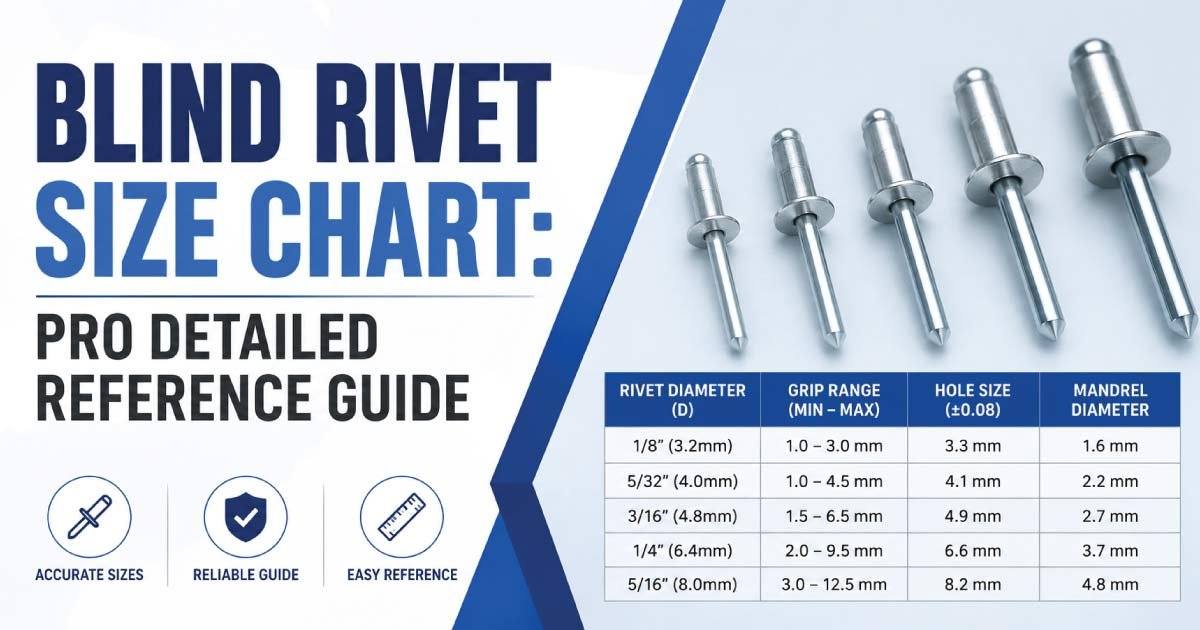
Blind rivets are one of the most popular permanent fasteners used in manufacturing, construction, automotive assembly, aerospace applications, and sheet metal fabrication. They are designed to be installed from only one side of the workpiece, making them ideal when access to the back side of the material is limited or impossible.
Understanding a Blind Rivet Size Chart is essential for selecting the correct rivet diameter, grip range, and length for a secure and reliable connection. This guide explains blind rivet sizes, dimensions, types, materials, uses, and installation methods.
What Is a Blind Rivet?
A blind rivet, also known as a pop rivet, is a mechanical fastener used to join two or more materials together when access is available from only one side. It consists of a rivet body and a mandrel (stem). During installation, the mandrel is pulled through the rivet body using a rivet gun, causing the body to expand and tightly clamp the materials. Once the correct force is reached, the mandrel breaks off, leaving a permanent joint.
Blind rivets are widely used in industries because they are quick, reliable, and easy to install from a single side.
How Does a Blind Rivet Work?
The working process of a blind rivet is simple and efficient, making it ideal for fast assembly operations.
- Drill a hole through the materials
- Insert the blind rivet into the hole
- Place the rivet gun on the mandrel
- Pull the trigger
- The rivet body expands behind the material
- The mandrel snaps off
The result is a strong, vibration-resistant, and permanent fastening joint suitable for many industrial applications.
Blind Rivet Size Chart
The Blind Rivet Size Chart shows common rivet diameters along with their corresponding hole sizes. This helps ensure proper fitment and strong joint performance.
| Rivet Diameter | Diameter (Inches) | Diameter (mm) | Hole Size |
|---|---|---|---|
| 3/32″ | 0.094 | 2.4 mm | 3/32″ |
| 1/8″ | 0.125 | 3.2 mm | 1/8″ |
| 5/32″ | 0.156 | 4.0 mm | 5/32″ |
| 3/16″ | 0.188 | 4.8 mm | 3/16″ |
| 1/4″ | 0.250 | 6.4 mm | 1/4″ |
These are the most commonly used blind rivet sizes across industrial applications.
Blind Rivet Grip Range Chart
Grip range refers to the total thickness of materials that a rivet can securely fasten. Selecting the correct grip range is essential for achieving a strong and reliable joint.
| Rivet Size | Grip Range |
|---|---|
| 1/8″ × 1/4″ | 0.020″ – 0.125″ |
| 1/8″ × 3/8″ | 0.125″ – 0.250″ |
| 5/32″ × 1/2″ | 0.188″ – 0.375″ |
| 3/16″ × 1/2″ | 0.250″ – 0.500″ |
| 1/4″ × 5/8″ | 0.375″ – 0.625″ |
Always select a rivet whose grip range matches the combined thickness of the materials being joined.
Common Blind Rivet Lengths
Blind rivets are available in various lengths to accommodate different material thicknesses and application requirements. Choosing the correct length ensures proper expansion and secure fastening.
| Length (Inches) | Length (mm) |
|---|---|
| 1/4″ | 6.35 mm |
| 3/8″ | 9.53 mm |
| 1/2″ | 12.7 mm |
| 5/8″ | 15.88 mm |
| 3/4″ | 19.05 mm |
| 1″ | 25.4 mm |
Longer rivets are typically used for thicker material assemblies, while shorter rivets are suitable for thin sheet materials.
Types of Blind Rivets
Different applications require different blind rivet designs. Each type is engineered to provide specific performance characteristics such as strength, sealing capability, grip range, or load distribution. Understanding the various blind rivet types helps ensure proper fastener selection for reliable, durable, and efficient assembly in different industries.
1. Open-End Blind Rivets
Open-end blind rivets are the most common and widely used type of blind rivet. They offer an economical fastening solution and can be installed quickly with standard riveting tools. Their versatility makes them suitable for numerous light-duty and general manufacturing applications.
Features:
- Economical
- Easy installation
- General-purpose use
Applications:
- Sheet metal
- HVAC systems
- Furniture manufacturing
2. Closed-End Blind Rivets
Closed-end blind rivets feature a sealed end that prevents moisture, air, and other contaminants from passing through the fastened joint. They are commonly used where leak prevention and corrosion resistance are important for maintaining long-term reliability and performance.
Features:
- Sealed design
- Prevents leakage
- Better moisture resistance
Applications:
- Marine equipment
- Tanks
- Outdoor structures
3. Multi-Grip Blind Rivets
Multi-grip blind rivets are designed to accommodate a wider range of material thicknesses than standard rivets. Their flexible grip capacity reduces the need for multiple rivet sizes, helping simplify inventory management and making installation more efficient in various assembly operations.
Features:
- Wide grip range
- Reduced inventory requirements
- Flexible installation
Applications:
- General manufacturing
- Maintenance work
- Large flange assemblies
4. Large Flange Blind Rivets
Large flange blind rivets have a larger head diameter that spreads the clamping force across a greater surface area. This feature helps prevent material damage and improves pull-through resistance when fastening soft, brittle, or thin materials.
Features:
- Larger head diameter
- Improved load distribution
- Better pull-through resistance
Applications:
- Soft materials
- Plastic assemblies
- Fiberglass components
5. Structural Blind Rivets
Structural blind rivets are specifically designed for heavy-duty applications requiring exceptional strength and durability. They provide high shear and tensile performance, making them ideal for demanding environments where vibration resistance and long-term joint integrity are essential.
Features:
- High strength
- Excellent vibration resistance
- Increased shear capacity
Applications:
- Heavy equipment
- Transportation
- Construction
Blind Rivet Materials
The material used in a blind rivet significantly affects its strength, corrosion resistance, weight, durability, and overall performance. Selecting the appropriate rivet material helps ensure compatibility with the application environment while improving the longevity and reliability of the fastened joint.
1. Aluminum Blind Rivets
Aluminum blind rivets are among the most commonly used rivets due to their lightweight construction and excellent corrosion resistance. They are easy to install and are ideal for applications where reducing weight is important without sacrificing reliable fastening performance.
Advantages:
- Lightweight
- Corrosion resistant
- Easy to install
Applications:
- HVAC systems
- Electronics
- General fabrication
2. Steel Blind Rivets
Steel blind rivets provide greater strength and durability than aluminum rivets, making them suitable for heavy-duty applications. Their high load-bearing capacity and cost-effectiveness make them a popular choice for industrial, construction, and automotive fastening requirements.
Benefits:
- High strength
- Durable
- Cost-effective
Applications:
- Automotive manufacturing
- Construction
- Machinery
3. Stainless Steel Blind Rivets
Stainless steel blind rivets offer outstanding corrosion resistance and long service life in harsh environments. They maintain their strength and appearance even when exposed to moisture, chemicals, and outdoor conditions, making them ideal for demanding applications.
Advantages:
- Excellent corrosion resistance
- Long service life
- Outdoor suitability
Applications:
- Marine environments
- Food processing equipment
- Outdoor structures
4. Copper Blind Rivets
Copper blind rivets are valued for their excellent electrical conductivity, corrosion resistance, and attractive appearance. They are commonly used in specialized applications where conductivity or decorative finishing is required along with dependable fastening performance.
Benefits:
- Electrical conductivity
- Corrosion resistance
- Attractive appearance
Applications:
- Electrical installations
- Decorative assemblies
Blind Rivet Head Styles
Blind rivet head styles are designed to meet different appearance, strength, and load-distribution requirements. Selecting the proper head style helps improve joint performance, enhance aesthetics, and ensure the rivet functions effectively in the intended application and material type.
1. Dome Head
Dome head blind rivets are the most commonly used rivet style because they provide a strong and reliable fastening solution for a wide range of applications. Their rounded profile offers an attractive appearance while maintaining excellent holding strength and versatility.
Features:
- Strong design
- Attractive appearance
- Versatile use
2. Countersunk Head
Countersunk head blind rivets are designed to sit flush with the material surface after installation. This creates a smooth, streamlined finish that improves appearance and reduces surface protrusions, making them suitable for applications where aerodynamics or aesthetics are important.
Features:
- Flush surface finish
- Smooth appearance
Applications:
- Aerospace
- Automotive panels
- Decorative projects
3. Large Flange Head
Large flange head blind rivets feature a wider head diameter that spreads clamping forces over a larger area. This design improves load distribution and helps prevent material pull-through, especially when fastening thin, soft, or brittle materials.
Features:
- Larger bearing area
- Better load distribution
Applications:
- Thin materials
- Soft materials
How to Read a Blind Rivet Size
Understanding blind rivet size designations is essential for selecting the correct fastener for a specific application. Rivet sizes typically include the diameter and length of the rivet body. These dimensions help determine the rivet’s strength, grip range, and suitability for the materials being joined.
1. Imperial Size Example
A typical blind rivet designation may appear as:
3/16″ × 1/2″
This means:
- Diameter = 3/16 inch
- Length = 1/2 inch
The diameter indicates the thickness of the rivet body and directly affects the rivet’s strength and load-carrying capability. The length represents the body length of the rivet and helps determine the material thickness it can securely fasten.
2. Metric Size Example
A metric blind rivet size may appear as:
4.8 mm × 12 mm
This means:
- Diameter = 4.8 mm
- Length = 12 mm
Metric sizing follows the same principle as imperial sizing. The first number represents the rivet diameter, while the second number represents the rivet length, allowing users to select the correct rivet for the required grip range and application.
3. Understanding Diameter and Length
The diameter of a blind rivet primarily determines its strength, shear resistance, and overall holding capacity. Larger diameters generally provide stronger joints. The length determines the rivet’s grip capacity, ensuring proper expansion behind the material and creating a secure, reliable connection.
How to Choose the Correct Blind Rivet Size
Selecting the correct blind rivet size is essential for creating a strong, secure, and long-lasting fastening connection. The right rivet depends on several factors, including material thickness, load requirements, environmental conditions, and hole dimensions. Understanding these factors helps prevent joint failure, vibration issues, and premature wear in both industrial and DIY applications.
1. Material Thickness
The most important factor when selecting a blind rivet is the total thickness of the materials being joined. This combined thickness must fall within the rivet’s grip range. If the grip range is too small or too large, the rivet may not clamp properly, resulting in a weak connection, reduced holding strength, and potential structural failure over time.
2. Load Requirements
The amount of load or force applied to the joint significantly influences rivet selection. Applications subjected to high tensile or shear loads typically require larger rivet diameters and stronger materials. Choosing a rivet with sufficient strength ensures the joint can withstand operational stresses, vibrations, and repeated use without loosening or breaking.
3. Material Type
Different materials require different rivet designs for optimal performance. Soft materials such as plastic, fiberglass, thin sheet metal, and wood can be damaged by concentrated pressure. Large flange blind rivets distribute the load over a wider surface area, reducing material deformation and improving holding strength while maintaining a secure and reliable connection.
4. Environmental Conditions
Environmental exposure plays a major role in rivet durability and service life. Outdoor, marine, and high-humidity environments can cause corrosion if unsuitable rivet materials are used. Stainless steel, aluminum, or corrosion-resistant coated rivets are commonly selected for harsh conditions to ensure long-term performance, structural integrity, and reduced maintenance requirements.
5. Hole Size
The drilled hole diameter must closely match the selected blind rivet diameter for proper installation. An oversized hole can reduce grip strength and cause joint movement, while an undersized hole may prevent installation. Following manufacturer-recommended hole sizes helps achieve maximum fastening strength, proper rivet expansion, and reliable joint performance.
Applications of Blind Rivets
Blind rivets are widely used across numerous industries because they provide strong, permanent fastening from one side of the workpiece. Their ease of installation, reliability, and versatility make them suitable for both light-duty and heavy-duty assembly applications.
1. Automotive Industry
The automotive industry uses blind rivets extensively for assembling components where access to the back side of the material is limited. They provide secure fastening while helping reduce assembly time and manufacturing costs.
Applications include:
- Body panels
- Trim components
- Interior assemblies
2. Aerospace Industry
Blind rivets are commonly used in aerospace applications because of their lightweight design and dependable fastening performance. They help create strong joints while minimizing overall aircraft weight.
Used for:
- Aircraft skin panels
- Interior structures
- Lightweight assemblies
3. Construction Industry
The construction sector relies on blind rivets for joining metal components quickly and efficiently. They are frequently used in building projects where durable and weather-resistant connections are required.
Applications include:
- Metal roofing
- Cladding systems
- Building panels
4. HVAC Systems
Blind rivets are essential in HVAC installations because they provide fast, secure connections for sheet metal components. Their reliability helps maintain the structural integrity of ductwork and ventilation systems.
Used for:
- Ductwork assembly
- Ventilation systems
- Sheet metal fabrication
5. Furniture Manufacturing
Furniture manufacturers use blind rivets to create strong and permanent joints in metal furniture assemblies. Their clean appearance and ease of installation make them ideal for commercial and residential furniture production.
Blind rivets provide strong permanent joints in metal furniture.
Advantages of Blind Rivets
Blind rivets offer numerous benefits that make them one of the most popular fastening solutions in industrial, commercial, and manufacturing applications. Their combination of strength, speed, and ease of installation provides significant advantages over many traditional fastening methods.
1. Key Benefits of Blind Rivets
Major benefits include:
- One-sided installation
- Fast installation
- Strong joints
- Vibration resistance
- Lightweight fastening
- Minimal maintenance
- Wide range of materials available
These advantages make blind rivets a preferred fastening solution for applications requiring dependable performance, efficient assembly, and long-term durability across a variety of industries and operating environments.
Common Installation Mistakes
Incorrect installation of blind rivets can significantly reduce joint strength, durability, and safety. Even small errors in selection or fitting can lead to failure under load, corrosion problems, or loosening over time. Understanding these common mistakes helps ensure strong, reliable, and long-lasting fastening performance in all applications.
1. Using the Wrong Grip Range
An incorrect grip range is a major installation mistake that directly affects joint strength. If the rivet cannot properly cover the total material thickness, it will not clamp securely. This leads to weak fastening, movement between sheets, vibration loosening, and reduced load-bearing capacity, eventually causing joint failure under stress.
2. Incorrect Hole Size
Hole size plays a critical role in rivet performance and structural integrity. Oversized holes reduce friction and grip, causing weak joints and possible shifting of materials. Undersized holes make installation difficult and may damage the rivet. Properly sized holes ensure correct expansion, tight fastening, and maximum holding strength of the joint.
3. Choosing the Wrong Material
Using incompatible materials between the rivet and the workpiece can lead to serious long-term issues. Dissimilar metals may react in corrosive environments, creating galvanic corrosion that weakens the connection. This results in rust, deterioration, and reduced service life. Selecting compatible or corrosion-resistant materials ensures durability and stable performance in all conditions.
4. Improper Rivet Length
Incorrect rivet length prevents proper setting and secure fastening. Short rivets may not fully expand behind the material, leading to weak clamping force and unstable joints. Excessively long rivets can deform improperly during installation. Choosing the correct length ensures full expansion, strong grip, and reliable performance under mechanical load conditions.
Blind Rivet vs Solid Rivet
| Feature | Blind Rivet | Solid Rivet |
|---|---|---|
| Installation Access | One Side | Two Sides |
| Installation Speed | Fast | Slower |
| Strength | Good | Excellent |
| Tool Requirement | Rivet Gun | Rivet Hammer |
| Common Use | General Assembly | Aerospace |
Blind rivets offer easier installation while solid rivets provide maximum strength.
Maintenance and Inspection
Regular maintenance and inspection of blind riveted joints are essential to ensure long-term safety, structural integrity, and reliable performance. Routine checks help identify early signs of wear or failure, preventing costly breakdowns and maintaining secure fastening in demanding applications.
1. Inspection Checklist
During inspection, the following conditions should be carefully checked to ensure the riveted joint remains in good working condition and continues to perform as intended under load and environmental stress.
Check for:
- Loose rivets
- Corrosion
- Cracks
- Pull-through damage
- Material fatigue
Each of these issues can weaken the joint over time and reduce the overall effectiveness of the fastening system, especially in high-vibration or outdoor environments.
2. Replacement of Damaged Rivets
Damaged or weakened rivets should always be replaced immediately to maintain structural safety and prevent further deterioration. Ignoring faulty rivets can lead to joint failure, reduced load-bearing capacity, and potential damage to connected components or equipment.
Conclusion
A Blind Rivet Size Chart is an essential reference for selecting the correct rivet diameter, grip range, and length. Whether you’re working on sheet metal fabrication, automotive assemblies, construction projects, or industrial equipment, choosing the right blind rivet ensures a secure, long-lasting connection.
By understanding blind rivet dimensions, materials, head styles, and applications, you can confidently select the best rivet for any project and achieve professional-quality results.
👉 Tapered Bearing Size Chart: Sizes, Types & Selection is an essential guide for understanding tapered roller bearing dimensions, series, load ratings, and selection criteria. Learn how to choose the right bearing for automotive hubs, industrial machinery, and heavy-duty equipment. Read the full guide for detailed size charts, bearing types, applications, and expert installation tips.

Engineer Hassan is a Mechanical Engineer with 16+ years of hands-on experience in mechanical hardware, fasteners, and workshop tools. He focuses on size selection, thread identification, and measurement, helping users choose the correct components with accuracy and safety.