
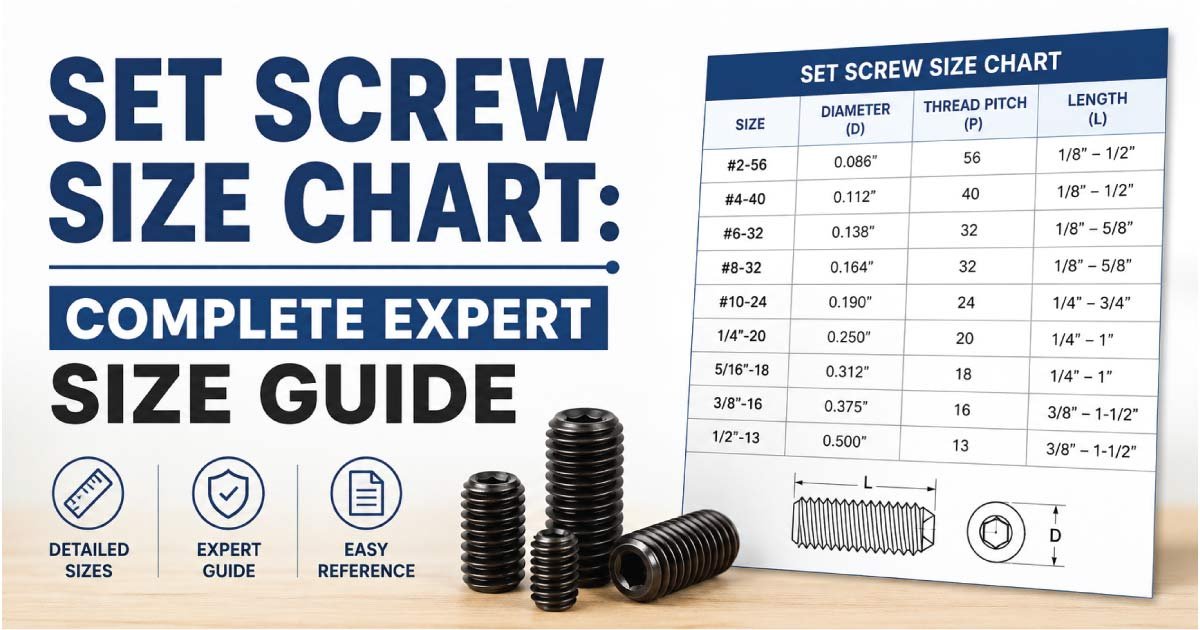
Set screws are small but extremely important fasteners used in machinery, automotive systems, industrial equipment, and power transmission assemblies. Unlike traditional screws, set screws are designed to secure one object within or against another object, typically without the use of a nut.
Understanding a Set Screw Size Chart helps engineers, mechanics, and DIY users choose the correct screw size for secure fastening and reliable performance. In this complete guide, you’ll learn about set screw sizes, dimensions, types, materials, applications, and selection methods.
What Is a Set Screw?
A set screw is a fully threaded screw that is usually installed flush with or below the surface of a component. Its primary purpose is to prevent movement between two mating parts, such as a gear mounted on a shaft or a pulley attached to a motor shaft.
Unlike bolts and machine screws, set screws generally do not have a traditional head.
Common uses include:
- Securing gears on shafts
- Locking pulleys in place
- Fixing collars onto shafts
- Holding knobs and handles
- Machinery assembly
- Automotive components
How Does a Set Screw Work?
A set screw is a type of fastener designed to secure one object within or against another without the use of a nut. It works by converting tightening force into concentrated pressure at the tip, which creates friction and prevents movement between components.
When tightened:
- The screw advances into a threaded hole.
- The tip makes direct contact with the mating part (such as a shaft or surface).
- Increasing torque generates compressive force at the contact point.
- Friction between surfaces prevents slipping or rotation.
- The component is locked securely in its position.
The effectiveness of a set screw depends on factors such as tip design, material hardness, and applied torque. In some applications, set screws are used to create a semi-permanent lock, while in others they allow easy adjustment or removal when maintenance is required.
Set Screw Size Chart
The following Set Screw Size Chart shows common imperial screw sizes and their approximate diameters.
| Screw Size | Major Diameter (Inches) | Diameter (mm) |
|---|---|---|
| #0 | 0.060 | 1.52 |
| #2 | 0.086 | 2.18 |
| #4 | 0.112 | 2.84 |
| #6 | 0.138 | 3.51 |
| #8 | 0.164 | 4.17 |
| #10 | 0.190 | 4.83 |
| #12 | 0.216 | 5.49 |
| 1/4″-20 | 0.250 | 6.35 |
| 5/16″-18 | 0.312 | 7.94 |
| 3/8″-16 | 0.375 | 9.53 |
| 1/2″-13 | 0.500 | 12.70 |
These sizes cover most industrial and mechanical applications.
Metric Set Screw Size Chart
Metric set screws are commonly used in machinery worldwide.
| Metric Size | Diameter (mm) |
|---|---|
| M2 | 2 mm |
| M3 | 3 mm |
| M4 | 4 mm |
| M5 | 5 mm |
| M6 | 6 mm |
| M8 | 8 mm |
| M10 | 10 mm |
| M12 | 12 mm |
| M16 | 16 mm |
| M20 | 20 mm |
Metric set screws are identified by the “M” designation followed by the thread diameter.
Common Set Screw Lengths
Set screw lengths vary according to application requirements.
| Length (Inches) | Length (mm) |
|---|---|
| 1/8″ | 3.18 mm |
| 3/16″ | 4.76 mm |
| 1/4″ | 6.35 mm |
| 5/16″ | 7.94 mm |
| 3/8″ | 9.53 mm |
| 1/2″ | 12.7 mm |
| 5/8″ | 15.88 mm |
| 3/4″ | 19.05 mm |
| 1″ | 25.4 mm |
| 1-1/2″ | 38.1 mm |
The correct length depends on shaft diameter, holding force requirements, and available thread engagement.
Types of Set Screws
Different set screw tip styles are designed to provide specific holding strength, positioning accuracy, and surface protection. Choosing the right type depends on whether the application requires permanent locking, frequent adjustment, or precise alignment.
1. Cup Point Set Screw
Cup point set screws are the most commonly used type. Their concave tip digs slightly into the surface, creating strong friction and excellent resistance against loosening, especially in vibrating environments.
Features:
- Concave tip
- Excellent holding power
- Resists vibration
Applications:
- Machinery
- Motors
- Power transmission equipment
2. Flat Point Set Screw
Flat point set screws have a smooth, flat contact surface that applies even pressure without deeply damaging the mating surface. They are ideal when frequent adjustments are required.
Features:
- Flat contact surface
- Minimal surface damage
- Easy adjustment
Applications:
- Precision equipment
- Frequent repositioning
3. Cone Point Set Screw
Cone point set screws feature a sharp, pointed tip that penetrates deeply into the material. This creates a very strong locking action, making them suitable for heavy-duty or permanent installations.
Features:
- Sharp point
- Deep penetration
- Strong locking action
Applications:
- Permanent installations
- Heavy-duty machinery
4. Dog Point Set Screw
Dog point set screws have an extended cylindrical tip that fits into a hole or groove for precise alignment. They are commonly used where accurate positioning is critical.
Features:
- Extended cylindrical tip
- Accurate positioning
- Excellent alignment
Applications:
- Gears
- Couplings
- Shafts
5. Oval Point Set Screw
Oval point set screws have a rounded tip that reduces surface damage while still providing good holding strength. They are often used in adjustable and precision assemblies.
Features:
- Rounded tip
- Reduced surface damage
- Good holding force
Applications:
- Adjustable assemblies
- Precision equipment
Understanding Set Screw Dimensions
A standard Set Screw Size Chart includes several important measurements that determine strength, fit, and compatibility. These dimensions help ensure proper selection for different mechanical and industrial applications.
1. Major Diameter
The major diameter is the outside diameter of the screw threads. It is one of the most important sizing factors because it directly affects how the screw fits into a threaded hole and how much load it can handle.
This determines:
- Thread size
- Load capacity
- Compatibility
A correctly selected major diameter ensures secure fastening and prevents stripping or loosening during operation.
2. Thread Pitch
Thread pitch refers to the distance between two adjacent threads. It influences how the screw engages with the internal threads and how smoothly it can be tightened or adjusted.
Thread pitch affects:
- Holding strength
- Adjustment precision
- Installation speed
Fine pitch threads provide better control and precision, while coarse threads allow faster installation and stronger grip in softer materials.
3. Length
Set screw length is measured from one end of the screw to the other because set screws are headless fasteners. This dimension determines how deeply the screw can engage with the component.
Accurate length selection ensures proper contact and stable locking without over-penetration or insufficient engagement.
4. Drive Size
The drive size refers to the internal recess used for tightening the screw. It determines which tool is required for installation and affects torque transfer efficiency.
Common drive styles include:
- Hex socket
- Slotted
- Torx
- Square drive
Choosing the correct drive type helps prevent stripping and improves installation performance.
Set Screw Materials
The material of a set screw plays a critical role in its strength, corrosion resistance, and overall durability. Different materials are selected based on environmental and load requirements.
1. Carbon Steel
Carbon steel is widely used due to its strength and affordability. It is suitable for general-purpose industrial applications where high corrosion resistance is not the primary concern.
Benefits:
- Strong
- Affordable
- Widely available
Often used for general industrial applications where cost-effectiveness is important.
2. Alloy Steel
Alloy steel set screws are heat-treated for improved strength and wear resistance. They are designed for demanding applications where higher mechanical performance is required.
Advantages:
- High strength
- Heat treated
- Excellent wear resistance
Used in heavy-duty machinery and high-stress environments.
3. Stainless Steel
Stainless steel set screws offer excellent corrosion resistance and durability. They are commonly used in environments exposed to moisture, chemicals, or outdoor conditions.
Benefits:
- Corrosion resistant
- Durable
- Suitable for outdoor use
Common grades:
- 18-8 Stainless Steel
- 304 Stainless Steel
- 316 Stainless Steel
4. Brass
Brass set screws are known for their corrosion resistance and non-magnetic properties. They also provide an attractive finish, making them suitable for visible or decorative applications.
Advantages:
- Corrosion resistance
- Non-magnetic properties
- Attractive appearance
Used in electrical components and decorative assemblies.
Set Screw Drive Types
The drive style of a set screw determines the tool required for installation and directly affects torque transfer, ease of use, and resistance to stripping. Different drive types are selected based on application requirements and installation conditions.
1. Hex Socket Drive
Hex socket drives are the most widely used type in set screws. They allow high torque application in a compact design, making them suitable for precision and industrial assemblies.
Benefits:
- High torque capacity
- Compact design
- Easy installation
2. Slotted Drive
Slotted drives feature a simple straight groove and are one of the oldest screw drive types. They are generally used in light-duty applications where high torque is not required.
Features:
- Simple design
- Low cost
- Common in light-duty applications
3. Torx Drive
Torx drives have a star-shaped design that provides excellent torque transfer and reduces slipping during installation. This makes them highly efficient and durable for repeated use.
Advantages:
- Improved torque transfer
- Reduced slipping
- Longer tool life
How to Read a Set Screw Size Chart
Reading a set screw size chart becomes easy once you understand the standard format used to describe diameter, thread pitch, and length. These values help ensure correct selection and proper fit.
Example: 1/4″-20 × 1/2″
This format represents an imperial measurement system.
It means:
- Diameter = 1/4 inch
- Thread pitch = 20 threads per inch
- Length = 1/2 inch
Metric Example: M6 × 10 mm
Metric set screws are even simpler and more direct.
It means:
- Diameter = 6 mm
- Length = 10 mm
Understanding this format helps prevent ordering mistakes and ensures the correct set screw is selected for the application.
How to Choose the Correct Set Screw Size
Choosing the correct set screw size is important for ensuring strong locking performance, proper alignment, and long-term reliability in mechanical assemblies. The selection depends on shaft size, load conditions, vibration levels, material compatibility, and environmental exposure. Each factor plays a key role in overall fastening performance.
1. Shaft Diameter
Shaft diameter is the primary factor in selecting a set screw size. A larger shaft requires a larger diameter set screw to create enough contact force for secure locking. If the screw is too small, it may slip or fail under pressure. Proper matching ensures stability and accurate positioning of components.
2. Load Requirements
Load requirements determine the strength and depth of engagement needed from the set screw. High-load applications require stronger screws with deeper thread engagement to prevent slipping or loosening. Light-duty uses can rely on smaller sizes, but heavy machinery demands higher-grade screws to maintain consistent holding power and safety.
3. Vibration Conditions
Vibration can cause set screws to loosen over time if not properly selected. In such environments, cup-point or cone-point set screws are preferred because they provide better grip on the shaft surface. These designs improve resistance to movement and help maintain tight locking even under continuous mechanical vibration.
4. Material Compatibility
Material compatibility is essential for preventing wear, galling, or damage between components. The set screw material should be suitable for the shaft and surrounding parts to ensure smooth interaction. Using incompatible materials can reduce performance and shorten service life, especially in high-friction or precision mechanical assemblies.
5. Environmental Conditions
Environmental conditions greatly influence set screw selection. Outdoor, humid, or corrosive environments require stainless steel or coated set screws to prevent rust and degradation. In dry indoor conditions, standard alloy steel may be sufficient. Choosing the right material ensures long-term durability and consistent locking performance in all conditions.
Conclusion
A Set Screw Size Chart is an essential reference for selecting the proper screw diameter, thread pitch, and length. Whether you’re securing gears, pulleys, collars, shafts, or machinery components, choosing the correct set screw improves reliability, safety, and performance.
By understanding set screw dimensions, tip styles, materials, and applications, you can confidently select the right fastener for any industrial, mechanical, or DIY project. Proper sizing and installation ensure long-lasting, secure connections that keep equipment operating efficiently.
Also Read: 👉 U-Bolt Size Chart: Dimensions, Types & Applications is a complete resource for understanding U-bolt sizes, dimensions, thread specifications, and applications. Learn how to select the correct U-bolt for pipes, tubing, structural supports, and automotive projects. Read the full guide to explore sizing charts, common types, materials, and expert installation tips.

Engineer Hassan is a Mechanical Engineer with 16+ years of hands-on experience in mechanical hardware, fasteners, and workshop tools. He focuses on size selection, thread identification, and measurement, helping users choose the correct components with accuracy and safety.