
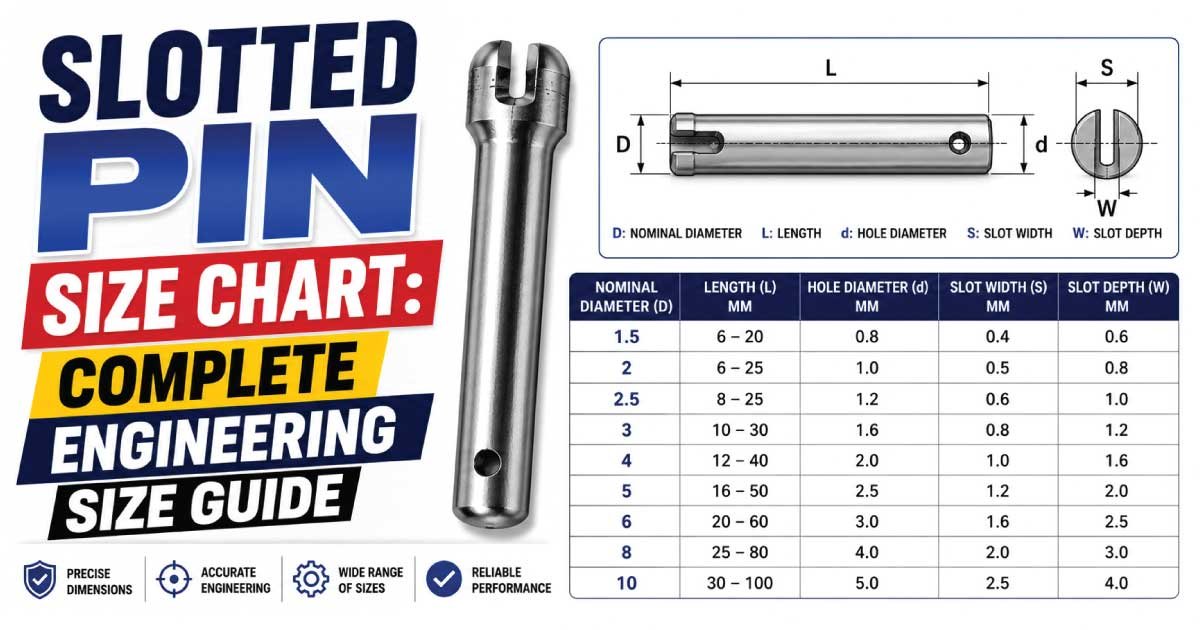
Slotted pins are precision fastening components designed to create secure mechanical connections between two or more parts.
They feature longitudinal slots along their surface that allow slight compression during installation, creating a spring-like gripping action inside the hole. Slotted pins are widely used in automotive assemblies, machinery, tools, electrical equipment, and industrial applications.
Choosing the correct slotted pin size ensures proper fit, alignment, strength, and long-term reliability. This guide explains standard slotted pin sizes, dimensions, materials, types, and uses.
What Is a Slotted Pin?
A slotted pin is a cylindrical metal pin with one or more slots cut along its length. These slots allow the pin to compress slightly when inserted into a drilled hole, creating a secure friction fit. Unlike solid pins, slotted pins provide flexibility and improved holding performance in applications exposed to vibration or movement.
Key features include:
- Longitudinal slot design
- Spring-like compression ability
- Easy installation
- High shear strength
- Reliable positioning
- Available in different materials and sizes
Why Slotted Pin Size Matters
Selecting the correct slotted pin size is important for achieving proper holding force and preventing component damage. A pin that is too small may loosen, while an oversized pin can damage the hole or make installation difficult.
Benefits of correct sizing include:
- Secure component alignment
- Improved load distribution
- Reduced movement between parts
- Longer service life
- Easy assembly and removal
- Better vibration resistance
Metric Slotted Pin Size Chart
The following table shows common metric slotted pin sizes used in mechanical and industrial applications.
| Nominal Diameter | Length Range | Slot Width (Approx.) | Common Applications |
|---|---|---|---|
| 2 mm | 6–30 mm | 0.5 mm | Small mechanisms |
| 3 mm | 8–40 mm | 0.6 mm | Electronics and tools |
| 4 mm | 10–50 mm | 0.8 mm | Machinery assemblies |
| 5 mm | 12–60 mm | 1.0 mm | Automotive components |
| 6 mm | 16–80 mm | 1.2 mm | General machinery |
| 8 mm | 20–100 mm | 1.6 mm | Industrial equipment |
| 10 mm | 25–120 mm | 2.0 mm | Heavy assemblies |
| 12 mm | 30–140 mm | 2.5 mm | Large machinery |
| 16 mm | 40–160 mm | 3.0 mm | Heavy-duty applications |
SAE Slotted Pin Size Chart
Imperial slotted pins are commonly used in older machinery, automotive equipment, and North American manufacturing systems.
| Diameter | Length Range | Common Applications |
|---|---|---|
| 1/16″ | 1/4″–1″ | Small mechanisms |
| 3/32″ | 1/4″–1-1/2″ | Tools and fixtures |
| 1/8″ | 1/2″–2″ | General assembly |
| 3/16″ | 1/2″–3″ | Automotive parts |
| 1/4″ | 3/4″–4″ | Machinery |
| 5/16″ | 1″–4″ | Industrial equipment |
| 3/8″ | 1″–5″ | Heavy applications |
| 1/2″ | 1-1/2″–6″ | Large machinery |
Main Parts of a Slotted Pin
Understanding the design features of a slotted pin helps in selecting the correct size and application.
1. Pin Diameter
The diameter determines how tightly the pin fits inside the drilled hole. Proper diameter selection ensures sufficient gripping force while preventing excessive installation stress.
2. Pin Length
Pin length determines the amount of engagement between connected components. A longer pin provides greater holding strength but must not interfere with surrounding parts.
3. Longitudinal Slot
The slot allows the pin to compress during insertion and expand after installation. This creates a secure friction fit while allowing slight flexibility during operation.
4. Chamfered Ends
Many slotted pins feature chamfered ends that guide the pin into the hole during installation. This reduces installation force and prevents damage to the pin or assembly.
Common Types of Slotted Pins
Slotted pins are available in different designs depending on strength requirements, installation methods, and operating conditions.
1. Standard Slotted Pin
Standard slotted pins feature a single slot running along their length. They are commonly used for general fastening and alignment applications where moderate holding strength is required.
Advantages include:
- Simple design
- Easy installation
- Low cost
- Wide availability
2. Heavy Duty Slotted Pin
Heavy-duty slotted pins are manufactured with increased diameter and stronger materials to handle higher shear loads. They are commonly used in industrial machinery and heavy equipment.
Benefits include:
- Higher strength
- Improved durability
- Greater load capacity
- Better resistance to vibration
3. Multiple Slotted Pin
Multiple slotted pins contain more than one slot around their circumference. This design provides increased flexibility and more consistent expansion inside the mounting hole.
Applications include:
- Precision machinery
- Automotive assemblies
- Mechanical joints
Common Slotted Pin Materials
Material selection affects strength, corrosion resistance, hardness, and service life.
1. Carbon Steel
Carbon steel slotted pins are commonly used for general mechanical applications because they provide good strength and affordability. Protective coatings improve corrosion resistance.
Advantages include:
- High strength
- Low cost
- Easy availability
- Suitable for general machinery
2. Stainless Steel
Stainless steel slotted pins provide excellent corrosion resistance and are used in environments exposed to moisture, chemicals, or outdoor conditions.
Benefits include:
- Rust resistance
- Long service life
- Low maintenance
- Suitable for harsh environments
3. Alloy Steel
Alloy steel slotted pins provide increased hardness, strength, and fatigue resistance. They are commonly selected for heavy-duty machinery and high-load applications.
Common Slotted Pin Grades and Standards
Slotted pins are manufactured according to international standards to ensure consistent dimensions and performance.
Common standards include:
- DIN 1481
- ISO 8741
- ASME B18.8
- ANSI standards
These standards define:
- Diameter tolerances
- Length dimensions
- Material requirements
- Slot specifications
- Mechanical properties
Common Applications of Slotted Pins
Slotted pins are widely used where secure positioning, alignment, and vibration resistance are required.
Major applications include:
- Automotive assemblies
- Gear mechanisms
- Machinery components
- Electrical equipment
- Agricultural machinery
- Hand tools
- Industrial fixtures
- Pumps
- Valves
- Robotics systems
📏 View Accurate Size Guide 👉 Tap Drill Size Chart: Complete Tap Drill Sizes Guide
How to Choose the Correct Slotted Pin Size
Selecting the correct slotted pin size is essential for achieving a secure connection, proper alignment, and reliable performance. The correct pin depends on the hole diameter, component thickness, load requirements, material type, and operating environment. Proper selection prevents loosening, excessive wear, and premature failure of connected parts.
1. Measure the Hole Diameter
The hole diameter is the most important factor when selecting a slotted pin. The pin should provide a firm fit without requiring excessive force during installation.
Consider the following measurements:
- Hole diameter
- Pin outside diameter
- Hole tolerance
- Component thickness
- Required grip strength
2. Select the Correct Pin Length
The pin length should provide enough engagement between connected components while avoiding unnecessary extension. A properly sized length improves load distribution and prevents movement between assembled parts.
Length selection depends on:
- Material thickness
- Number of connected parts
- Required engagement depth
- Available installation space
3. Consider the Load Requirements
Different applications require different levels of shear strength and holding force. Heavy machinery and industrial equipment require stronger slotted pins compared with lightweight assemblies.
Load factors include:
- Shear force
- Impact loads
- Vibration levels
- Operating speed
- Equipment type
4. Choose the Right Material
Material selection affects corrosion resistance, strength, and durability. Choose a material that matches the operating environment and mechanical requirements.
Common choices include:
- Carbon steel for general use
- Stainless steel for corrosion resistance
- Alloy steel for heavy-duty applications
Slotted Pin Load Capacity Chart
The load capacity depends on pin diameter, material strength, installation condition, and application design. The following values are general guidelines.
| Pin Diameter | Light Load | Medium Load | Heavy Load |
|---|---|---|---|
| 3 mm | 100–300 N | 300–500 N | 500–800 N |
| 5 mm | 300–700 N | 700–1200 N | 1200–1800 N |
| 6 mm | 500–1000 N | 1000–1800 N | 1800–2500 N |
| 8 mm | 1000–2000 N | 2000–3500 N | 3500–5000 N |
| 10 mm | 1500–3000 N | 3000–5000 N | 5000–8000 N |
| 12 mm | 2500–5000 N | 5000–8000 N | 8000–12000 N |
Slotted Pin Material Comparison
Different materials provide different performance characteristics depending on strength, corrosion resistance, and working conditions.
| Material | Strength | Corrosion Resistance | Common Applications |
|---|---|---|---|
| Carbon Steel | High | Moderate | General machinery |
| Stainless Steel | Medium–High | Excellent | Outdoor and corrosive environments |
| Alloy Steel | Very High | Moderate | Heavy industrial equipment |
| Hardened Steel | Excellent | Moderate | High-load applications |
📏 View Accurate Size Guide 👉 Perfect Bolt Selection Guide for Mechanical Projects
Advantages of Slotted Pins
Slotted pins provide several advantages over solid pins because their flexible design allows easier installation and improved grip inside the hole.
Advantages include:
- Easy installation
- Strong friction fit
- Absorbs vibration
- Prevents component movement
- Cost-effective fastening solution
- Requires no threading
- Available in many sizes
- Suitable for repeated assembly
Limitations of Slotted Pins
Although slotted pins are highly useful, they are not suitable for every fastening application. Understanding their limitations helps prevent incorrect use.
Common limitations include:
- Limited resistance to extreme loads
- Requires accurate hole sizing
- Can deform under excessive force
- Not suitable for high-temperature applications without proper material selection
- Removal may require additional tools
How to Install a Slotted Pin
Proper installation ensures maximum holding strength and prevents damage to the pin or connected components.
Basic Installation Steps
- Select the correct slotted pin size.
- Check the hole diameter and condition.
- Align the connected components.
- Place the pin at the opening.
- Drive the pin using a suitable punch.
- Ensure the pin is fully seated.
- Inspect for proper fit and alignment.
Tools Used for Slotted Pin Installation
Using the correct tools prevents damage and ensures proper installation.
Common tools include:
- Pin punch
- Hammer
- Arbor press
- Hydraulic press
- Installation fixture
- Measuring tools
Maintenance Tips for Slotted Pins
Regular inspection helps identify wear, loosening, and damage before failure occurs. Proper maintenance improves equipment reliability.
Maintenance recommendations:
- Inspect pins regularly
- Check for cracks or deformation
- Replace worn pins
- Keep assemblies clean
- Monitor excessive vibration
- Check hole wear
- Use correct replacement sizes
Common Installation Mistakes
Incorrect installation can reduce the performance of slotted pins and cause premature failure.
Avoid these mistakes:
- Using incorrect pin diameter
- Installing into oversized holes
- Selecting the wrong material
- Hammering excessively
- Reusing damaged pins
- Ignoring corrosion
- Using improper tools
- Installing without proper alignment
Slotted Pin vs Solid Pin
Both slotted pins and solid pins are used for alignment and fastening, but they have different characteristics.
| Feature | Slotted Pin | Solid Pin |
|---|---|---|
| Installation | Easier | Requires precise fit |
| Flexibility | High | Low |
| Vibration Resistance | Excellent | Moderate |
| Load Capacity | Medium | High |
| Hole Tolerance | More forgiving | Requires accuracy |
| Cost | Lower | Higher |
Slotted Pin vs Spring Pin
Slotted pins and spring pins are similar because both provide friction-based fastening, but their designs differ.
| Feature | Slotted Pin | Spring Pin |
|---|---|---|
| Design | Single open slot | Rolled tube design |
| Strength | Medium | High |
| Flexibility | Moderate | Excellent |
| Installation Force | Lower | Higher |
| Common Use | Alignment and assembly | Heavy machinery |
Industries That Use Slotted Pins
Slotted pins are used across many industries where reliable positioning and vibration resistance are required.
Major industries include:
- Automotive manufacturing
- Aerospace equipment
- Agricultural machinery
- Industrial machinery
- Electronics
- Robotics
- Tool manufacturing
- Medical equipment
- Construction equipment
- Manufacturing plants
📏 View Accurate Size Guide 👉 Nut Sizes and Types for Mechanical Projects
Expert Takeaway Slotted Pins Size
Slotted pins are reliable mechanical fasteners designed to provide secure alignment, vibration resistance, and easy installation in a wide range of applications.
Selecting the correct diameter, length, material, and standard ensures maximum performance and long service life.
From automotive components and industrial machinery to precision equipment and manufacturing systems, properly chosen slotted pins provide a simple, effective, and durable fastening solution.
FAQs:
What is a slotted pin used for?
A slotted pin is used to secure and accurately align mechanical components by creating a tight friction fit inside a drilled hole. It is commonly installed in machinery, automotive assemblies, power tools, agricultural equipment, and industrial systems where reliable positioning, vibration resistance, and dependable fastening are essential for proper operation.
What is the difference between a slotted pin and a spring pin?
A slotted pin features a single slot running along its length, while a spring pin is formed from rolled steel with overlapping edges. Spring pins provide greater flexibility and shock absorption, whereas slotted pins are easier to install and offer excellent holding strength for many mechanical applications.
Can slotted pins be reused?
Although a slotted pin may sometimes be reused, it is generally considered a single-use fastener. Repeated installation and removal can reduce its gripping force and reliability. For safety-critical or high-load applications, replacing the pin with a new one is recommended to maintain secure fastening performance.
How do I measure a slotted pin?
Measure a slotted pin by checking its outside diameter, overall length, slot width, and material type. The pin diameter should match the hole size to achieve the correct interference fit, while the length must provide sufficient engagement for secure alignment and dependable mechanical performance.
What material is best for slotted pins?
The best material depends on the application. Carbon steel is suitable for general-purpose machinery, stainless steel offers excellent corrosion resistance for harsh environments, and alloy steel provides superior strength and durability for heavy-duty, high-load, and demanding industrial applications where maximum performance is required.

Engineer Hassan is a Mechanical Engineer with 16+ years of hands-on experience in mechanical hardware, fasteners, and workshop tools. He focuses on size selection, thread identification, and measurement, helping users choose the correct components with accuracy and safety.