
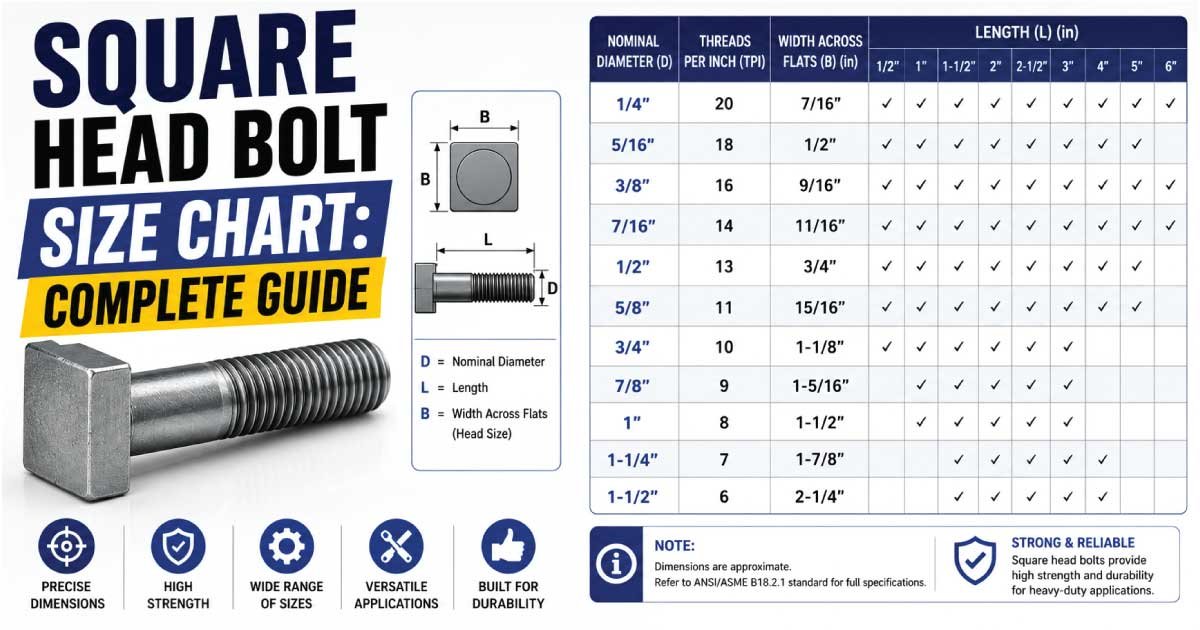
Square head bolts are traditional fasteners recognized for their four-sided heads, providing a larger gripping surface than hex bolts. They are commonly used in heavy construction, machinery, agricultural equipment, timber framing, utility installations, and restoration projects.
Their design allows secure tightening with adjustable wrenches while offering excellent resistance to loosening. Selecting the correct square head bolt size is essential for achieving strong joints, proper load distribution, and long-lasting performance.
This guide covers square head bolt sizes, dimensions, materials, measurement methods, and practical selection tips.
What Is a Square Head Bolt?
A square head bolt is a threaded fastener with a square-shaped head instead of the more common hexagonal design. The square head provides four flat gripping surfaces, making installation easier with standard tools while reducing the likelihood of wrench slippage. Square head bolts are widely used in structural applications, heavy equipment, railroad construction, and vintage machinery restoration because of their strength and traditional appearance.
Primary Functions
- Joins structural components
- Provides high clamping force
- Supports heavy loads
- Simplifies wrench grip
- Improves fastening reliability
- Allows easy maintenance
Common Types of Square Head Bolts
Square head bolts are available in several designs to accommodate different industries, materials, and installation requirements. Understanding these variations helps ensure the correct fastener is selected for the intended application.
1. Fully Threaded Square Head Bolt
Fully threaded square head bolts have threads running along the entire length of the shank, providing maximum thread engagement for applications requiring adjustable fastening and strong holding power.
Advantages
- Maximum thread engagement
- Easy adjustment
- Strong clamping force
- Versatile applications
- Simple replacement
2. Partially Threaded Square Head Bolt
Partially threaded square head bolts feature a smooth shoulder between the head and threaded section. This design improves shear strength and is commonly used in structural assemblies.
Benefits
- Higher shear strength
- Reduced thread wear
- Better alignment
- Strong structural support
- Improved durability
3. Heavy Square Head Bolt
Heavy square head bolts feature larger heads and thicker shanks to withstand higher loads. They are commonly used in bridges, industrial machinery, mining equipment, and heavy structural steel.
Applications
- Structural steel
- Heavy machinery
- Mining equipment
- Bridge construction
- Industrial plants
4. Stainless Steel Square Head Bolt
Stainless steel square head bolts provide excellent corrosion resistance, making them ideal for marine environments, food processing equipment, chemical plants, and outdoor installations exposed to moisture.
Square Head Bolt Size Chart (Inch Sizes)
The following table lists common inch-size square head bolts used in industrial and construction applications.
| Bolt Diameter | Thread Size | Common Lengths |
|---|---|---|
| 1/4″ | 20 TPI | 1/2″ – 4″ |
| 5/16″ | 18 TPI | 3/4″ – 5″ |
| 3/8″ | 16 TPI | 1″ – 6″ |
| 1/2″ | 13 TPI | 1″ – 8″ |
| 5/8″ | 11 TPI | 1-1/2″ – 10″ |
| 3/4″ | 10 TPI | 2″ – 12″ |
| 7/8″ | 9 TPI | 2″ – 14″ |
| 1″ | 8 TPI | 2″ – 16″ |
Metric Square Head Bolt Size Chart
Metric square head bolts are commonly used in industrial machinery, construction equipment, and international engineering projects.
| Bolt Size | Thread Pitch | Common Lengths |
|---|---|---|
| M6 | 1.0 mm | 16–60 mm |
| M8 | 1.25 mm | 20–80 mm |
| M10 | 1.5 mm | 25–100 mm |
| M12 | 1.75 mm | 30–120 mm |
| M16 | 2.0 mm | 40–150 mm |
| M20 | 2.5 mm | 50–180 mm |
| M24 | 3.0 mm | 60–200 mm |
| M30 | 3.5 mm | 80–250 mm |
Understanding Square Head Bolt Dimensions
Knowing the dimensions of a square head bolt helps ensure proper fit, strength, and compatibility with nuts, washers, and mounting holes. Accurate measurements reduce installation errors and improve joint reliability.
1. Bolt Diameter
Bolt diameter is measured across the outside of the threaded shank. It determines the bolt’s strength and must match the diameter of the corresponding hole and nut.
2. Bolt Length
Bolt length is measured from the underside of the square head to the end of the threaded shank. Selecting the correct length ensures adequate thread engagement while preventing excessive bolt projection.
3. Head Width
Head width is measured across the flat sides of the square head. This dimension determines the wrench size required for installation and affects the amount of torque that can be applied safely.
How to Measure a Square Head Bolt
Accurate measurements help identify replacement bolts and ensure compatibility with existing hardware. A digital caliper or bolt gauge provides the most precise results.
Step 1: Measure the Bolt Diameter
Measure the outside diameter of the threaded portion using a digital caliper.
Measurement Tips
- Clean the threads before measuring
- Measure across the thread peaks
- Verify measurements in multiple locations
- Compare with standard bolt charts
Step 2: Measure the Bolt Length
Measure from the underside of the square head to the end of the bolt. Do not include the head thickness when determining bolt length.
Step 3: Measure the Head Width
Measure across two opposite flat sides of the square head. This helps determine the correct wrench size and confirms the bolt specification.
Common Square Head Bolt Materials
The material used to manufacture a square head bolt determines its strength, corrosion resistance, and suitability for different environments. Selecting the proper material improves durability and service life.
Carbon Steel Square Head Bolts
Carbon steel bolts are widely used in construction and industrial equipment because they provide excellent strength at an economical cost.
Advantages
- High tensile strength
- Cost-effective
- Easy availability
- Good machinability
- Suitable for general construction
Stainless Steel Square Head Bolts
Stainless steel bolts provide outstanding corrosion resistance and are commonly used in marine equipment, food processing, and chemical industries.
Benefits
- Excellent corrosion resistance
- Long service life
- Hygienic surface
- Low maintenance
- Weather resistant
Alloy Steel Square Head Bolts
Alloy steel square head bolts are designed for heavy-duty applications requiring exceptional strength, wear resistance, and durability under high loads and harsh operating conditions.
Applications of Square Head Bolts
Square head bolts are widely used in industries where strong, dependable fastening is required. Their simple head design also makes them popular in restoration and historical construction projects.
Construction Industry
Square head bolts secure steel frameworks, timber structures, bridges, heavy foundations, and structural supports where dependable fastening is critical.
Common Applications
- Steel construction
- Timber framing
- Bridges
- Utility poles
- Structural supports
Industrial Machinery
Manufacturing equipment and heavy machinery use square head bolts to assemble frames, gearboxes, motors, conveyors, and industrial equipment subjected to heavy loads and vibration.
Typical Uses
- Mining equipment
- Agricultural machinery
- Manufacturing plants
- Conveyor systems
- Mechanical assemblies
How to Choose the Correct Square Head Bolt Size
Selecting the correct square head bolt size is essential for achieving a strong, secure, and long-lasting connection. The bolt diameter, length, thread type, material, and strength grade should match the application’s load requirements and environmental conditions. Proper bolt selection improves joint stability, prevents loosening, and extends the service life of both the fastener and the connected components.
Selection Checklist
- Measure the mounting hole diameter
- Determine the required bolt length
- Select the correct thread size
- Choose the proper thread pitch
- Verify the strength grade
- Select the appropriate material
- Match the nut and washer size
- Consider corrosion resistance
- Calculate the required load capacity
- Follow engineering specifications
🔩 Read Expert Sizing Guide 👉 Screwdriver Types Explained: Complete Guide for Beginners
Square Head Bolt Strength Grades
Square head bolts are manufactured in different strength grades to suit light-duty, structural, and heavy industrial applications. Higher grades provide greater tensile strength and load-carrying capacity.
Common Strength Grades
The most commonly used bolt grades include:
- Grade 2
- Grade 5
- Grade 8
- ASTM A307
- ASTM A325
- ASTM A490
- Class 4.6
- Class 8.8
- Class 10.9
- Class 12.9
Higher-strength bolts are commonly used in bridges, structural steel, heavy machinery, mining equipment, and industrial construction.
Square Head Bolt Material Comparison
Choosing the correct material improves strength, corrosion resistance, and durability while ensuring compatibility with the working environment.
| Material | Best Applications | Main Advantages |
|---|---|---|
| Carbon Steel | General construction | High strength and economical |
| Stainless Steel 304 | Food processing | Corrosion resistant and hygienic |
| Stainless Steel 316 | Marine applications | Superior corrosion resistance |
| Alloy Steel | Heavy machinery | High tensile strength |
| Galvanized Steel | Outdoor structures | Excellent rust protection |
| Zinc-Plated Steel | Indoor equipment | Affordable corrosion resistance |
Common Square Head Bolt Installation Mistakes
Improper installation can weaken joints, reduce load capacity, and shorten the service life of the fastener. Following correct installation procedures helps ensure dependable performance.
Avoid these common mistakes:
- Using the wrong bolt diameter
- Selecting an incorrect bolt length
- Overtightening the bolt
- Undertightening the connection
- Mixing incompatible fastener grades
- Installing damaged threads
- Omitting washers when required
- Using incorrect torque values
- Ignoring alignment issues
- Reusing severely worn bolts
Square Head Bolt Maintenance Tips
Routine inspection helps maintain joint integrity and prevents unexpected fastener failures. Regular maintenance also extends the service life of structural assemblies and machinery.
Maintenance recommendations include:
- Inspect for corrosion
- Check bolt tightness
- Replace damaged bolts
- Examine thread condition
- Lubricate threads when required
- Inspect washers and nuts
- Remove accumulated debris
- Monitor vibration
- Verify torque values
- Follow preventive maintenance schedules
Consistent maintenance improves equipment reliability and reduces repair costs.
Advantages of Using the Correct Square Head Bolt Size
Using the properly sized square head bolt improves structural integrity while reducing maintenance requirements and preventing joint failure.
Major advantages include:
- Strong and secure fastening
- Excellent load distribution
- Improved shear resistance
- Reduced loosening
- Longer service life
- Better vibration resistance
- Easier installation
- Lower maintenance costs
- Reliable structural performance
- Increased operational safety
🔩 Read Expert Sizing Guide 👉 Allen Key Metric & SAE Sizes: Quick Selection Guide
Signs a Square Head Bolt Needs Replacement
Square head bolts can deteriorate over time due to heavy loads, vibration, corrosion, and environmental exposure. Routine inspections help identify wear before serious failures occur.
Common warning signs include:
- Rust or corrosion
- Bent bolt shank
- Damaged threads
- Rounded square head
- Cracked bolt head
- Loose connections
- Excessive vibration
- Visible stretching
- Worn washers
- Frequent retightening requirements
Replacing damaged bolts promptly helps maintain the safety and reliability of the assembly.
Applications of Square Head Bolts Across Industries
Square head bolts are widely used in industries requiring durable and dependable fastening solutions for structural and mechanical assemblies.
Construction Industry
Construction projects use square head bolts to assemble steel frameworks, timber structures, bridges, utility poles, and heavy structural components where high strength and reliable fastening are required.
Agricultural Equipment
Farm machinery uses square head bolts in tractors, cultivators, harvesting equipment, trailers, and grain handling systems because they are durable and easy to tighten with common tools.
Mining and Heavy Equipment
Mining machinery relies on high-strength square head bolts to secure crushers, conveyors, excavators, drilling equipment, and structural frames operating under heavy loads and severe vibration.
Railroad and Restoration Projects
Square head bolts remain popular in railroad infrastructure, historical building restoration, vintage machinery, and antique vehicle restoration because they preserve the original appearance while providing dependable fastening performance.
Important Takeaways
Selecting the correct square head bolt size is essential for achieving strong, secure, and reliable connections in structural, industrial, agricultural, and restoration projects.
By understanding bolt dimensions, strength grades, materials, thread specifications, and installation practices, engineers and maintenance professionals can confidently choose the right fastener for any application.
Using accurate square head bolt size charts, following recommended torque specifications, and performing regular inspections significantly improves joint performance, extends service life, reduces maintenance costs, and enhances safety across a wide range of mechanical and construction applications.
🔩 Read Expert Sizing Guide 👉 Spanner Size Chart: Sizes, Types & Applications Guide
FAQs:
How do I determine the correct square head bolt size?
Measure the mounting hole diameter, required grip length, and thread specification before selecting a square head bolt. Compare these dimensions with a standard square head bolt size chart to choose the correct diameter, length, and thread pitch, ensuring proper fit, secure fastening, and reliable long-term performance.
What is the difference between a square head bolt and a hex bolt?
A square head bolt has four flat sides that provide a larger gripping surface for wrenches, making it suitable for heavy-duty and restoration work. A hex bolt has six sides, allowing easier access in confined spaces. Both perform similar fastening functions but differ in head design.
Which material is best for square head bolts?
The best material depends on the application. Carbon steel is suitable for general construction, stainless steel provides excellent corrosion resistance for outdoor and marine environments, and alloy steel offers superior strength for heavy equipment, structural projects, and demanding industrial applications requiring high load capacity.
Can square head bolts be reused?
Square head bolts can often be reused if they are free from thread damage, stretching, corrosion, cracks, or deformation. However, bolts used in critical structural, high-load, or safety-related applications should generally be replaced during maintenance to ensure maximum reliability and maintain proper fastening performance.
How long do square head bolts last?
The service life of a square head bolt depends on factors such as material quality, environmental exposure, applied loads, corrosion, and maintenance practices. When properly selected, installed, and maintained, high-quality square head bolts can provide reliable performance and remain in service for several decades.

Engineer Hassan is a Mechanical Engineer with 16+ years of hands-on experience in mechanical hardware, fasteners, and workshop tools. He focuses on size selection, thread identification, and measurement, helping users choose the correct components with accuracy and safety.