
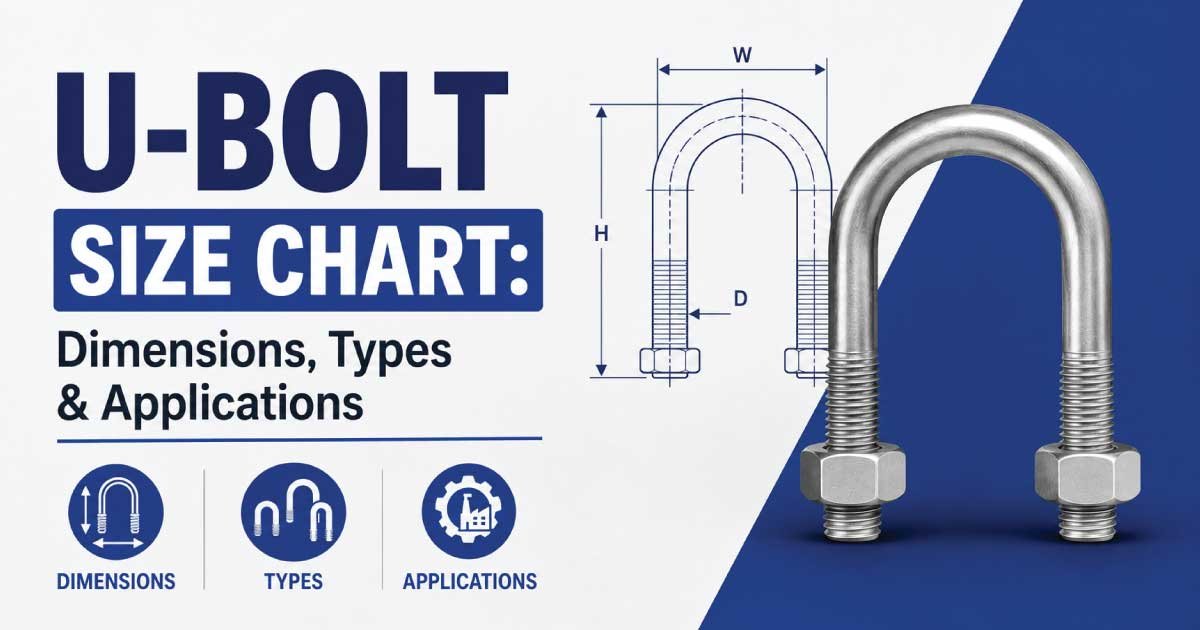
U-bolts are among the most commonly used fastening components in construction, automotive, plumbing, marine, and industrial applications. Their simple U-shaped design provides a secure way to attach pipes, tubes, poles, and structural components to various surfaces.
Choosing the correct U-bolt size is critical for safety, durability, and performance. A U-bolt that is too small may fail under load, while an oversized U-bolt can lead to improper installation and reduced clamping force.
This comprehensive guide explains U-bolt dimensions, types, materials, applications, and includes a practical U-bolt size chart to help you select the right fastener for your project.
What Is a U-Bolt?
A U-bolt is a metal fastener shaped like the letter “U” with threaded ends on both sides. Nuts are attached to the threaded ends to secure the bolt around a pipe, tube, pole, or structural member.
U-bolts are designed to provide strong clamping force and are widely used in applications where round objects need to be firmly attached to a support structure.
Common Uses of U-Bolts
- Pipe support systems
- Automotive leaf spring assemblies
- Exhaust systems
- Marine equipment
- Construction frameworks
- Agricultural machinery
- Electrical installations
- HVAC systems
Why U-Bolt Size Matters
Selecting the correct U-bolt size is critical for ensuring both safety and reliable mechanical performance in structural and piping systems. A properly sized U-bolt provides strong and stable fastening, preventing movement or loosening under load. It also ensures even pressure distribution, which helps protect connected components and extends the overall service life of the assembly.
A properly sized U-bolt provides:
- Secure clamping force
- Improved load distribution
- Reduced vibration
- Longer service life
- Better structural stability
Incorrect sizing can result in:
- Loose connections
- Premature wear
- Equipment failure
- Safety hazards
Standard U-Bolt Size Chart
The following chart shows common U-bolt sizes used in industrial and construction applications.
| Pipe Size | Rod Diameter | Inside Width | Inside Length |
|---|---|---|---|
| 1/2 inch | 1/4 inch | 7/8 inch | 2 inch |
| 3/4 inch | 1/4 inch | 1-1/8 inch | 2-1/2 inch |
| 1 inch | 5/16 inch | 1-3/8 inch | 3 inch |
| 1-1/4 inch | 5/16 inch | 1-5/8 inch | 3-1/2 inch |
| 1-1/2 inch | 3/8 inch | 1-7/8 inch | 4 inch |
| 2 inch | 3/8 inch | 2-3/8 inch | 4-1/2 inch |
| 2-1/2 inch | 1/2 inch | 2-7/8 inch | 5 inch |
| 3 inch | 1/2 inch | 3-1/2 inch | 6 inch |
| 4 inch | 1/2 inch | 4-1/2 inch | 7 inch |
| 6 inch | 5/8 inch | 6-5/8 inch | 9 inch |
These dimensions may vary slightly depending on manufacturer specifications and industry standards.
Understand The U-Bolt Dimensions
To properly select and use a U-bolt size chart, it is essential to understand the key dimensions that define its size and application. Each measurement plays an important role in ensuring correct fit, secure fastening, and safe load handling. Accurate dimension selection helps prevent installation issues and improves overall structural stability.
1. Rod Diameter
Rod diameter refers to the thickness of the U-bolt material itself. It is one of the most important strength-related measurements because it directly affects load-carrying capacity and durability. A thicker rod provides higher strength and better resistance to bending or deformation under heavy loads.
Common diameters include:
- 1/4 inch
- 5/16 inch
- 3/8 inch
- 1/2 inch
- 5/8 inch
- 3/4 inch
Larger rod diameters generally provide higher load capacity and are used in heavy-duty applications where strong clamping force and structural reliability are required.
2. Inside Width
Inside width is the distance between the two parallel legs of the U-bolt. This measurement is critical because it determines whether the U-bolt will properly fit around the pipe or component being secured. Incorrect width can lead to improper clamping or installation failure.
The inside width must match the outside diameter of the pipe or component being secured to ensure a tight and stable fit.
3. Inside Length
Inside length refers to the measurement from the inside curve of the U-bolt to the end of the threaded portion. This dimension determines how much material or structure the U-bolt can properly accommodate while still allowing secure fastening.
Proper inside length ensures adequate grip and stable mounting without stressing the bolt or connected components.
4. Thread Length
Thread length is the portion of the U-bolt that is threaded to allow nuts and washers to be tightened securely. It plays an important role in assembly flexibility and adjustment during installation. Longer thread lengths provide greater adjustment range and ease of fitting.
Adequate thread length ensures secure tightening, proper alignment, and reliable clamping force in different applications.
Types of U-Bolts
Several U-bolt designs are available to suit different structural, mechanical, and industrial applications. Each type is shaped and engineered to match specific load conditions, mounting surfaces, and installation requirements. Selecting the correct type ensures better grip, improved stability, and longer service life of the assembled components.
1. Round U-Bolts
Round U-bolts are the most commonly used type and are designed specifically for securing pipes and cylindrical objects. Their smooth curved shape allows them to wrap evenly around round surfaces, providing balanced clamping force and easy installation in a wide range of applications.
Features:
- Designed for pipes and tubes
- Easy installation
- Widely available
Applications:
- Plumbing
- Exhaust systems
- Marine equipment
2. Square U-Bolts
Square U-bolts are designed with a squared bend to fit square or rectangular tubing more securely. This shape improves contact with flat surfaces, resulting in better load distribution and increased stability under stress or vibration in structural applications.
Features:
- Better fit around square tubing
- Improved load distribution
Applications:
- Construction
- Structural steel
- Equipment mounting
3. Semi-Round U-Bolts
Semi-round U-bolts combine features of both round and square designs. They offer a versatile fit that can accommodate slightly irregular or specialized shapes, making them suitable for custom engineering and unique industrial installations where standard designs may not fit properly.
Applications:
- Specialized industrial equipment
- Custom installations
4. Long Tangent U-Bolts
Long tangent U-bolts feature extended straight sections before the curved portion begins. This design provides additional grip length and stability, making them ideal for heavy-duty applications where stronger clamping force and improved structural support are required.
Applications:
- Large pipe installations
- Heavy-duty structural supports
Metric U-Bolt Size Chart
Metric U-bolts are widely used outside North America.
| Thread Size | Inside Width (mm) | Inside Length (mm) |
|---|---|---|
| M6 | 20 | 50 |
| M8 | 25 | 60 |
| M10 | 35 | 75 |
| M12 | 50 | 100 |
| M16 | 65 | 125 |
| M20 | 90 | 150 |
| M24 | 120 | 200 |
Metric sizes are common in Europe, Asia, and international industrial equipment.
Common Materials Used in U-Bolts
Material selection is a critical factor in determining the strength, durability, and corrosion resistance of U-bolts. Different working environments require different materials to ensure long service life and safe performance. Choosing the right material helps prevent rusting, deformation, and premature failure, especially in outdoor, industrial, or high-load applications.
1. Carbon Steel
Carbon steel is the most widely used material for U-bolts due to its balance of strength, availability, and affordability. It offers reliable mechanical performance for general-purpose applications where extreme corrosion resistance is not required. Carbon steel U-bolts are commonly used in standard industrial and structural setups.
Benefits:
- Affordable
- Strong
- Easy to manufacture
Applications:
- General construction
- Industrial equipment
2. Stainless Steel
Stainless steel U-bolts are preferred in environments where moisture, chemicals, or salt exposure is present. This material offers excellent corrosion resistance and maintains its appearance and structural integrity over time. It is ideal for applications where durability and cleanliness are important.
Benefits:
- Excellent corrosion resistance
- Long service life
- Attractive appearance
Applications:
- Marine equipment
- Food processing
- Outdoor installations
3. Galvanized Steel
Galvanized steel is carbon steel that has been coated with a protective layer of zinc to improve resistance against rust and corrosion. It provides a cost-effective solution for moderately harsh environments where additional protection is needed without the higher cost of stainless steel.
Benefits:
- Improved rust resistance
- Cost-effective protection
Applications:
- Outdoor structures
- Utility poles
- Agricultural equipment
4. Alloy Steel
Alloy steel U-bolts are designed for heavy-duty and high-stress applications. By adding elements such as chromium, nickel, or molybdenum, alloy steel achieves superior strength and durability. These U-bolts perform well under extreme loads and demanding operating conditions.
Benefits:
- High strength
- Superior durability
- Better fatigue resistance
Applications:
- Heavy machinery
- Construction equipment
👉 Cotter Pin Size Chart for Secure Connections provides essential information on cotter pin dimensions, standard sizes, measurement methods, and common applications. Whether you’re securing castle nuts, clevis pins, machinery components, or automotive assemblies, this guide helps you select the correct cotter pin size for a safe and reliable connection. Read the full post to understand sizing standards, installation tips, and best practices for long-lasting fastening performance.
How to Measure a U-Bolt
Accurate measurement of a U-bolt is essential for proper fit, safe installation, and reliable performance. Even small measurement errors can lead to poor clamping, misalignment, or failure under load. By carefully measuring all key dimensions, you can ensure the replacement or new U-bolt matches the application requirements perfectly.
Step 1: Measure Rod Diameter
The rod diameter refers to the thickness of the U-bolt material itself. Use a caliper to measure the diameter accurately at any straight section of the bolt. This measurement is important because it determines the strength and load-carrying capacity of the U-bolt. An incorrect diameter can result in weak fastening or structural failure.
Step 2: Measure Inside Width
Inside width is the distance between the inner sides of the two legs of the U-bolt. This measurement ensures the U-bolt fits properly around the pipe, beam, or component it is intended to secure. If the width is too small or too large, the U-bolt will not clamp correctly, affecting stability and safety.
Step 3: Measure Inside Length
The inside length is measured from the inner top of the curved section to the end of the threaded legs. This dimension determines how deep the U-bolt can wrap around the object being secured. Proper inside length ensures a tight fit and helps distribute pressure evenly during fastening.
Step 4: Measure Thread Length
Thread length refers to the portion of the U-bolt that is threaded and used for fastening nuts. Measuring this ensures there is enough threaded area to properly secure the load with washers and nuts. Insufficient thread length can weaken the joint and reduce overall holding strength.
Recording all four measurements—rod diameter, inside width, inside length, and thread length—ensures a precise match for replacement or new installation, improving safety, stability, and performance.
U-Bolt Applications
U-bolts are widely used across different industries due to their strong clamping ability and versatility in securing pipes, tubes, and structural components. Their simple design allows them to provide stable fastening in both light-duty and heavy-duty environments where vibration resistance and load stability are important.
1. Automotive Industry
In the automotive sector, U-bolts are commonly used to secure suspension and exhaust components. They play an important role in maintaining stability and alignment in vehicle systems, especially in heavy-duty trucks where strong fastening is required for safety and performance.
Common uses include:
- Leaf spring mounting
- Exhaust systems
- Axle assemblies
Heavy-duty trucks frequently use large U-bolts to secure suspension components and ensure safe load handling under continuous stress and vibration.
2. Plumbing Systems
U-bolts are widely used in plumbing systems to support and secure piping structures. They help maintain proper alignment and prevent movement caused by water pressure, vibration, or thermal expansion in both residential and industrial installations.
Used for:
- Water pipes
- Drain lines
- Industrial piping
3. Marine Industry
In marine environments, U-bolts are essential for securing components exposed to water and harsh weather conditions. Stainless steel U-bolts are commonly used due to their excellent resistance to rust and corrosion, ensuring long-lasting performance in wet conditions.
4. Construction
U-bolts are extensively used in construction projects to secure structural elements and support frameworks. They provide strong fastening solutions for heavy materials and help maintain stability in buildings, utility systems, and industrial installations.
Used to secure:
- Structural steel
- Frameworks
- Utility poles
- Equipment supports
5. Agricultural Equipment
Agricultural machinery relies on U-bolts to withstand constant vibration, heavy loads, and rough working conditions. Their strength and durability make them suitable for equipment that operates in demanding field environments over long periods.
Examples include:
- Tractors
- Trailers
- Harvesters
👉 U Bolt Dimensions and Selection Guide for Your Project provides detailed information on U-bolt measurements, sizing methods, materials, and selection criteria. Whether you’re working on piping systems, structural supports, automotive applications, or industrial equipment, this guide helps you choose the right U-bolt for a secure and durable installation. Read the full post to understand key dimensions, avoid sizing mistakes, and ensure reliable project performance.
How to Choose the Correct U-Bolt Size
Selecting the correct U-bolt size is important for ensuring strong fastening, safety, and long-term durability in mechanical and structural applications. Proper selection depends on multiple technical factors such as load, environment, and fitting dimensions. Choosing the right size helps prevent loosening, deformation, and premature failure.
1. Pipe or Tube Diameter
The inside width of the U-bolt must match the outside diameter of the pipe or tube being secured. This ensures a tight and stable grip without causing stress or deformation. Incorrect sizing can lead to movement, poor clamping, or system instability during operation.
2. Load Requirements
Load capacity is a key factor when selecting a U-bolt. Heavier loads require thicker rod diameters to provide sufficient strength and resistance to bending. Proper load matching ensures safety, structural stability, and long service life under continuous stress conditions.
3. Environmental Conditions
Environmental exposure significantly affects U-bolt performance and durability. Factors such as moisture, saltwater, chemicals, and temperature variations must be considered. In harsh environments, corrosion-resistant materials are necessary to prevent rust and maintain long-term reliability.
Consider:
- Moisture
- Saltwater exposure
- Chemicals
- Temperature
4. Material Selection
Material choice plays an important role in ensuring durability and resistance to environmental damage. Stainless steel or coated materials are preferred for outdoor and corrosive environments. Proper material selection improves lifespan and reduces maintenance requirements in demanding applications.
5. Thread Requirements
Adequate thread length is necessary for secure fastening using nuts and washers. Insufficient threading can reduce clamping strength and stability. Ensuring proper thread length allows for safe tightening, better adjustment, and reliable performance in different installation conditions.
Common U-Bolt Installation Mistakes
Proper installation of U-bolts is essential for ensuring safety, stability, and long service life. Even high-quality U-bolts can fail if they are installed incorrectly. Understanding common mistakes helps prevent damage to components and ensures reliable performance in structural and mechanical applications.
1. Over-Tightening
Over-tightening a U-bolt applies excessive force on the threads and the secured component. This can lead to permanent damage, reduced strength, and shortened service life of the assembly. It may also deform pipes or structural parts, affecting alignment and system integrity.
- Damages threads
- Deforms pipes
- Reduces service life
2. Under-Tightening
Under-tightening occurs when insufficient torque is applied during installation. This results in a loose connection that cannot properly secure the component. Over time, vibration and movement can worsen the issue, leading to instability and potential system failure.
- Causes vibration
- Leads to loosening
- Allows component movement
3. Incorrect Size Selection
Using a U-bolt with incorrect dimensions is a common installation error. If the size does not match the pipe or load requirements, it results in poor fitment and weak support. This significantly reduces performance and can compromise safety in critical applications.
4. Uneven Tightening
Uneven tightening occurs when one side of the U-bolt is tightened more than the other. This creates an unbalanced force distribution, leading to stress concentration and reduced holding strength. Both nuts must be tightened evenly to ensure proper alignment and secure fastening.
👉 Complete Guide to Stud Bolt Sizes and Applications covers stud bolt dimensions, thread standards, materials, and common industrial uses. Whether you’re working with flanges, pressure vessels, pipelines, or heavy machinery, understanding stud bolt sizing is essential for safe and reliable fastening. Read the full post to learn how to select the correct stud bolt size, understand industry standards, and ensure long-lasting connection performance.
U-Bolt Maintenance Tips
Regular maintenance of U-bolts is essential for ensuring long-term safety, strength, and reliability in structural and mechanical systems. Routine inspection helps detect early signs of damage, corrosion, or loosening, which can prevent failures and reduce maintenance costs over time.
1. Inspect for Corrosion
Corrosion is one of the most common issues affecting U-bolts, especially in outdoor or humid environments. Regular inspection helps identify rust formation and surface deterioration early, allowing timely action before the material weakens and loses its structural strength.
- Check for rust
- Look for surface deterioration
2. Examine Threads
Threads play a critical role in maintaining secure fastening. Damaged or worn threads can reduce clamping strength and lead to loosening under load or vibration. Regular inspection ensures the threads remain in good condition for safe and reliable performance.
3. Check Torque
Torque levels should be checked periodically to ensure U-bolts remain properly tightened. Over time, vibration and load changes can cause loosening. Regular torque verification helps maintain secure fastening and prevents movement or instability in connected components.
4. Replace Damaged Components
Bent, cracked, or severely corroded U-bolts should be replaced immediately. Damaged components cannot provide reliable support and may lead to system failure. Timely replacement ensures safety and maintains the structural integrity of the assembly.
5. Lubricate Threads
Applying lubrication to threads helps prevent seizure, rust formation, and corrosion. It also makes future tightening and removal easier during maintenance. Proper lubrication improves serviceability and extends the overall lifespan of the U-bolt assembly.
Conclusion
A U-bolt size chart is an essential reference for selecting the proper fastener for pipes, tubes, structural components, and equipment mounting applications. Understanding rod diameter, inside width, inside length, and material options ensures a secure and reliable installation. Whether you are working on automotive suspension systems, industrial piping, marine equipment, or construction projects, choosing the correct U-bolt size improves safety, durability, and overall performance. By following the sizing guidelines and maintenance recommendations outlined in this guide, you can maximize the service life and reliability of your U-bolt installations.
👉 Anchor Bolt Sizes: How to Choose the Right Size is a practical guide that explains anchor bolt dimensions, common types, load considerations, and selection methods. Whether you’re securing structural steel, machinery, columns, or concrete foundations, choosing the correct anchor bolt size is critical for safety and stability. Read the full post to understand sizing requirements, avoid installation errors, and ensure strong, reliable anchoring for your project.
Frequently Asked Questions
1. What size U-bolt do I need?
To select the correct U-bolt size, measure the outside diameter of the pipe or component you want to secure. The U-bolt’s inside width should closely match this measurement for a proper fit. Correct sizing ensures firm clamping, prevents movement, and improves safety, stability, and overall structural performance in the application.
2. Are U-bolts measured by pipe size?
Yes, many U-bolts are commonly specified according to the nominal pipe size they are designed to fit. This makes selection easier in standard piping systems. However, it is still important to confirm actual measurements because pipe wall thickness and manufacturing tolerances can affect the final fit and installation accuracy.
3. Can U-bolts be reused?
U-bolts can sometimes be reused if they are still in good condition and show no signs of bending, corrosion, or thread damage. However, for safety-critical or high-load applications, replacement is generally recommended. Reusing worn U-bolts can reduce clamping strength and increase the risk of failure during operation.
4. Which material is best for outdoor use?
For outdoor environments, galvanized steel and stainless steel are the most commonly recommended materials. These materials offer strong resistance to rust, moisture, and weather exposure. Stainless steel provides the highest corrosion protection, while galvanized steel offers a more cost-effective solution with adequate durability for many outdoor applications.
5. How tight should a U-bolt be?
U-bolts should always be tightened according to the manufacturer’s recommended torque specifications. Over-tightening can damage the bolt, deform the clamped component, or weaken the joint, while under-tightening may lead to loosening and vibration. Proper torque ensures secure fastening, balanced load distribution, and long-term reliability of the assembly.

Engineer Hassan is a Mechanical Engineer with 16+ years of hands-on experience in mechanical hardware, fasteners, and workshop tools. He focuses on size selection, thread identification, and measurement, helping users choose the correct components with accuracy and safety.