
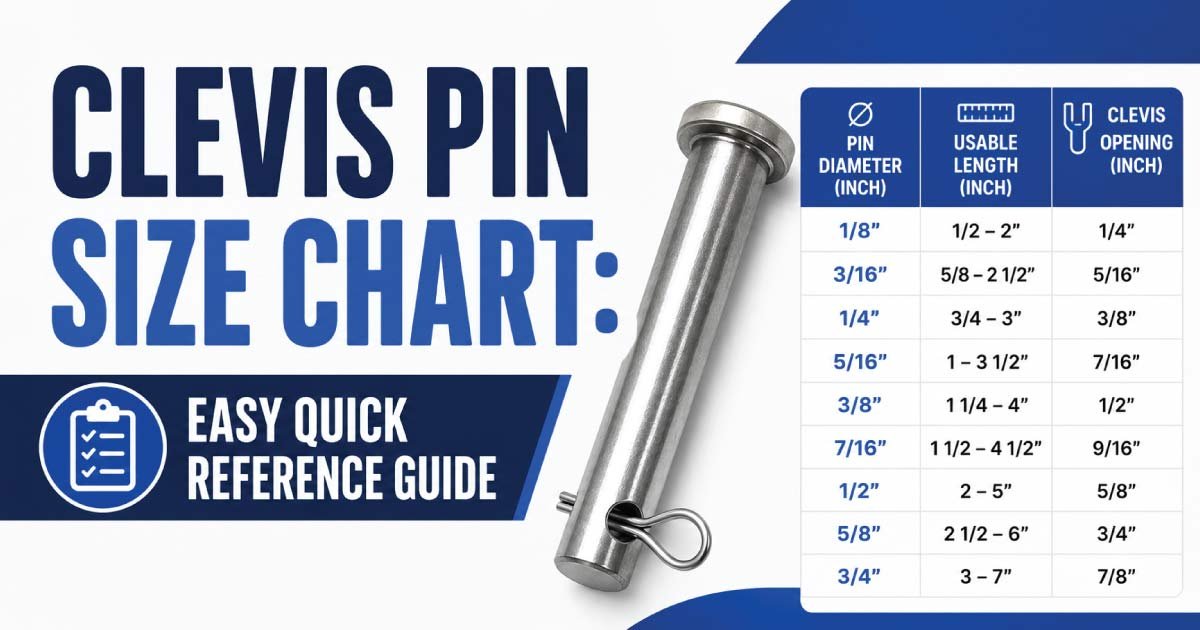
Clevis pins are simple but highly important mechanical fasteners used to connect two components in a secure yet removable way. They are widely used in automotive systems, agricultural machinery, construction equipment, trailers, and industrial assemblies where pivoting motion and quick assembly are required.
Understanding a Clevis Pin Size Chart helps you select the correct pin diameter, length, and hole compatibility for safe and efficient performance. In this guide, you will learn clevis pin sizes, dimensions, types, materials, applications, and how to choose the right size.
What Is a Clevis Pin?
A clevis pin is a cylindrical metal fastener used to connect two components through aligned holes. It is typically secured with a cotter pin, split pin, or hairpin clip to prevent it from slipping out during operation.
Clevis pins are designed for applications that require controlled movement along with secure connection. They are commonly used in mechanical systems where parts need to pivot, rotate, or be quickly assembled and disassembled.
Common applications include:
- Linkages
- Levers
- Steering systems
- Hydraulic cylinders
- Machine joints
Unlike permanent fasteners, clevis pins allow controlled motion, making them ideal for assemblies that require flexibility and frequent maintenance.
How Does a Clevis Pin Work?
A clevis pin functions as a pivot or hinge point in mechanical assemblies, allowing movement while maintaining a secure connection between components.
Working Process
- Holes in two components are aligned
- The clevis pin is inserted through both holes
- A cotter pin, split pin, or R-clip is inserted at the end
- The pin is locked in place
- The joint is allowed to rotate or remain fixed depending on design
Working Principle
This mechanism enables smooth pivoting motion while preventing axial disconnection. Because of its simple design, the clevis pin is widely used in systems that require reliable movement, easy assembly, and quick disassembly during maintenance or adjustment.
Types of Clevis Pins
Clevis pins are available in different designs to meet varying strength, locking, and installation requirements. Each type is suited for specific mechanical applications where controlled movement and secure fastening are needed.
1. Standard Clevis Pin
The standard clevis pin is the most commonly used type in general mechanical assemblies. It provides a simple and reliable connection between components with basic locking support.
Features:
- Smooth cylindrical body
- One drilled hole for locking
- Easy installation
Applications:
- Linkages
- Levers
- Machinery joints
2. Grooved Clevis Pin
Grooved clevis pins have surface grooves that improve grip and reduce the chance of slipping. They offer better vibration resistance compared to standard designs.
Features:
- Grooved body for improved grip
- Reduced slipping
- Better vibration resistance
Applications:
- Automotive systems
- Heavy machinery
3. Threaded Clevis Pin
Threaded clevis pins include a threaded end that provides additional locking security. They are designed for applications requiring higher resistance to axial movement.
Features:
- Threaded end for additional locking
- Higher security
- Better resistance to axial movement
Applications:
- Construction equipment
- Structural assemblies
4. Quick Release Clevis Pin
Quick release clevis pins are designed for fast installation and removal. They typically use an R-clip or ball-lock mechanism and are ideal for reusable or temporary assemblies.
Features:
- Designed for fast removal
- Uses R-clip or ball lock
- Reusable and convenient
Applications:
- Trailers
- Agricultural attachments
- Temporary assemblies
Clevis Pin Materials
Clevis pins are manufactured from different materials depending on the required strength, durability, corrosion resistance, and working environment. Proper material selection ensures safe operation and long service life in mechanical systems.
1. Carbon Steel
Carbon steel is the most commonly used material for clevis pins due to its good strength and cost-effectiveness. It is often zinc plated to improve resistance against rust and corrosion.
Features:
- Most commonly used
- Strong and economical
- Often zinc plated for rust protection
2. Stainless Steel
Stainless steel clevis pins provide excellent corrosion resistance, making them ideal for harsh environments such as outdoor, marine, and moisture-prone applications. They also offer long service life.
Features:
- Excellent corrosion resistance
- Long service life
- Suitable for outdoor and marine environments
3. Alloy Steel
Alloy steel clevis pins are heat-treated to provide higher strength and improved durability. They are commonly used in heavy-duty machinery where high load capacity is required.
Features:
- High strength
- Heat treated
- Used in heavy-duty machinery
4. Brass
Brass clevis pins are used in specialized applications where corrosion resistance, non-sparking properties, and safe electrical usage are important. They are suitable for light-duty and sensitive environments.
Features:
- Corrosion resistant
- Non-sparking
- Used in electrical and special applications
How to Choose the Correct Clevis Pin Size
Selecting the correct clevis pin size is essential for ensuring secure connections, smooth movement, and reliable performance in mechanical systems. Clevis pins are widely used in linkage, pivot, and structural applications, so proper sizing based on load, motion, and environment is critical for safety and durability.
1. Hole Diameter
Hole diameter is the first and most important factor in clevis pin selection. The pin must fit snugly into the hole without excessive looseness or tightness. A loose fit can cause vibration, wear, and misalignment, while a tight fit may damage components or make installation difficult.
2. Load Requirements
Load requirements directly determine the required pin diameter and strength. Higher loads need thicker clevis pins to withstand shear and tensile forces without bending or failure. Proper load matching ensures stability, prevents deformation, and maintains safe operation in both light-duty and heavy-duty mechanical applications.
3. Movement Type
The type of movement in the system also affects pin selection. Rotational or pivoting systems require smooth, correctly sized clevis pins that allow controlled motion without excessive friction. Proper fit ensures smooth articulation, reduces wear, and improves overall mechanical efficiency in dynamic assemblies and linkage mechanisms.
4. Environmental Conditions
Environmental exposure plays a major role in material selection. In outdoor, humid, or corrosive conditions, stainless steel clevis pins are preferred due to their resistance to rust and degradation. Choosing the right material ensures long-term durability, reduced maintenance, and consistent performance in harsh operating environments.
5. Safety Requirements
Critical or high-risk applications may require additional safety features such as locking or threaded clevis pins. These designs prevent accidental disengagement under vibration or load. Selecting enhanced safety options ensures secure fastening, reduces failure risk, and improves reliability in demanding industrial and structural systems.
Applications of Clevis Pins
Clevis pins are widely used in many industries because they allow secure connection while still permitting controlled pivoting or rotational movement. Their simple design makes them ideal for systems that require frequent adjustment, maintenance, or movement.
1. Automotive Industry
In automotive systems, clevis pins are used to connect moving components that require smooth motion and reliable locking under vibration and load.
Used in:
- Steering linkages
- Brake systems
- Suspension components
2. Agricultural Equipment
Clevis pins are essential in agricultural machinery where durability and flexibility are needed in harsh working environments.
Used in:
- Tractor attachments
- Hydraulic arms
- Harvesting machines
3. Construction Equipment
Heavy construction machines rely on clevis pins for strong and adjustable mechanical connections that can withstand high loads and continuous movement.
Used in:
- Excavators
- Loaders
- Cranes
4. Industrial Machinery
In industrial systems, clevis pins are used in mechanical linkages and moving assemblies to ensure smooth operation and reliable performance.
Used in:
- Conveyor systems
- Mechanical linkages
- Pump assemblies
5. Marine Applications
Clevis pins are widely used in marine environments where corrosion resistance and secure fastening are critical for safety and performance.
Used in:
- Boat rigging
- Deck equipment
- Marine linkage systems
Advantages of Clevis Pins
Clevis pins are widely used in mechanical systems because they provide a simple, strong, and flexible method of connecting components while still allowing controlled movement.
Advantages include:
- Easy installation and removal
- Cost-effective solution
- Reusable in many applications
- Allows controlled movement
- High durability
- Available in multiple sizes
- Low maintenance requirement
These benefits make clevis pins one of the most widely used fasteners in mechanical linkages and joint assemblies.
Clevis Pin vs Cotter Pin
Clevis pins and cotter pins are often used together in mechanical assemblies, but they serve different functions. Clevis pins provide structural connection, while cotter pins act as locking devices.
| Feature | Clevis Pin | Cotter Pin |
|---|---|---|
| Function | Structural connection | Locking fastener |
| Movement | Allows rotation | No movement |
| Strength | Medium to high | Low |
| Reusability | High | Low |
| Application | Mechanical joints | Safety locking |
Clevis pins and cotter pins are commonly used together to create a secure and functional joint system that allows movement while preventing accidental disassembly.
Common Installation Mistakes
Correct installation of clevis pins is essential for maintaining secure joints, smooth movement, and long-term mechanical reliability. Even small errors in sizing, alignment, or material selection can lead to loosening, wear, or complete failure of the assembly. Understanding these mistakes helps improve safety and performance.
1. Incorrect Diameter Selection
Selecting the wrong clevis pin diameter is a frequent installation error. If the pin is too small, it can cause wobbling, vibration, and excessive wear in the joint. If it is too large, it may not fit into the hole or could damage the assembly during installation, reducing overall reliability.
2. Missing Locking Clip
Failing to use a locking device such as a cotter pin or R-clip is a serious safety mistake. Without proper locking, the clevis pin can gradually work its way out due to vibration or movement. This can lead to sudden disconnection, equipment failure, or unsafe operating conditions in mechanical systems.
3. Poor Alignment
Improper alignment of holes during installation can damage both the clevis pin and the connected components. Misaligned parts create uneven stress, making insertion difficult and increasing wear over time. Correct alignment ensures smooth installation, proper load distribution, and reliable operation without unnecessary mechanical stress or deformation.
4. Wrong Material Selection
Using non-corrosion-resistant materials in outdoor or harsh environments can result in rust, weakening, and early failure of the clevis pin. Exposure to moisture or chemicals accelerates degradation. Choosing stainless steel or coated materials ensures durability, improved lifespan, and consistent performance in demanding environmental conditions.
Maintenance and Inspection
Regular maintenance and inspection of clevis pins are essential to ensure safe operation, reliable performance, and long service life. Over time, wear, vibration, and environmental exposure can affect the integrity of the pin and its locking components.
1. Inspection Checklist
Clevis pins should be routinely checked for any signs of damage or wear that may reduce their effectiveness in mechanical assemblies.
Check for:
- Wear or bending
- Corrosion or rust
- Loose fit
- Hole elongation
- Locking clip damage
2. Replacement Guidelines
Any clevis pin showing signs of damage, deformation, or excessive wear should be replaced immediately. Prompt replacement helps prevent mechanical failure, maintains proper alignment, and ensures the safety and reliability of the entire assembly.
Conclusion
A Clevis Pin Size Chart is an essential reference for selecting the correct diameter and length for safe and reliable mechanical connections. Whether used in automotive systems, agricultural machinery, construction equipment, or industrial assemblies, choosing the right clevis pin ensures smooth movement, secure locking, and long-term performance.
By understanding clevis pin types, materials, dimensions, and applications, you can confidently select the right fastener for any mechanical system and ensure safe and efficient operation in all conditions.
👉 Rivet Size Chart: Types, Uses and Complete Guide is a comprehensive resource for understanding rivet sizes, diameters, grip ranges, and fastening applications. Learn how to choose the right rivet for metal fabrication, construction, automotive, and aerospace projects. Read the full guide for detailed size charts, rivet types, installation methods, and expert selection tips.

Engineer Hassan is a Mechanical Engineer with 16+ years of hands-on experience in mechanical hardware, fasteners, and workshop tools. He focuses on size selection, thread identification, and measurement, helping users choose the correct components with accuracy and safety.